Things to do in Barcelona
-
A
Palau Reial de Pedralbes
Across Avinguda Diagonal from the main campus of the Universitat de Barcelona is the entrance to Parc del Palau Reial. In the park is the Palau Reial de Pedralbes, an early-20th-century building that belonged to the family of Eusebi Güell (Gaudí’s patron) until they handed it over to the city in 1926 to serve as a royal residence. Among its guests have been King Alfonso XIII, the president of Catalonia and General Franco.
The palace houses three museums, two of them temporarily housed here.
The Museu de Ceràmica has a good collection of Spanish ceramics from the 10th to 19th centuries, including work by Picasso and Miró. Spain inherited from the Muslims, and then…
reviewed
-
B
Parc d’traccions
The reason most barcelonins come up to Tibidabo is for some thrills (but hopefully no spills) in this funfair, close to the top funicular station. Among the main attractions are El Pndol, La Muntanya Russa and Hurakan. El Pndol is a giant arm holding four passengers, which drops them at a speed that reaches 100km/h in a period of less than three seconds (a force of four times gravity) before swinging outward – not for the squeamish. La Muntanya Russa is a massive new big dipper, which at its high point affords wonderful views before plunging you at 80km/h through woods. Hurakan tosses its passengers about with sudden drops and stomach-turning 360-degree turns. Far tamer…
reviewed
-
C
Manzana de la Discordia
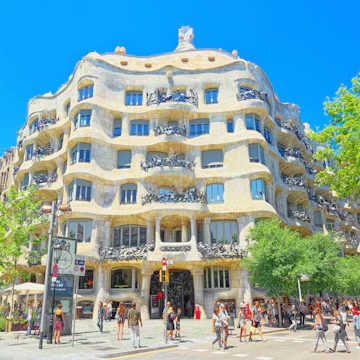
This is one of the most wonderful roads in Barcelona. The discord came about because various well-to-do families all wanted their houses done in the latest style and each hired a different architect. Here Gaudí, Enric Sagnier and others battle it out in bricks and mortar. Not to be missed.
On the first corner, at No 35, is Domenech i Montaner's most lavish residence, Casa Lleo Morera. Its ground floor facade was ripped out in the 1940s by philistines who wanted bigger shop windows. But the decorative nymphs and reliefs, depicting the owners work and hobbies, are still intact and the lobby is wonderfully whimsical.
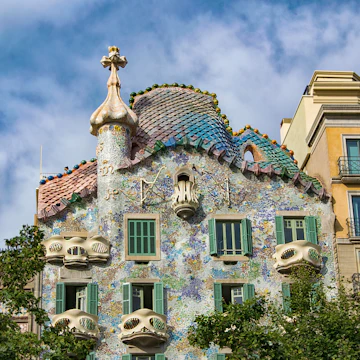
Casa Batlo, at No 43, is a remodelled Gaudífied gem…
reviewed
-
D
Museu Marítim
Venice had its Arsenal and Barcelona the Reials Drassanes (Royal Shipyards), from which Don Juan of Austria’s flagship galley was launched to lead a joint Spanish-Venetian fleet into the momentous Battle of Lepanto against the Turks in 1571.
These mighty Gothic shipyards are not as extensive as their Venetian counterparts but they’re an extraordinary piece of civilian architecture nonetheless. Today the broad arches shelter the Museu Marítim, the city’s seafaring-history museum and one of the most fascinating museums in town.
The shipyards were, in their heyday, among the greatest in Europe. Begun in the 13th century and completed by 1378, the long, arched bays (the…
reviewed
-
E
Museu de la Música
Some 500 instruments (less than a third of those held) are on show in this museum, housed on the 2nd floor of the administration building in L’Auditori, the city’s main classical-music concert hall.
Instruments range from a 17th-century baroque guitar through to lutes (look out for the many-stringed 1641 archilute from Venice), violins, Japanese kotos, sitars from India, eight organs (some dating from the 18th century), pianos, a varied collection of drums and other percussion instruments from across Spain and beyond, along with all sorts of phonographs and gramophones. There are some odd pieces indeed, like the buccèn, a snake-head-adorned brass instrument.
Much of…
reviewed
-
F
Museu de les Arts Decoratives, Palau Reial de Pedralbes
The Museu de les Arts Decoratives in Palau Reial de Pedralbes brings together an eclectic assortment of furnishings, ornaments and knick-knacks dating as far back as the Romanesque period. The plush and somewhat stuffy elegance of Empire- and Isabelline-style divans can be neatly compared with some of the more tasteless ideas to emerge on the subject of seating in the 1970s. It is planned eventually to house these collections in a brand-new design museum in Plaça de les Glòries Catalanes. When this will happen is open to speculation and, in the meantime, some of the collection will get a new temporary home in what was until 2008 the Museu Tèxtil i d’Indumentària in…
reviewed
-
G
Barcelona Walking Tours
The Oficina d'Informació de Turisme de Barcelona organises guided walking tours. One explores the Barri Gòtic; another follows in the footsteps of Picasso and winds up at the Museu Picasso, entry to which is included in the price; and a third takes in the main jewels of Modernisme. Also offered is a gourmet tour of traditional purveyors of fine foodstuffs across the old city; it includes a couple of chances to taste some of the products. All tours last two hours and start at the tourist office. All tours are available in both English and Spanish at 6pm from June to September.
reviewed
-
H
Sinagoga Maj14
When an Argentine investor bought a run-down electrician’s store with an eye to converting it into central Barcelona’s umpteenth bar, he could hardly have known he had stumbled onto the remains of what could be the city’s main medieval synagogue (some historians cast doubt on the claim). Remnants of medieval and Roman-era walls remain in the small vaulted space that you enter from the street. Also remaining are tanners’ wells installed in the 15th century. The second chamber has been spruced up for use as a synagogue. A remnant of late-Roman-era wall here, given its orientation facing Jerusalem, has led some to speculate that there was a synagogue here even in Roman…
reviewed
-
I
Hospital de la Santa Creu i de Sant Pau
Domènech i Montaner outdid himself as architect and philanthropist with this Modernista masterpiece, long considered one of the city’s most important hospitals. The complex, including 16 pavilions – together with the Palau de la Música Catalana, a joint World Heritage Site – is lavishly decorated and each pavilion is unique.
Domènech i Montaner wanted to create a unique environment that would also cheer up patients. Among artists who contributed statuary, ceramics and artwork was the prolific Eusebi Arnau. The hospital facilities have been transferred to a new complex on the premises, freeing up the century-old structures, which are being restored to their former…
reviewed
-
J
Poble Espanyol
Welcome to Spain! All of it! This ‘Spanish Village’ is both a cheesy souvenir hunters’ haunt and an intriguing scrapbook of Spanish architecture built for the Spanish crafts section of the 1929 World Exhibition. You can meander from Andalucía to the Balearic Islands in the space of a couple of hours, visiting surprisingly good copies of Spain's characteristic buildings.
You enter from beneath a towered medieval gate from Ávila. Inside, to the right, is an information office with free maps. Straight ahead from the gate is the Plaza Mayor (Town Square), surrounded with mainly Castilian and Aragonese buildings. It is sometimes the scene of summer concerts. Elsewhere…
reviewed
Advertisement
-
Jardins del Laberint d’Horta
Laid out in the twilight years of the 18th century by Antoni Desvalls, Marquès d’Alfarras i de Llupià, this carefully manicured park remained a private family idyll until the 1970s, when it was opened to the public. Many a fine party and theatrical performance was held here over the years, but it now serves as a kind of museum-park. The gardens take their name from a maze in their centre, but other paths take you past a pleasant artificial lake (estany), waterfalls, a neoclassical pavilion and a false cemetery. The last is inspired by 19th-century romanticism, characterised by an obsession with a swooning, anaemic (some might say silly) vision of death. The labyrinth,…
reviewed
-
K
Església de Sants Just i Pastor
This somewhat neglected, single-nave church, with chapels on either side of the buttressing, was built in 1342 in Catalan Gothic style on what is reputedly the site of the oldest parish church in Barcelona. Inside, you can admire some fine stained-glass windows. In front of it, in a pretty little square that was used as a set (a smelly Parisian marketplace) in 2006 for Perfume: The Story of a Murderer, is what is claimed to be the city’s oldest Gothic fountain.
On the morning of 11 September 1924, Antoni Gaudí was arrested as he attempted to enter the church from this square to attend Mass. In those days of the dictatorship of General Primo de Rivera, it took little to…
reviewed
-
Montserrat Royal Basilica Half-Day Trip from Barcelona
4 hours 30 minutes (Departs Barcelona, Spain)
by Viator
lt;pgt;Getaway to the Montserrat mountains on a half-day trip from Barcelona. You'll visit the Royal Basilica with its 12th-century carving of the Black Virgin…Not LP reviewed
from USD$61.14 -
L
Museu Barbier-Mueller d'Art Pre-Colombí
The wonderfully illuminated artefacts inside the medieval Palau Nadal are part of the treasure trove of pre-Columbian art collected by Swiss businessman Josef Mueller (who died in 1977) and his son-in-law Jean-Paul Barbier, who directs the Musée Barbier-Mueller in Geneva. Together, the two museums form one of the most prestigious collections of such art in the world.
In blacked-out rooms, the beautifully spotlit artefacts stand out as if on stage. South American gold jewellery introduces the collection, followed by rooms containing ceramics, jewellery, statues, textiles and other objects. Every year or two, the composition of the exhibition is altered, with pieces moved…
reviewed
-
M
Palau del Baró Quadras
Puig i Cadafalch designed Palau del Baró Quadras (built 1902–06) in an exuberant Gothic-inspired style. The main facade is its most intriguing, with a soaring, glassed-in gallery. Take a closer look at the gargoyles and reliefs – the pair of toothy fish and the sword-wielding knight clearly have the same artistic signature as the architect behind Casa Amatller.
Decor inside is eclectic, but dominated by Middle Eastern and East Asian themes. The setting is appropriate for its occupant: Casa Asia is a cultural centre celebrating the relationship between Spain and the Asia-Pacific region. Visiting the varied temporary exhibitions (mostly on the 2nd floor) allows you…
reviewed
-
N
Museu de Ceràmica
Museu de Ceràmica, in the Palau Reial de Pedralbes, has a good collection of Spanish ceramics from the 10th to 19th centuries, including work by Picasso and Miró. Spain inherited from the Muslims, and then further refined, a strong tradition in ceramics – here you can compare some exquisite work (tiles, porcelain tableware and the like) from some of the greatest centres of pottery production across Spain, including Talavera de la Reina in Castilla-La Mancha, Manises and Paterna in Valencia, and Teruel in Aragón.
reviewed
-
Montserrat and Cava Trail Small Group Day Trip from Barcelona
10 hours (Departs Barcelona, Spain)
by Viator
Combine mountains, history and wine on a visit to Montserrat and either the Freixenet or Codorniu winery on a full-day small group tour by minivan from…Not LP reviewed
from USD$105.92 -
O
Zona de Banys
A 300m stroll east from the Edifici Fòrum is the Zona de Banys, with kayaks and bikes available for rent, the option to learn diving, and other activities. This tranquil seawater swimming area was won from the sea by the creation of massive cement-block dykes. At its northern end, like a great rectangular sunflower, an enormous photovoltaic panel turns its face up to the sun to power the area with solar energy. Along with another set of solar panels in the form of porticoes, it generates enough electricity for 1000 households. Just behind it spreads Port Fòrum, Barcelona’s third marina. The area is unified by an undulating esplanade and walkways that are perfect for…
reviewed
-
Flamenco Night at Tablao Cordobes
2 hours (Departs Barcelona, Spain)
by Viator
Feel the passion of the flamenco at Barcelona's legendary Tablao Cordobes, where some of the greatest names in flamenco have performed. Entertained by an…Not LP reviewed
from USD$56.31 -
P
Fundació Antoni Tàpies
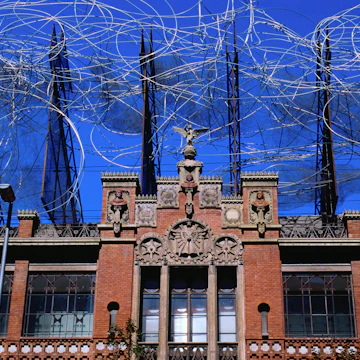
The Fundació Antoni Tàpies is both a pioneering Modernista building (completed in 1885) and the major collection of leading 20th-century Catalan artist Antoni Tàpies. A man known for his esoteric work, Tàpies died in February 2012, aged 88; he leaves behind a powerful range of paintings and a foundation intended to promote contemporary artists.
The building, designed by Domènech i Montaner for the publishing house Editorial Montaner i Simón (run by a cousin of the architect), combines a brick-covered iron frame with Islamic-inspired decoration. Tàpies crowned it with the meanderings of his own mind, a work called Núvol i Cadira (Cloud and Chair) that spirals above…
reviewed
Advertisement
-
Barcelona in One Day Sightseeing Tour
9 hours (Departs Barcelona, Spain)
by Viator
Combine two best-selling half-day tours of Barcelona at a discounted price and see the best of Barcelona in one day. You'll spend a full day seeing all the…Not LP reviewed
from USD$119.33 -
Q
Font Màgica
The main fountain of a series that sweeps up the hill from Avinguda de la Reina Maria Cristina to the grand facade of the Palau Nacional, Font Màgica is a unique performance in which the water can look like seething fireworks or a mystical cauldron of colour.
It is wonderful that an idea that was cooked up for the 1929 World Exposition has, since the 1992 Olympics, again become a magnet. With a flourish, the ‘Magic Fountain’ erupts into a feast of musical, backlit aquatic life. On hot summer evenings especially, this 15-minute spectacle (repeated several times throughout the evening) mesmerises onlookers. On the last evening of the Festes de la Mercè in September, a…
reviewed
-
Girona, Figueres and Dali Museum Day Trip from Barcelona
11 hours 30 minutes (Departs Barcelona, Spain)
by Viator
Discover the Salvador Dali Museum at Figueres and the magical medieval town of Girona on a full-day trip from Barcelona. Figueres and Girona are two of the most…Not LP reviewed
from USD$97.88 -
R
Museu de Ceràmica, Palau Reial de Pedralbes
The palace houses two museums. The Museu de Ceràmica has a good collection of Spanish ceramics from the 13th to 19th centuries, including work by Picasso and Miró. Spain inherited from the Muslims, and then further refined, a strong tradition in ceramics – here you can compare some exquisite work (tiles, porcelain tableware and the like) from some of the greatest centres of pottery production across Spain, including Talavera de la Reina in Castile, Manises and Paterna in Valencia, and Teruel in Aragón. Upstairs is a display of fanciful modern ceramics from the 20th century – here they have ceased to be a tool with aesthetic value and are purely decorative.
reviewed
-
S
Parc de la Creueta del Coll
Not far from Park Güell, this refreshing public park has a pleasant, meandering, splashing pool. The pool, along with swings, showers and snack bar, makes a relaxing family stop on hot summer days and is strictly a local affair. The park area is open all year; only the lake-pool closes outside summer.
The park is set inside a deep crater left by long years of stone quarrying. On one side of it, an enormous cement sculpture, Elogio del Agua (Eulogy to Water) by Eduardo Chillida, is suspended. You can wander the trails around the high part of this hill-park and enjoy views of the city and Tibidabo. From the Penitents Metro station, it’s a 15-minute walk. Enter from…
reviewed