go to content go to search box go to global site navigation

Russia

Things to do in Russia

‹ Prev

of 110

  1. A

    St Basil’s Cathedral

    At the southern end of Red Square, framed by the massive facades of the Kremlin and GUM department store, stands the icon of Russia: St Basil’s Cathedral. This crazy confusion of colours, patterns and shapes is the culmination of a style that is unique to Russian architecture. Before St Basil’s, this style of tent roofs and onion domes had been used to design wooden churches. In 1552 Ivan the Terrible captured the Tatar stronghold of Kazan on the feast of Intercession. He commissioned this landmark church, officially the Intercession Cathedral, to commemorate the victory. From 1555 to 1561 architects Postnik and Barma created this masterpiece that would become the…

    reviewed

  2. Stolby Nature Reserve

    Arguably Krasnoyarsk's greatest attractions are the spiky volcanic rock pillars called stolby. These litter the woods in the 17,000-hectare Stolby Nature Reserve south of the Yenisey River. To reach the main concentration of pillars, start by walking 7km down a track near Turbaza Yenisey. Alternatively, there is much easier access via a long chair lift from beside Kafe Bobrovyylog (ul Sibirskaya).

    This usually runs year-round on request, but was closed throughout 2005 during a massive ski-slope redevelopment. From the top of the chair lift, walk for two minutes to a great viewpoint or around 40 minutes to reach the impressive Takmak Stolby. Infected ticks are dangerous…

    reviewed

  3. B

    State Hermitage Museum

    There are art galleries, there are museums, there are the great museums of the world and then there is the Hermitage. An unrivalled collection of art treasures housed in the magnificent palace from which the Romanov tsars ruled the Russian Empire, the State Hermitage will inevitably be the focus of any first visit to St Petersburg, and rightly so. At the information kiosk of the State Hermitage Museum you can pick up a free colour map of the museum, available in most European languages. Immediately after ticket inspection you can hire an audio guide (R250) with recorded tours in English, German, French, Italian or Russian. Groups enter from the river side of the Winter…

    reviewed

  4. C

    Shinok

    In case you didn’t think Moscow’s themed dining was over the top, this restaurant has re-created a Ukrainian peasant farm in central Moscow. Servers wear colourfully embroidered shirts and speak with Ukrainian accents (probably lost on most tourists). The house speciality is vareniki (the Ukrainian version of pelmeni ). As you dine, you can look out the window at a cheerful babushka while she tends the farmyard animals (very well taken care of, we’re assured).

    reviewed

  5. D

    Armoury

    The Armoury dates back to 1511, when it was founded under Vasily III to manufacture and store weapons, imperial arms and regalia for the royal court. Later it also produced jewellery, icon frames and embroidery. During the reign of Peter the Great all craftspeople, goldsmiths and silversmiths were sent to St Petersburg, and the armoury became a mere museum storing the royal treasures. A fire in 1737 destroyed many of the items. In the early 19th century, new premises were built for the collection. Much of it, however, never made it back from Nizhny Novgorod, where it was sent for safekeeping during Napoleon’s invasion in 1812. Another building to house the collection was…

    reviewed

  6. E

    Cathedral of Christ the Saviour

    This gargantuan cathedral now dominates the skyline along the Moscow River. It sits on the site of an earlier and similar church of the same name, built between 1839 and 1860, and finally consecrated in 1883. The church commemorates Russia’s victory over Napoleon. The original was destroyed during Stalin’s orgy of explosive secularism. Stalin planned to replace the church with a 315m-high Palace of Soviets (including a 100m-high statue of Lenin), but the project never got off the ground – literally. Instead, for 50 years the site served an important purpose: the world’s largest swimming pool. This time around, the church was completed in a mere two years, in time for…

    reviewed

  7. F

    Gulag History Museum

    In the midst of all the swanky shops on ul Petrovka, an archway leads to a courtyard that is strung with barbed wire and hung with portraits of political prisoners. This is the entrance to a unique museum dedicated to the Chief Administration of Corrective Labour Camps and Colonies, better known as the GULAG. Guides dressed like guards describe the vast network of labour camps that once existed in the former Soviet Union and recount the horrors of camp life. Millions of prisoners spent years in these labour camps, made famous by Alexander Solzhenitsyn’s book The Gulag Archipelago. More than 18 million people passed through this system during its peak years, from 1929 to…

    reviewed

  8. G

    Turandot

    If you wanted to go to Disney World, but somehow ended up in Moscow, Turandot should be at the top of your dining wish list. Completely costumed in wigs and gowns, musicians play chamber music and servers scuttle to and fro. The decor is unbelievably extravagant, with hand-painted furniture, gilded light fixtures and frescoed cupola ceiling. It is certainly every bit as elaborate as Cinderella’s castle. Turandot is named for a Puccini opera set in old Peking, which is as good a reason as any to serve Chinese and Japanese food in this baroque interior.

    reviewed

  9. H

    Regional Museum

    The Regional Museum is one of Siberia’s best. Its wonderfully incongruous 1912 building combines art nouveau and Egyptian temple-style features. Arranged around a Cossack explorer’s ship are models, icons, historical room interiors and nature rooms where you can listen to local birdsong and animal cries. The basement hosts a splendid ethnographic section comparing the historical fashion sense of shamans from various tribal groups. The gift shop sells old coins, medals, postcards and excellent maps.

    reviewed

  10. I

    Mariinsky Theatre

    Home to the world-famous Kirov Ballet and Opera company, a visit here is a must, if only to delight in the sparkling glory of the interior. Use the website to book and pay for tickets in advance of your visit to the theatre and to the acoustically splendid new concert hall, which is nearby. The theatre-themed souvenirs are for sale in the Mariinsky gift shop. None of it is cheap, but where else can you get a ‘Property of Kirov Ballet’ T-shirt?

    reviewed

  11. Advertisement

  12. J

    TsDL (Central House of Writers)

    The acronym stands for Tsentralny Dom Literatov, or Central House of Writers, which is the historic building housing this fancy restaurant. A glittery chandelier above, plush carpets under foot and rich oak panelling all around create a sumptuous setting for an old-fashioned Russian feast.

    reviewed

  13. Five O’Clock

    Vladivostok, take note of this novel idea – coffee, brownies, cakes and quiche (R50), all made daily and sold for less than an espresso at most ‘cafes’. Lots of midday snackers come in, perhaps to see the Queen plate behind the register.

    reviewed

  14. K

    16 Tons

    This club is widely believed to be the hottest live music venue in the capital, attracting top local and foreign bands, who almost always play to a packed house. The brassy English pub-restaurant downstairs has an excellent house-brewed bitter.

    reviewed

  15. L

    NEP

    Waitresses clad in Red Army khaki, a decor of Soviet regalia and a menu of fun-poking takes on proletariat fare make this communist theme restaurant an amusing if pricey choice. Some English spoken.

    reviewed

  16. M

    Zoom Café

    Popular boho/student hangout with regularly changing art exhibitions. Serves unfussy tasty European and Russian food; has wi-fi access, a very relaxed ambience and a no-smoking zone.

    reviewed

  17. N

    Tretyakov Gallery

    The exotic boyar castle on a little lane in Zamoskvorechie contains the main branch of the State Tretyakov Gallery, housing the world’s best collection of Russian icons and an outstanding collection of other pre­revolutionary Russian art. Show up early to beat the queues.

    The building was designed by Viktor Vasnetsov between 1900 and 1905. The gallery started as the private collection of the 19th-century industrialist brothers Pavel and Sergei Tretyakov. Pavel was a patron of the Peredvizhniki, or Wanderers, a group of 19th-century painters who broke away from the conservative Academy of Arts and started depicting common people and social problems. Nowadays, these are…

    reviewed

  18. O

    Kolomenskoe Museum-Reserve

    Set amid 4 sq km of parkland, on a bluff above a bend in the Moscow River, this Museum-Reserve is an ancient royal country seat and Unesco World Heritage Site. Many festivals are held here, so check if anything is happening during your visit. From Bolshaya ul, enter at the rear of the grounds through the 17th-century Saviour Gate to the whitewashed Our Lady of Kazan Church, both built in the time of Tsar Alexey. The church faces the site of his great wooden palace, which was demolished in 1768 by Catherine the Great. Ahead, the white, tent-roofed 17th-century front gate and clock tower mark the edge of the old inner-palace precinct. The golden double-headed eagle that…

    reviewed

  19. P

    Alexandrovsky Garden

    The first public park in Moscow, Alexandrovsky Garden sits along the Kremlin’s western wall. Colourful flower beds and impressive Kremlin views make it a favourite strolling spot for Muscovites and tourists alike. Back in the 17th century, the Neglinnaya River ran through the present gardens, with dams and mills along its banks. When the river was diverted underground, the garden was founded by architect Osip Bove, in 1821. Enter through the original gates at the northern end. The Tomb of the Unknown Soldier (Mogila neizvestnogo soldata) at its north end is a kind of national pilgrimage spot, where newlyweds bring flowers and have their pictures taken. The tomb contains…

    reviewed

  20. Q

    Izmaylovsky Park & Royal Estate

    Izmaylovo is best known for its extensive arts and crafts market, held every weekend beside the royal estate. After shopping, Izmaylovsky Park and the crumbling royal estate are nice for a picnic or more serious outdoor activity. A former royal hunting reserve 10km east of the Kremlin, Izmaylovsky Park is the nearest large tract of undeveloped land to central Moscow. Its 15 sq km contain a recreation park at the western end and a much larger expanse of woodland (Izmaylovsky Lesopark) east of Glavnaya alleya, the road that cuts north–south across the park. Trails wind around this park, making it a good place to escape the city for hiking or biking. From Partizanskaya metro…

    reviewed

  21. R

    ZKP Tagansky Cold War Museum

    On a quiet side street near Taganskaya pl sits a nondescript neoclassical building. This is the gateway to the secret Cold War–era communications centre, ZKP Tagansky. Operated during the Cold War by Central Telephone and Telegraph, the facility was meant to serve as the communications headquarters in the event of a nuclear attack. As such, the building was just a shell and served as entry into the 7000-sq-metre space that is 60m underground.

    Now managed by private interests, the facility is being converted into a sort of museum dedicated to the Cold War. Unfortunately, not much remains from that era. The vast place is nearly empty, except for a few exhibits set up for…

    reviewed

  22. Advertisement

  23. S

    Bronze Horseman

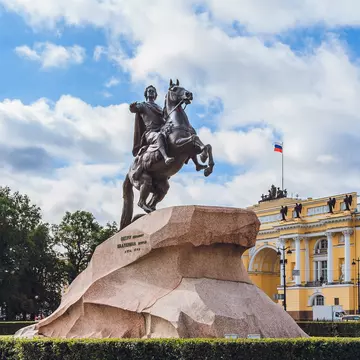
    The most famous statue of Peter the Great was immortalised as the Bronze Horseman in the poem by Pushkin. With his mount rearing above the snake of treason, Peter’s enormous statue stands at the river end of pl Dekabristov. The statue was sculpted over 12 years for Catherine the Great by Frenchman Etienne Falconet. Its inscription reads ‘To Peter I from Catherine II – 1782’. Many have read significance into Catherine’s linking of her own name with that of the city’s founder: she had no legitimate claim to the throne and this statue is sometimes seen as her attempt to formalise the link (philosophical, if not hereditary) between the two monarchs. The significance of the…

    reviewed

  24. T

    Novodevichy Cemetery

    Adjacent to the Novodevichy Convent, the Novodevichy Cemetery is one of Moscow’s most prestigious resting places – a veritable who’s who of Russian politics and culture. Here you will find the tombs of Bulgakov, Chekhov, Gogol, Mayakovsky, Prokofiev, Stanislavsky and Eisenstein, among many other Russian and Soviet cultural notables.

    In Soviet times Novodevichy Cemetery was used for eminent people the authorities judged unsuitable for the Kremlin wall, most notably Khrushchev. The intertwined white-and-black blocks round Khrushchev’s bust were intended by sculptor Ernst Neizvestny to represent Khrushchev’s good and bad sides.

    The tombstone of Nadezhda Alliluyeva,…

    reviewed

  25. U

    Gorky Park

    Part ornamental park, part fun fair, Gorky Park is one of the most festive places in Moscow – a perfect way to escape the hubbub of the city. Officially the Park Kultury (Park of Culture), it’s named after Maxim Gorky. The park stretches almost 3km along the river, upstream of Krymsky most. You can’t miss the showy entrance, marked by colourful flags waving in the wind, and the happy sounds of an old-fashioned carousel. Inside, Gorky Park has a small Western-style amusement park, which features two roller coasters and almost a dozen other terror-inducing attractions (that is, aside from the view of the Peter the Great statue). Most of the rides cost around R50 to R100.…

    reviewed

  26. V

    Historical Museum

    The Historical Museum charges per single-room floor. The best is Buddiyskoe Iskustvo (3rd floor), displaying thangka, Buddhas and icons salvaged from Buryatiya's monasteries before their Soviet destruction. Note-sheets in English fail to explain the fascinating, gaudy papier-mâché models of Khvashan's eight unruly sons urinating at one another.

    Note the Gungarba shrine table (every Buryat home once had one), the Atsagat medical charts (Tibetan medicine was apparently standard here until the 1940s) and the walnut necklace on grey, clown-faced Sagan Obugen (walnuts were exotic in Buryatiya). The less-interesting 2nd floor traces Buryat history in maps, documents and…

    reviewed

  27. W

    Lenin’s Tomb

    Although Vladimir Ilych requested that he be buried beside his mum in St Petersburg, he still lies in state at the foot of the Kremlin wall, receiving visitors who come to pay their respects to the founder of the Soviet Union. The embalmed leader has been here since 1924 (apart from a retreat to Siberia during WWII). Before joining the queue at the northwestern corner of Red Square, drop your camera at the left-luggage office in the State History Museum, as you will not be allowed to take it with you. Humourless guards ensure that visitors remain respectful. After trouping past the embalmed figure, emerge from the mausoleum and inspect the Kremlin wall, where other…

    reviewed