Sights in Russia
-
A
General Staff Building
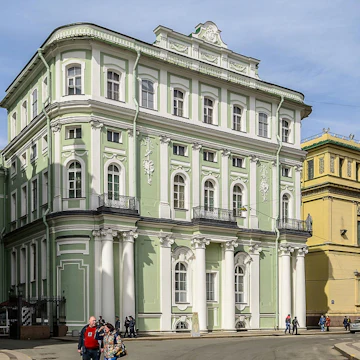
The western wing of this magnificent building on Dvortsovaya pl was formerly used by the Ministry of Foreign Affairs, including private apartments for the minister himself. The fabulous Carlo Rossi–designed interiors have been meticulously maintained, and today house exhibition hallsdisplaying items from the Hermitage collection. Here, the art of 20th-century French painters Pierre Bonnard and Maurice Denis is on permanent display. Monarchists will appreciate the ‘heraldic eagle’, also featured in 600-plus examples of graphics, paintings and applied arts from Russia and Western Europe.
reviewed
-
B
Military Museum
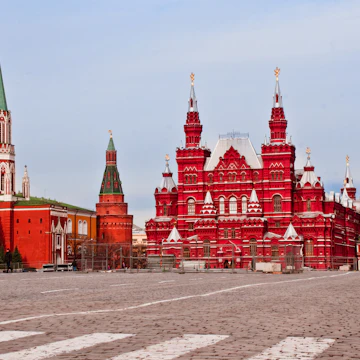
Vladimir’s Golden Gate – part defensive tower, part triumphal arch – was modelled on the very similar structure in Kyiv. Originally built by Andrei Bogolyubsky to guard the main, western entrance to his city, it was later restored under Catherine the Great. Now you can climb the narrow stone staircase to check out the Military Museum. It is a small exhibit, the centrepiece of which is a diorama of old Vladimir being ravaged by nomadic raiders in 1238 and 1293. Across the street to the south you can see a remnant of the old wall that protected the city.
reviewed
-
C
Loft Project ETAGI
Creating the biggest buzz in St Petersburg’s thriving contemporary art scene recently has been the complex Loft Project Floors. Hidden away, off the main road, in the former Smolensky Bread Bakery, Floors consists of four large and industrial-looking gallery spaces, the main one being Globe Gallery on the fifth floor where the complex’s creators, architects Savelij Arkhipenko and his brother Egor also have their design office. At the time of research there were plans to create a summer café and viewing space on the roof and to install a wine bar at the rear of the gallery.
reviewed
-
Konstantinovsky Palace
Konstantinovsky Palace has also been fully restored. Excursions visit the fabulous ‘parade rooms’, including the Blue Room and the over-the-top ornate Marble Room, as well as the ceremonial guestrooms of the president and the first lady. Most impressively, visitors can take a peak into the wine cellar. Apparently, as far back as 1755 these premises were used to house the emperor’s collection of Hungarian wine, when the Winter Palace was under construction. These days the vinniy pogreb contains a collection of more than 13,000 bottles from all over the world.
reviewed
-
Lenin Museum
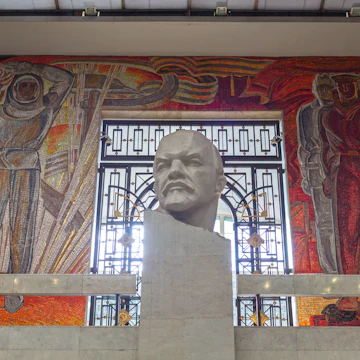
In Lenin’s later years, he and his family spent time at the 1830s Murozov manor house, set on lovely wooded grounds 32km southeast of the capital. Designed by Fyodor Shekhtel, it now houses a Lenin museum, where you can see a re-creation of Lenin’s Kremlin office, as well as his vintage Rolls Royce – one of only 15 such automobiles in the world. Bus 439 (R50, 30 minutes) leaves every 1½ hours for the estate from the Domodedovskaya metro station in Moscow. By car, follow the M4 highway (Kashirskoe sh) 11km past MKAD, then turn left to Gorki Leninskie.
reviewed
-
D
Syuyumbike Tower
Nearby, the slightly leaning 59m-high Syuyumbike Tower is named after a long-suffering princess who was married to three successive khans. Ivan the Terrible launched his siege of Kazan as a result of Syuyumbike's refusal to marry him - according to legend. To save her city, the princess agreed to marry the tsar, but only if he could build a tower higher than any other mosque in Kazan in a week.
Unfortunately for Syuyumbike, the tower was completed, driving her to jump to her death from its upper terrace shortly thereafter. Today, the tower competes with a rival landmark inside the kremlin.
reviewed
-
E
Monastery of the Transfiguration of the Saviour
Founded in the 12th century, the Monastery of the Transfiguration of the Saviour was one of Russia’s richest and best-fortified monasteries by the 16th century. The oldest surviving structures, dating from 1516, are the Holy Gate near the main entrance by the river, and the austere Cathedral of the Transfiguration (admission R60; open Thu-Mon). Other buildings house exhibits on history, ethnography and icons, the newest, Treasures of Yaroslavl(admission R100), featuring works of gold, silver and precious gems.
reviewed
-
House of Unions & State Duma
The buildings lining Okhotny ryad, just north of Tverskaya ul, serve official functions. The glowering State Duma was erected in the 1930s for Gosplan (Soviet State Planning Department), source of the USSR’s Five-Year Plans, but it is now the seat of the Russian parliament. The green-columned House of Unions dates from the 1780s. Its ballroom, called the Hall of Columns, is the famous location of one of Stalin’s most grotesque show trials, that of Nikolai Bukharin, a leading Communist Party theorist who had been a close associate of Lenin. Both buildings are closed to the public.
reviewed
-
F
Primorsky Art Gallery
Vladivostok’s bipolar art museum, the Primorsky Art Gallery, has a small collection at its original locale (ul Aleutskaya 12), but the main collection has moved indefinitely to two separate halls east of Park Provotsky (with separate admissions). The one to the west features 19th- and early 20th-century oil masters (including Feshin’s sassy Golden Hairs from 1914), packed onto limited wall space. The east gallery features changing exhibits of local painters (when we dropped by they featured fascinating graphic artwork from ’60s Soviet-ho! books).
reviewed
-
G
Pl Iskusstv (Arts Sq)
Just a block east of the Griboedov Canal is the quiet pl Iskusstv (Arts Sq), named after its cluster of museums and concert halls. In the 1820s and 1830s, Carlo Rossi designed this square and the lovely Mikhailovskaya ul, which joins it to Nevsky pr. A statue of Pushkin, erected in 1957, stands in the middle of the tree-lined square. The square is surrounded by the Shostakovich Philharmonia, Brodsky House-Museum, Mussorgsky-Mikhailovsky Theatre, Russian Museum and Museum of Ethnography.
reviewed
Advertisement
-
Kukushka.ru
Calling all railway buffs! Pereslavl-Zalessky is home to a unique railway museum known as Kukushka.ru. The collection of locomotives occupies tracks and a depot that were used up until the middle of the 20th century. Don’t miss the opportunity to ride on the hand cart (adult/child R60/30). The museum is about 16km out of town. From ul Kardovskogo (the main road into town from Moscow or Sergiev Posad) turn left onto Podgornaya ul and follow the road along the shoreline of Lake Pleshcheevo. At the village of Talitsy, look for the ‘Muzey’ sign and turn left to the museum.
reviewed
-
H
Regional History Museum
The Regional History Museum offers a series of well laid-out halls in an evocative 1894 red-brick building. Highlights are many, particularly a far-better-than-average look into native cultures, a few English captions in the stuffed-animal section, and a full-on panorama of the snowy 1922 civil war battle at Volochaevka. No Gulag coverage, though the nearby prison population was bigger than the city’s in the ’30s. At research time, the museum was busy adding on a second wing as the Amur RiverMuseum, which may require an additional ticket.
reviewed
-
I
Church Of The Deposition Of The Robe
This delicate single-domed church, beside the west door of the Assumption Cathedral, was built between 1484 and 1486 in exclusively Russian style. It was the private chapel of the heads of the Church, who tended to be highly suspicious of such people as Italian architects.
Originally an open gallery or porch surrounded the church; it was later removed and the church was connected with the palace for the convenience of the tsars. The interior walls, ceilings and pillars are covered with 17th-century frescoes. It houses an exhibition of 15th- to 17th-century woodcarvings.
reviewed
-
J
Mikhailovsky Castle
Rastrelli’s fairy-tale wooden creation for Empress Elizabeth was knocked down in the 1790s to make way for the bulky Mikhailovsky Castle. The pale-orange-painted building was briefly home to Paul I, who was suffocated in his bed only a month after moving into the castle. Later it became a military engineering school (hence its more common name Engineers’ Castle). Inside are some finely restored state rooms, including the lavish burgundy throne room of the tsar’s wife Maria Fyodorovna and some of the original statues from the Summer Garden.
reviewed
-
K
Matryoshka Museum
On a quiet side street, the Matryoshka Museum – formerly the Museum of Folk Art – is a two-room museum showcasing designer matryoshka dolls and different painting techniques. The centrepiece is a 1m-high matryoshka with 50 dolls inside. The exhibit demonstrates the history of this favourite Russian souvenir. Don’t come looking for modern-day, pop-culture-inspired dolls because the museum takes a traditionalist tact. Downstairs, an excellent souvenir shop offers a wide selection of handicrafts, including hand-painted matryoshki.
reviewed
-
Taltsy
About 47km east of Irkutsk, 23km before Listvyanka, Taltsy is an impressive outdoor collection of old Siberian buildings set in a delightful riverside forest. Amid the renovated farmsteads are two chapels, a church, a watermill, some Evenki graves and the eye-catching 17th-century Iliminsk Ostrog watchtower. Listvyanka–Irkutsk buses and marshrutky stop on request at Taltsy’s entrance (look out for the roadside ‘ Музей’ sign), and the ticket booth is a minute’s walk through the forest.
reviewed
-
L
Academy of Arts Museum
Guarded by two imported Egyptian sphinxes said to be about 3500 years old, the Academy of Arts Museum is certainly worth a look if you are interested in Russian art. Inside are works done by academy students and the faculty since its founding in 1775, including many studies and temporary exhibitions. Boys would live in this building from the age of five until they graduated at age 15 – it was an experiment to create a new species of human: the artist. With graduates including Ilya Repin, Karl Bryullov and Anton Losenko, something must have worked.
reviewed
-
M
Lenin Museum
In Lenin’s later years, he and his family spent time at the 1830s Murozov manor house, set on lovely wooded grounds 32km southeast of the capital. Designed by Fyodor Shekhtel, it now houses a Lenin museum, where you can see a re-creation of Lenin’s Kremlin office, as well as his vintage Rolls Royce – one of only 15 such automobiles in the world. Bus 439 (R50, 30 minutes) leaves every 1½ hours for the estate from the Domodedovskaya metro station in Moscow. By car, follow the M4 highway (Kashirskoe sh) 11km past MKAD, then turn left to Gorki Leninskie.
reviewed
-
N
Sculpture Park
Behind and beside the New Tretyakov, the wonderful, moody Sculpture Park is Moscow's most atmospheric spot to indulge in some Soviet nostalgia. Formerly called the Park of the Fallen Heroes, it started as a collection of Soviet statues (Stalin, Dzerzhinsky, a selection of Lenins and Brezhnevs) put out to pasture when they were ripped from their pedestals in the post-1991 wave of anti-Soviet feeling.
These discredited icons have now been joined by contemporary work, including an eerie bust of Stalin surrounded by heads representing millions of purge victims.
reviewed
-
O
Guvd Museum
For police enthusiasts, the great but little-known GUVD Museum chronicles the history of criminality and law enforcement by the Ministry of Internal Affairs in Leningrad/St Petersburg. This balanced, fascinating exhibition, featuring photos, costumes and weapons in several large halls, will acquaint you with interesting titbits about gang bosses and the Mafia’s reign of terror in the 1920s through the fight to control illegal abortions and alcohol production. You’ll need to get a guided tour for this, so you will want to book in advance.
reviewed
Advertisement
-
P
Romanov Death Site
On the night of 16 July 1918, Tsar Nicholas II, his wife and children were murdered in the basement of a local merchant's house, known as Dom Ipatyeva (named for its owner, Nikolay Ipatyev). During the Soviet period, the building housed a local museum of atheism, but it was demolished in 1977 by then-governor Boris Yeltsin, who feared it would attract monarchist sympathisers.
Today, the site is marked by an iron cross dating from 1991, and a second marble cross from 1998 when the Romanovs' remains were sent to St Petersburg for burial in the family vault.
reviewed
-
Mamaev Kurgan
Known as Hill 102 during the battle of Stalingrad, Mamaev Kurgan was the site of four months of fierce fighting. It's now a moving memorial to all who died in this bloody fight. The complex's centrepiece is an evocative 72m (236ft) statue of Mother Russia wielding a sword that extends another 11m (35ft) above her head.
The area is covered with statues, memorials and ruined fortifications. The Pantheon is inscribed with the names of 7200 soldiers who died here, which are meant to represent the 600,000 Russian soldiers who were killed in this tragic battle.
reviewed
-
Q
Dostoevsky Houses
Dostoevsky lived in three flats on this tiny street alone. From 1861 to 1863, he lived at No 1. In 1864, he spent one month living in the faded red building at No 9, before moving to No 7. Here, he lived from 1864 to 1867 and wrote Crime and Punishment; indeed, the route taken by the novel’s antihero Raskolnikov to murder the old woman moneylender passed directly under his window. While this area has changed enormously, it’s still possible to catch glimpses of the grim reality of slum life that pervaded this place in the mid-19th century.
reviewed
-
Nizhnesvirsky Nature Reserve
On the southeastern shore of Lake Ladoga, the 416 sq km Nizhnesvirsky Nature Reserve, 240km from St Petersburg, is an important stopover for migratory birds and home to a variety of animals, among them the Lake Ladoga ringed seal, a freshwater subspecies particular to the area. Arrangements to visit the reserve can be made directly, or through the American Association for the Support of Ecological Initiatives (AASEI). In St Petersburg call the AASEI’s local branch ADONIS, or contact the US headquarters.
reviewed
-
R
Diamond Fund Exhibition
This collection, mainly precious stones and jewellery garnered by tsars and empresses, includes such weighty beasts as the 190-carat diamond given to Catherine the Great by her lover Grigory Orlov. The displays of unmounted diamonds are stunning, revealing the real beauty of these gems. There are almost no signs, even in Russian, as the locals are only allowed in as part of a guided tour. No tours are offered in other languages, which is to your advantage, since you do not have to wait as the Russian visitors do. It's in the same building as the Armoury.
reviewed