Things to do in Puerto Rico
-
A
Estación Experimental Agrícola Federal
Strolling is an attraction at the Estación Experimental Agrícola Federal, the tropical agricultural research station of the US Department of Agriculture. and in the adjacent city park known as Parque de los Próceres. These grounds lie just southeast of the RUM campus. At the agricultural station you will see plantations of yams, plantains, bananas, cassavas and other tropical ‘cash crops’ as researchers evaluate new hybrids and species introduced to the island (including a cinnamon tree from Sri Lanka). The gardens have one of the largest collections of tropical plants in the world known to have beneficial effects on human health. The Parque de los Próceres, on the…
reviewed
-
B
Museo de la Música Puertorriqueña
This spacious pink villa designed by Juan Bertoli Calderoni, father of Puerto Rico’s neoclassical style, offers Ponce’s best museum experience, and is a must for those interested in the sound of the island. A guided tour of the museum showcases the development of Puerto Rico’s music, allowing hands-on demonstrations of the island’s indigenous instruments. The collection of Taíno, African and Spanish instruments – especially the handcrafted four-string guitar-like cuatros and three-sting trios – and careful explanation of Puerto Rican musical traditions are highlights. The museum also hosts a three-week seminar on drum building in July, and holds traditional…
reviewed
-
La Guancha Paseo Tablado
One of Ponce's most successful urban beautification projects of the last couple decades was the boardwalk La Guancha Paseo Tablado, commonly known as 'La Guancha,' which lies about 3 miles south of the city center near the relatively lonely Ponce Hilton. Built in the mid-1990s, it's a haven for picnicking families and strolling couples to watch yachts slide in and out of the harbor.
Its chief points of interest include a concert pavilion, a handful of open-air bars and food kiosks, a couple of fine-dining restaurants, a well-kempt public beach and a humble observation tower. Monday and Tuesday are slow, but on the weekends the place picks up with a breezy, festive…
reviewed
-
C
Balneario Escambrón
Balneario Escambrón. Imagine it - a sheltered arc of raked sand, decent surf breaks, plenty of local action and the sight of a 17th-century Spanish fort shimmering in the distance. But, hang on a minute. Are you really still only a stone's throw from Old San Juan and the busy tourist strip of Condado? Balneario Escambrón is almost too good to be true, which is probably why a lot of people miss it.
Perched on the north end of the slither of land that is Puerta de Tierra and abutting majestic Parque del Tercer Milenio, this palm-fringed yet rugged beach just might be one of the best municipal options offered anywhere. Adding convenience to enchantment, there are…
reviewed
-
D
Punta Higüero Lighthouse
Nicknamed El Faro, the Punta Higüero Lighthouse dates from 1892 and rises almost 100ft above the terrain. It was restored in 1922 after being severely damaged by a tsunami set off by the devastating 1918 earthquake. The 26,000-candlepower light has been automated since 1933 and still helps ships navigate the Pasaje de la Mona. The lighthouse park is a popular attraction in Rincón.
There are picnic tables, the odd food kiosk and a small museum inside the lighthouse building that displays artifacts from shipwrecks and relays anecdotes from the area's maritime history. The principal reason to come here, however, is for the view. Five great surf breaks are nearby, and…
reviewed
-
E
Parque De Bombas
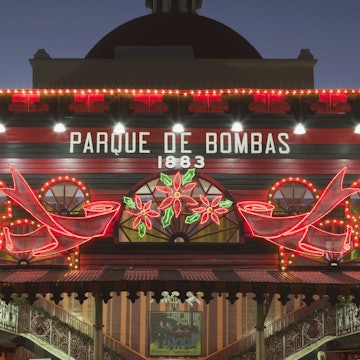
Ponceños will claim that the eye-popping Parque De Bombas is Puerto Rico's most frequently photographed building - not too hard to believe as you stroll around the black-and-red-striped Arabian-style edifice and make countless, unwitting cameos in family photo albums. Originally constructed in 1882 as an agricultural exhibition hall, the space later housed the city's volunteer firefighters, who are commemorated in a small, tidy exhibit on the open second floor.
Since 1990, the landmark has had a perfect function as a tourist information center - even the most hapless touristo can't miss it - where a pleasant, bilingual staff will sell you tickets for a trolley and point…
reviewed
-
La Coca Trail
This popular 1.8-mile hike will take you a little over an hour each way. The trailhead is just up the road past the falls of the same name - just before the Yokahú Tower - and there is a small parking lot here. It's a fairly benign, low-altitude trail following streams through tabonuco forest.
La Coca made its mark on El Yunque history when a US college professor disappeared here for 12 days in 1997, claiming after his rescue that he got off the trail and was lost. The Forest Service, which had enlisted a search party of 60 volunteers and aircraft, was hardly amused. If you follow La Coca to its end, you can go left (east) along Carrillo Trail to the eastern part of the…
reviewed
-
F
Calypso Tropical Café
Wall-to-wall suntans, svelte girls in bikini tops, bare-chested blokes nursing cold beers, and syncopated reggae music drifting out beneath the sun-dappled palm trees; the Calypso is everything you’d expect a beachside surfers’ bar to be – and perhaps a little more. All that’s missing is a prepsychedelic-era Brian Wilson propping up the jukebox (then again, Brian never could surf). On the ocean side of the leafy road to the lighthouse, Calypso hosts the oldest pub scene in Rincón and regularly books live bands to cover rock, reggae and calypso classics. Not surprisingly, it’s a microcosm of the region at large and the place to go to find out about surf gossip,…
reviewed
-
G
Playa Isla Verde
Resort pluggers will tell you that Playa Isla Verde is the Copacabana of Puerto Rico with its legions of tan bodies and dexterous beach bums flexing their triceps around the volleyball net. Other more savvy travelers prefer to dodge the extended families and colonizing spring-break hedonists that stake space here and head west to Ocean Park. Whatever your subjective view, this broad mile-long wedge of sand that lies between Punta Las Marías and Piñones is an undeniable beauty.
The downside - if there is one - is access. Cutting in front of the towering condos and plush hotels of Av Isla Verde, the beach is completely obscured from the road and, as a result, lacks the…
reviewed
-
H
Paseo de la Princesa
Emanating a rather distinctly European flavor, the Paseo de la Princesa is a 19th-century esplanade situated just outside the city walls. Lined with antique street lamps, shade trees, statues, benches, fruit vendors' carts and street entertainers, this romantic walkway culminates at the magnificent Raíces Fountain, a stunning statue/water feature that depicts the island's eclectic Taíno, African and Spanish heritage.
The Paseo is an ideal place to indulge in that most refined of Latin pastimes, the evening stroll - an activity best enjoyed at sunset when the breeze blows stiffly off the bay, the fountain shimmers under haunting colored lights and assorted vendors tempt…
reviewed
Advertisement
-
Playa Luquillo
Set on a calm bay facing northwest and protected from the easterly trade winds, the public part of this beach makes a mile-long arc to a point of sand shaded by evocative coconut palms. The beach itself is a plane of broad, gently sloping yellow powder that continues its gradual slope below the water. Although crowds converge here at weekends and during holidays, Luquillo has always been more about atmosphere than solitude. With its famous strip of 50-plus food kiosks congregated at its western end, it’s also a great place to sample the local culinary culture, including scrumptious surullitos (fried cornmeal and cheese sticks). There is a bathhouse, a refreshment stand,…
reviewed
-
El Yunque Trail
This is the big enchilada for most visitors and takes you to the top of El Yunque (3496ft, 1049m) in 1½ hours or longer. Starting on Rte 191 Km 12.2 opposite the Palo Colorado Visitor's Center, the 2.4 mile trail is mostly paved or maintained gravel as you ascend through cloud forest to the observation deck, which is surrounded by microwave communication towers that transmit to the islands of Culebra and Vieques.
If you want a rock scramble from here, take Los Picachos Trail (0.17 miles) to another old observation tower and feel as if you have crested a tropical Everest. You can return via a different route by descending down the Mt Britton Spur/Mt Britton Trail and…
reviewed
-
I
Wet & Liquid
Here they are, the beautiful people, perched on zebra-striped stools or lounging on strategically positioned sofas, martinis in hand. The buffed body-builders, the fashionistas, the 20-something wannabe actresses corseted into tight black dresses. Popularly considered to be two of San Juan’s most esteemed watering holes, Wet and Liquid comprise two separate bars situated in Isla Verde’s Water & Beach Club. Liquid dominates the ground floor, Wet inhabits the roof. Interconnected by a space-age elevator that is decorated rather surreally with its own water feature, this is where San Juan’s well-heeled and the well-endowed come to swap email addresses. The real glitterati…
reviewed
-
Galloway’s Bar & Restaurant
Snowbirds Welcome’ reads the sign out the front, but those four-seasoned spring-breakers from Minneapolis you’ve just spied sitting out on the waterfront deck aren’t the only birds pecking at the food. Small black feathered creatures will make a beeline for any spare tasty morsels, so hold on to your seafood crab salad and freshly prepared octopus before it all ends up as bird-feed. Something of a local legend, Galloway’s combines great seafood with a picturesque waterfront setting on Boquerón’s rustic downtown strip. It’s terrific for children, too.
All pretense of being a restaurant is dropped by 9pm on weekends, when a yuppie crowd shows up for live 1980s…
reviewed
-
Taíno Ceremonial Site
This Taíno ceremonial site, off Hwy 111, is not dramatic in the sense of having monumental ruins. The power of the place comes from its first-rate setting in a natural botanical garden of ceiba, ausubo and tabonuco trees shading the mid-slopes of the Central Mountains. There are also 10 ceremonial bateyes (Taíno ball courts), which date back about 800 years to the time of the original Taíno inhabitants. Stone monoliths line many of the courts; some weigh up to a ton, but most are small. One court measures 60ft by 120ft. Quite a few have petroglyphs, such as the famous Mujer de Caguana, who squats in the pose of the traditional ‘earth mother’ fertility symbol.
reviewed
-
Reserva Natural Laguna de Joyuda
The heart of the 300-acre Reserva Natural Laguna de Joyuda is a saltwater lagoon a mile long and a half-mile wide, with a depth that rarely exceeds 4ft. The sanctuary is of great importance to waterfowl and other migratory birds that come here to prey on more than 40 species of fish. Humans come here for the same reason.
The reserve is also home to another of Puerto Rico's famous bioluminescent bodies of water, which is like its famous cousins in La Parguera and Vieques but free of commercial tourism. After dark, micro-organisms give the dark water a green glow. Travelers with access to a kayak can launch a nighttime exploration of the lagoon; watch for the access road…
reviewed
-
J
Iglesia de Porta Coeli
This small church might not look much, but it is one of the oldest surviving ecclesial buildings in the Americas. Originally constructed between 1606 and 1607 on the orders of Queen Isabella of Spain, it once served as the chapel for a Dominican monastery that stood on this site until the 1860s. The current structure dates from a 1692 renovation and despite its architectural simplicity it retains a dramatic position at the crown of a long, steep flight of steps overlooking Plaza Santo Domingo.
The Porta Coeli ('Heaven's Gate' in Latin) has an interior with ausubo pillars and roof beams, and a ceiling made from palm wood, which is typical of construction in Puerto Rico…
reviewed
-
K
Parque Muñoz Rivera
Spanning half the width of Puerta de Tierra between the Atlantic and Av Ponce de León, this green space, known as Parque Muñoz Rivera, dates back over 50 years and injects some much needed breathing space into the surrounding urbanity. It has shade trees, trails, a kid's playground, and a 'Peace Pavilion', which sometimes hosts community events. An artisans' fair is held here and at the adjacent Parque Sixto Escobar on most weekends.
Parque Sixto Escobar - named for the famed Puerto Rican boxer - was the site of the eighth Pan American Games, held in 1979, and is now home to an Olympic athletics track, and the gusty Balneario Escambrón. It also hosts the annual Heineken…
reviewed
-
L
Parrot Club
The menu’s in Spanglish, the decor’s a lurid mix of orange, blue and yellow, and the waitress could quite conceivably be sporting a pink wig. Welcome to the Parrot Club, where Puerto Rican politicians wind down and enamored gringos live it up. Until the Parrot’s opening in 1996, the concept of SoFo didn’t even exist. But, with its caustic blend of live jazz and tasty ‘nuevo Latino ’ cuisine, this restaurant quickly set new standards and spawned the ultimate in neighborhood chic – an acronym. Now well into its second decade the menu continues to win kudos with its eclectic crabcakes caribeños, pan-seared tuna and vegetarian tortes.
reviewed
-
M
Puerta de Tierra
Less than 2 miles in length and only one-quarter of a mile broad, this district occupies the lowland, filling the rest of the area that was colonial San Juan. Puerta de Tierra takes its name from its position as the 'gateway of land' leading up to the walls of Old San Juan, which was the favored route of land attack by waves of English and Dutch invaders. For centuries, Puerta de Tierra was a slum much like La Perla, although far less picturesque.
It was a place where free blacks and multiracial people lived, excluded from the protection of the walled city where the Spaniards and criollos (islanders of European decent) postured like European gentry and maneuvered for…
reviewed
Advertisement
-
Cueva del Indio
Heading east from the Faro de los Morrillos, Hwy 681 takes you along a rugged coastline punctuated by coral outcroppings, dunes and lagoons. The countryside is largely rural, but clutches of beach houses have grown up along sections of the road. You will find the Cueva del Indio (Indian's Cave) near one such settlement, about 2 miles east of the lighthouse. Look out for an Esso gas station on the right. You can park here (ask permission) and follow the well-worn path across the road to the shore.
The surf crashes around the cave's entrance, which leads to a descending staircase and a substantial collection of Taíno petroglyphs on the walls. Bring a flashlight and good…
reviewed
-
N
El Capitolio
Sandwiched between Av Muñoz Rivera and Av Ponce de León, just east of Fuerte San Cristóbal, is El Capitolio of the commonwealth. Resembling a smaller, Romanesque version of the US Capitol, the building commands an authoritative position in Puerta de Tierra overlooking the wave-lashed coast. The much-revered constitution of the commonwealth, which moved the island a step closer to its citizens’ dreams of freedom from colonialism in 1951, is on display inside the 80ft rotunda. Regular sessions of the legislature meet inside, while rallies for and against statehood occur outside every time the government calls for an island-wide plebiscite on the issue.
reviewed
-
Isla Culebrita
If you need a reason to rent a kayak or hire a water taxi, Isla Culebrita is it. This small island, just a mile east of Playa Zoni, is part of the wildlife refuge. With its abandoned lighthouse, six beaches, tide pools, reefs and nesting areas for seabirds, Isla Culebrita has changed little in the past 500 years. The north beaches, such as the long crescent of Playa Tortuga, are popular nesting grounds for sea turtle, and you may see these animals swimming near the reefs just offshore.
Bring a lot of water, sunscreen, a shirt and a hat if you head for Isla Culebrita, because there is little shade here. The Isla is also home to a ruined lighthouse earmarked for extensive…
reviewed
-
Bosque Estatal de Carite
Less than an hour south of San Juan, the Bosque Estatal de Carite was created in 1935 to protect the watersheds of various local rivers from the forces of erosion. Measuring 6000 acres in area, the mountain reserve is easily accessed from the San Juan metro area, and it can get crowded on weekends and during the summer when sanjuaneros come here to enjoy the 72°F temperatures, green shade, and dozens of lechonerías (restaurants specializing in suckling pig) that line Hwy 184 as it approaches the northern forest entrance. The forest is one of the first points of interest you will hit if you are traversing the Ruta Panorámica east to west.
reviewed
-
O
Puerta de San Juan
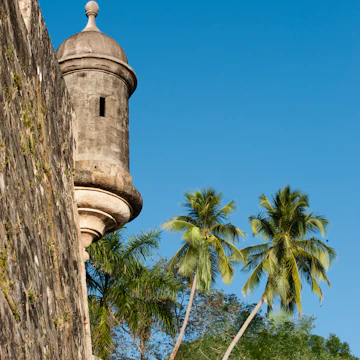
Spanish ships once anchored in the cove just off these ramparts to unload colonists and supplies, all of which entered the city through a tall red portal known as Puerta de San Juan. This tunnel through the wall dates from the 1630s. It marks the end of the Paseo de la Princesa, and stands as one of three remaining gates into the old city (the others lead into the cemetery and the enclave of La Perla). Once there were a total of five gates, and the massive wooden doors were closed each night to thwart intruders.
Turn right after passing through the gate and you can follow the Paseo del Morro northwest, paralleling the city walls for approximately ¾ of a mile.
reviewed