Things to do in Puerto Rico
-
A
Teatro Yagüez
The beautiful Teatro Yagüez would be an architectural icon in any European capital, let alone quiescent Mayagüez, a city that sometimes struggles to assert its understated cultural identity. Dubbed the ‘Cathedral of Sonorous Art’ by enamored locals, the building was the brainchild of Francisco Maymón, the son of Italian immigrants who was an early pioneer of silent movies in Puerto Rico at the beginning of the 20th century. Maymón inaugurated his first theater in 1909, an opulent neobaroque structure that was filled with Italian ceilings and tiles imported from Spain. Hosting opera, orchestral concerts, silent movies and plays, it rapidly became the font of polite…
reviewed
-
Bosque Estatal de Cambalache
Cambalache covers an area of just 1000 acres, making it smaller than a lot of Puerto Rican resort hotels. The entrance to this compact but little-visited forest reserve lies west of Barceloneta, in front of - wait for it - a Job Corps facility. Despite this rather inauspicious introduction, the forest is ecologically varied and characterized by distinctive karstic formations; countless mogotes pop straight up from the landscape to heights of 160ft.
Its many caves provide homes for fruit bats, which often swarm like bees into the evening sky. The forest has a picnic area, eight miles of hiking trails, two designated trails for mountain bikes (though they're often washed…
reviewed
-
B
Museo de Arte de Ponce (Map)
With an expertly presented collection, this commanding art museum is the vibrant heart of the city’s artistic community, easily among the best fine-arts centers in the Caribbean and itself worth the trip from San Juan. Set across from Universidad Católica, about 10 blocks to the south of Plaza Las Delicias, the museum’s expertly curated collection – some 850 paintings, 800 sculptures and 500 prints – represents five centuries of Western art that was donated in large part by former governor Luis Ferré. While typical museum etiquette applies, the intimate spaces are loaded with works presented in a fully bilingual manner, and visitors can get up close and personal to take…
reviewed
-
Bosque Estatal de Guánica (Guánica Biosphere Reserve)
Make sure you stop by the ranger station to pick up some maps before exploring this marvellous park. You can take a half-hour hike to a beach through three different kinds of forests, tramping the coast until you find a secluded cove for sunning yourself, before hiking back to your car by a different trail.
And all of this takes place in an area where birds, bullfrogs, the pale blue Caribbean and the sunshine make music together. The forest's uneven rainfall and drainage patterns have created an unusual variety of habitats for more than 700 varieties of plants (48 in danger of extinction), which attract a large number of birds. Some studies claim that at least 40 of the…
reviewed
-
Lagoon
This lagoon - Lagoon Tortuguero, is the only natural lake in Puerto Rico, making its protection extra precious. It is also one of the most ecologically diverse spots on the island, listing 717 species of plant and 23 different types of fish. Hiking around this pretty spot yields ocean views, and you can also fish and kayak in the lake – though you’ll have to bring your own equipment. Ask the rangers on duty about the trails, though they’re pretty obvious. Some locals use them for jogging. One of the lake’s stranger problems is its caiman infestation. In the 1990s there was an odd craze to buy striped South American caimans. Locals bought them in their droves, only to…
reviewed
-
C
Area Arqueológica Hombre de Puerto Ferro
You will find this site marked by a sign on Hwy 997, east of Esperanza. About a quarter mile east of the entrance to Sun Bay (Sombé), take the dirt road on your left (it heads inland). Drive for about two minutes until you find the burial site of the Indian known as the 'Hombre de Puerto Ferro', which is surrounded by a fence. Big boulders identify a grave where a 4000-year-old skeleton (now on exhibit at the Fortín) was exhumed.
Little is known about the skeleton, but archaeologists speculate that it is most likely the body of one of Los Arcaicos (the Archaics), Puerto Rico's earliest known inhabitants; this racial group made a sustained migration as well as seasonal…
reviewed
-
D
Plaza Las Delicias
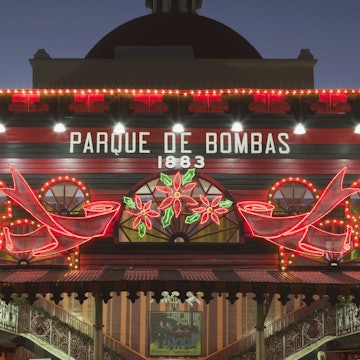
The soul of Ponce is its idyllic Spanish colonial plaza, Plaza Las Delicias, within which stands two of the city's landmark buildings, Parque de Bombas and Catedral Nuestra Señora de Guadalupe.
At any hour of the day a brief stroll around its border will get you well acquainted with Ponce - the smell of panderias (bakeries) follows churchgoers across the square each morning, children squeal around the majestic Fuente de Leones (Fountain of Lions) under the heat of midday, and lovers stroll under its lights at night.
Even as the kiosks selling lottery tickets and trinkets, the commercial banks and the fast-food joints encroach at the edges (a Burger King and a Church's mar…
reviewed
-
Bosque Estatal de Maricao
This forest of more than 10,000 acres lies along the Ruta Panorámica south of Maricao, and the drive is spectacular, with sharp curves snaking over ridges as the mountainsides fall away into steep valleys. As you make this drive, you will see places to pull your car off the road at trailheads that lead into the woods or traverse down steep inclines.
Curiously, few of the trails are maintained or mapped by the DRNA. In fact, guides to Bosque Estatal de Maricao are difficult to come by, both at the department's office in San Juan and in Maricao. So if you are coming here to hike, get yourself a topo map of the area from a map supplier in the USA, or ask an island bookstore…
reviewed
-
E
Chez Shack
What have ’60s psychedelic band the Mamas and Papas and Vieques’ most bohemian restaurant got in common? They both owe at least a part of their success to expat impresario and restaurateur Hugh Duffy. In the 1960s, Duffy owned a restaurant called ‘Love Shack’ on the nearby island of St Thomas, where he hosted folk-music nights with a quartet of spaced-out hippies called the New Journeymen. It was an important first break. But while the Journeymen changed their name to the Mamas and Papas and headed off to LA for some California Dreamin’, Duffy transplanted himself 13 miles to the west where he opened up Chez Shack, a quirky Caribbean hangout that quickly began…
reviewed
-
El Yunque
Tourist authorities are fond of promoting this reserve as the only tropical forest in the US national park system. The Taínos believed the god of happiness hung out on El Yunque, and you'll understand why when you hike through this magnificent rainforest. On a clear day you can even bag an eyeful of the Virgin Islands.
Covering 11,200 ha (28,000 acres) in the Luquillo mountains, this bountiful lush rainforest is home to more than 400 tree and fern species, most of which thrive in the hothouse conditions. There are 13 well-maintained hiking trails in the reserve, ranging from leisurely 15-minute wanders along sealed paths to a heart-pounding trek to the peak of El Yunque.…
reviewed
Advertisement
-
Aguirre
Crumbling monuments to the sugar industry are evident everywhere on the south east part of the island, but there's no more heartbreaking reminder of departed 'King Sugar' than sleepy little Aguirre, which borders the Bahía de Jobos and is so far off the beaten path that it doesn't appear on many tourist maps. The now-moldering sugar town was booming in the early-20th-century.
In it's day it was complete with a mill, company stores, hospital, theater, hotel, bowling alley, social club, golf course, marina, executive homes and narrow-gauge railroad. This was the planned private community of the Central Aguirre sugar company, and at its height (around 1960) it processed…
reviewed
-
Mirador La Piedra Degetau
This nest of boulders lies on a hilltop and was once the 'thinking place' of Ponce-born writer Federico Degetau y González, who became the island's first resident commissioner in Washington DC, from 1900 to 1904. This must have been a truly sublime place in its day, with views of the mountains, the Atlantic and the Caribbean. On a clear evening, you can actually see cruise ships leaving San Juan more than 20 miles to the north and the lights of Ponce beginning to glow to the south.
Sadly, the natural beauty of the site has been marred by an architecturally horrific park and lookout tower that dwarf the actual rocks, which huddle like small pebbles to the side. Myriad…
reviewed
-
CORALations
Two of Culebra's most isolated beaches - Resaca and Brava - are nesting sites for the endangered leatherback sea turtle, the largest living sea turtle in the world. The nesting season runs April through early June and each year small groups of volunteers are recruited by the US Fish & Wildlife Refuge to oversee the delicate egg-laying process.
Volunteers meet at sunset before traveling out to the beaches where they are required to count eggs, measure turtles, and document the event for environmental records. At the same time, participants are able to witness one of nature's most transfixing and timeless events in stunning close-up. Volunteer postings are understandably…
reviewed
-
F
Trois Cent Onze
After putting all his creative energy into his food, French owner Christophe Gourdain presumably couldn’t muster up enough energy to think up an original name for his formidable culinary extravaganza: hence Trois Cent Onze (311), the place’s numerical address on Fortaleza St. With its well-established French connection, 311 has the words ‘elegant, ’ ‘refined’ and ‘sophisticated’ written all over it, conjuring up classy European cuisine without too many of those Latino-fusion makeovers (alas, no mofongo with a camembert twist here). Glide into one of the island’s most romantic interiors, awash with billowing white curtains, flickering candles and delightful…
reviewed
-
La Piedra
Cough too loudly here and you could end up on the local radio. La Piedra, situated next to the Piedra Degetau Park is a long-time mountain institution that also accommodates the recording studios of Radio Cumbre. Yes, that guy on the next table behind the thick pane of reinforced glass isn’t a waiter wearing ear muffs; he’s a DJ reaching out over the airwaves on 1470AM. Broadcasting credentials aside, La Piedra serves up some rather decent food to accompany its regular diet of music and topical chat – chicken in a tamarind sauce and chicken broth and mofongo (mashed plantains) are popular local favorites. Thanks to its prime Ruta Panorámica location it also acts as…
reviewed
-
Island Ventures
You can reach Isla Caja de Muertos through Island Ventures. The name - which translates to Coffin Island - seems cribbed from the script from a swashbuckling adventure flick, but the big lizards here run a lazy show, trotting across dusty, cacti-lined trails and over the mangrove marsh. The morbid moniker itself even has a tame origin; it's thought to have come from an 18th-century French author's observation that the island's silhouette looked like a body in a casket.
But the opportunity for a refreshing, day-long escape from the congestion of Ponce is key, starting with some of the best snorkeling around and plenty of tranquil, if somewhat rocky stretches of beach. Day…
reviewed
-
Culebra National Wildlife Refuge
More than 1500 acres of Culebra's 7000 acres constitute the Culebra National Wildlife Refuge, which US President Theodore Roosevelt signed into law almost 100 years ago, and which is protected by the Departamento de Recursos Naturales y Ambientales (DRNA; Department of Natural Resources & Environment). Most of this land lies along the Península Flamenco, and from Monte Resaca east to the sea, and includes all of the coastline as well as more than 20 offshore cays, with the exception of Cayo Norte. The US Fish & Wildlife Service administers these lands.
Monte Resaca, Isla Culebrita and Cayo Luis Peña are open to the public from sunrise to sunset daily, and all have some…
reviewed
-
G
Plaza de San José
Adjacent to the uppermost terrace of the Plaza del Quinto Centenario, where it meets Calle San Sebastián, is the Plaza de San José. This relatively small cobblestone plaza is dominated by a statue of Juan Ponce de León, cast from an English cannon captured in the raid of 1797. The plaza is probably the highest point in this city and serves as a threshold to four cultural sites on its perimeter. The neighborhood around the plaza, on San Sebastián and the intersecting Calle del Cristo, is the original home of the restaurant, bar and café scene that began in Old San Juan more than a decade ago.
There are still plenty of places to grab a bite to eat in a shady building…
reviewed
-
Refugio de Boquerón
The western part of Bosque Estatal de Boquerón carries the name Refugio de Boquerón. It is made up of more than 400 acres of mangrove wetlands, about 2 miles south of town between the coast and Hwy 301. This is an excellent area for bird-watching; more than 60 species are commonly sighted. A number of duck species migrate here in the winter, as well as osprey and mangrove canary. An excellent way to see this sanctuary is to rent a kayak and paddle south across Bahía de Boquerón (Boquerón Bay).
The main office can provide more information and has a 700ft walkway leading into the mangroves. Or stop at Km 1.1 just off Rte 101 and start walking along the trail you see…
reviewed
-
H
La Fortaleza
A steep climb along Recinto Oeste takes you to the top of the city wall and the guarded iron gates of La Fortaleza. Also known as El Palacio de Santa Catalina, this imposing building is the oldest executive mansion in continuous use in the western hemisphere, dating from 1533. Once the original fortress for the young colony, La Fortaleza eventually yielded its military pre-eminence to the city’s newer and larger forts, and was remodeled and expanded to domicile island governors for more than three centuries. You can join a guided tour that includes the mansion’s Moorish gardens, the dungeon and the chapel. Free guided tours generally run on weekdays except holidays; tours…
reviewed
Advertisement
-
I
Mercado de Río Piedras
If you like the smell of fish and oranges, the bustle of people, and trading jests in Spanish as you bargain for a bunch of bananas, the Mercado de Río Piedras is for you. As much a scene as a place to shop, the market continues the colonial tradition of an indoor market that spills into the streets.
The four long blocks of shops and inexpensive restaurants lining Paseo de Diego, and facing the market, have been closed to auto traffic, turning the whole area into an outdoor mall. You can shop or just watch as the local citizens negotiate for everything from chuletas (pork chops) and camisas (shirts) to cassettes featuring Puerto Rican pop-music wonders like Menudo.…
reviewed
-
J
Casa Blanca
First constructed in 1521 as a residence for Puerto Rico’s pioneering governor, Juan Ponce de León (who died before he could move in), the Casa Blanca is the oldest continuously occupied house in the western hemisphere. For the first 250 years after its construction it served as the ancestral home for the de León family. In 1779 it was taken over by the Spanish military, then with the change of Puerto Rico’s political status in 1898, it provided a base for US military commanders until 1966. Today it is a historic monument containing a museum, secluded grounds, a chain of fountains and an Alhambra-style courtyard. The interior rooms are decked out with artifacts from…
reviewed
-
Corporación Piñones Se Integra
The Corporación Piñones Se Integra is a community based nonprofit organization that is involved in improving the facilities in Puerto Rico’s poorer barrios, particularly Loíza. Concurrently, they are working hard to keep the island’s traditional Afro-Caribbean culture alive. Headquartered in the Centro Cultural Ecoturístico de Piñones situated to the right of Rte 187 immediately after you cross the bridge at Boca de Cangrejos, the organization promotes some of Puerto Rico’s best bomba y plena performances at its on-site Café El Búho at 9pm on the second and last Friday of each month. You can also arrange traditional dancing and percussion lessons here (phone…
reviewed
-
E Franco & Co
Most of Puerto Rico’s culinary legends are less than 20 years old, but this salt-of-the-earth grocery-store-cum-café has been here for over a century and a half and is still drawing in punters from as far away as San Juan for a monthly stock up. Cocooned in the waterfront warehouse district, Franco’s is an upmarket place with tables scattered around a glass-topped deli counter in the style of an old English tearoom. Order your lunch from a set menu and you’ll receive a complimentary brazo gitano that goes down well with a cup of fine Puerto Rican coffee. Stocked with assorted condiments, fresh baked goods and opulent hampers, the store affords plenty of…
reviewed
-
K
Iglesia de San José
What it lacks in grandiosity it makes up for in age; the Iglesia de San José in the Plaza de San José is the second-oldest church in the Americas, after the cathedral in Santo Domingo in the Dominican Republic. Established in 1523 by Dominicans, this church with its vaulted Gothic ceilings still bears the coat of arms of Juan Ponce de León (whose family worshipped here), a striking carving of the Crucifixion and ornate processional floats. For 350 years, the remains of Ponce de León rested in a crypt here before being moved to the city’s cathedral, down the hill. Another relic missing from the chapel is a Flemish carving of the Virgin of Bethlehem, which came to the…
reviewed