Things to do in Warsaw
-
Former Jewish Ghetto
Before WWII, much of Warsaw's thriving Jewish community lived in Mirów and Muranów, two districts to the west of Al Jana Pawła II. It was here that the Nazis created the Warsaw Ghetto in 1940, which was razed after the 1943 Ghetto Uprising. Today the area is characterised by cheap, communist-era apartment buildings, but a few remnants of Jewish Warsaw still survive in the former Jewish Ghetto. It is a large area to cover on foot, but fortunately the main sights are clustered together in the northern part.
reviewed
-
A
Ul Próżna
Ul Próżna, a short street leading off Plac Grzybowski, opposite the Teatr Żydowski (the Jewish Theatre), is an eerie and incongruous survivor of WWII. Its crumbling, unrestored redbrick façades, the ornamental stucco long since ripped away by bomb blasts, are still pockmarked with bullet and shrapnel scars. A few blocks to the south, in the courtyard of an apartment building at ul Sienna 55, stands one of the few surviving fragments of the redbrick wall that once surrounded the Warsaw Ghetto.
reviewed
-
B
Cafe Blikle
The mere fact that Blikle has survived two world wars and the pressure of communism makes it a household name. But what makes this legendary café truly famous is its donuts, for which people have been queuing up for generations. Join the back of the line and find out why.
reviewed
-
C
Bar Mleczny Pod Barbakanem
This popular milk bar looks as though it hasn’t changed for decades. It serves cheap, unpretentious Polish standards in a location that would be the envy of many upmarket eateries.
reviewed
-
D
Royal Castle
This massive brick edifice, now a marvellous copy of the original that was blown up by the Nazis towards the end of the war, began life as a wooden stronghold of the dukes of Mazovia in the 14th century. Its heyday came in the mid-17th century, when it became one of Europe's most splendid royal residences, and during the reign of Stanisław August Poniatowski (1764-95) when its grand Baroque apartments were created. It then served the tsars, and in 1918, after Poland had regained its independence, it became the residence of the president. Today it is filled with period furniture, works of art, and an army of old ladies watching your every move.
Two floors of the castle are…
reviewed
-
E
Old Town
The Old Town was rebuilt from the foundations up because after the war it was nothing but a heap of rubble. The monumental reconstruction, which took place between 1949 and 1963, aimed at restoring the appearance of the town in its best times, the 17th and 18th centuries. Every authentic architectural fragment found among the ruins was incorporated in the restoration.
In 1945, the Old Town Square was just the walls of two houses sticking out of the rubble, today it is a harmonious blend of Renaissance, baroque and Gothic elements. It's alive and atmospheric, doesn't feel contrived, and is replete with open-air cafés and art stalls. The Historical Museum of Warsaw occupi…
reviewed
-
F
Al Jerozolimskie
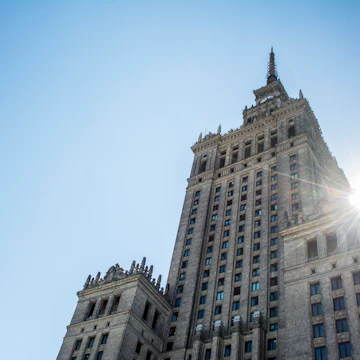
Al Jerozolimskie is a big, ugly thoroughfare that creates a physical east-west border through the city. The area to its south was ear-marked by the communists for post-WWII development, and some of the city's boldest socialist-realist architecture can be found here. Ul Marszałkowska, a broad avenue running south from near the financial district, contains the most impressive examples.
Its stretch between Plac Konstytucji (Constitution Square) and Plac Zbawciela is lined with arcades bearing giant reliefs of heroic workers - the imposing scale and rigid, rectilinear forms are pinnacles of conformity and control. Constitution Square itself is also worth a look for its two g…
reviewed
-
G
Ghetto Heroes Monument
About 200m north of Pawiak Prison Museum, on the corner of ul Anielewicza and ul Zamenhofa, is a tree-lined park, which in summer is dotted with sunbathers. It's an incongruously peaceful setting for the Ghetto Heroes Monument, a memorial to the thousands who lost their lives in the ill-fated Ghetto Uprising of 1943. The grey stone tower is built of Swedish granite, originally imported by the Nazis to build their own victory monument.
On one side a bronze relief depicts a crush of doomed but defiant insurgents; on the other is a scene of martyrdom - a Jewish elder clutching a Torah scroll leads a group of his people, the sinister outlines of Nazi helmets and bayonets visi…
reviewed
-
Praga
Crossing the Vistula from the Old Town into Praga, Warsaw's eastern suburb, is like entering another city. Clean, level streets and renovated buildings are replaced by broken roads and crumbling façades, and much of the populace is working class and poor. Despite the grit, Praga is the place to be. The area is slowly being gentrified as artists, musicians, and entrepreneurs move in, attracted by its pre-WWII buildings (as it was not directly involved in the battles of 1944, Praga didn't suffer much damage) and cheap rent. Ventures open and close on a regular basis but the list of established places grows steadily longer.
InfoPraga (www.infopraga.com.pl; ul Ząbkowska 36 )…
reviewed
-
H
Muzeum Pawilon-X
Muzeum Pawilon-X, which preserves a wing of the old political prison. The cells are labelled with the names of the more famous prisoners who were incarcerated here, the best known being Józef Piłsudski, who did time in cell No 25 on the 1st floor; another cell contains the anvil on which prisoners were made to forge their own shackles. Inside are paintings by Alexander Sochaczewski (1843–1923), a former inmate who, along with 20,000 other anti-Russian insurgents, was transported to the labour camps of Siberia in 1866. The paintings, such as the huge Pożegnanie Europy (Farewell to Europe), depict the suffering of his fellow prisoners. In the museum grounds is an origi…
reviewed
Advertisement
-
I
Łazienki Park
Łazienki Park - pronounced wah-zhen-kee - is a beautiful park of manicured greens and wild patches. Its popularity extends to families, Sunday strollers, proud peacocks, and the many red squirrels that call it home.
Łazienki Park - pronounced wah-zhen-kee - is a beautiful park of manicured greens and wild patches. Its popularity extends to families, Sunday strollers, proud peacocks, and the many red squirrels that call it home. Once a hunting ground attached to Ujazdów Castle, Łazienki was acquired by King Stanisław August Poniatowski in 1764 and transformed into a splendid park complete with palace, amphitheatre and various follies and other buildings. The centrepiece …
reviewed
-
J
Wilanów Palace
The best place to start exploring the complex is Wilanów Palace. Its highlights include the two-storey Grand Entrance Hall, the Grand Dining Room, and the Gallery of Polish Portraits, featuring a collection of paintings from the 16th to 19th centuries. Note the so-called coffin portraits – a very Polish feature – that are images painted on a piece of tin or copperplate personifying the deceased, then attached to the coffin during the funeral. The exterior of the palace is adorned with impressive murals, including a 17th-century sundial with a bas-relief of Chronos, god of time. As guides are expensive, you might be better off picking up an audio-guide (6zł).
reviewed
-
K
Plac Bankowy
Like most of Warsaw's squares, Plac Bankowy is too big and busy to be appealing. It was once the financial district of 19th-century Warsaw, but the only reminder of this is spread along the western side of the square; here you'll see the imposing City Hall (Ratusz; M0570) and the former stock exchange and Bank of Poland building, both grand neoclassical buildings designed by Antonio Corazzi in the 1820s. The eastern side of the square was redeveloped after WWII and is now dominated by a blue skyscraper built on the site of a synagogue destroyed by the Nazis. The story goes that a local rabbi placed a curse on the site and, sure enough, the skyscraper was dogged by problem…
reviewed
-
L
Ul Nowy Świat
Running from the junction of ul Świętokrzyska and ul Krakowskie Przedmieście to Al Jerozolimskie, Ul Nowy Świat , or New World St, is the busiest street in Warsaw outside the Old Town, but here it's generally Poles who make up the masses.
It's long been the city's fashionable shopping street, and is lined with restaurants, shops and cafés. Most of the buildings date from post-WWII, but the restoration here was so complete that the predominant architecture style is 19th-century neoclassical. Aside from shopping, eating and drinking, the best thing to do here (and its side alleys ul Foksal and ul Chmielna) is find a comfy seat and watch the parade of Poles.
reviewed
-
M
Palace on the Water
Palace on the Water is the former residence of king Stanisław August Poniatowski. It straddles an ornamental lake (gondola rides 6/4zł per adult/child) and like most other Łazienki buildings was designed by the court architect Domenico Merlini. During WWII the Nazis attempted to blow it up, but succeeded only in starting a fire that destroyed much of the 1st floor. Renovated and refurbished, the palace is open to guided tours – highlights include the 17th-century marble reliefs depicting scenes from Ovid’s Metamorphoses gracing the original bathhouse ( łazienki in Polish, hence the name), and the ornate ballroom.
reviewed
-
N
Centrum Hadlowo-Usłagowe
Dive through the archway at ul Novy Śiwat 26 and you'll discover Centrum Hadlowo-Usłagowe, a collection of bars, eateries and shops in stark contrast to the rapidly modernising face of 21st-century Warsaw. Here tiny drinking holes with names such as Pemek and Windigo fill a T-junction of squat concrete bunkers, attracting a young, bohemian crowd eager to avail of the relaxed vibe and cosy retro furniture.
There's also outdoor seating, but the open-air party moves inside at 22:00 due to city regulations. Lining the stomach is no problem either, with Turkish available from Kafefajka and Antalya, sushi from Besuto, and Asian from Cô tú.
reviewed
-
O
Old Town Square
The partially walled Old Town (Stare Miasto) is centred on Old Town Square, which, for those with an eye for historical buildings, is the loveliest in Warsaw. It's lined with tall houses exhibiting a fine blend of Renaissance and Baroque with Gothic and neoclassical elements - aside from the façades at Nos 34 and 36, all were reconstructed after WWII. An 1855 statue of the Mermaid (Syrena), the symbol of Warsaw, occupies the square's central position, the site of the city's original town hall demolished in 1817.
On almost any given day, the square is swamped with tourists enjoying the pretty surrounds and numerous cafés and restaurants.
reviewed
-
P
Pawiak Prison Museum
Built between 1830 and 1833, Pawiak was Poland’s most notorious political prison, once used for incarcerating the enemies of the Russian tsar. During WWII it became even more notorious as the Gestapo’s main prison facility – between 1939 and 1944 around 100,000 prisoners passed through its gates, of whom around 37,000 were executed on site and 60,000 transported to the gas chambers. It was blown up by the Nazis in 1944, but half of the mangled gateway, complete with rusting, original barbed wire, and three detention cells (which you can visit) survive, along with chilling memoirs of the horrors suffered by the inmates.
reviewed
-
Q
Sigismund III Vasa Column
A natural spot from which to start exploring the Old Town is triangular Castle Square (Plac Zamkowy). Attracting snap-happy tourists by the hundreds each day is the square's centrepiece, the Sigismund III Vasa Column. This lofty 22m-high monument to the king who moved the capital from Kraków to Warsaw was erected by the king's son in 1644 and is Poland's second-oldest secular monument (after Gdańsk's Neptune). It was knocked down during WWII, but the statue survived and was placed on a new column four years after the war. The original, shrapnel-scarred granite column now lies along the south wall of the Royal Castle.
reviewed
-
R
Citadel
Continuing north of the New Town you'll soon see the Citadel, a massive 19th-century fortress overlooking the Vistula. Built by the Russian tsar to intimidate Warsaw following the November Insurrection of 1830, it served as a notorious political prison for years and nowadays is used by the military. The huge gate overlooking the river is known as Brama Straceń (Gate of Execution; M056E), a spot where political prisoners were executed all too frequently after the 1863 uprising.
From the gate, a short cobbled road leads to the Muzeum Pawilon-X, which preserves a wing of the old political prison.
reviewed
Advertisement
-
S
John Paul II Collection
The latter houses the John Paul II Collection, an art collection donated to the Catholic Church by the Carrol-Porczyński family. It’s quite a surprise to find the likes of Dali, Van Gogh, Constable, Rubens, Goya and Renoir gracing the walls of a fairly non-descript museum, and to normally have them all to yourself. Polish artists are also represented, including Warsaw-born Wojciech Gerson (1831–1901), whose massive Baptism of Lithuania (1889), which beautifully captures Lithuania’s conversion to Christianity, is highly expressive despite lacking colour.
reviewed
-
T
Holy Cross Church
The Holy Cross Church has witnessed more student demonstrations and tear gas than any other church in Poland. During the Warsaw Rising, it was the site of heavy fighting between the insurgents and the Germans. It was seriously damaged, but some original Baroque altarpieces have survived and adorn its interior. Note the epitaph to Frédéric Chopin on the second pillar on the left-hand side of the nave. It covers an urn containing the composer’s heart, brought from Paris after Chopin’s death and placed here in accordance with his will.
reviewed
-
U
Umschlagplatz Monument
The Umschlagplatz Monument marks the site of the umschlagplatz (literally, 'taking-away place'), the railway terminus from which Warsaw's Jews were transported to Treblinka. The rectangle monument's marble walls are carved with more than 3000 Jewish forenames, from Aba to Zygmunt, and the stark message: 'Along this path of suffering and death over 300,000 Jews were driven in 1942-43 from the Warsaw Ghetto to the gas chambers of the Nazi extermination camps'.
Its shape is symbolic of the cattle trucks into which the prisoners were herded.
reviewed
-
V
Wilanów Gardens and Parks
The side gate next to the northern wing of the Wilanów palace leads to the Wilanów gardens and parks, which, like the palace itself, display a variety of styles. The central part comprises a manicured, two-level Baroque Italian garden, which extends from the palace down to the lake, the south is Anglo-Chinese in design, and the northern section is an English landscape park.
Get to Wilanów on bus 116 or 180 from any stop on ul Krakowskie Przedmieście, ul Nowy Świat or Al Ujazdowskie.
reviewed
-
W
St Anne’s Church
St Anne’s Church is arguably the most ornate church in the city. It miraculously escaped major damage during WWII, which explains why it sports an original trompe l’œil ceiling, a Rococo high altar and gorgeous organ. The façade is also Baroque in style, although there are neoclassical touches here and there, and the detached belfry is thoroughly neo-Renaissance. At the top of the belfry is a viewing platform, which offers superb views over the Old Town.
reviewed