Getting around
Contents
Boat
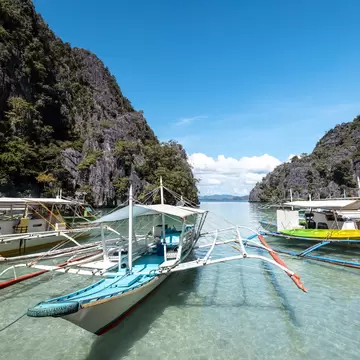
Spend any length of time in the Philippines and you're bound to find yourself on a boat. Boats range from the high-class multideck WG&A ferries and highly efficient luxury passenger catamarans (known as fastcraft or fast ferries) to the smallest of outriggers (called bangka or pumpboats), which shuttle between myriad beaches and piers.
Ferry & fastcraft
Ferries of all descriptions and levels of seaworthiness ply the waters between islands. They are often overcrowded; cramming every inch of leaky tubs with passengers doesn't make them watertight, but it does increase the probability of the ship sinking, especially in heavy seas. You often have options as to which boat to travel on, so ask around about reliable companies and ferries and plan accordingly.
Fastcraft are becoming an increasingly common sight between islands. These are smaller, lighter and newer than the ferries, and are well fitted, reliable and safe. They aren't called fastcraft for nothing, as they can cut long rides by half. One modern convenience used to excess on these spiffy ships is air-conditioning, which is permanently set to 'arctic' - take a sweater or fleece.
Though service on the main routes is pretty reliable, you'll need to be prepared for changes in the itinerary. Adverse weather conditions (especially during the typhoon season) or renovation of a ferry can totally alter the sailing times and boats used for various trips. As with planes, boats fill to overflowing during Christmas, New Year, Holy Week and All Saints' Day/All Souls' Day, as well as to the locations of major festivals.
On board, there are several levels of comfort and cost. Bunks on or below deck on 3rd class should be fine, as long as the ship isn't overcrowded.
Ferry prices vary widely but, as a guide, the fare for the 22-hour voyage between Manila and Cebu City costs P1768 to P6414 on WG&A/Superferry, depending on which class you choose to travel. Before purchasing your ticket, it pays to ask about discounts. Ferries, like airlines, offer promotional discounts. Also inquire about student discounts: some shipping lines knock 15% to 30% off if you can show a valid student ID.
The following are the main ferry companies in the Philippines:
Negros Navigation (02-245 5588 in Manila; www.negrosnavigation.ph)
Sulpicio Lines (02-245 0616 in Manila; www.sulpiciolines.com)
WG&A/Superferry (02-528 7000 in Manila; www.superferry.com.ph)
Small craft
Ferries may carry more weight, but bangka (also known as pumpboats) are the backbone of inter-island travel. These are small wooden boats with two wooden or bamboo outriggers. In some areas, in addition to single rides, bangka can be hired for day trips at a reasonable cost. The cost of the boat trip can be shared between the number of passengers aboard.
Bangka are powered by recycled automotive engines, so they can be noisy - we recommend bringing earplugs if you're sensitive to noise and plan a lot of bangka travel. They are often on regular schedules, but won't hit the surf if seas are rough; bangka pilots aren't always crazy about night trips either.
Be wary of crossing fast-flowing rivers, especially when they're swollen by floods. Jury-rigged and overloaded 'ferries' - often just several bangka tied beneath a wooden platform - are particularly prone to capsizing.
Hitching
Hitching is never entirely safe in any country in the world, and we don't recommend it. Travellers who decide to hitch should understand that they are taking a small but potentially serious risk. People who do choose to hitch will be safer if they travel in pairs and let someone know where they are planning to go. And, needless to say, hitching in the guerrilla territory of Mindanao is positively suicidal.
The cost of transport in the Philippines is generally so low that hitchhiking isn't worth the trouble; you're seldom left stranded without a cheap and willing jeepney in sight. A hitchhiker is such an unusual sight in the Philippines that most regular drivers will probably ignore you if you stand on the roadside with your thumb out; the only ones who might stop are truck or jeepney drivers, who would expect a few pesos if they gave you a lift.
Bus & tram
Bus
An enormous number of bus services cover the Philippines and generally do it quite cheaply and reliably. Island-hopping on a bus is even an option; in fact, you can travel all the way from the northernmost tip of Luzon to the southernmost corner of Mindanao without getting your feet wet.
Departures are usually quite frequent, but take care if there's only one bus a day - drivers sometimes decide to leave earlier than scheduled if the bus is full! Many Filipinos like to travel early in the morning or after nightfall, when it's cool, so there are often more buses at this time.
As in most countries, it pays to mind your baggage while buses load and unload.
Costs
You can roughly calculate the fare and the time a bus journey will take based on distance. Regular buses generally cover a bit under 2km per peso and the average speed is about 50km per hour. Voilà! A 100km journey costs P50 or so and takes two hours.
On the other hand, you'd need a slide rule and a crystal ball to factor in chickens crossing the road, the number of flat tyres, heart-stopping spurts of speed and so on, all of which seem to have been magically factored into the actual price you pay. It's a bit easier to take a look at the prices written on chalkboards wherever the buses depart.
Air-con buses are around 15% to 20% more expensive than ordinary buses, and trips on gravel roads are normally pricier than travel on sealed roads.
Car & motorcycle
If time is short, driving yourself is a quicker option than relying on jeepneys and other public transport, but it does come with caveats. Philippine driving is possibly at its most manic in and around Manila, and in Luzon's central mountains. It's less life-threatening elsewhere, though, and verges on pleasant in and around cities such as Cebu.
Whatever you do, don't try to emulate the local style - driving in the Philippines is one area of cultural difference where the 'when in Rome' principle doesn't apply.
Insurance
Philippine law requires that you have third-party auto insurance with a Philippines auto-insurance company when you drive in the Philippines. If you rent a car, this can be arranged with the rental agency. You are required to carry a minimum of P750,000 of insurance. Auto insurance is available from local insurance agencies.
Train
The route south from Manila to the Bicol region in southeast Luzon is the only railway line in the country. Although it's old and none too speedy, it's a viable option for travel down to Naga and Legaspi and points along the way.
Travel documents
Reservations
As noted earlier, drivers get an itchy pedal foot when the bus is full, and clutching a reservation to your chest as the bus zooms away without you is cold comfort. That said, reservations are useful, especially on popular routes and early-morning buses where competition for a seat can be pretty stiff.
In bigger towns, reservations can be made with the bus company by phone or in person; in smaller centres, often a particular shop takes reservations for buses belonging to one or more companies. On some routes you can also ring to request that a bus stop for you at a designated time and place.
Tours
There are a variety of tours of the Philippines available. The following is just a sample of what's available.
EcoFirst Adventures (www.ecofirstadventures.com) This USA-based company offers a variety of adventure-sports trips in Palawan.
Philippine-Travel.com (www.philippine-travel.co.uk) This UK-based operator offers a variety of tours including diving and live-aboards.
Philippines Private Tours (www.philippinesprivatetours.com) Operated by Lonely Planet author Chris Rowthorn, this company specialises in private tours of Palawan and Manila. It also offers airport pickups in Manila and online consulting about Philippines travel.
Local transport
Jeepney
A jeepney is what you'd get if you crossed a jeep with a bus. Jeepneys are the main mode of public transportation in most towns, and are used for both local and long-distance transport in the Philippines. They can be flagged down anywhere, but usually prefer to stop where there is a crowd of potential customers. The Filipino phrase bayad ko (buy-yad-ko) translates as 'here is my fare' and will get the driver's attention.
Jeepneys are plentiful on most routes, but you may have to wait a while to get your ride: jeepney drivers are not inclined to depart until they've got (at least) a full load. During the rush hours or in the aftermath of a sudden downpour, be prepared to be packed in like sardines, with three or four hardy souls clinging to the back or the roof of the vehicle for dear life.
Jeepneys follow a set route (though this can suddenly change due to traffic conditions) and stop on demand, but it can be hard to see where you are from inside the vehicle - the best seats are up the front next to the driver. In big cities like Manila, jeepneys are festooned with signboards indicating where the vehicle goes; in other places, there's one sign in the front. Occasionally jeepneys are unmarked and you'll have to ask the driver where it's going.
Paying for a jeepney ride is straightforward - there's a price (ask other passengers if you're unsure) and you pay it, usually under the watchful eye of fellow travellers, who will help with translations if need be.
The average price for a short trip in Manila is P7 and you can pay anywhere along the way. The driver usually has change, at least for smaller bills. If you are too far from the driver, simply hand your money to a passenger near the driver - not only will they pass on your money to the driver but will hand you back your change as well.
When you want to get off, you can rap on the roof, hiss (you'll be joined by a chorus of 'Psst!' from the other passengers) or use the correct term, pára (pa-ra), which is Filipino for 'stop'.
If you don't mind the expense, you can hire a jeepney (plus the jeepney driver, of course) and have it all to yourself for around P1500 to P2000 a day (sometimes less outside Manila).
When taking long-distance jeepney rides, these are some things to keep in mind:
Find out what the fare should be before you hop in. You can ask other passengers or passersby, or, if that fails, try a nearby shop.
Try not to be the first person to get into an empty jeepney. If the driver suddenly takes off, you may have just hired a vehicle on a pricey 'special ride' (which is probably the case if the driver doesn't stop for anyone else). If this happens, ask the driver to stop, and explain that you're only looking for a regular ride.
Take care if several men suddenly get in and try to sit near you. Chances are you're being set up to be pickpocketed - get off and find another vehicle.
On long trips it's worth trying to get a seat next to the driver - there's more leg room in the front and the time passes more quickly if you can see where you're going.
Light rail
Some parts of Manila are served by an elevated railway system.
Tricycle
The tricycle is basically the Philippine rickshaw: a little, roofed sidecar bolted to a motorbike or, less often, a bicycle. Tricycles are found in their various forms nearly everywhere and are useful - essential even - for short trips. In many areas, they can also be rented by the hour for around P100.
The flat fare around town is usually P5 per passenger; for longer trips around town, you will be charged at least double this figure. Note that this is the rate that locals pay. In some towns you can get away with paying the local rate; in many tourist areas, however, your chances of getting such a rate range from slim to nonexistent. In these areas, drivers of motorised tricycles will routinely quote P150 - especially if night is fast approaching and/or the trip involves unsealed roads. Locals would pay a fraction of this price, so feel free to haggle.
Tricycles are often garishly done up in the mode of a jeepney, and you'll likely hear one before you see one from the noise of the smoke-belching two-stroke engine.
Tricycles in Manila (where they're also called pedicabs or sidecars) are normally confined to certain routes, usually around commercial centres or residential villages or subdivisions, and will seldom venture away from their regular beat.
Van
Vans (minibuses) have become popular in many parts of the Philippines as rivals to jeepneys and regular buses. Operated privately, these vehicles usually hang around bus depots or busy shopping centres and take passengers (in air-conditioned comfort) to set destinations. The cost of a ride in a van is two or three times more than for a jeepney (the basic fare in Manila is P10 per passenger), but the extra comfort is certainly worth the additional cost. Unlike jeepneys and buses, which are often decrepit, without air-conditioning and therefore exposed to exhaust fumes and noise, these vans are generally newer vehicles and are always air-conditioned, sometimes to freezing point. The drawback is that drivers hate to head off with half-empty vehicles, so you may have to wait a while or pay extra to leave straight away. Conversely, this mode of public transport has become so popular that it may be hard to get a seat (a van accommodates nine passengers plus driver and no 'hangers-on' are allowed).
Many vans, particularly those operating in Manila, are locally assembled Toyota models, referred to as 'FX'. The fare is usually around P25 for long rides and P15 for shorter hops. They can also be hired like taxis, sometimes at prearranged flat rates, sometimes for rates that must be agreed upon by negotiating with the driver.
Air
The main domestic carriers are Philippine Airlines (PAL), Cebu Pacific Air and Air Philippines. Smaller carriers include Asian Spirit, SEAIR and Island Transvoyager (only for El Nido in Palawan).
Size is important when it comes to Philippine air travel. Smaller airlines fly smaller planes, and smaller airports have more basic facilities. You're more likely to get on a flight during popular travel times with a bigger airline; on the other hand, the smaller planes often land (or at least try to) when the big planes turn back or stay on the ground. Generally speaking, PAL flies the largest and newest planes.
Flight routes tend to be skewed towards the major airports, so airlines can fly from busy Airport X to towns A, B and C, but not necessarily between A, B and C. Routes in the southern Philippines are particularly hit-and-miss.
Reasonably reliable flight information, as well as online booking, is available online from airline websites and travel sites such as www.lakbay.net. All domestic carriers have roughly comparable fares, and on certain routes you can get promotional (ie seasonal) discounts of 20% to 30% if you buy your ticket two or three days in advance (check with the airline for exact details). Schedules and prices change, and promotions rapidly come and go.
It's best to book in advance, but don't plan too tight a schedule - flight delays are a fact of life in the Philippines. During the wet season, schedules can be erratic due to the weather. If there is a typhoon warning, most flights will be grounded; few ferries will venture out of harbours either, so you may just have to wait it out. You can bank on the first few flights following a typhoon being massively overbooked. There's also the risk of smaller airlines cancelling flights at the last minute if not enough passengers show up at the airport or airfield.
Christmas, New Year, Holy Week (the week culminating in Easter) and All Saints' Day/All Souls' Day (1/2 November) are the most heavily booked periods. Wherever you go, be sure to reconfirm your flight, though this isn't always a guarantee against being bumped.
Bicycle
Cycling around the Philippines is a seldom-explored option, but away from the treacherous traffic and exhaust fumes it can be a great way to get around the quieter, less visited islands such as the Batanes or Guimaras. Locals get around on bikes in many of these places, and the promise of peaceful rides along coastal and mountain roads to out-of-the-way villages makes cycling well worth the effort.
You can take bicycles on domestic flights (you may have to partially disassemble the bicycle), but take heed of the baggage allowance on small planes. If there's room, you can stow your bike on a bus or jeepney, usually for a small charge.
Hire
As guesthouses and resorts realise the virtues of hiring out bicycles, self-powered transport is getting easier to come by on some islands. Depending on where you are, mountain bikes go for around P300 per day.
Purchase
Purchasing a bicycle locally is no better or worse than anywhere else in the world. In the big cities you will most likely find a bicycle shop or two in major shopping centres, though, unlike in most other Southeast Asian countries, there are very few commuters on bicycles, hence prices tend to be a bit higher.
Philippines
Things to do
- All things to do (725)
- Activities (139)
- Entertainment (112)
- Restaurants (256)
- Shopping (83)
- Sights (129)
- Tours (6)