Sights in Arequipa
- Sort by:
- Popular
-
A
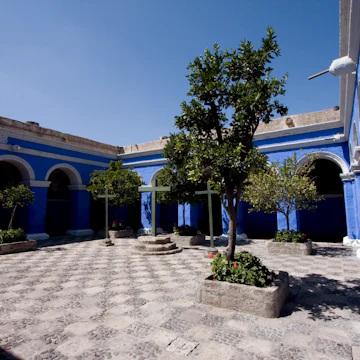
Monasterio de Santa Catalina
Even if you’ve already overdosed on colonial edifices, this convent shouldn’t be missed. Occupying a whole block and guarded by imposing high walls, it is one of the most fascinating religious buildings in Peru. Nor is it just a religious building – this 20,000-sq-meter complex is almost a citadel within the city. It is a disorienting place with twisting passageways, ascetic living quarters, period furnishings and religious art – a photographer’s paradise.
reviewed
-
B
Museo Santury
Officially the Museo de la Universidad Católica de Santa María, this museum exhibits ‘Juanita, the ice princess’ – the frozen body of an Inca maiden sacrificed on the summit of Nevado Ampato, a snow-covered volcano to the northwest of Arequipa, more than 500 years ago. Multilingual tours (available in Spanish, English, French, German and Italian) consist of a video followed by an examination of various burial artifacts, culminating in a respectful viewing of the frozen mummy, preserved in a carefully monitored glass-walled exhibition freezer. Although Juanita is not on display from January to April, another child sacrifice discovered in the mountains around Arequipa is…
reviewed
-
C
Monasterio de la Recoleta
This musty monastery was constructed on the west side of the Río Chili in 1648 by Franciscan friars, though now it has been completely rebuilt. Scholarship was an integral part of the Franciscans’ order, and bibliophiles will delight in the huge library, which contains more than 20,000 dusty books and maps; the oldest volume dates back to 1494. The library is open for supervised visits; just ask at the entrance. There is a well-known museum of Amazonian artifacts (including preserved jungle animals) collected by the missionaries, and an extensive collection of pre-Conquest artifacts and religious art of the escuela cuzqueña (Cuzco School). Guides who speak Spanish,…
reviewed
-
Yanahuara
The peaceful neighborhood of Yanahuara makes a diverting excursion from the city center. It's within walking distance: go west on Av Puente Grau over the Puente Grau bridge, and continue on Av Ejército for half a dozen blocks. Turn right on Av Lima and walk five blocks to a small plaza. At the side of the plaza there's a mirador (lookout) with excellent views of Arequipa and El Misti.
The round-trip walk from the city center should take around two hours, but there are also combis (minibuses) to Yanahuara from along Av Puente Grau (and returning from Yanahuara's plaza to the city) every few minutes to speed you along.
reviewed
-
D
Museo de Arte Virreinal de Santa Teresa
This gorgeous 17th-century Carmelite convent was only recently opened to the public as a living museum. The colonial-era buildings are justifiably famed for their decoratively painted walls and restored rooms filled with priceless votive objets d’art, murals, precious metalworks, colonial-era paintings and other historical artifacts. It is all capably explained by student tour guides who speak Spanish, English, French, German and Portuguese; tips are appreciated. A charming shop at the front of the complex sells baked goods and rose-scented soap made by the nuns.
reviewed
-
E
Iglesia de la Compañía
Just off the southeast corner of the Plaza de Armas, this Jesuit church, one of the oldest in Arequipa, is noted for its ornate main facade and main altar, which is carved in the churrigueresque style (an intricate decorative motif popular during the late Spanish baroque period) and completely covered in gold leaf. To the left of the altar is the San Ignacio chapel, with a polychrome cupola smothered in junglelike murals of tropical flowers, fruit and birds, among which mingle warriors and angels.
reviewed
-
F
Museo Arqueológico Chiribaya
Opened in 2008, the Museo Arqueológico Chiribaya houses an impressive collection of artifacts from the pre-Incan Chiribaya civilization, including well-preserved textiles and the only pre-Inca gold collection in southern Peru. The museum is housed in a beautiful colonial mansion that features design details by French engineer Gustave Eiffel, of Eiffel Tower fame. University student guides offer 40-minute tours in Spanish, English, Portuguese, French, Italian and German when prearranged.
reviewed
-
G
La Catedral
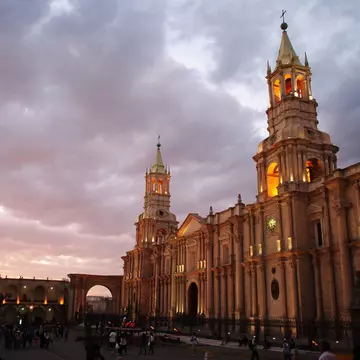
The history of La Catedral, the cathedral that dominates Arequipa’s main plaza, is filled with doggedness. The original structure, dating from 1656, was gutted by fire in 1844. Consequently rebuilt, it was then promptly flattened by the earthquake of 1868. Most of what you see now has been rebuilt since then. An earthquake in 2001 toppled one enormous tower, and made the other slump precariously, yet by the end of the next year the cathedral looked as good as new once again.
reviewed
-
Iglesia de San Miguel Arcángel
In the inner suburb of Cayma you’ll find the eye-catching Iglesia de San Miguel Arcángel, dating from 1730. For a tip, the church warden may take you up the small tower, which has panoramic views. To reach Cayma from Yanahuara, walk along San Vicente and then take Av León Velarde, or catch one of the regular combis (minibuses) marked ‘Cayma’ from Av Puente Grau (S1, 15 minutes).
reviewed
-
Paucarpata
The rural suburb of Paucarpata , about 8km southeast of the city center, makes a pleasant country escape. Combis can be caught along Goyeneche, Independencia and Paucarpata, which is the eastern continuation of Mercaderes (25 minutes), or you can take a taxi. Paucarpata itself features an attractive colonial church on the main plaza and several good picanterías (local restaurants).
reviewed
Advertisement
-
La Mansión del Fundador
The 17th-century La Mansión del Fundador, once owned by Arequipa’s founder Garcí Manuel de Carbajal, has been restored with original furnishings and paintings, and even has its own chapel. The mansion is in the village of Huasacache, 9km from Arequipa’s city center, most easily reached by taxi (round-trip S20). Local city tours occasionally stop here.
reviewed
-
El Molino de Sabandía
A 3km walk from the plaza brings you to El Molino de Sabandía. This mill was built in 1785, fell into disrepair and was restored two centuries later; it now grinds once more for visitors. The neat grounds, shaded with weeping willows and providing great views of El Misti, are a favorite of picnickers.
reviewed
-
Iglesia San Juan Batista
Turn right on Av Lima and walk five blocks to a small plaza, where you’ll find the Iglesia San Juan Batista, which dates from 1750. The popular Fiesta de la Virgen de Chapi is held on May 1. At the side of the plaza there’s a mirador (lookout) with excellent views of Arequipa and El Misti.
reviewed
-
Museo Regional Histórico Etnológico Municipal
The small Museo Regional Histórico Etnológico Municipal is housed in a tumbledown colonial building. Paintings, historical documents, maps and other paraphernalia pertaining to the city's history are displayed here. Most interesting are the satirical caricatures of stately 19th-century Peruvian elite.
reviewed
-
H
Museo Arqueológico de la Universidad Católica de Santa María
The university-run Museo Arqueológico de la Universidad Católica de Santa María has interesting little displays on local excavation sites, as well as some artifacts, including surprisingly well-preserved ancient ceramics. Guided tours are available in Spanish and English; tips are expected.
reviewed
-
I
Casa de Moral
Built in 1730, Casa de Moral is named after the 200-year-old mulberry tree in its central courtyard. Owned by BCP, the house is now one of the most accessible for snooping, and bilingual guides are available. It has a fascinating little map collection charting South American development.
reviewed
-
Cayma
Beyond Yanahuara is Cayma , another inner suburb of Arequipa's city center, nicknamed El Balcón (the Balcony) for its privileged views. To reach Cayma from Yanahuara, walk along San Vicente and then take Av Leon Velarde, or catch one of the regular combis marked 'Cayma' from Av Puente Grau.
reviewed
-
Plaza de Armas
The Plaza de Armas showcases the city's sillar architecture and the cathedral. The colonnaded balconies overlooking the plaza are a great place to relax over a snack or a coffee, though it's the views you're be paying for, not the bland, overpriced café fare.
reviewed
-
J
Casa Ricketts
Easy to visit, Casa Ricketts was built in 1738, it has served as a seminary, archbishop’s palace, school, home to well-to-do families, and now as a working bank. Look for the puma-headed fountains in the interior courtyard.
reviewed
-
K
Iglesia de San Francisco
Originally built in the 16th century, Iglesia de San Francisco has been badly damaged by several earthquakes. It still stands, however, and visitors can see a large crack in the cupola – testimony to the power of quakes.
reviewed
Advertisement
-
San Ignacio chapel
To the left of the altar of the Iglesia de la Compañía is the San Ignacio chapel , with a polychrome cupola smothered in junglelike murals of tropical flowers, fruit and birds, among which mingle warriors and angels.
reviewed
-
L
Casona Iriberry
Worth a peek and housing the Universidad Nacional de San Agustín (UNSA) within its 18th-century colonial halls and patios.
reviewed
-
M
Museo Santury
Officially the Museo de la Universidad Católica de Santa María, this museum exhibits ‘Juanita, the ice princess’ – the frozen body of an Inca maiden sacrificed on the summit of Nevado Ampato, a snow-covered volcano to the northwest of Arequipa, more than 500 years ago. Multilingual tours (available in Spanish, English, French, German and Italian) consist of a video followed by an examination of various burial artifacts, culminating in a respectful viewing of the frozen mummy, preserved in a carefully monitored glass-walled exhibition freezer. Although Juanita is not on display from January to April, another child sacrifice discovered in the mountains around Arequipa is…
reviewed