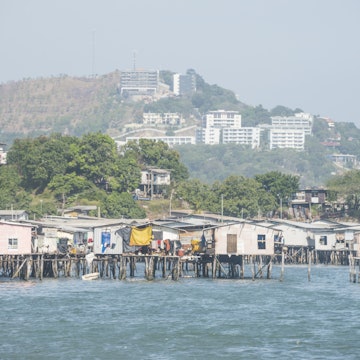
Sights in Papua New Guinea
-
A
Coastwatchers' Memorial Beacon
The 30m-high Coastwatchers' Memorial beacon, visible 25km out to sea, is a reminder of those who stayed behind enemy lines during WWII to report on Japanese troop and ship movements. It's a rather ugly concrete memorial, but the 3km beach-front road south of the memorial is the most pleasant walk in Madang, fringed by palm trees and poincianas and backed by the golf course with fine views across Astrolabe Bay.
reviewed
-
US airbase
If you head to Los Negros Island, east of Lorengau, check out the remains of the US airbase at Lombrum. There's a fine anti-aircraft gun as you enter, and rows of old hangers. General MacArthur's HQ is still in use by the PNG Navy. The former Australian refugee detention centre, where asylum seekers who were arriving in Australia were processed during Australia's 'Pacific Solution' days, is located here too.
reviewed
-
Hansa Bay
Hansa Bay is a popular diving spot past Bogia, where the wreckage of 35 Japanese freighters and US aircraft lie in a shallow harbour. The upper deck of the 6000-ton Shishi Maru lies in just 6m of water, two anti-aircraft guns on the bow point upwards and brass shell castings litter the deck. Two fire engines are sitting in the hold, just before the bridge, where they were waiting to be unloaded.
reviewed
-
Mission Point to Cape Boram
Near the main wharf lie the rusting remains of MV Busama. Further down at Kreer, on the road to the airport, there's the wooden hulk of a Taiwanese fishing junk. On the beach between Kreer Market and the hospital are some rapidly disappearing rusting Japanese landing barges. The Japanese War Memorial marks the mass grave of many troops. The soldier's bodies were later exhumed and returned to Japan.
reviewed
-
Alotau Harbour
The Alotau Harbour is the most colourful part of town and it's worth exploring. There are one-man canoes, brightly painted island boats, work tugs and passenger vessels. The busy harbour activity attests to it being the province's main cargo hub. For a bird's-eye view of the harbour, walk up the steps in town to the hospital, take the right fork and keep going for a couple of hundred metres.
reviewed
-
B
New Guinea Club & Rabaul Museum
Just next door to Admiral Yamamoto's Bunker is New Guinea Club & Rabaul Museum. Established in 1933, this club was a businessmen's club with strict guidelines for membership. It was destroyed in WWII and rebuilt in the 1950s to its former glory only to be destroyed again by fire in 1994. It has been partly restored and is now home to a small museum. Ask at the Rabaul Hotel for the key.
reviewed
-
C
Queen Emma's House
Head to the site of Queen Emma's house, located right where the road terminates at the Ralum Country Club. Emma Forsayth, from Samoa, started a trading business at Mioko in the Duke of York Islands in 1878 before extending her empire to include plantations, trade stores and ships. Don't hold your breath; there's not much to see of Gunantambu, her grand home, which was ruined in WWII.
reviewed
-
D
Japanese Memorial Peace Park
This park contains a memorial and a fish pond. Tok Pisin doesn't have a word for peace; 'Peace' sounds like pis, which means fish. Thus, most locals refer to the park as pis park, which is perhaps appropriate given the fish pond and the general ambivalence that many modern Papua New Guineans have towards WWII. Ironically, the peace park is enclosed by a wire fence.
reviewed
-
museum
There's a tiny museum in a stockaded compound and most of the items in the small display are for sale. The place is a sort of old mens' home and a couple of older fellows show you around and accept your donation. The covered structure in the compound is the grave of a former provincial premier, and you'll see similar (but usually smaller) structures all around the Tari area.
reviewed
-
Panguna
High in the centre of the island, the dormant mine of Panguna (still off-limits at the time of writing) is one of the world's largest artificial holes. Bougainville Copper Limited was the operator of the open-cut mine. Copper was discovered at Panguna in 1964. There are talks of reopening that mine once the situation in Bougainville is fully stabilised. Stay tuned.
reviewed
Advertisement
-
Keu Caves
Caves around Kundiawa were used as burial places. At the time of research, it wasn't clear whether a local guide could take you there. Don't visit the caves without consulting local advice as it might be tambu (taboo). There are other large caves, suitable for caving, close to Kundiawa, while the Keu Caves are very close to the main road near Chuave.
reviewed
-
Bomana War Cemetery
It's only 46km to Sogeri but there is enough to see to make it a full-day trip. The first stop is the large and carefully tended Bomana War Cemetery, where 4000 PNG and Australian WWII soldiers are buried; American soldiers who died in PNG were generally shipped home for burial. It's a serene yet sobering place. PMV 16 from Gordons Market runs past the gate.
reviewed
-
Wawela
The road south of Losuia is dotted with villages but seldom sees motorised transport. Wawela is on a beautiful, curving sand beach edging a cool, deep, protected lagoon. On a falling tide, beware of the channel out to sea from the bay: the current can be very strong. To get here you'll need to rent a bike from Butia Lodge or charter a PMV for a few hours.
reviewed
-
skull caves
It is possible to visit the skull caves of Bebere and Kosame, where traditional burial rites are still observed. Custom dictates that the bodies of dead relatives are placed into the hull of a canoe and interred in a cave until the flesh has rotted from the bones. The skeletons are then removed, cleaned and displayed on the walls of the caves.
reviewed
-
Mt Wilhelm
Climbing to the 4509m (14,790ft) summit of Mt Wilhelm has long been a highlight for many visitors to the country's Highlands. It's hard work, but on a clear day you can see both the north and south coasts of the mainland. If you don't plan on tackling the summit, the region around the base offers fantastic walking and dramatic landscapes.
reviewed
-
Laloki River gorge
A few kilometres past the Bomama War Cemetery cemetery, the road winds up the impressive Laloki River gorge and you're soon more than 600m above sea level. There are several viewing points looking into the gorge and up to the Rouna Falls and power station. Just beyond is a small store and a track leading to the rundown Kokoda Trail Motel.
reviewed
-
Davit Wreck
Hansa Bay also has some spectacular wreck dives. A Japanese freighter has one davit projecting from the water (known as the Davit Wreck); it was sunk in 1943 by US bombers. You can swim through the wreck, which makes this an exciting dive in only 12m of water. The Madang dive shops organise dives to Hansa Bay and other north-coast sites.
reviewed
-
WWII Dump
Towards the end of WWII the area was used as a staging post for US troops and vast numbers of GIs passed through. The war's abrupt end left millions of dollars worth of aircraft and equipment redundant, so the whole lot was bulldozed into a huge hole; ask at Dregerhafen High School, about 4km south of Gagidu Station, for directions.
reviewed
-
Kaileuna Island
Of the islands off Kiriwina, Kaileuna Island is the easiest and cheapest to access as boats carrying buai (betel nut) travel from Losuia most days. The villages of Kaisiga, in the south, and Tawema to the north have beautiful white-sand beaches and predictably relaxed locals. Ask around the wharf to see if a boat is going.
reviewed
-
Buin
About 260km south of Buka, Buin really feels the end of the line. It suffered less damage than Kieta and Arawa during the conflict. During WWII, Buin hosted a large Japanese army base and the area has many rusting relics. The Japanese had plans to resettle a huge number of civilian Japanese at an area called Little Tokyo.
reviewed
Advertisement
-
Vanimo Forest Products
The Malaysian logging company Vanimo Forest Products is logging the province and there are business opportunities with cross-border trade. Hopes are high for development even though the Indonesian and Malaysian business people seem to have a disdain for the local service workers that is quite palpable and uncomfortable.
reviewed
-
Mt Balbi
A good base, Wakunai is where you can arrange a three-day trek to Mt Balbi (2685m), or follow the Nooma Nooma track that crosses the island to Torokina, on the west coast (count on a three-day minimum). From Mt Balbi, you can see the active Mt Bagana (1730m). In Wakunai, your best source of information is Suzie Akoitai.
reviewed
-
Namatanai
This is the second-largest town on New Ireland Province; it has a hotel, supermarket and a few stores (but no bank). Namatanai was an important station in the days of German occupation. Now it's just a transit point on a pretty bay. You'll get electricity only from 18:00 to 22:00, despite the local hydro project.
reviewed
-
Wau Ecology Institute
There are several places around Wau and Bulolo of interest to walkers and nature lovers, particularly those with a thing for insects. The Wau Ecology Institute seems to be steadily running down, but its laboratory, library, museum, lecture theatre, large insect collection and accommodation are still operating.
reviewed
-
Vivigani
The most northwesterly of the group, Goodenough is one of the most steeply sided islands on earth, with Mt Oiautukekea reaching 2566m at the summit. There are fertile coastal plains flanking the mountain range and a road runs around the northeast coast through Vivigani, site of the major airstrip in the group.
reviewed