Showing 1-24 of 24 results
-
Bergen Aquarium
At the end of the Nordnes Peninsula, the Bergen Aquarium has a big outdoor tank with seals and penguins, as well as 70 indoor tanks. You'll never forget the loveable steinbit, the hideous anglerfish or the school of herring, which seems to function as a single entity.
-
Bergen Art Museum
Beside the Lille Lungegårdsvann lake, Bergen Art Museum exhibits a superb collection of 18th- and 19th-century pieces by international and Norwegian artists, including Munch, Miró, Picasso, Kandinsky and Paul Klee.
-
Bergen Cathedral
Bergen Cathedral, also known as St Olav's Church, is well worth a visit. The stonemasonry in the entrance hall is superb; it was carved by the same stonemasons as those who adorned Westminster Abbey's chapter house in London.
-
Bryggens Museum
The archaeological Bryggens Museum was built on the site of Bergen's first settlement, and the 800-year-old foundations unearthed during construction have been incorporated into the exhibits, which include medieval tools, pottery, skulls and runes. The permanent exhibition documenting Bergen in around 1300 is particularly interesting.
-
Cultural History Collection
The two main University Museums include: the Cultural History Collection with Viking weaponry, medieval altars, folk art, period furnishings, Inuit and Aleut cultures and displays covering everything from Henrik Ibsen to Egyptian mummies; and the Natural History Collection.
-
Damsgård Manor
The 1770 Damsgård Manor, 3km west of town, may well be Norway's (if not Europe's) finest example of 18th-century rococo timber architecture. The building's superb, even over-the-top highlight is the baroque garden, which includes sculptures, ponds and plant specimens that were common 200 years ago. To get there, take bus No 19 from the centre.
-
Fantoft Stave Church
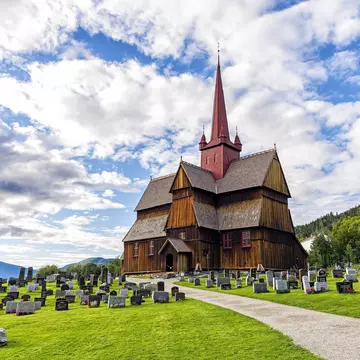
In a lovely leafy setting (which goes by the name 'Paradise') south of Bergen, was built in Sognefjord around 1150 and moved to the southern outskirts of Bergen in 1883. It was burned down by a Satanist (and soon-to-be-released heavy metal musician) in 1992, but it has since been painstakingly reconstructed. The adjacent cross, originally from Sola in Rogaland, dates from 1050. Get off the bus at the Fantoft stop on Birkelundsbakken and walk uphill through the park for about five minutes.
-
Fløibanen Funicular
For an unbeatable city view, ride the 26-degree Fløibanen Funicular to the top of Mt Fløyen (320m), with departures every 15 minutes.
-
Håkonshallen
The large ceremonial hall Håkonshallen, adjacent to the Rosenkrantz Tower, was constructed by King Håkon Håkonsson from 1247-61 and completed for his son's wedding and coronation. The roof was blown off in 1944 thanks to the explosion of a Dutch munitions boat, but extensive restoration has been carried out. There are hourly guided tours in summer.
-
Hanseatic Museum
The terrific Hanseatic Museum provides a window onto the world of Hanseatic traders. Housed in a rough-timber building from 1704, it starkly reveals the contrast between the austere living and working conditions of Hanseatic merchant sailors and apprentices, and the lifestyles of the management.
-
Advertisement
-
Lysøen Estate
The beautiful Lysøen Estate , on the island of the same name, was built in 1873 as the summer residence of renowned Norwegian violinist Ole Bull. After the death of Ole Bull's French-born wife, Felicité Villeminot, Bull purchased the 70-hectare Lysøen island, about 20km south of Bergen. Between 1872 and 1873, he and architect Conrad Fredrik von der Lippe constructed the fantasy villa 'Lysøen'.
-
Mariakirken
The stone church Mariakirken, with its Romanesque entrance and twin towers, dates from the early 12th century and is Bergen's oldest building. The interior features 15th-century frescoes and a splendid baroque pulpit donated by Hanseatic merchants in 1676.
-
Maritime Museum
Bergen's Maritime Museum is essential to understanding the history of this seafaring city. It features models of ships from Viking times to the present and exhibits tracing Norway's maritime history.
-
Natural History Collection
The two main University Museums include: the Cultural History Collection with Viking weaponry, medieval altars, folk art, period furnishings, Inuit and Aleut cultures and displays covering everything from Henrik Ibsen to Egyptian mummies; and the Natural History Collection .
-
Nordnes Sjøbad
If you fancy a swim but can't face cold fjord waters, the outdoor heated pool (27°C) at the Nordnes Sjøbad at the water's edge is good. For something a little cooler, there's a diving board to the open water.
-
Old Bergen Museum
The open-air Old Bergen Museum, 4km north of the city centre, boasts a fine collection of 35 structures from the 18th and 19th centuries. A 30-minute walk from Torget will get you there or take a bus (No 20-23). Admission to the grounds is free and they are open all year.
-
Rosenkrantz Tower
Built in the 1560s by Bergen governor Erik Rosenkrantz, Rosenkrantz Tower was a residence and defence post. It also incorporates parts of the keep (1273) of King Magnus the Lawmender and the 1520s fortress of Jørgen Hansson. Spiral staircases lead past halls and sentry posts to a reasonable harbour view from the summit.
-
Schøtstuene
An essential complement to the Hanseatic Museum, Schøtstuene is a reconstruction of one of the original assembly halls where the fraternity of Hanseatic merchants once met for their business meetings and beer guzzling.
-
Siljustøl Museum
Harald and Marie Sæverud lived in Siljustøl, a simple timber home. It was constructed in the 1930s of natural stone and untreated wood in an attempt to create unity with the environment. Harald Sæverud's first symphony was completed in 1920 and he endeared himself to Norwegians everywhere when, during WWII, he wrote protest music against the Nazi occupation. In 1986 he was made official composer of the Bergen International Music Festival. When he died in March 1992, he was given a state funeral and buried at Siljustøl, as requested. To get there, take bus No 30 from platform 20.
-
Theta Museum
This excellent one-room reconstruction of a clandestine Resistance headquarters, uncovered by the Nazis in 1942, is now Norway's tiniest museum. Appropriately enough, finding it is still a challenge. It's behind the Enhjørningen restaurant; pass through the alley and up the stairs to the 3rd floor.
-
Advertisement
-
Troldhaugen
A two-storey home, Troldhaugen dates from 1885 and occupies an undeniably lovely setting on a lush and scenic peninsula by the coastal Nordåsvatnet lake, south of Bergen. Composer Edvard Grieg and his wife Nina Hagerup spent every summer here from 1885 until Grieg's death in 1907. Today the house and grounds are open to the public, there's a multimedia Grieg exhibition and a 200-seat concert hall.
-
Ulriksbanen Cable Car
The Ulriksbanen Cable Car ascends to the radio tower and café atop Mt Ulriken (642m), offering a panoramic view of the city and surrounding fjords and mountains. The 'Bergen in a Nutshell' ticket includes the cable car and a return bus from the tourist office. Otherwise, it's a 45-minute walk from the centre or a few minutes' ride on bus No 2 or 31 from the post office or bus No 50 from Bryggen.
-
University Museums
The two main University Museums include: the Cultural History Collection with Viking weaponry, medieval altars, folk art, period furnishings, Inuit and Aleut cultures and displays covering everything from Henrik Ibsen to Egyptian mummies; and the Natural History Collection.
-
Waterfront Fish Market
The Waterfront Fish Market at Torget has a happy, bustling vibe that's hard to tear yourself away from. Here, fishy odours assault the olfactory senses, spilt effluent turns the quay into a slippery mess, and you'll find a range of tasty seafood snacks .
Showing 1-24 of 24 results