Things to do in Nepal
-
Everest Circuit
22 days (Kathmandu)
Spectacular traverse from Gokyo Lakes to Kala Pattar affording incredible views of Mount Everest.
Not LP reviewed
from USD$2,790 -
A
Kumbeshwar Temple
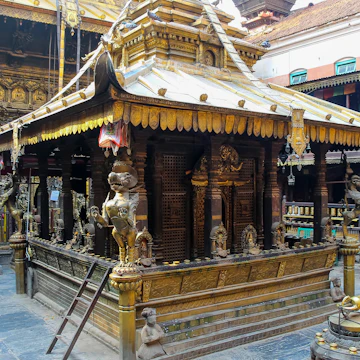
Directly north of Durbar Sq is Kumbeshwar Temple , one of the valley's three five-storey temples. The temple dominates the surrounding streets and is said to date from 1392, making it the oldest temple in Patan. The temple is noted for its graceful proportions and fine woodcarvings and is dedicated to Shiva, as indicated by the large Nandi, or bull, facing the temple.
The temple platform has two ponds whose water is said to come straight from the holy lake at Gosainkund, a long trek north of the valley. An annual ritual bath in the Kumbeshwar Temple's tank is claimed to be as meritorious as making the arduous walk to Gosainkund.
Thousands of pilgrims visit the Kumbeshwar…
reviewed
-
East Monastic Zone
The East Monastic Zone is set aside for monasteries from the Theravada school. The area is less developed than the western zone and the track is bumpier, but many of the monasteries have peaceful woodland settings.
Close to the north end of the pond, the Royal Thai Buddhist Monastery is an imposing wat (Thai-style monastery) built from gleaming white marble. Next door is the rather plain and austere Mahamaya Vishwa Shanti Buddha Vihara, constructed as a joint venture between Japanese Buddhists and the Indian Mahabodhi Society.
A short cycle ride south is the Myanmar Golden Temple, one of the oldest structures in the compound. There are three prayer halls here - the most…
reviewed
-
B
Kumari Bahal
At the junction of Durbar and Basantapur Sqs is a red brick, three-storey building with some incredible intricately carved windows. This is the Kumari Bahal, home to the Kumari, the young girl who is selected to be the town's living goddess until she reaches puberty and reverts to being a normal mortal. The building, in the style of the courtyarded Buddhist vihara (monastic abodes) of the valley, was built in 1757 by Jaya Prakash Malla.
Inside the building the three-storey courtyard, or Kumari Chowk, is enclosed by magnificently carved wooden balconies and windows, making it quite possibly the most beautiful courtyard in Nepal. Photographing the goddess is forbidden, but…
reviewed
-
C
Golden Gate & 55 Window Palace
The Golden Gate is generally agreed to be the single most important piece of art in the whole valley. The gate and palace were built by King Bhupatindra Malla, but were not completed until 1754 during the reign of Jaya Ranjit Malla, the last of the Bhaktapur Malla kings. The magnificent Golden Gate, or Sun Dhoka, and the entrance to the 55 Window Palace ( M0463) adjoin the National Art Gallery.
A Garuda, the vehicle of Vishnu, tops the torana (the carved pediment above the temple door) and is shown here disposing of a number of serpents, which are the Garuda's sworn enemies. The four-headed and 10-armed figure of the goddess Taleju Bhawani is featured directly over the…
reviewed
-
D
Nyatapola Temple
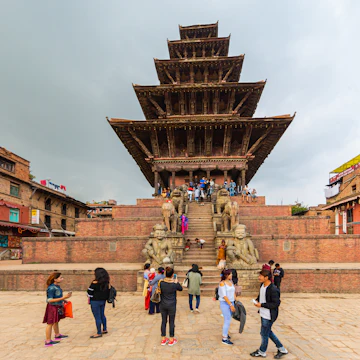
The five-storey, 30m-high Nyatapola Temple ( M0458) is not only the highest temple in Nepal, but also one of the best examples of traditional Newari temple architecture. The temple appears to soar above Bhaktapur's rooftops, with the snow-capped Himalaya as a dramatic backdrop.
Built during the reign of King Bhupatindra Malla in 1702, its design and construction were so solid that the 1934 earthquake caused only minor damage. The stairway leading up to the temple is flanked by guardian figures at each plinth level. The bottom plinth has the legendary Rajput wrestlers Jayamel and Phattu, said to have the strength of 10 men. On the plinths above are two elephants, then two…
reviewed
-
E
Bhairabnath Temple
The well-restored, triple-roofed Bhairabnath Temple (also known as the Kasi Vishwanath or Akash Bhairab; M045A) has an unusual rectangular plan and a somewhat chequered history. It was originally built as a one-storey temple in the early 17th century, but was rebuilt with two storeys by King Bhupatindra Malla in 1717. The 1934 earthquake caused great damage to the temple and it was completely rebuilt and a third floor added.
Casually stacked by the north wall of the temple are the enormous wheels and temple chariot runner on which the image of Bhairab (a fearsome form of Shiva) is conveyed around town during the Bisket festival in mid-April. Bhaktapur celebrates Bisket…
reviewed
-
F
Pachali Bhairab & the Southern Ghats
Between Tripureshwar Marg and the Bagmati River at Pachali Bhairab a huge, ancient pipal tree forms a natural sanctuary for an image of Bhairab Pachali, surrounded by tridents (Pachali is a form of Shiva). To the side lies the brass body of Baital, one of Shiva's manifestations. Worshippers gather here on Tuesday and Saturday. It is particularly busy here during the festival of Pachali Bhairab Jatra.
From the temple you could explore the temples and ghats that line the holy, polluted, Bagmati River. Head south of Pachali Bhairab to the ghats on the riverbank to find a collection of lovely statuary. To the west is the Newari-style pagoda of the Lakshmi Mishwar Mahadev; to…
reviewed
-
G
Krishna Mandir
After you enter Durbar Sq, the third temple you reach is the Krishna Mandir , which was built by King Siddhinarsingh Malla. Records indicate that the temple was completed with the installation of the image on the 1st floor in 1637. With its strong Mughal influences, this stone temple is clearly of Indian design, unlike the nearby brick-and-timber, multiroofed Newari temples.
The 1st and 2nd floors of this temple are made up of a line of three miniature pavilions, from the top of which rises a shikhara-style spire. Musicians can often be heard playing upstairs.
Krishna is an incarnation of Vishnu, so the god's vehicle, the man-bird Garuda, kneels with folded arms on top of…
reviewed
-
H
Til Mahadev Narayan Temple
It's easy to miss Taumadhi Tole's third interesting temple, as it is hidden away behind the buildings on the southern side of the square. You can enter the temple's courtyard through a narrow entrance through those buildings, or through an arched entrance facing west, just to the south of the square.
This double-roofed Vishnu temple has a Garuda kneeling on a high pillar in front, flanked by pillars bearing Vishnu's sankha and chakra symbols. Some of the temple's struts also depict Garudas. A lingam in a yoni (female equivalent of the phallic symbol) stands inside a grilled structure in front and to one side of the temple. A plaque to the lower right of the door depicts…
reviewed
Advertisement
-
I
Indra Chowk
The busy shopping street of Makhan Tole spills into Indra Chowk, the courtyard named after the ancient Vedic deity, Indra. On the right of the square is the Akash Bhairab Temple, or Bhairab of the Sky Temple. From the balcony four metal lions rear out over the street. The temple's entrance is at the right-hand side of the building, guarded by two more metal lions, but non-Hindus cannot enter.
The silver image inside is visible through the open windows from out in the street, and during important festivals, particularly Indra Jatra (September), the image is displayed in the square. A large lingam (phallic symbol) is also erected in the centre of the square at that time.
In…
reviewed
-
J
Potters' Sq
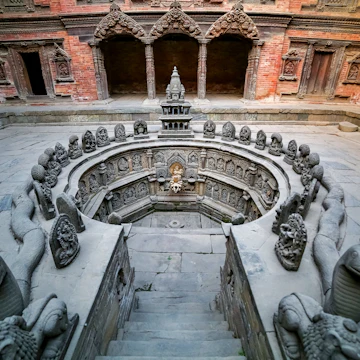
On the northern side of the square a small hillock is topped by a Ganesh shrine and a shady pipal tree. There are fine views over the river to the hills south of Bhaktapur. The square itself has two small temples: a solid-brick central Vishnu Temple and the double-roofed Jeth Ganesh Temple. The latter is an indicator of how long the activity all around the square has been going on - a wealthy potter donated the temple in 1646 and to this day its priest is chosen from the potter caste.
Pottery is very clearly what this square is all about; the southern side of the square is lined with clay stores and potters' wheels, and the square (and other parts of town) is often filled…
reviewed
-
K
Uku Bahal
This Buddhist monastery near the Mahabouddha Temple is one of the best known in Patan. The main courtyard is absolutely packed with interesting bits and pieces - dorjes, bells, peacocks, elephants, Garudas, rampant goats, kneeling devotees and a regal-looking statue of a Rana general. The lions are curious, seated on pillars with one paw raised in salute, looking as if they should be guarding a statue of Queen Victoria in her 'not-amused' incarnation rather than a colourful Nepali monastery.
As you enter the main courtyard from the north look for the finely carved wooden struts above, on the northern side of the courtyard. They are said to be among the oldest of this type…
reviewed
-
L
Taleju Temple
The square's most magnificent temple stands at to the northeast but is not open to the public. Even Hindus can only visit the temple briefly during the annual Dasain festival. The Taleju Temple was built in 1564 by Mahendra Malla. Taleju Bhawani was originally a goddess from the south of India, but she became the titular deity, or royal goddess, of the Malla kings in the 14th century. Taleju temples were erected in her honour in Patan and Bhaktapur, as well as in Kathmandu.
The temple stands on a 12-stage plinth and reaches more than 35m high, dominating the Durbar Sq area. The eighth stage of the plinth forms a wall around the temple, in front of which are 12 miniature…
reviewed
-
M
King Yoganarendra Malla's Statue
Immediately north of the Hari Shankar Temple is a tall column topped by a figure of King Yoganarendra Malla (1684-1705) and his queens. The golden figure of the kneeling king, atop a lotus bud and protected by the hood of a cobra, has been facing towards his palace since the year 1700. On top of the cobra's head is the figure of a bird; legend has it that as long as the bird remains there the king may still return to his palace.
Accordingly, a door and window of the palace are always kept open and a hookah (a water pipe used for smoking) is kept ready for the king should he return. A rider to the legend adds that when the bird flies off, the elephants in front of the…
reviewed
-
N
Maju Deval
A pleasant half hour can easily be spent sitting on the steps of this Shiva temple. In fact the nine-stage ochre platform of the Maju Deval is probably the most popular meeting place in the city. From here you can watch the constant activity of fruit and vegetable hawkers, the comings and goings of taxis and rickshaws, and the flute and other souvenir sellers importuning tourists.
The large, triple-roofed temple has erotic carvings on its roof struts and offers great views over the square and across the roofs of the city. Marigold sellers set up shop on the ground level. The temple dates from 1690 and was built by the mother of Bhaktapur's King Bhupatindra Malla. The…
reviewed
-
Walking Tours
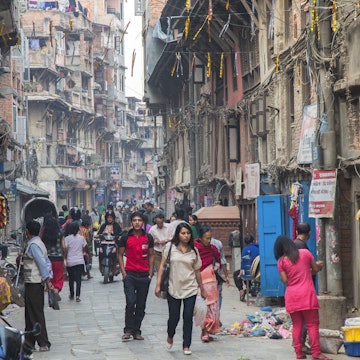
For the visitor, Bhaktapur is really a town of one curving road - the old trade route to Tibet - that links several squares. Traffic free, the traditionally intact town is also in many ways the most timeless and is perfect for walking around. The cobblestone streets link a string of temples, monastery courtyards and monumental squares, and the sidestreets are peppered with shrines, wells and water tanks at every turn.
The lack of traffic makes walking through Bhaktapur a particular pleasure and certainly more enjoyable than walking in Kathmandu.
The town's cultural life is also vibrant, with centuries-old traditions of craftsmanship and strong communities of potters,…
reviewed
-
O
Dattatreya Temple
The tall, square Dattatreya Temple was originally built in 1427, but alterations were made in 1458. Like some other important structures in the valley it is said to have been built using the timber from a single tree.
The temple is dedicated to Dattatreya, a blending of Brahma, Vishnu and Shiva, although the Garuda-topped pillar and the traditional weapons of Vishnu (conch and a disc) on their pillars indicate the strong influence of Vishnu. The temple is important to Shaivites, Vaishnavites and Buddhists.
The three-storey temple is raised well above the ground on its base, the sides of which are carved with some erotic scenes. The front section, which was a later…
reviewed
-
P
Rani Pokhari
This large fenced tank is said to have been built by King Pratap Malla in 1667 to console his queen over the death of their son (who was trampled by an elephant). The pool (pokhari means pool or small lake) was apparently used during the Malla era for trials by ordeal and later became a favourite suicide spot.
Perhaps because of the high suicide rate, the gate to the tank and its central Shiva Temple is unlocked only one day each year, during the festival of Tihar. The footbridge over the nearby chowkaffords the best views of Rani Pokhari. The chowk has rather optimistically been declared a no-horn zone.
Across Kantipath is a long imposing building originally known as the…
reviewed
-
Q
Dhum Varahi Shrine
In an unprepossessing schoolyard just inside Kathmandu's Ring Rd to the northeast of Kathmandu, a huge pipal tree encloses a small shrine and a dramatic 5th-century sculpture of Vishnu as a wild boar with a stocky human body, holding Prithvi, the earth goddess, on his left elbow.
The statue is interesting because it is one of the earliest depictions of an animal-human, created before iconographic rules were established, which perhaps contributes to the unusual sense of movement and vitality that the statue possesses. The statue shows Vishnu rescuing Prithvi from the clutches of a demon.
To get here head north along the Ring Rd from Pashupatinath and take a left about 200m…
reviewed
Advertisement
-
R
Jaisi Deval Temple
The south of Kathmandu's old city was the heart of the ancient city in the Licchavi period (4th to 9th centuries) and its major temple is the tall, triple-roofed Jaisi Deval Temple, built just two years before Durbar Sq's famous Maju Deval (which is one platform higher). It's a Shiva temple, as indicated by the bull on the first few steps and the mildly erotic carvings on some of the temple struts.
Right across the road from the temple is a stone lingam rising a good 2m from a yoni (female equivalent of a phallic symbol). This is definitely a god-sized phallic symbol and a prayer here is said to aid fertility.
In its procession around the town during the Indra Jatra…
reviewed
-
Sarangkot
The view of the Annapurna Himalaya from Sarangkot is almost a religious experience. From here, you can see a panoramic sweep of Himalayan peaks, from Dhaulagiri (8167m) in the west to the perfect pyramid of Machhapuchhare (6997m) and the rounded peak of Annapurna II (7937m) in the east. At dawn and dusk, the sun picks out the peaks in brilliant colours.
The main village is just below the ridge, but a set of concrete steps leads uphill to a dramatic viewpoint in the ruins of an ancient kot (hill-fort).
The fort is currently occupied by the Nepali army, but photography is fine, as long as you don't take pictures of the soldiers.
There's another ruined fort at Kaskikot…
reviewed
-
S
Pujari Math
There are 10 buildings around the square that were originally used as maths (Hindu monasteries).The best known was the Pujari Math. It was originally constructed in the 15th century during the reign of King Yaksha Malla, but was rebuilt in 1763. German experts renovated the building in 1979 as a wedding gift for the then King Birendra. Until the 20th century, an annual caravan brought tributes to the monastery from Tibet.
The Pujari Math is principally famed for the superb 15th-century peacock window, 30m down a small alley on the right-hand side. It is reputed to be the finest carved window in the valley and is the subject of countless postcards and photographs. The shop…
reviewed
-
Best of Annapurna Dhaulagiri
16 days (Kathmandu)
A remote trek into the heart of the Annapurnas.
Not LP reviewed
from USD$2,090 -
Janakpur Women’s Development Centre
One of the best-known social projects is the Janakpur Women’s Development Centre, just outside Janakpur in the village of Kuwa. Around 40 Mithila women are employed at the centre, producing paper paintings, papier-mâché boxes and mirrors, screen-printed fabrics and hand-thrown ceramics. The bright colours and animated imagery are both unique and delightful, and the money raised goes directly towards improving the lives of rural women. You can meet the artisans and buy directly from the centre. It’s also worth picking up a copy of the Master Artists of Janakpur, which provides an excellent insight into the lives of several of the artists and how they’ve benefited…
reviewed