Things to do in Bodhnath (Boudha)
- Sort by:
- Popular
-
Bodhnath Stupa
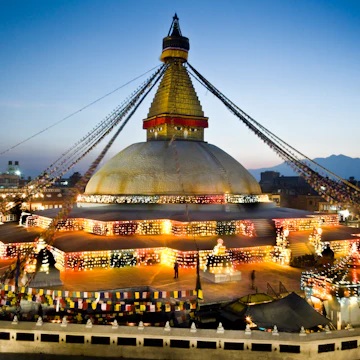
There doesn't seem to be much agreement on how old the Bodhnath Stupa is, but it is likely that the first stupa (chörten in Tibetan) was built some time after AD 600, after the Tibetan king, Songtsen Gampo, was converted to Buddhism by his two wives: the Nepali princess Bhrikuti and Wencheng Konjo from China. The stupa was said to have been built by a prince as penance for unwittingly killing his father.
The current stupa structure was probably built after the depredation of the Mughal invaders in the 14th century. Stupas were originally built to house holy relics. It is not certain if there is anything interred at Bodhnath, but some believe that there is a piece of bone…
reviewed
-
Flavor’s Café
Formerly New Orleans, this upscale place has changed its name but not its menu, which covers everything from Nepali choyla (spiced meat curry) to Cajun chicken and steaks. There’s wireless internet, and tables are set in a calm, covered courtyard, or upstairs on the roof, for stupa views.
reviewed
-
Double Dorjee Restaurant
On the lane north of the stupa, this cosy Tibetan-run place targets backpackers and the dharma crowd with good prices, tasty Tibetan and Western food and soft sofas to relax in.
reviewed
-
Authentic Himalayan Textiles
Authentic Himalayan Textiles 'From exile to textiles' could be the slogan in this stylish showroom, which specialises in antique striped Tibetan aprons, known as pangden, that have been collected from across the Himalaya (each region has its own characteristic design). Older pieces are used to create stylish patchwork wall hangings, cushion covers and bags, and any spare threads are rewoven into carpets.
Even the carpet dust is reused in paper production! Products aren't cheap but you can be sure that only traditional vegetable dyes have been used.
reviewed
-
Shechen Tennyi Dargyeling Gompa
To the west and down the alley leading to the Dragon Guest House, the huge Shechen Tennyi Dargyeling Gompa was established by the famous Nyingmapa lama Dilgo Khyentse Rinpoche to replace the destroyed Shechen Gompa in eastern Tibet. Today, the monastery has a thriving community of over 300 monks and novices and the main prayer hall features fabulous murals by artists from Bhutan. The attached Tsering Art School produces Buddhist crafts that are sold in the monastery shop.
reviewed
-
Shechen Tengyi Dargyeling Gompa
Northwest of the stupa, the impressive Shechen Tengyi Dargyeling Gompa was established by the famous Nyingmapa lama Dilgo Khyentse Rinpoche to act as an exiled version of Shechen Gompa in eastern Tibet. It has a large and thriving community of over 180 monks and is a popular destination for Tibetan pilgrims. The fine interior decorations are the work of artists from Bhutan. To the right of the main building is the Tsering Art School.
reviewed
-
Ka-Nying Sheldrup Ling Gompa
North of here, down a side alley, is the large 'white gompa' of Ka-Nying Sheldrup Ling Gompa , one of the largest monasteries in Bodhnath, with nice gardens and a richly decorated interior with some fine paintings and thangkas. The gompa hosts a popular annual seminar on Vajrayana training in November. You'll hear the tap-tap-tapping of handicraft workshops in the street leading up to the monastery.
reviewed
-
Sakya Tharig Gompa
Take the alley running northeast from the Bodhnath (Boudha) stupa, past the small Gelugpa Samtenling Gompa, and turn right to reach the Sakya Tharig Gompa. This sprawling complex includes a large Buddhist school and the prayer hall at the back contains a huge statue of Sakyamuni inlaid with turquoise, red coral, dzi beads and other precious materials.
reviewed
-
The Bodhnath Stupa
The first stupa at Bodhnath was built sometime after AD 600, when the Tibetan king, Songtsen Gampo, converted to Buddhism. According to legend, the king constructed the stupa as an act of penance after unwittingly killing his father. Unfortunately, the first stupa was wrecked by Mughal invaders in the 14th century, so the current stupa is a more recent construction.
reviewed
-
Tarik Gompa
The Sakyapa school Tarik Gompa to the northeast of the stupa does not have the imposing architectural unity of the others - it has obviously been built in stages over a number of years - but there are some high-quality frescoes inside the ground-floor chapel and you can climb upstairs to a splendidly adorned Sakyamuni Buddha. Just east of here is Tabsang Gompa, a Kargyud monastery.
reviewed
Advertisement
-
Tamang Gompa
The new Tamang Gompa and Guru Lhakhang are currently being built on the north side of the stupa enclosure. A small plaque here honours Ekai Kawaguchi (1866-1945), the first Japanese to make it to Tibet (he passed through Bodhnath in 1899). For an excellent account of his remarkable travels see Scott Berry's book A Stranger in Tibet, available in Thamel bookshops.
reviewed
-
Tsamchen Gompa
Tsamchen Gompa is the only gompa that opens directly onto the stupa on the western side. There are some fine paintings and a magnificent Maitreya (Jampa in Tibetan), the Future Buddha, covered in beautiful embroideries. Don't miss the massive enclosed prayer wheel on the left of the entrance.
reviewed
-
Zhungchuanluohuang Hotel
This place may be a bit of a mouthful, but it's a damn good-tasting mouthful. It's a bit unnerving to see Chinese characters in the heart of Tibetan Bodhnath but the food is tasty and authentically Sichuanese. Try the gongbaojiding - chicken with chilli and peanuts.
reviewed
-
Rabsel Garden Café
For some peace and quiet, head past the row of chörtens west of the Shechen Tengyi Dargyeling Gompa to this garden oasis. The vegetarian-only dishes stretch to lasagne, quiche, soup with homemade bread and veggie wraps, and there are good daily specials.
reviewed
-
Saturday Café
Looking more like something you’d find in Portland, Oregon, this multistorey cafe serves excellent vegetarian meals, snacks and cakes. There’s a bookshop full of holistic titles and it even serves organic coffee. Come early for a seat with a view on the rooftop.
reviewed
-
Tibetan Eating Houses
For those on a shoestring budget, there are plenty of small Tibetan eating houses in the streets behind the stupa that serve up authentic Tibetan thugpa (noodle soup) - any place with a curtain across an open door is probably one.
reviewed
-
Garden Kitchen
A partly open-air place near the Shechen Tennyi Dargyeling Gompa, serving the usual globe-trotting menu in pleasing surroundings. Reasonable prices attract many long-term dharma students.
reviewed
-
Tsering Art School
The shop at this art school has an on-site tailor and workshop that produces thangkas, incense and clay sculptures. The shop also sells incense, CDs and a few Buddhist books.
reviewed
-
Café du Temple
Run by the same people as the Café du Temple in Patan, this smart and efficient place targets tour groups with a solid menu of international food, plus grand views.
reviewed
-
Tsering Art School Shop
The shop at Shechen Gompa has an on-site tailor and a workshop that produces thangkas, incense and sculptures. The shop also sells Buddhist reference books and CDs.
reviewed
Advertisement
-
Stupa View Terrace & Restaurant
The views are as good as they claim at this superior traveller-oriented place to the north of the stupa, with good vegetarian food and proper clay-oven pizzas.
reviewed
-
Rangjung Yeshe Institute
Attached to the Ka-Nying Sheldrup Ling Gompa, Rangjung Yeshe Institute runs classes in Tibetan, Sanskrit, Nepali and Buddhist studies.
reviewed
-
Festive Fare Restaurant
On the southwest side of the stupa, this place serves up set meals to tour groups. The rooftop tables have fabulous views.
reviewed
-
Samtenling Gompa
East of the stupa, the Gelugpa Samtenling Gompa is the oldest monastery in Bodhnath.
reviewed