Sights in Ulaanbaatar
-
A
Gandan Khiid
The Gandan Khiid is one of Mongolia's most important monasteries, and also one of its biggest tourist attractions. The full name, Gandantegchinlen, translates roughly as 'the great place of complete joy'.
Building was started in 1838 by the fourth Bogd Gegeen, but like most monasteries in Mongolia the purges of 1937 fell heavily on Gandan. When US Vice President Henry Wallace asked to see a monastery during his visit to Mongolia in 1944, then prime minister Choibalsan guiltily scrambled to open this one to cover up the fact that he had recently laid waste to Mongolia's religious heritage. The khiid remained a 'show monastery' for other foreign visitors until 1990 when ful…
reviewed
-
Sükhbaatar Square
In July 1921 in the centre of Ulaanbaatar, the 'hero of the revolution', Damdin Sükhbaatar, declared Mongolia's final independence from the Chinese. The Square now bears his name and features a statue of him astride his horse. Sükhbaatar would have been very disappointed to learn that the Square was also where the first protests were held in 1990, which eventually led to the fall of communism in Mongolia.
Today, the Square is occasionally used for rallies, ceremonies and even rock concerts, but is generally a serene place where only the photographers are doing anything. Near the centre of the square, look for the large plaque that lists the former names of the city - Ör…
reviewed
-
B
Zanabazar Museum of Fine Arts
The Zanabazar Museum of Fine Arts has a superb collection of paintings, carvings and sculptures, including many by the revered sculptor and artist Zanabazar. It also contains other rare, and sometimes old, religious exhibits such as scroll thangka(paintings) and Buddhist statues, representing the best display of its kind in Mongolia. A bonus is that most of the exhibit captions in the museum are in English.
The second room contains some fine examples of the sculptor's work including five Dhyani, or Contemplation, Buddhas (cast in 1683) and Tara in her 21 manifestations.
Also worth checking out are the wonderful tsam masks (worn by monks during religious ceremonies) and the…
reviewed
-
C
Mongolian National Modern Art Gallery
Sometimes called the Fine Art Gallery, it contains a large and impressive display of modern and uniquely Mongolian paintings and sculptures. It has a mixture of depictions of nomadic life, people and landscapes, ranging from impressionistic to nationalistic. The Soviet romantic paintings depicted in thangka style are especially interesting, but the most famous work is Tsevegjav Ochir's 1958 The Fight of the Stallions.
The entrance is in the courtyard of the Palace of Culture. The main gallery is on the 3rd floor, there are temporary exhibits on the 2nd floor and a shop on the 1st floor.
reviewed
-
D
Choijin Lama Temple Museum
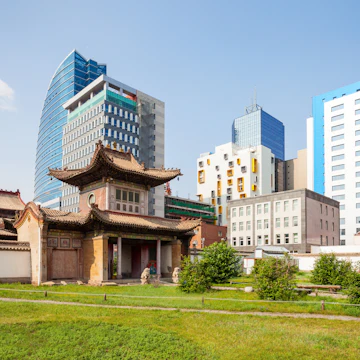
This temple-museum is a hidden gem of architecture and history, smack in the middle of downtown Ulaanbaatar. Sadly, it's under threat of losing its quaint character, as shoddily constructed buildings are thrown up all around it. Already the view of the complex is hindered by ugly buildings that now form its backdrop.
Still, Choijin Lama is well-worth a visit. It was the home of Luvsan Haidav Choijin Lama ('Choijin' is an honorary title given to some monks), the state oracle and brother of the Bogd Khan. The construction of the monastery commenced in 1904 and was completed four years later. It was closed in 1938 and probably would have been demolished but it was saved as …
reviewed
-
E
National Museum of Mongolian History
Still sometimes referred to by its previous name, the Revolutionary Museum, the National Museum of Mongolian History is an Ulaanbaatar highlight.
The recently renovated 1st floor has some interesting exhibits on Stone Age sites in Mongolia (dating back 700,000 years), as well as petroglyphs, deer stones (stone sculptures of reindeer and other animals) and burial sites from the Hun and Uighur eras.
The 2nd floor houses an outstanding collection of costumes, hats and jewellery, representing most of Mongolia's ethnic groups. Take a gander as some of the elaborate silverwork of the Dariganga minority or the outrageous headgear worn by Khalkh Mongols. Some of the outfits conta…
reviewed
-
Winter Palace of Bogd Khan
Built between 1893 and 1903, this palace is the place where Mongolia's eighth Living Buddha, and last king, Jebtzun Damba Hutagt VIII (often called the Bogd Khan), lived for 20 years. For reasons that are unclear, the palace was spared destruction by the Russians and turned into a museum. The summer palace, on the banks of Tuul Gol, was completely destroyed.
There are six temples in the grounds. The white building to the right as you enter is the Winter Palace itself. It contains a collection of gifts received from foreign dignitaries, such as a pair of golden boots from a Russian tsar, a robe made from 80 unfortunate foxes and a ger lined with the skins of 150 snow leopa…
reviewed
-
F
Museum of Natural History
The Museum of Natural History is a serious throwback to the Soviet era. It has exhibits featuring Mongolia's geography, flora and fauna, including the requisite section with stuffed and embalmed animals, birds and even fish. The general impression, however, is that you've stumbled into the warehouse of a long-deceased taxidermist, rather than into a serious scientific exhibition. Some of the animals have been fixed with puzzling expressions, as if they remain perplexed as to how they ended up in such an unfortunate state. In any case, budding geologists may appreciate the generally stoic meteorites.
The most impressive section is the Palaeontology Hall and its array of co…
reviewed
-
G
Victims of Political Persecution Memorial Museum
The little-known Victims of Political Persecution Memorial Museum consists of a series of haunting displays chronicling the bloody communist purges of the 1930s - an aggressive campaign to eliminate 'counter-revolutionaries'. During the campaign, intellectuals were arrested and put on trial, sent to Siberian labour camps or shot. Mongolia lost top writers, scientists and thinkers. One hall reveals this tragedy most vividly with a display of human skulls pierced with bullet holes.
The museum was inspired by the deeds of former prime minister P Genden, who was executed in Moscow by the Komitet Gosudarstvennoy Bezopasnosti (KGB; Committee for State Security) in 1937 for refu…
reviewed
-
Migjid Janraisig Süm
At the end of the main path as you enter the Gandan Khiid is the magnificent white Migjid Janraisig Süm, the monastery's main attraction. Lining the walls of the temple are hundreds of images of Ayush, the Buddha of longevity, which stare through the gloom to the magnificent Migjid Janraisig statue.
The original statue was commissioned by the eighth Bogd Khan in 1911, in hopes that it might restore his eyesight - syphilis had blinded him; however it was carted away by Russia in 1937 (it was allegedly melted down to make bullets). The new statue was dedicated in 1996 and built with donations from Japan and Nepal. It is 26m high and made of copper with a gilt gold covering…
reviewed
Advertisement
-
H
Centre of Shaman Eternal Heavenly Sophistication
Ulaanbaatar's official Shaman Centre is a ramshackle collection of squalid gers teetering on the slope that leads to Gandan Monastery. While not particularly mystifying at first sight, this is the real deal, with a bona fide shaman at its helm, holding daily court. The resident shaman, Zorigtbaatar, is known for his fiery orations that rile up the faithful into a frenzy. There are two gers: one that honours the shamanic spirits and another that replicates nature, complete with a small lake, trees and stuffed animals. It is in the nature ger where the shaman performs his dance. If there is a ceremony going on, and you want your fortune told, you'll need to make a small don…
reviewed
-
I
Dashchoilon Khiid
Dashchoilon Khiid was originally built in 1890, but was destroyed in the late 1930s. The monastery was partially rebuilt and is now located in three huge concrete gers that once formed part of the State Circus. There are plans afoot to expand the monastery to include a six-storey building which will house a 17m-high statue of Maidar. So far, the only part of the statue to exist is the 108-bead rosary, donated by monks from Japan (each bead weighs 45.5kg, making it the largest in the world). You can get to Dashchoilon from a lane running off Baga Toiruu - look out for the orange-and-brown roof.
reviewed
-
J
Bakula Rinpoche Süm
The Bakula Rinpoche Süm, also known as the Pethub Stangey Choskhor Ling Khiid, was founded in 1999 by the late Indian ambassador, himself a reincarnate lama from Ladakh. The Rinpoche's ashes were interred inside a golden stupa inside the temple in July 2004. The monastery, used mainly as a centre for Buddhist teaching, also has a Centre for Buddhist Medicine. The monastery is not a must-see unless you are interested in learning about traditional medicine. The complex is located where Ikh Toiruu meets Sambugiin Örgön Chölöö, behind the Container Market.
reviewed
-
K
Gesar Süm
Belonging to Gandan Khiid, Gesar Süm is named after the mythical Tibetan king. The lovely temple is a fine example of Chinese-influenced architecture. It is a popular place for locals to request, and pay for, puja (a blessing ceremony). Allegedly, the temple was placed here to stop the movement of the hill behind it, which was slowly creeping towards the centre of the city. It's easy to visit the temple as it lies between Gandan and the city centre.
reviewed
-
Zaisan Memorial
The tall, thin landmark on top of the hill south of the city is the Zaisan Memorial. Built by the Russians to commemorate 'unknown soldiers and heroes' from various wars, it offers the best views of Ulaanbaatar and the surrounding hills. The enormous tank at the bottom of the hill - part of the Mongolia People's Tank Brigade - saw action against the Nazis during WWII.
reviewed
-
L
Mongolian National Artists Union
A unique cultural experience in Ulaanbaatar is a visit to the studios of the Mongolian National Artists Union. The artists are welcoming and you can offer to buy their work on the spot. It's in a blue building with a bronze statue of a seated monk above the door. The Arts Council of Mongolia (319 015) conducts tours here for around US$25 per group of five.
reviewed
-
M
Mongolian Artists' Exhibition Hall
If you want to see more Mongolian art, and maybe buy some, head into the Mongolian Artists' Exhibition Hall, on the 2nd floor of the white marble building diagonally opposite the CPO. This is a rotating collection of modern and often dramatic paintings, carvings, tapestries and sculptures. The displays often change and there's a good souvenir shop.
reviewed
-
N
Ulaanbaatar City Museum
The Ulaanbaatar City Museum offers a brief but insightful view of Ulaanbaatar's history through old maps and photos. The most interesting item is a huge painting of the capital as it looked in 1912, in which you can clearly make out major landmarks such as Gandan Khiid and the Winter Palace of Bogd Khan.
reviewed
-
O
Mongolian Stock Exchange
The clay-red building to the southwest of Sükhbaatar Square is the Mongolian Stock Exchange, which was opened in 1992 in the former Children's Cinema. The small park opposite the Stock Exchange contains a 0-kilometer marker, the point from which all distances in Mongolia are measured.
reviewed
-
P
Wedding Palace
Inside the large, white square building located just southwest of the Victims of Political Persecution Memorial Museum is the Wedding Palace. Built in 1976 by the Russians, it has since been used for tens of thousands of wedding ceremonies, including the marital vows of a few foreigners.
reviewed
Advertisement
-
Q
Chinggis Khaan Statue
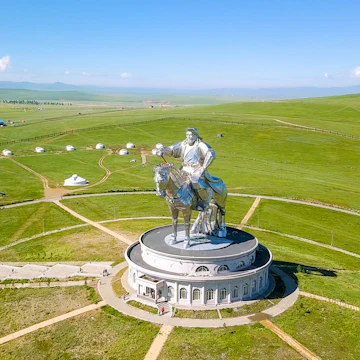
At the centre of the marble construction on the north end of the Square is a seated bronze Chinggis Khaan Statue lording over his nation. He is flanked by Ögedei (on the west) and Kublai (east). Two famed Mongol soldiers (Boruchu and Mukhlai) guard the entrance to the monument.
reviewed
-
R
International Intellectual Museum
The International Intellectual Museum, also known as the Mongolian Toy Museum, is in a pink building behind the round 'East Centre'. It has a collection of puzzles and games made by local artists. One puzzle requires 56,831 movements to complete, says curator Zandraa Tumen-Ulzii.
reviewed
-
S
Red Ger Art Gallery
The Red Ger Art Gallery showcases modern artwork by Mongolia's top contemporary painters. English-speaking guides are available. From the gallery, continue towards to the back of the building to find two more halls, one featuring prints and the second containing folk art.
reviewed
-
Buddha Park
Buddha Park features a 16m-tall standing Sakyamuni image. The funds to build the park were donated by a 99-year-old Mongolian monk named Guru Dev. Below the statue is a small room containing thangkas, sutras and images of the Buddha and his disciples.
reviewed
-
T
Theatre Museum
The Theatre Museum is worthwhile if you're interested in the dramatic arts - the collection of puppets is wonderful. The museum is on the 3rd floor of the Palace of Culture (its entrance is on the northern side of building).
reviewed