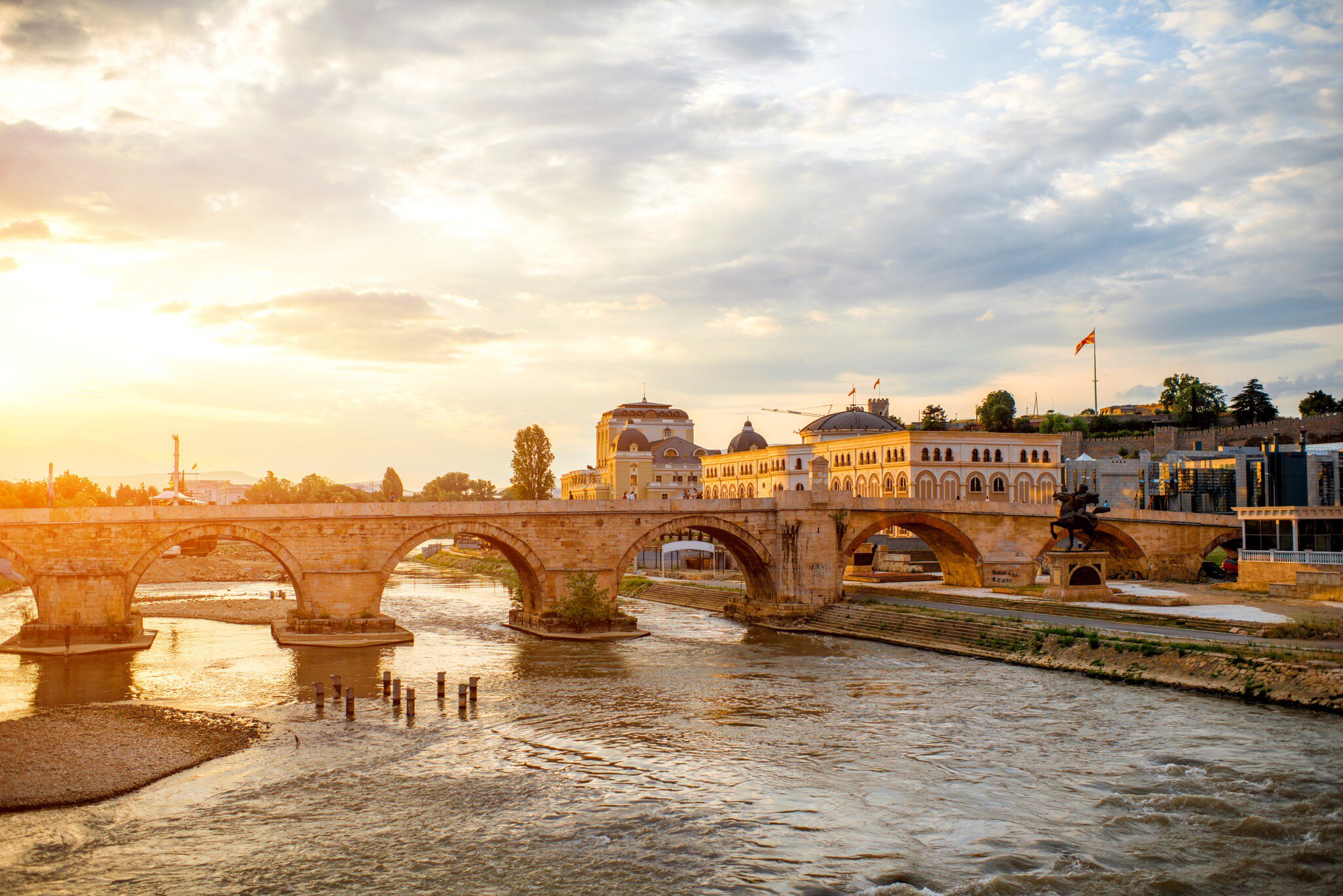
Sights in Macedonia
- Sort by:
- Popular
-
Sveti Jovan Bigorski Monastery
This fully working monastery is one of the most popular with visitors to Macedonia. It was first established in 1020 on the spot where the icon of Sveti Jovan Bigorski (St John the Forerunner, aka St John the Baptist) miraculously appeared, and has been destroyed and rebuilt many times over the centuries.
The main church has an incredible carved altar-screen (iconostasis) with over 200 human figures and 500 animals. The monastery has a magnificent forest location looking up to the heights of Mt Korab.
The monastery has self-catering dormitories where you can stay overnight.
reviewed
-
A
Car Samoil's Castle
The emphatically restored, 10th-century Car Samoil's Castle, on the town's heights, looks less interesting inside than its exterior suggests, but there are splendid views over the Old Town and Ohrid Lake from the crenellated walls and towers.
reviewed
-
Sveti Pantelejmon Monastery
For a great view of the city, take the 20-minute taxi ride up Mount Vodno to the Sveti Pantelejmon monastery with its sweet little 12th-century church and excellent traditional restaurant.
reviewed
-
B
Sveti Kliment i Pantelejmon
Go up through the park towards the newly built Sveti Kliment i Pantelejmon, standing next to the remains of Ohrid's oldest church of the same name. The foundations of the 5th-century basilica with their intricate mosaics are on display in front of the new church. The foundations of a 4th-century church close by have been covered with a roof on pylons to show the original roofline.
There are more mosaics here, usually covered with sand outside the summer months to help preserve them. One of the mosaics shows a swastika symbol - an old Indo-Aryan sun symbol long before the Nazis appropriated it.
reviewed
-
C
Sveti Spas
The tiny monastery Sveti Spas was built below ground level because during Ottoman times it was illegal for a church to be taller than a mosque. It boasts an iconostasis 10m wide and 6m high, beautifully carved in the early 19th century. Look for the carvers' miniature self-portrait in the left side of the carving. Across the cloister is a room with the Tomb and Museum of Goce Delčev, independence campaigner and national hero, killed by the Ottomans in 1903.
reviewed
-
D
City Museum
South of the centre, the only interesting thing about the City Museum is its partly-ruined exterior. The clock is frozen at 5.17 on the morning of the tragic Skopje earthquake of 27 July 1963, which killed 1066 people and almost demolished the city. On the left is Tito's message of support to the shattered citizens. Go around to the back for a strange mix of decaying shops and bars amid abandoned railway carriages and artillery.
reviewed
-
E
Classical Amphitheatre
Ohrid's Classical Amphitheatre was first built around the time of the birth of Christ, and wasn't fully uncovered until 1984. The amphitheatre was originally built for plays and oratory, but in the late Roman era the first 10 rows were pulled out and replaced with a wall, so the theatre could be used as an arena for bloodspots. Its original purpose has been restored and the amphitheatre is used for Summer Festival performances.
reviewed
-
F
City Art Gallery
In the Old Town, or Čaršija, the Daud Paša Baths (1466), once the largest Turkish bath in the Balkans, is now the City Art Gallery. The seven rooms housing mainly modern art are lit by the sun coming through the small star-shaped holes in the domed ceiling, and you can't help but imagine how sumptuous it must have been to bathe here in another age.
reviewed
-
National Gallery
Across from Sveti Dimitija is the Daut Pašin Amam (1466), once the largest Turkish bathhouse in the Balkans, and now home to the National Gallery. Housing some excellent modern art and a small collection of icons dating back to the 14th century, the building is lit by star-shaped holes in the brickwork of the beautiful copper-clad domes.
reviewed
-
Treskavec Monastery
This is the most magnificent, and perhaps the most remote, place in Macedonia, with a breathtaking and dramatic mountaintop setting, among huge piles of boulders. Prepare to be amazed by some of the colourful and intricate frescoes at the 14th-century church of the Holy Mother of God (Sveta Bogorodica), the monastery's spiritual heart.
reviewed
Advertisement
-
Lake Matka
Lake Matka is a place of calm cool nature, where the steep canyon reflects in the green mirror of the lake and boats glide on its smooth surface. There is plenty to do for those who want action, with opportunities for hiking and rock climbing, or you can go for a boat ride and take a peek at the local caves and their dark life.
reviewed
-
G
Sveti Jovan at Kaneo
Follow the signs for Sveti Jovan at Kaneo along the winding streets. This amazing little 13th-century church will appear before you on the cliffs above the lake. The unusual half-folded umbrella roof of the dome indicates that there was an Armenian influence in its design - this is a distinct feature of Armenian churches.
reviewed
-
H
National Museum
A great example of 19th-century Macedonian architecture is the 1827 National Museum. The museum collection is divided into the Robev Residence, which houses an archaeological display, and the Urania Residence with an ethnographic display. Both rooms make for an interesting hour of exploring Macedonia's history.
reviewed
-
I
Museum of Macedonia
The Museum of Macedonia is a fascinating place to while away a few hours. Reflecting the depth of culture in this ancient land, the earliest exhibits date back 7500 years to the Neolithic period. Keep your eyes open for a phallus-spouted drinking vessel that set the standard for joke shops for millennia.
reviewed
-
Memorial Room
A 2.5m bronze statue of Mother Teresa stands sentinel at the entrance to a small square, not far from the now-demolished house where she was raised. Her simple Memorial Room is in the base of an 18th-century feudal tower. A superb socialist relief fronts the Army House to the right of the tower.
reviewed
-
J
Sveta Sofija
Further up Car Samoil is the grandiose 11th-century church of Sveta Sofija, originally built as a cathedral. The frescoes are extremely well preserved thanks to having been whitewashed during the church's days as a mosque. An English-speaking guide is usually on hand.
reviewed
-
K
Mustafa Paša Mosque
Beyond the museum the exquisite 1492 Mustafa Paša Mosque has an earthquake-cracked dome and a shady garden with a fountain. The ruins of the Kale, across the street from the mosque, has panoramic views of Skopje from the 11th century Cyclopean wall.
reviewed
-
L
Sveti Bogorodica Bolnička
Sveti Bogorodica Bolnička, near the lower gate of the town wall, was originally a hospital church. In times of plague people wanting to enter Ohrid were quarantined here for up to 40 days before being allowed into the town.
reviewed
-
M
Sveti Nikola Bolnički
Sveti Nikola Bolnički was one of two hospital churches. In times of plague people wanting to enter Ohrid were quarantined here for up to 40 days before being allowed into the town. It boasts delicate frescoes.
reviewed
-
N
Sveti Kliment
Continue towards the Upper Gate (Gorna Porta) to the gorgeous, 13th-century Sveti Kliment, patterned inside with vividly restored frescoes of biblical scenes. Opposite this church is an icon gallery.
reviewed
Advertisement
-
O
Sveti Dimitrija
Although dominated by mosques and mainly populated by Albanian Muslims, you'll find the cute 19th-century church of Sveti Dimitrija just over the bridge from Čaršija.
reviewed
-
Sveti Kliment Ohridski
The massive modern church of Sveti Kliment Ohridski does a good impersonation of a mosque, with its large interlocking domes and freestanding bell tower.
reviewed
-
P
Čifte Amam
The Čifte Amam is a beautiful old bathhouse that is now used for temporary exhibitions.
reviewed