Things to do in Rome
-
A
Villa dei Quintili
Set on lush green fields, this vast 2nd-century villa was the luxurious abode of two brothers who were consuls under Emperor Marcus Aurelius. Alas, the villa’s splendour was to be the brothers’ downfall – in a fit of jealousy, Emperor Commodus had them both killed, taking over the villa for himself. The highlight is the well-preserved baths complex with a pool, caldarium (hot room) and frigidarium (cold room).
reviewed
-
B
Piazza della Repubblica
Flanked by grand 19th-century neoclassical colonnades, this landmark piazza was laid out as part of Rome’s post-unification makeover. It follows the lines of the semicircular exedra (benched portico) of Diocletian’s baths complex and was originally known as Piazza Esedra. In the centre, the Fontana delle Naiadi aroused puritanical ire when it was unveiled by architect Mario Rutelli in 1901. The nudity of the four naiads or water nymphs, who surround the central figure of Glaucus wrestling a fish, was considered too provocative – how Italy has changed. Each reclines on a creature symbolising water in a different form: a water snake (rivers), a swan (lakes), a lizard…
reviewed
-
C
Open Colonna
Spectacularly set at the back of Palazzo delle Esposizioni, superchef Antonello Colonna’s superb, chic restaurant is tucked onto a mezzanine floor under an extraordinary glass roof. The cuisine is new Roman: innovative takes on traditional dishes, cooked with wit and flair. The best thing? There’s a more basic but still delectable fixed two-course lunch or buffet for €15, and Saturday and Sunday brunch at €28, served in the dramatic, glass-ceilinged hall, with a terrace for sunny days.
reviewed
-
D
Trattoria Monti
The Camerucci family runs this elegant, intimate, brick-arched place, where the air of contentment is palpable as you enter – a reflection of the top-notch traditional cooking from the Marches region, with an unusual menu that includes lots of daily specials. There are wonderful fried things, delicate pastas and ingredients such as pecorino di fossa (sheep’s cheese aged in caves), goose, swordfish, sultanas, mushrooms and truffles. Try the speciality egg-yolk tortelli pasta. Desserts are delectable, including apple pie with zabaglione that’s worthy of a postcard home. Word has spread, so book ahead.
reviewed
-
E
Chiesa di San Martino ai Monti
This was already a place of worship in the 3rd century – Christians would meet here, in what was then the home of a Roman named Equitius. In the 4th century, after Christianity was legalised, a church was constructed, later rebuilt in the 6th and 9th centuries. It was then completely transformed by Filippo Gagliardi in the 1650s. It’s of particular interest for Gagliardi’s frescoes of the Basilica di San Giovanni in Laterano before it was rebuilt in the mid-17th century and St Peter’s Basilica before it assumed its present 16th-century look. Remnants of the more distant past include the ancient Corinthian columns dividing the nave and aisles.
reviewed
-
F
Galleria Nazionale d’Arte Moderna
The oft-overlooked Galleria Nazionale d’Arte Moderna e Contemporanea is definitely worth a visit. Set in a vast belle époque palace are works by some of the most important exponents of modern Italian art. There are canvases by the macchiaioli (the Italian Impressionists) and futurists Boccioni and Balla, as well as several impressive sculptures by Canova and major works by Modigliani and De Chirico. International artists are also represented, with works by Degas, Cezanne, Kandinsky, Klimt, Mondrian, Pollock and Henry Moore.
reviewed
-
G
Bassetti Tessuti
Hidden away in a run-of-the-mill palazzo (palace), Bassetti Tessuti is a sprawling, technicolour temple to textiles. From fine Italian wools and silks, to cheetah-print faux fur, a jaw-dropping 200,000 fabrics line its endless sea of soaring, cracked rooms. Brothers Emidio and Lorenzo Bassetti set up shop in 1954, serving everyone from couture royalty to needle-savvy homemakers.
It's a fabulously atmospheric place, caught in a retro time warp of linoleum floors and wizened old men pushing cart after cart of rare and luscious threads.
reviewed
-
H
Museo Ebraico di Roma
The historical, cultural and artistic heritage of Rome’s Jewish community is chronicled in this small but engrossing museum. Housed in the city’s early 20th-century synagogue, Europe’s second largest, it presents harrowing reminders of the hardships experienced by the city’s Jewry. Exhibits include copies of Pope Paul IV’s papal bull confining the Jews to the ghetto and relics from the Nazi concentration camps.
You can also book one-hour guided walking tours of the Ghetto (adult/reduced €8/5) at the museum.
reviewed
-
I
Chiesa di San Paolo entro le Mura
With its stripy neo-Gothic exterior and prominent position, Rome’s American Episcopal church is something of a landmark in this city. Inside, the unusual 19th-century mosaics, designed by the Birmingham-born artist and designer Edward Burne-Jones, feature the faces of his famous contemporaries. In his representation of The Church on Earth, St Ambrose (on the extreme right of the centre group) has JP Morgan’s face, and General Garibaldi and Abraham Lincoln (wearing a green tunic) are among the warriors. In the small garden outside the church there are a number of modern sculptures.
reviewed
-
J
Monte Testaccio
Right in the centre of the neighbourhood, this artificial hill is made almost entirely of smashed amphorae. Between the 2nd century BC and the 3rd century AD, Testaccio was Rome’s river port. Supplies of wine, oil and grain were transported here in huge terracotta amphorae, which, once emptied, were dumped in the river. When the Tiber became almost unnavigable as a consequence, the pots were smashed and the pieces stacked methodically in a pile, which over time grew into a large hill – Monte Testaccio.
reviewed
Advertisement
-
K
Pastificio Cerere
This hub of Rome’s contemporary art scene started life as a pasta factory in 1905. Abandoned in 1960, it came to prominence as home of the Nuova Scuola Romana (New Roman School), a group of six artists who set the nation’s art scene alight in the early 1980s, and who are still the organisation’s historic resident artists, but added to their number is a new generation, including Maurizio Savini, famous for his sculptures in pink chewing gum. There are regular shows in the building’s gallery and courtyard exhibition spaces, often featuring works created especially for the site.
reviewed
-
Frascati Wine Tasting Tour from Rome
3 hours 30 minutes (Departs Rome, Italy)
by Viator
Taste the nectar of the gods on a wine-tasting afternoon tour from Rome to beautiful Frascati. On the only wine-tasting tour from Rome available, you'll visit…Not LP reviewed
from USD$79.11 -
L
Ripa 12
Whether or not it's true that carpaccio di spigola (very fine slices of marinated raw sea bass) was first served at this graceful, wood-beamed Calabrian restaurant, the seafood here is top-notch. On the menu you'll find a mix of dishes playing on traditional themes - gnocchetti con fagioli e cozze (small gnocchi with beans and mussels), for example - as well as Calabrian specialities such as fiery-hot salami. There are some streetside tables but unless you want your fish smoked by traffic fumes you're better off inside.
reviewed
-
M
Chiesa di San Lorenzo in Lucina
Little remains of the original 5th-century church that was built here atop an ancient well sacred to Juno. But that shouldn’t detract from what is a very pretty church, complete with Romanesque bell tower and a long 12th-century columned portico. Inside, the otherwise standard baroque decor is elevated by Guido Reni’s Crocifisso (Crucifixion) above the main altar, and a fine bust by Bernini in the fourth chapel on the southern side. The French painter Nicholas Poussin, who died in 1655, is buried in the church.
reviewed
-
N
Basilica di Santa Cecilia in Trastevere
The last resting place of Saint Cecilia (the patron saint of music) features a stunning 13th-century fresco by Pietro Cavallini in the nuns' choir – the door is to the left of the church as you face it. Inside the church itself, below the altar, Stefano Moderno's mysterious, breathtaking sculpture is a delicate rendition of exactly how Saint Cecilia's miraculously preserved body was apparently found when it was unearthed in the Catacombs of San Callisto in 1599. Beneath the church you can visit the excavations of a maze of Roman houses, one of which is thought to have been that of the young Cecilia.
reviewed
-
O
Ai Tre Scalini
The Three Steps is always packed, with crowds spilling out into the street. Apart from a tasty choice of wines, it sells the damn fine Menabrea beer, brewed in northern Italy. You can also tuck into a heart-warming array of cheeses, salami, and dishes such as porchetta di Ariccia con patate al forno (roasted Ariccia pork with roast potatoes).
reviewed
-
Papal Audience Tickets and Presentation
4 hours (Departs Rome, Italy)
by Viator
Book your ticket for a Papal Audience with Pope Francis I in the Vatican City. The Papal Audience tickets are free of charge but you must reserve them. This…Not LP reviewed
-
P
Stadio di Domiziano
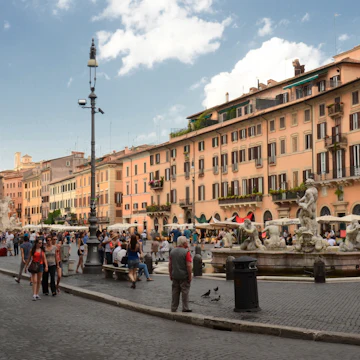
Like many of the city’s great landmarks, Piazza Navona sits on the site of an ancient monument, in this case the 1st-century-AD Stadio di Domiziano. This 30,000-seat stadium, remains of which can be seen from Piazza Tor Sanguigna, used to host games – the name Navona is a corruption of the Greek word agon, meaning public games. Inevitably, though, it fell into disrepair and it wasn’t until the 15th century that the crumbling arena was paved over and Rome’s central market transferred here from Campidoglio.
reviewed
-
Q
Chiesa di Santa Maria della Scala
The Chiesa di Santa Maria della Scala dates from the turn of the 17th century. The big white façade hides a gloriously baroque interior with a particularly flamboyant marble altar. Next door, the Farmacia di Santa Maria della Scala, which supplied medicine to the popes in the 18th century, is still run by monks from the adjacent Carmelite monastery.
The monks are renowned for having commissioned, and then rejected, Caravaggio's Il Transito della Vergine (Transition of the Virgin), now in the Louvre (Paris).
reviewed
-
R
Cimitero Acattolico per gli Stranieri
Despite the busy roads that surround it, Rome’s ‘Non-Catholic Cemetery for Foreigners’ (aka the Protestant Cemetery) is a surprisingly restful place. As the traffic thunders past, you can wander the lovingly tended paths contemplating Percy Bysshe Shelley’s words: ‘It might make one in love with death to think that one should be buried in so sweet a place.’ And so he was, along with fellow Romantic poet John Keats and a whole host of luminaries, including Antonio Gramsci, the revered founder of the Italian Communist Party.
reviewed
Advertisement
-
S
Museo Nazionale Romano: Terme di Diocleziano
The Terme di Diocleziano is a complex of baths, libraries, concert halls and gardens that was ancient Rome's largest, covering about 13 hectares and having a capacity for 3000 people. Completed in the early 4th century, it fell into disrepair after the aqueduct that fed the baths was destroyed by invaders in about AD 536. Today the bath complex ruins constitute part of the impressive Museo Nazionale Romano: Terme di Diocleziano. Through memorial inscriptions and other artefacts, the museum supplies a fascinating insight into the structure of Roman society, with exhibits relating to cults and the development of Christianity and Judaism. Upstairs delves into even more…
reviewed
-
Ghost and Mystery Walking Tour of Rome
90 minutes (Departs Rome, Italy)
by Viator
Tour the dark heart of Rome on a night-time Ghost and Mystery Walking Tour. When the sun sets over Rome, another side of the city comes to life - an older and…Not LP reviewed
from USD$29.50 -
Rome by Night Walking Tour
3 hours (Departs Rome, Italy)
by Viator
Take an atmospheric evening stroll around Rome's floodlit monuments with an expert guide who'll bring the Eternal City alive. Perfect for first-time visitors,…Not LP reviewed
from USD$40.22 -
T
Chiesa di San Giovanni Battista dei Fiorentini
The last resting place of Francesco Borromini and Carlo Maderno, this graceful 16th-century church was commissioned by the Medici Pope Leo X as a showcase for Florentine artistic talent. Jacopo Sansovino won a competition for its design, which was then executed by Antonio Sangallo the Younger and Giacomo della Porta. Carlo Maderno completed the elongated cupola in 1614, while, inside, the altar is by Borromini.
A favourite venue for concerts, the church’s 17th-century organ is played at noon Mass every Sunday.
reviewed
-
U
Quartiere Coppedè
Best entered from the corner of Via Tagliamento and Via Dora, this compact quarter is a mesmerising mishmash of Tuscan turrets, Liberty sculptures, Moorish arches, Gothic gargoyles, frescoed façades and palm-fringed gardens, all designed by little-known Florentine architect Gino Coppedè between 1913 and 1926. At its heart is whimsical Piazza Mincio and the Fontana delle Rane (Fountain of the Frogs), a modern take on the better known Fontana delle Tartarughe in the Jewish Ghetto.
reviewed