go to content go to search box go to global site navigation

Rome

Things to do in Rome

  1. Small-Group Food Tour in Rome: Espresso, Gelato and Tiramisu

    Small-Group Food Tour in Rome: Espresso, Gelato and Tiramisu

    2 hours 30 minutes (Departs Rome, Italy)

    by Viator

    Enjoy a must-do culinary experience on this espresso and gelato walking tour in Rome. Led by a local food-loving guide, this tour will teach you the secrets…

    Not LP reviewed

    from USD$60.33
  2. Rome City Bike Tour

    Rome City Bike Tour

    3 to 4 hours (Departs Rome, Italy)

    by Viator

    Enjoy the best of Rome on a four-hour bike tour with a local guide. Cycle through Rome, discovering its ancient monuments, fancy shopping streets, beautiful…

    Not LP reviewed

    from USD$42.90
  3. A

    Trambus Open

    Trambus operates two tour buses: the 110open and the Archeobus. The 110open is an open-top double-decker bus, equipped with an audioguide in eight languages, that departs from the bus terminus outside Termini and stops at the Quirinale, Colosseum, Bocca della Verità, Piazza Venezia, Piazza Navona, St Peter’s, Piazza Cavour, Ara Pacis, Trevi Fountain and Via Veneto. The entire tour lasts two hours, but the tickets, available on board, from the Info Boxes on Piazza dei Cinquecento and at the Colosseum, are valid for 24 hours and allow you to hop off and on as you please. Archeobus is another stop-and-go bus, which takes sightseers down Via Appia Antica, stopping at 16…

    reviewed

  4. B

    Area Archeologica del Teatro di Marcello

    Rising from the ruins to the east of Via del Teatro di Marcello, the Teatro di Marcello is the star of this recently opened archaeological area.

    The theatre was originally planned by Julius Caesar but remained unfinished at the time of his death in 44 BC. Augustus then inherited the project and named it after his favourite nephew Marcellus, who had died earlier in 23 BC. By 17 BC the theatre was in use, and was formally inaugurated in 11 BC.

    Capable of holding more than 20,000 people, it was frequently restored after fires and earthquakes until it eventually fell into disuse. In AD 365 it was partially demolished and the stone used to restore nearby Ponte Cestio.

    Beyond…

    reviewed

  5. C

    Galleria Nazionale d'Arte Antica: Palazzo Barberini

    The 17th-century Palazzo Barberini was commissioned by Urban VIII to celebrate the Barberini family's rise to papal power. Many high-profile baroque architects worked on it, including rivals Bernini and Borromini; the former contributed a large squared staircase, the latter a helicoidal one. Today the palace houses part of Galleria Nazionale, a Renaissance and baroque art feast. Besides works by Raphael, Caravaggio, Guido Reni, Bernini, Filippo Lippi, Holbein, Titian and Tintoretto, there is the captivating ceiling of the main salon, the Triumph of Divine Providence (1632–39) by Pietro da Cortona. Don't miss Hans Holbein's famous portrait of a portly Henry VIII (c 1540)…

    reviewed

  6. D

    Basilica di Santa Sabina

    A genuinely spiritual spot, this solemn basilica was founded by Peter of Illyria in around AD 422. It was enlarged in the 9th century and again in 1216, just before it was given to the newly founded Dominican order – look out for the mosaic tombstone of Muñoz de Zamora, one of the order’s founding fathers, in the nave floor. A 20th-century restoration returned it to its original look. One of the few surviving 4th-century elements are the basilica’s cypress-wood doors. They feature 18 carved panels depicting biblical events, including one of the oldest Crucifixion scenes in existence. It’s quite hard to make out in the top left, but it depicts Jesus and the two thieves…

    reviewed

  7. Skip the Line: Vatican in One Day

    Skip the Line: Vatican in One Day

    8 hours 30 minutes (Departs Rome, Italy)

    by Viator

    Vatican City’s most comprehensive introduction combining two walking tours to see Michelangelo’s Sistine Chapel, Gallery of Maps, Raphael's Rooms, St. Peter's…

    Not LP reviewed

    from USD$130.72
  8. 3-Day Italy Trip: Naples, Pompeii, Sorrento and Capri

    3-Day Italy Trip: Naples, Pompeii, Sorrento and Capri

    3 days (Departs Rome, Italy)

    by Viator

    Explore Italy’s scandalously beautiful Campania region on a 3-day southern Italy tour from Rome, with 4-star hotel accommodation in Sorrento included! After…

    Not LP reviewed

    from USD$552.40
  9. Skip the Line: Vatican Museums Tickets

    Skip the Line: Vatican Museums Tickets

    3 hours (Departs Rome, Italy)

    by Viator

    Use your skip-the-line Vatican Museums ticket to explore ones of the world’s greatest museum complexes at leisure! A veritable Aladdin’s Cave, the Vatican…

    Not LP reviewed

    from USD$46.93
  10. E

    Domus Aurea

    A monumental exercise in vanity, the Domus Aurea (Golden House) was Nero’s great gift to himself. Built after the fire of AD 64 and named after the gold that covered its facade, it was a huge complex covering up to a third of the city.

    It’s estimated only around 20% remains of the original complex. Nero’s successors attempted to raze all trace of his megalomania. Vespasian drained Nero’s ornamental lake and, in a highly symbolic gesture, built the Colosseum in its place, Domitian built a palace on the Palatino, and Hadrian, having sacked the palace, then entombed it in earth. This process formed Colle Oppio, a hill atop which Hadrian constructed a baths complex. The…

    reviewed

  11. Advertisement

  12. F

    Basilica & Catacombe di San Sebastiano

    Before you duck into the catacombs, take a moment to explore the 4th-century basilica on top. Much altered over the years, it is dedicated to St Sebastian, who was martyred and buried here in the late 3rd century. In the Capella delle Reliquie you’ll find one of the arrows used to kill him and the column to which he was tied. On the other side of the church is a marble slab with Jesus’ footprints. The Catacombe di San Sebastiano were the first catacombs to be so called, the name deriving from the Greek kata (near) and kymbas (cavity), because they were located near a cave. During the persecutory reign of Vespasian, they provided a safe haven for the remains of St…

    reviewed

  13. G

    Capuchin Cemetery

    Long after memories of all the rest of Rome's interiors run together in an opulent blur, visitors vividly recall the particulars of the bizarre and macabre chapels of this cemetery, where the decorative elements - from the picture frames to the light fittings - are all made of human bones.

    Between 1528 and 1870, the brown-clad Capuchin monks adorned this cemetery with the dried remains of their departed brothers. The message is appropriately pious: 'What you are now we used to be, what we are now you will be'. The effect is rather sensational.

    There is an arch crafted from hundreds of skulls, vertebrae used as fleurs-de-lys, and light fixtures made of limb bones. The…

    reviewed

  14. H

    Auditorium Parco della Musica

    Rome's premier concert venue, and one of Europe's most popular arts centres, this state-of-the-art modernist complex combines architectural innovation with perfect acoustics. Designed by Renzo Piano, its three concert halls and 3000-seater open-air arena stage everything from classical music concerts to tango exhibitions, book readings and film screenings. The auditorium is also home to Rome's top orchestra, the world-class Orchestra dell' Accademia Nazionale di Santa Cecilia (www.santacecilia.it). To get to the auditorium, take tram 2 from Piazzale Flaminio or bus M from Stazione Termini, which departs every 15 minutes between 5pm and the end of the last performance.

    reviewed

  15. I

    Villa Farnesina

    This gorgeous 16th-century villa features some awe-inspiring frescoes by Sebastiano del Piombo, Raphael and the villa's original architect, Baldassare Peruzzi. The most famous frescoes are in the Loggia of Cupid and Psyche on the ground floor, which are attributed to Raphael, who also painted the Trionfo di Galatea (Triumph of Galatea) in the room of the same name. On the 1st floor, Peruzzi's dazzling frescoes in the Salone delle Prospettive are a superb illusionary perspective of a colonnade and panorama of 16th-century Rome.

    reviewed

  16. 5-Day Best of Italy Trip

    5-Day Best of Italy Trip

    5 days / 4 nights (Departs Rome, Italy)

    by Viator

    See the best of Italy in five days on this must-do tour from Rome, and fall in love with Assisi, Siena, Florence, Bologna, Padua, Venice and Montepulciano –…

    Not LP reviewed

    from USD$695.19
  17. J

    Chiesa di Santa Prassede

    Famous for its brilliant mosaics, this 9th-century church is dedicated to St Praxedes, an early Christian heroine who hid Christians fleeing persecution and buried those she couldn’t save in a well. The position of the well is now marked by a marble disc on the floor of the nave.

    The mosaics, produced by artists whom Pope Paschal I had brought in specially from Byzantium, bear all the hallmarks of their eastern creators, with bold gold backgrounds and a marked Christian symbolism. The apse mosaics depict Christ flanked by Saints Peter, Pudentiana and Zeno on the right, and Paul, Praxedes and Pope Paschal on the left. All the figures have golden halos except for Paschal,…

    reviewed

  18. K

    Galleria Colonna

    The only part of Palazzo Colonna open to the public, this opulent 17th-century gallery houses the Colonna family’s private art collection. It’s not the capital’s largest collection but with works by Salvatore Rosa, Guido Reni, Guercino and Annibale Carracci, it’s well worth the ticket price. The gallery’s six rooms are crowned by glorious ceiling frescoes, all dedicated to Marcantonio Colonna, the family’s greatest ancestor, who defeated the Turks at the naval Battle of Lepanto in 1571. Works by Giovanni Coli and Filippo Gherardi in the Great Hall, Sebastiano Ricci in the Landscapes Room and Giuseppe Bartolomeo Chiari in the Throne Room commemorate his efforts. Of the…

    reviewed

  19. Skip the Line: Vatican Museums Small-Group Tour including Sistine Chapel and St Peter's Basilica

    Skip the Line: Vatican Museums Small-Group Tour including Sistine Chapel and St Peter

    3 hours (Departs Rome, Italy)

    by Viator

    See the highlights of the world-famous Vatican Museums in one morning on this intimate, small-group Vatican walking tour! Starting early in the morning to beat…

    Not LP reviewed

    from USD$125.36
  20. 2-Day Italy Trip: Naples, Pompeii, Sorrento and Capri

    2-Day Italy Trip: Naples, Pompeii, Sorrento and Capri

    2 days (Departs Rome, Italy)

    by Viator

    Take time out to tour four of Italy's most popular cities - Naples, Pompeii, Sorrento and Capri - on a two-day excursion from Rome. You'll visit UNESCO World…

    Not LP reviewed

    from USD$414.30
  21. L

    Basilica di San Lorenzo Fuori le Mura

    St Lawrence Outside the Walls is one of Rome’s four patriarchal basilicas, and is an atmospheric, tranquil edifice that’s starker than many of the city’s grand churches, a fact that only adds to its breathtaking beauty. It was the only one of Rome’s major churches to have suffered bomb damage in WWII, and is a hotchpotch of rebuilds and restorations, yet still has the serenity of a harmonious whole.

    St Lawrence was burned to death in AD 258, and Constantine had the original basilica constructed in the 4th century over his burial place, but it was rebuilt 200 years later. Subsequently a nearby 5th-century church dedicated to the Virgin Mary was incorporated into the…

    reviewed

  22. Advertisement

  23. Florence Day Trip from Rome

    Florence Day Trip from Rome

    15 hours (Departs Rome, Italy)

    by Viator

    Visit Florence on day trip from Rome and see its top attractions with an expert guide at your side! Start with a guided tour of the incredible Accademia…

    Not LP reviewed

    from USD$201.12
  24. Skip the Line: Crypts and Roman Catacombs Small Group Walking Tour

    Skip the Line: Crypts and Roman Catacombs Small Group Walking Tour

    3 hours (Departs Rome, Italy)

    by Viator

    Discover Rome’s hidden delights and quirky sites on a 3-hour walking tour of the underground catacombs, Capuchin Crypt and the Basilica of San Clemente. The…

    Not LP reviewed

    from USD$71.06
  25. M

    Il Vittoriano

    Known also as the Altare della Patria (Altar of the Fatherland), this massive mountain of white marble towers over Piazza Venezia. Begun in 1885 to commemorate Italian unification and honour Victor Emmanuel II, it incorporates the Tomb of the Unknown Soldier, as well as the Museo Centrale del Risorgimento documenting Italian unification.

    For Rome's best 360-degree views, take the Roma dal Cielo lift from the side of the building up to the very top of the monument.

    reviewed

  26. N

    Basilica di Sant’Agnese Fuori le Mura & Mausoleo di Santa Costanza

    Although a bit of a hike, it’s well worth searching out this intriguing medieval religious complex. In the 7th-century Basilica di Sant’Agnese fuori le Mura look out for the golden apse mosaic depicting St Agnes with the signs of her martyrhood – a flame and sword, standing on the flames that failed to kill her. According to tradition, the 13-year-old Agnes was sentenced to be burnt at the stake but when the flames failed to kill her she was beheaded on Piazza Navona and buried in the catacombs beneath this church.

    Across the convent courtyard is the 4th-century Mausoleo di Santa Costanza. The squat circular building has a dome supported by 12 pairs of granite…

    reviewed

  27. O

    Piazza San Pietro

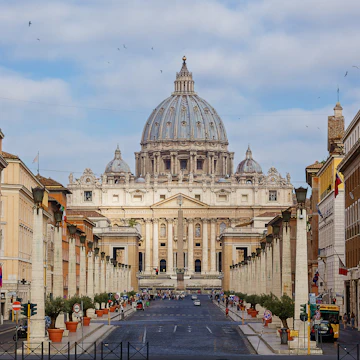
    One of the world’s great public spaces, the piazza was laid out by Gian Lorenzo Bernini between 1656 and 1667 for Pope Alexander VII. Seen from above, it resembles a giant keyhole with two semicircular colonnades, each consisting of four rows of Doric columns, encircling a giant ellipse that straightens out to funnel believers into the basilica. The effect was deliberate – Bernini described the colonnades as representing ‘the motherly arms of the church’. The 25m obelisk in the centre was brought to Rome by Caligula from Heliopolis in Egypt and later used by Nero as a turning post for the chariot races in his circus.

    The scale of the piazza is dazzling: at its…

    reviewed