go to content go to search box go to global site navigation

Rome

Things to do in Rome

‹ Prev

of 42

  1. A

    Colosseum

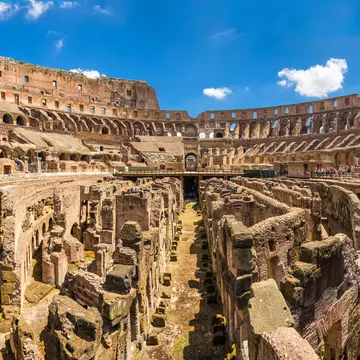
    A monument to raw, merciless power, the Colosseum (Colosseo) is the most thrilling of Rome's ancient sights. It's not just the amazing completeness of the place, or its size, but the sense of violent history that resonates: it was here that gladiators met in mortal combat and condemned prisoners fought off wild beasts in front of baying, bloodthirsty crowds. Two thousand years later it's Italy's top tourist attraction, pulling in between 16,000 and 19,000 people on an average day.

    Built by the emperor Vespasian (r AD 69–79) in the grounds of Nero's palatial Domus Aurea, the Colosseum was inaugurated in AD 80. To mark the occasion, Vespasian's son and successor Titus (r…

    reviewed

  2. B

    Pantheon

    Along with the Colosseum, the Pantheon is one of Rome's iconic sights. A striking 2000-year-old temple (now a church), it is the city's best-preserved ancient monument and one of the most influential buildings in the Western world. The greying, pock-marked exterior might look its age, but inside it's a different story and it's an exhilarating experience to pass through its towering bronze doors and have your vision directed upwards to the world's largest unreinforced concrete dome.

    Its current form dates from around AD 120, when Emperor Hadrian built over Marcus Agrippa's original temple (27 BC) – you can still see Agrippa's name inscribed on the pediment. Hadrian's temple…

    reviewed

  3. C

    Trevi Fountain

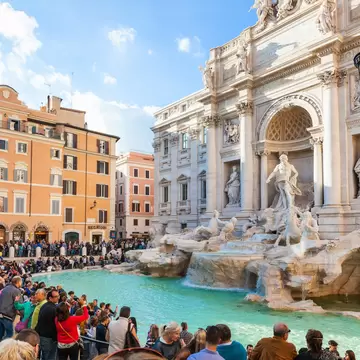
    This fountain almost fills an entire piazza, and is Rome's most famous fountain, its iconic status sealed when Anita Ekberg splashed here in La Dolce Vita. The flamboyant baroque ensemble was designed by Nicola Salvi in 1732 and depicts Neptune's chariot being led by Tritons with sea horses – one wild, one docile – representing the moods of the sea. The water comes from the aqua virgo, a 1st-century-BC underground aqueduct, and the name Trevi refers to the tre vie (three roads) that converge at the fountain. It's traditional to throw a coin into the fountain to ensure your return to the Eternal City. It's usually very busy around the fountain during the day, so it's…

    reviewed

  4. D

    St Peter’s Basilica

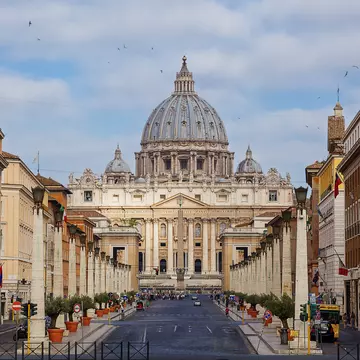
    In Vatican City, a city of astounding churches, St Peter’s Basilica outdazzles them all. Awe-inspiringly huge, rich and spectacular, it’s a monument to centuries of artistic genius. On a busy day, around 20,000 visitors pass through here. If you want to be one of them, remember to dress appropriately – no shorts, miniskirts or bare shoulders. If you want to hire an audioguide (€5), they’re available at a desk in the cloakroom to the right of the entrance. Free English-language guided tours of the basilica are run from the Vatican tourist office, the Centro Servizi Pellegrini e Turisti, at 9.45am on Tuesday and Thursday and at 2.15pm every afternoon between Monday and…

    reviewed

  5. E

    Vatican Museums

    Visiting the Vatican Museums is an unforgettable experience that requires strength, stamina and patience. You’ll need to be on top of your game to endure the inevitable queues – if not for a ticket then for the security checks – and enjoy what is undoubtedly one of the world’s great museum complexes.

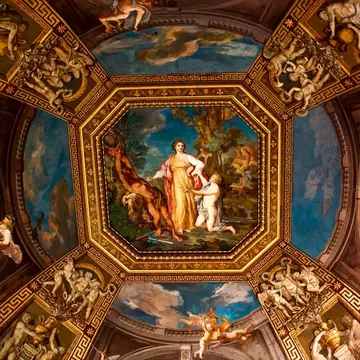
    Founded by Pope Julius II in the early 16th century and enlarged by successive pontiffs, the museums are housed in what is known collectively as the Palazzo Apostolico Vaticano. This massive 5.5-hectare complex consists of two palaces – the Vatican palace nearest St Peter’s and the Belvedere Palace – joined by two long galleries. On the inside are three courtyards:…

    reviewed

  6. F

    Piazza di Spagna & the Spanish Steps

    The Spanish Steps (Scalinata della Trinità dei Monti) provide a perfect auditorium for people-watching, and have been a magnet for visitors since the 18th century. The Piazza di Spagna was named after the Spanish Embassy to the Holy See, and consequently the steps were so-named, although they were designed by the Italian Francesco de Sanctis and built in 1725 with a legacy from the French. They lead to the French Chiesa della Trinità dei Monti, which was commissioned by King Louis XII of France and consecrated in 1585. In addition to the great views from outside, it boasts some wonderful frescoes by Daniele da Volterra. His Deposizione (Deposition), in the second chapel…

    reviewed

  7. G

    Piazza del Popolo

    For centuries the sight of public executions, this elegant neoclassical piazza is a superb people-watching spot. It was originally laid out in 1538 to provide a grandiose entrance to the city – at the time, and for centuries before, it was the main northern gateway into the city. Since then it has been extensively altered, most recently by Giuseppe Valadier in 1823. Guarding its southern entrance are Carlo Rainaldi’s twin 17th-century baroque churches, Chiesa di Santa Maria dei Miracoli and Chiesa di Santa Maria in Montesanto, while over on the northern flank is the Porta del Popolo, created by Bernini in 1655. In the centre, the 36m-high Egyptian obelisk was moved…

    reviewed

  8. H

    Campo de' Fiori

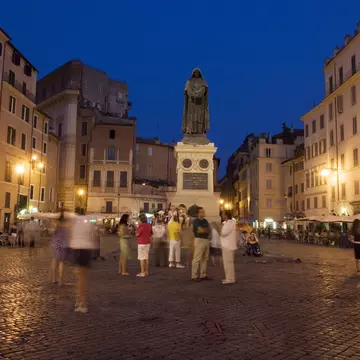
    Noisy, colourful 'Il Campo' is a major focus of Roman life: by day it hosts a much-loved market, while at night it morphs into a raucous open-air pub. Towering over the square is the Obi-Wan-like form of Giordano Bruno, a monk who was burned at the stake for heresy in 1600.

    reviewed

  9. I

    Il Posto Accanto

    On pretty Via del Boschetto, this homely, family-run restaurant is small - there are only 25 places - and instantly memorable, lined by harvest-festival displays of fruit and veg. The food is splendid, with homemade ravioli and fish among the house specialities.

    reviewed

  10. J

    Ibiz – Artigianato in Cuoio

    In this pint-sized workshop, Elisa Nepi and her father craft exquisite, well-priced leather goods, including wallets, bags, belts and sandals, in simple but classy designs and myriad colours. With €40 you should be able to pick up a wallet, purse or pair of sandals.

    reviewed

  11. Advertisement

  12. K

    Piazza Navona

    With its baroque palazzi and extravagant fountains, pavement cafes, hawkers and surging crowds, stadium-sized Piazza Navona is Rome's most iconic public square. Laid out on the ruins of an arena built by Domitian in AD 86, it was paved over in the 15th century and for almost 300 years hosted the city's main market.

    Of the piazza's three fountains, Bernini's high-camp Fontana dei Quattro Fiumi (Fountain of the Four Rivers) dominates. Depicting personifications of the Nile, Ganges, Danube and Plate rivers, it's festooned with a palm tree, lion and horse and topped by an obelisk. Legend has it that the figure of the Nile is shielding his eyes from the Chiesa di Sant'Agnese in…

    reviewed

  13. L

    Chiesa del Gesù

    An imposing, much-copied example of late-16th-century Counter-Reformation architecture, this is Rome's most important Jesuit church. The facade by Giacomo della Porta is impressive, but it's the awesome gold and marble interior that is the real attraction. Of the art on display, the most astounding work is the Trionfo del Nome di Gesù (Triumph of the Name of Jesus), the swirling, hypnotic vault fresco by Giovanni Battista Gaulli (aka Il Baciccia), who also painted the cupola frescoes and designed the stucco decoration.

    Baroque master Andrea Pozzo designed the Cappella di Sant'Ignazio in the northern transept. Here you'll find the tomb of Ignatius Loyola, the Spanish…

    reviewed

  14. M

    Imperial Forums

    The ruins over the road from the Roman Forum are known collectively as the Imperial Forums (Fori Imperiali). Constructed between 42 BC and AD 112 by successive emperors, they were largely buried in 1933 when Mussolini built Via dei Fori Imperiali. Excavations have since unearthed much of them, but work continues and visits are limited to the Mercati di Traiano (Trajan's Markets), accessible through the Museo dei Fori Imperiali.

    Little that's recognisable remains of the Foro di Traiano (Trajan's Forum), except for some pillars from the Basilica Ulpia and the Colonna di Traiano (Trajan's Column), whose minutely detailed reliefs celebrate Trajan's military victories over the…

    reviewed

  15. N

    Chiesa di Santa Maria Sopra Minerva

    Built on the site of an ancient temple to Minerva, the Dominican Chiesa di Santa Maria Sopra Minerva is Rome’s only Gothic church, although little remains of the original 13th-century design.

    Inside, in the Cappella Carafa (also called the Cappella della Annunciazione), you’ll find two superb 15th-century frescoes by Filippino Lippi and the majestic tomb of Pope Paul IV. Left of the high altar is one of Michelangelo’s lesser-known sculptures, Cristo Risorto (Christ Bearing the Cross; 1520). An altarpiece of the Madonna and Child in the second chapel in the northern transept is attributed to Fra Angelico, the Dominican friar and painter, who is also buried in the…

    reviewed

  16. O

    Chiesa di San Luigi dei Francesi

    Church to Rome’s French community since 1589, this baroque church boasts no less than three canvases by Caravaggio: La Vocazione di San Matteo (The Calling of Saint Matthew), Il Martiro di San Matteo (The Martyrdom of Saint Matthew) and San Matteo e l’Angelo (Saint Matthew and the Angel), together known as the St Matthew cycle. These were among Caravaggio’s earliest religious works, painted between 1600 and 1602, but they are inescapably his, featuring down-to-earth realism and stunning use of chiaroscuro (a three-dimensional effect created with contrasting highlights and dark shading). Before you leave the church, take a moment to enjoy Domenichino’s colourful…

    reviewed

  17. P

    Roman Forum (Foro Romano)

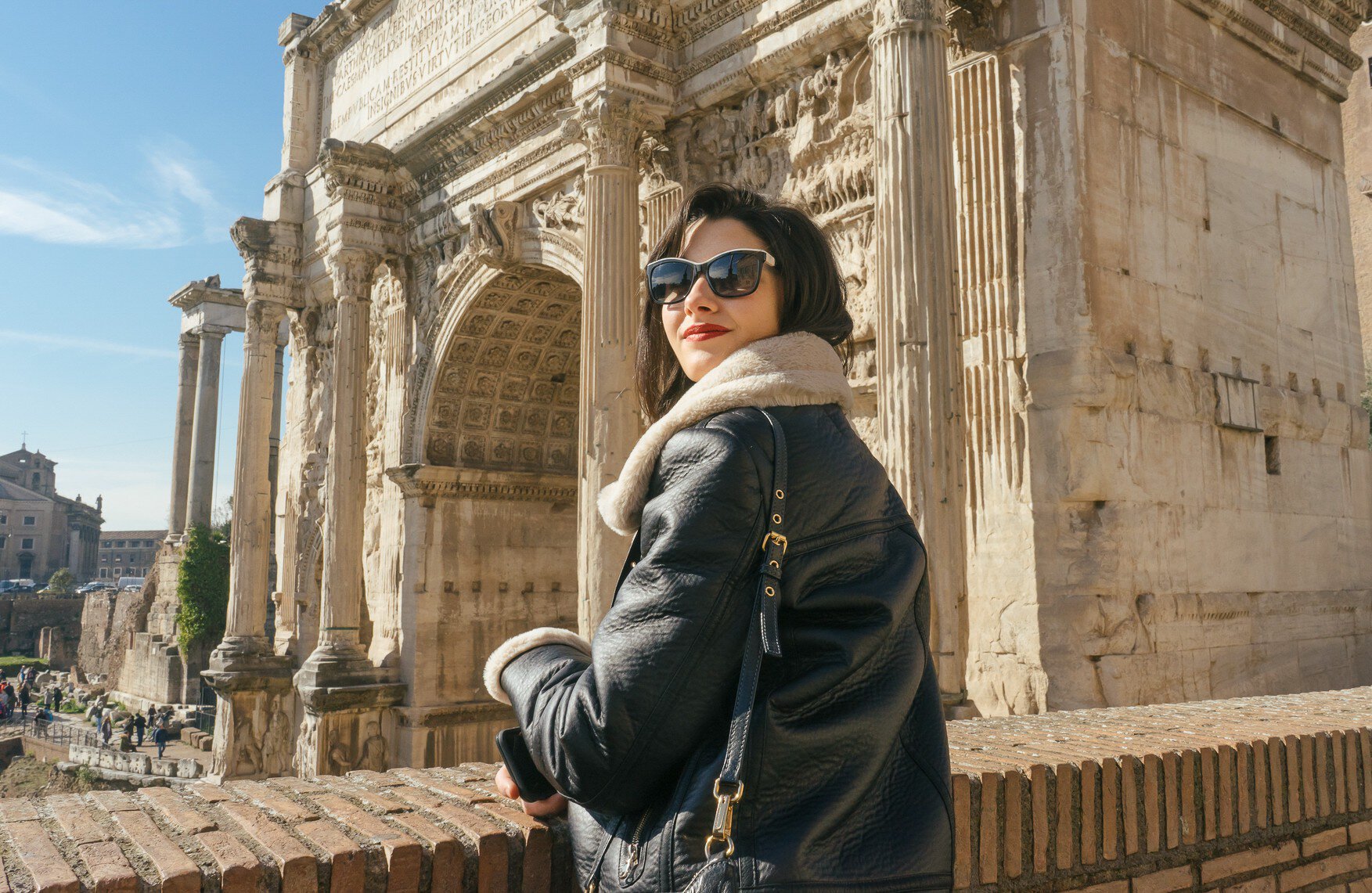
    Today an impressive, if rather confusing, sprawl of ruins, the Roman Forum was once a gleaming complex of marble-clad temples, proud basilicas and vibrant public spaces: the gleaming heart of an ancient city.

    Originally an Etruscan burial ground, it was first developed in the 7th century BC and expanded over subsequent centuries. Its importance declined after the 4th century until eventually it was used as pasture land. In the Middle Ages it was known as the Campo Vaccino (literally 'Cow Field') and extensively plundered for its stone and marble. The area was systematically excavated in the 18th and 19th centuries, and excavations continue to this day.

    Entering from Largo…

    reviewed

  18. Q

    Siciliainbocca

    Lemon-yellow and lined in dazzling southern ceramics, this trattoria is sunny in demeanour and colour. It's a great place to sample sumptuous seafood, Sicilian specialities like caponata (browned vegetables, anchovies and capers), and the island's legendary desserts, such as cannoli (fried pastry tubes filled with ricotta) accompanied by pantelleria, the great muscatel. There's another branch in Flaminio (06 324 01 87; Via Flaminia 390; ;Tue-Sun).

    reviewed

  19. R

    'Gusto

    Once a mould-breaking warehouse-style gastronomic complex – all exposed-brickwork and industrial chic – 'Gusto is still buzzing after all these years. It's a great place to sit on the terrace and eat Neapolitan-style pizzas (rather than the upmarket restaurant fare, which receives mixed reports). There's live music on Tuesday and Thursday evenings.

    reviewed

  20. S

    Alfredo e Ada

    For a taste of a authentic Roman cooking, head to this much-loved place with its wood panelling and spindly marble- topped tables. It’s distinctly no-frills – the wine list consists of two choices, red or white – but the food, whatever is put in front of you (there’s no menu), is filling and warming, just like your Italian nonna would have cooked it.

    reviewed

  21. T

    Lo Zozzone

    With a few inside tables and a mile-long menu of panini, the affectionally named ‘dirty one’ is a top spot for a cheap lunchtime bite. The filling, delicious panini are made with pizza bianca and combinations of cured meats, cold cuts, cheeses and vegetables.

    reviewed

  22. Advertisement

  23. U

    Giolitti

    This started as a dairy in 1900 and still keeps the hoards happy with succulent sorbets and creamy combinations. Gregory Peck and Audrey Hepburn swung by in Roman Holiday and it used to deliver marron glacé to Pope John Paul II.

    reviewed

  24. V

    La Fonte della Salute

    It might not be quite the ‘fountain of health’ of the name, but the fruit flavours are so delicious they must surely be good for the soul.

    reviewed

  25. W

    Da Giggetto

    The atmospheric ghetto, rustic interiors, white-jacketed waiters, Roman-Jewish cooking – who needs more? Celebrate all things fried by tucking into the marvellous carciofi alla giudia and follow on with delicious calamari (fried squid). In the warmer months, fight your way to an outside table under the shadow of the ruins of the Portico d’Ottavia.

    reviewed

  26. X

    Museo Nazionale Romano: Palazzo Altemps

    This gem of a museum houses the best of the Museo Nazionale Romano's formidable collection of classical sculpture. Many pieces come from the celebrated Ludovisi collection, amassed by Cardinal Ludovico Ludovisi in the 17th century. Prize exhibits include the 5th-century Trono Ludovisi (Ludovisi Throne), a carved marble throne depicting Aphrodite being plucked from the sea as a newborn babe. It shares a room with two colossal heads, one of which is the goddess Juno and dates from around 600 BC. The wall frieze (about half of which remains) depicts the 10 plagues of Egypt and the Exodus.

    The building's baroque frescoes provide an exquisite decorative backdrop. The walls of…

    reviewed

  27. Y

    Torre Argentina Cat Sanctuary

    Cats may be as iconic in Rome as the Colosseum, but for many of the capital's felines, life is anything but purrfect. Hundreds of kittens are abandoned at the city's volunteer-run Torre Argentina Cat Sanctuary, a common occurrence in a country where neutering pets is hardly in vogue. Expectantly, sterilisation is the shelter's primary concern, along with nursing ill and injured cats and finding them good homes right across the world.

    The centre itself inhabits part of a mostly unexcavated Roman temple in the Area Sacra di Largo di Torre Argentina, close to the spot where Julius Caesar was slain in 44 BC. For the historical lowdown (ask to see the ancient latrine), join…

    reviewed