go to content go to search box go to global site navigation

Northern Ireland

Things to do in Northern Ireland

  1. A

    Guildhall

    Standing just outside the city walls opposite the Tower Museum, the neo-Gothic Guildhall was originally built in 1890, then rebuilt after a fire in 1908. As the seat of the old Londonderry Corporation, which institutionalised the policy of discriminating against Catholics over housing and jobs, it incurred the wrath of nationalists and was bombed twice by the Irish Republican Army (IRA) in 1972.

    From 2000 to 2005 it was the seat of the Bloody Sunday Inquiry (www.bloody-sunday-inquiry.org.uk), headed by Lord Saville, which sat from March 2000 till December 2004. The inquiry heard from 900 witnesses, received 2500 witness statements, and allegedly cost the British taxpayer…

    reviewed

  2. B

    Linen Hall Library

    Opposite City Hall, on North Donegall Sq, is the Linen Hall Library. Established in 1788 to 'improve the mind and excite a spirit of general inquiry', the library was moved from its original home in the White Linen Hall to the present building a century later. Thomas Russell, the first librarian, was a founding member of the United Irishmen and a close friend of Wolfe Tone. Russell was hanged in 1803 after Robert Emmet's abortive rebellion.

    The library houses some 260,000 books, more than half of which are part of its important Irish and local-studies collection. The political collection consists of pretty much everything that has been written about Northern Irish…

    reviewed

  3. C

    City Hall

    The Industrial Revolution transformed Belfast in the 19th century, and its rapid rise to muck-and-brass prosperity is manifested in the extravagance of City Hall. Built in classical Renaissance style in fine, white Portland stone, it was completed in 1906 and paid for from the profits of the gas supply company.

    The hall is fronted by a statue of a rather dour 'we are not amused' Queen Victoria. The bronze figures on either side of her symbolise the textile and shipbuilding industries, while the child at the back represents education. At the northeastern corner of the grounds is a statue of Sir Edward Harland, the Yorkshire-born marine engineer who founded the Harland &…

    reviewed

  4. Mount Stewart

    The magnificent 18th-century Mount Stewart is one of Northern Ireland’s grandest stately homes. It was built for the Marquess of Londonderry and is decorated with lavish plasterwork, marble nudes and priceless artworks. Much of the landscaping of the beautiful gardens was supervised in the early 20th century by Lady Edith, wife of the seventh marquess, for the benefit of her children – the Dodo Terrace at the front of the house is populated with unusual creatures from history (dinosaurs and dodos) and myth (griffins and mermaids), accompanied by giant frogs and duck-billed platypuses. Mount Stewart is on the A20, 3km north-west of Greyabbey and 8km south-east of…

    reviewed

  5. D

    The Entries

    The narrow alleyways running off High St and Ann St, known as the Entries, were once bustling commercial and residential thoroughfares; Pottinger's Entry, for example, had 34 houses in 1822.

    Joy's Entry is named after Francis Joy, who founded the Belfast News Letter in 1737, the first daily newspaper in the British Isles (it's still in business). One of his grandsons, Henry Joy McCracken, was executed for supporting the 1798 United Irishmen revolt.

    The United Irishmen were founded in 1791 by Wolfe Tone in Peggy Barclay's tavern in Crown Entry, and used to meet in the historic Kelly's Cellars (1720; ) on Bank St, off Royal Ave.

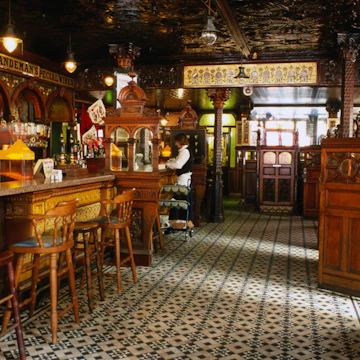
    White's Tavern (1630; ) , on Wine Cellar Entry

    reviewed

  6. E

    Albert Memorial Clock Tower

    At the east end of High St is Belfast's very own leaning tower. Erected in 1867 in honour of Queen Victoria's dear departed husband, it is not as dramatically out of kilter as the more famously tilted tower in Pisa, but does, nevertheless, lean noticeably to the south – as the locals say, 'Old Albert not only has the time, he also has the inclination.' Restoration work has stabilised its foundations and left its Scrabo sandstone masonry sparkling white.

    reviewed

  7. Castle Coole

    When King George IV visited Ireland in 1821, the second Earl of Belmore had a state bedroom specially prepared at Castle Coole in anticipation of the monarch's visit. The king, however, was more interested in dallying with his mistress at Slane Castle and never turned up. The bedroom, draped in red silk and decorated with paintings depicting The Rake's Progress (the earl's sniffy riposte to the king's extramarital shenanigans), is one of the highlights of the one-hour guided tour.

    Designed by James Wyatt, this Palladian mansion was built between 1789 and 1795 for Armar Lowry-Corry, the first Earl of Belmore, and is probably the purest expression of late-18th-century…

    reviewed

  8. F

    Custom House

    South along the river is the elegant Custom House, built by Lanyon in Italianate style between 1854 and 1857; the writer Anthony Trollope once worked in the post office here. On the waterfront side the pediment carries sculpted portrayals of Britannia, Neptune and Mercury. The Custom House steps were once Belfast's equivalent of London's Speakers' Corner, a tradition memorialised in a bronze statue preaching to an invisible crowd.

    Looking across the River Lagan from the Custom House, East Belfast is dominated by the huge yellow cranes of the Harland & Wolff shipyards. The modern Queen Elizabeth Bridge crosses the Lagan just to the south, but immediately south again is…

    reviewed

  9. G

    St Patrick's Church of Ireland Cathedral

    The city's Anglican cathedral occupies the site of St Patrick's original stone church. The present cathedral's ground plan is 13th century but the building itself is a Gothic restoration dating from 1834 to 1840. A stone slab on the exterior wall of the north transept marks the burial place of Brian Ború, the high king of Ireland, who died near Dublin during the last great battle against the Vikings in 1014.

    Within the church are the remains of an 11th-century Celtic Cross that once stood nearby, and the Tandragee Idol, a curious granite figure dating back to the Iron Age. In the south aisle is a memorial to Archbishop Richard Robinson (1709–94), who founded Armagh's…

    reviewed

  10. H

    St Anne's Cathedral

    Built in imposing Hiberno-Romanesque style, St Anne's Cathedral was started in 1899 but did not reach its final form until 1981. As you enter you'll see that the black-and-white marble floor is laid out in a maze pattern – the black route leads to a dead end, the white to the sanctuary and salvation. The 10 pillars of the nave are topped by carvings symbolising aspects of Belfast life; look out for the Freemasons' pillar (the central one on the right, or south, side). In the south aisle is the tomb of Unionist hero Sir Edward Carson (1854–1935). The stunning mosaic of The Creation in the baptistry contains 150,000 pieces of coloured glass; it and the mosaic above the…

    reviewed

  11. Advertisement

  12. I

    Lagan Weir

    Across the street from the Custom House is Bigfish (1999), the most prominent of the many modern artworks that grace the riverbank between Clarendon Dock and Ormeau Bridge. The giant ceramic salmon – a symbol of the regeneration of the River Lagan – is covered with tiles depicting the history of Belfast.

    It sits beside Lagan Weir, the first stage of the Laganside Project, completed in 1994. Years of neglect and industrial decline had turned the River Lagan, the original lifeblood of the city, into an open sewer flanked by smelly, unsightly mudflats. The weir, along with a program of dredging and aeration, has improved the water quality so much that salmon, eels and sea…

    reviewed

  13. Lough Navar Forest Park

    This forest park lies at the western end of Lower Lough Erne, where the Cliffs of Magho – a 250m-high and 9km-long limestone escarpment – rise above a fringe of native woodland on the south shore. An 11km scenic drive through the park leads to the Magho Viewpoint. The panorama from the cliff top here is one of the finest in Ireland, especially before sunset: it looks out over the shimmering expanse of Lough and river to the Blue Stack Mountains, the sparkling waters of Donegal Bay and the sea cliffs of Slieve League. The vehicle entrance to Lough Navar Forest Park is on the minor Glennasheevar road between Garrison and Derrygonnelly, 20km south-east of Belleek (take the…

    reviewed

  14. Workhouse Museum

    Across the river from the walled city lies the largely Protestant Waterside district. At the height of the Troubles, many Protestants living in and around the Bogside moved across the river to escape the worst of the violence. Here you'll find the Workhouse Museum housed in Derry's original 1840-1946 workhouse.

    Daily life at the workhouse for the 800 inmates was designed to encourage them to leave as soon as possible, alive or dead. One of the exhibits is the grisly horse-drawn hearse used to carry away the corpses.

    Other displays cover the Potato Famine, while the excellent Atlantic Memorial exhibition tells the story of the WWII Battle of the Atlantic and the major role…

    reviewed

  15. Old Bushmills Distillery

    Bushmills is the world's oldest legal distillery, having been granted a licence by King James I in 1608. Bushmills whiskey is made with Irish barley and water from St Columb's Rill, a tributary of the River Bush, and matured in oak barrels. During ageing, the alcohol content drops from around 60% to 40%; the spirit lost through evaporation is known, rather sweetly, as 'the angels' share'. After a tour of the distillery you're rewarded with a free sample (or a soft drink), and four lucky volunteers get a whiskey-tasting session to compare Bushmills with other brands.

    reviewed

  16. J

    Cultúrlann McAdam Ó Fiaich

    The focus for community activity is this Irish language and cultural centre, housed in a red-brick, former Presbyterian church. It's a cosy and welcoming place with a tourist information desk, a shop selling a wide selection of books on Ireland, Irish-language material, crafts, and Irish music CDs, and a good cafe- restaurant, Caifé Feirste. The centre also has an art gallery and a theatre that stages music, drama and poetry events.

    reviewed

  17. K

    Odyssey Complex

    The Odyssey Complex is a huge sporting and entertainment centre on the eastern side of the river across from Clarendon Dock. The complex features a hands-on science centre, W5; a 10,000-seater sports arena (home to the Belfast Giants ice-hockey team); a multiplex cinema with an IMAX screen; a video-games centre; and a dozen restaurants, cafes and bars.

    The Odyssey Complex is a five-minute walk across Lagan Weir from the city centre. Metro bus 26 from Donegall Sq W to Holywood stops outside the complex (5 minutes, hourly Monday to Friday only).

    reviewed

  18. L

    Enniskillen Castle

    Enniskillen Castle, a former stronghold of the 16th-century Maguire chieftains, guards the western end of the town's central island, its twin-turreted Watergate looming over passing fleets of cabin cruisers. Within the walls you'll find the Fermanagh County Museum, which has displays on the county's history, archaeology, landscape and wildlife. The 15th-century keep contains the Royal Inniskilling Fusiliers Regimental Museum, full of guns, uniforms and medals – including eight Victoria Crosses awarded in WWI; it's dedicated to the regiment that was raised at the castle in 1689 to support the army of William I.

    reviewed

  19. M

    Titanic Quarter

    Belfast's former shipbuilding yards - the birthplace of the RMS Titanic - stretch along the east side of the River Lagan, dominated by the towering yellow cranes known as Samson and Goliath. The area is currently undergoing a €1 billion regeneration project known as Titanic Quarter, which plans to develop the long-derelict docklands over the next 15 to 20 years.

    There are plans to build an 'iconic attraction' in the Titanic Quarter in time for the centenary of the Titanic's launch in 2012. In the meantime, the informative and entertaining commentary on the Lagan Boat Company's Titanic Tour is the best way to learn about the history of the shipyards.

    reviewed

  20. Nendrum Monastic Site

    The Celtic monastic community of Nendrum was built in the 5th century under the guidance of St Mochaoi (St Mahee). It is much older than the Norman monastery at Greyabbey on the opposite shore and couldn't be more different. The scant remains provide a clear outline of its early plan, with the foundations of a number of churches, a round tower, beehive cells and other buildings, as well as three concentric stone ramparts and a monks' cemetery, all in a wonderful island setting. A particularly interesting relic is the stone sundial that has been reconstructed using some of the original pieces. The minor road to Mahee Island from the lough's western shore crosses a causeway…

    reviewed

  21. N

    Royal Victoria Hospital

    The Royal Victoria Hospital claims to be the world's first air-conditioned building. The artwork railings date from 1906. Known locally as the RVH, it played an important role in creating the first ever portable defibrillator and, in the 1970s and '80s, developed a well-earned reputation for expertise in the treatment of gunshot wounds.

    The wavy form of the railings mimics the structure of DNA - look for the little yellow Xs and Ys for X- and Y-chromosomes - and the portraits (laser-cut in sheet steel) chart the progress of a human life from birth to the age of 100.

    For advice on medical and dental emergencies, call the 24hr NHS Direct on 0845 4647.

    reviewed

  22. Advertisement

  23. Castle Archdale Country Park

    This park has pleasant woodland and lakeshore walks and cycle tracks in the former estate of 18th-century Archdale Manor. The island-filled bay was used in WWII as a base for Catalina flying boats, a history explained in the visitor centre. You can hire bikes for £4/8/12 per hour/ half-day/full-day, or swap two wheels for four legs – the park offers pony trekking (£15 per hour), as well as short rides (£5 per 15 minutes) for beginners. There are also boats for hire (£55/80 per half-day/full-day), and you can also rent fishing rods (£5 per day including bait). The park is 16km northwest of Enniskillen on the B82, near Lisnarick.

    reviewed

  24. O

    SS Nomadic

    The Hamilton Graving Dock, just northeast of the Odyssey Complex, is now the permanent berth of SS Nomadic – the only surviving vessel of the White Star Line (the shipping company that owned the Titanic). In 2006 she was rescued from the breaker's yard and brought to Belfast. The little steamship once served as a tender ferrying 1st- and 2nd-class passengers between Cherbourg Harbour and the giant Olympic Class ocean liners (which were too big to dock at the French port); on 10 April 1912 she delivered 142 1st-class passengers to the ill-fated Titanic. She was still undergoing restoration work at the time of research, but should be open to the public by April 2012.

    reviewed

  25. Official Black Taxi Tours

    Black-taxi tours of West Belfast's murals - known locally as the 'bombs and bullets' or 'doom and gloom' tours - are being offered by an increasing number of taxi companies and local cabbies. These can vary in quality and content, but in general they're an intimate and entertaining way to see the sights and can be customised to suit your own interests. There are also historical taxi tours of the city centre.

    For a one-hour tour expect to pay around £25 total for one or two people, and around £8 per person for three to six. Call and they will pick you up anywhere in the city centre. A recommended company is Official Black Taxi Tours.

    reviewed

  26. Harpers Taxi Tours

    Black-taxi tours of West Belfast's murals - known locally as the 'bombs and bullets' or 'doom and gloom' tours - are being offered by an increasing number of taxi companies and local cabbies. These can vary in quality and content, but in general they're an intimate and entertaining way to see the sights and can be customised to suit your own interests. There are also historical taxi tours of the city centre.

    For a one-hour tour expect to pay around £25 total for one or two people, and around £8 per person for three to six. Call and they will pick you up anywhere in the city centre. A recommended company is Harpers Taxi Tours.

    reviewed

  27. Sinn Féin Headquarters

    The red-brick Sinn Féin Headquarters has the famous mural of a smiling Bobby Sands, the hunger striker who was elected as MP for West Belfast just a few weeks before he died in 1981. The text reads, in Sands' own words, 'Our revenge will be the laughter of our children'.

    A few blocks further on, on the right between Waterford St and Springfield Rd, look out for the Ruby Emerald Take-Away at 105 Falls Rd - it was on the pavement outside this shop (known as Clinton's Hot Food from 1996 to 2003) that the historic handshake between Sinn Féin leader Gerry Adams and US president Bill Clinton took place in November 1995.

    reviewed