go to content go to search box go to global site navigation

Iran

Things to do in Iran

  1. Khaneh Kolbadi

    The restored 125-year-old Khaneh Kolbadi is reminiscent of an 18th-century khan’s palace. Thick walls kept the lower floor warm in winter while the light, bright upper floor could be opened to through drafts for hot summers. Its orosi windows (wood-framed puzzles of multicoloured glass) supposedly disorientated mosquitoes. The building is slated to become a museum incorporating the historic Vasir-e Hamam (bathhouse) behind.

    reviewed

  2. Imam Square

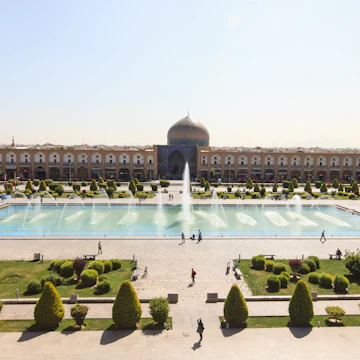
    Known for centuries as Naqsh-e Jahan, or 'pattern of the world', this vast square is home to what is arguably the most majestic collection of buildings in the Islamic world. It's also the second-largest square on earth (after Tiananmen Square).

    Begun in 1602 as the centrepiece of Shah Abbas the Great's new capital, the square was designed as home to the finest architectural jewels of the Safavid empire - the Imam Mosque, Sheikh Lotfollah Mosque and Ali Qapu Palace.

    reviewed

  3. Manar Jomban

    The 14th-century tomb of Abu Abdullah, a revered dervish, is in Kaladyn. The tomb is popularly known as Manar Jomban because pushing hard against one minaret will start it, and the other minaret, swaying back and forth. The minarets were added during the 17th century. Attendants climb up to shake them once an hour, on the hour. Iranians love this sight, but it’s only barely worth the trip – and on slow days they might not be shaken at all.

    reviewed

  4. Vank Cathedral

    Built between 1606 and 1655 with the encouragement of the Safavid rulers, Vank Cathedral is the historic focal point of the Armenian church in Iran. The church’s exterior is unexciting, but the interior is richly decorated and shows the curious mixture of styles – Islamic tiles and designs alongside Christian imagery – that characterises most churches in Iran. The frescoes are truly magnificent, and sometimes wonderfully gruesome.

    reviewed

  5. A

    Jameh Mosque

    The Jameh Mosque is a veritable museum of Islamic architecture and still a working mosque. Within a couple of hours you can see and compare 800 years of Islamic design, with each example near to the pinnacle of its age. The range is quite stunning: from the geometric elegance of the Seljuks, through to the Mongol period and on to the refinements of the more baroque Safavid style. At more than 20,000 sq metres, it is also the biggest mosque in Iran.

    reviewed

  6. Haram-e Razavi

    Imam Reza’s Holy Shrine is enveloped in a series of sacred precincts collectively known as the Haram-e Razavi, or Haram for short. This magical city-within-a-city sprouts dazzling clusters of domes and minarets in blue and pure gold behind vast fountain-cooled courtyards and magnificent arched arcades. It’s one of the marvels of the Islamic world whose moods and glories should be fully savoured more than once at varying times of day.

    reviewed

  7. B

    Hezardestan Traditional Teahouse

    Hezardestan is one of Iran’s most beautiful teahouse-restaurants. Carpets, samovars, antique qalyans, cushions and wooden benches are surrounded by walls adorned with scenes from Ferdosi’s Shahnamah. There’s live music most nights, the manager speaks fluent English and the food is pretty good including vegetarian possibilities. Just be prepared for hefty ‘service’ and ‘tea’ charges that can double the bill.

    reviewed

  8. Room of Sultan Uljeitu

    To fully appreciate the Jameh Mosque you must go into the fine interior rooms. The Room of Sultan Uljeitu, a 14th-century Shiite convert, is home to one of the mosque's greatest treasures - an exquisite stucco mihrabawash with dense Quranic inscriptions and floral designs. Next door is the Timurid-era Winter Hall (Beit al-Sheta), built in 1448 and lit by alabaster skylights - ask the caretaker to turn off the neon (or do it yourself) to see the full effect.

    reviewed

  9. C

    Khan-e Zinat ol-Molk

    Down a small lane beside the garden is the Khan-e Zinat ol-Molk, which was originally the private, andaruni area of the complex and is named after its last owner, the daughter of the builder Qavam. Today most of the finely decorated rooms are stuffed with exhibits in the Fars History Museum, while others serve as galleries for young Shirazi artists. The gardens are in a walled compound 400m south of the Nasir ol-Molk Mosque.

    reviewed

  10. D

    Hammam-e Sultan Mir Ahmad

    Hammam-e Sultan Mir Ahmad is a superb example of an Iranian bathhouse, built around 450 years ago. A recent restoration has stripped away 17 layers of plaster (look just inside the second room to see them) to reveal the original sarough, a type of plaster made of milk, egg white, soy flour and lime, which is said to be stronger than cement. There is usually an English-speaking guide at the door who can show you around.

    reviewed

  11. Advertisement

  12. E

    Mehdi Gholibek Hamam

    In its shadow, Mehdi Gholibek Hamam is one of Iran’s most interesting and spacious bathhouse museums. The main delight is the wonderful central dome re-painted for centuries in multiple levels – most recently in 1922 with naive murals that feature anthropomorphic figures gallivanting between giant bicycles, a Russian vintage car, an early biplane and a curiously unconcerned- looking victim facing a firing squad.

    reviewed

  13. F

    Khangostar Restaurant

    Located in Julfa Hotel, Khangostar Restaurant offers probably the best food in Esfahan – locals, our own experience and overwhelmingly positive reader feedback can attest to this. Servings are enormous here, (even by Iranian standards!) and the menu large and varied, but mainly Iranian. It’s busy rather than romantic, and the salad and dessert bars might seem a bit Sizzler, but hey, you won’t complain when you get there.

    reviewed

  14. G

    Park-e Mellat

    Many Tehranis say Park-e Mellat is their favourite in-town getaway, and if you’re here around dusk on any spring or summer afternoon you’ll find plenty of people enjoying the shaded areas around a small lake. On weekend nights you’ll find just as many young people cruising up and down Valiasr Ave, several to a car, showing off their new noses as they flirt and swap phone numbers through car windows.

    reviewed

  15. Palaeontological Museum

    Located underground in green Park-e Sangi, about 500m east of Shohada Sq, the Palaeontological Museum is the passion and life’s work of local mountaineer Mohsen Tajrobekar. Mohsen has collected a stunning array of fossils from the mountains around Kerman and his finds have caused scientists to re-assess the origins of some present-day species. They include a perfectly petrified fish believed to be 530 million years old.

    reviewed

  16. H

    Sharzeh Traditional Restaurant

    Talk about atmosphere! The night we ate at the Sharzeh it was going off like the proverbial frog in a sock, with diners singing and clapping along with musicians playing traditional music in the centre of the two-level space. Great fun! The Iranian food was well-prepared, tasty and plentiful. It’s diagonally opposite the entrance to the Vakil Bazaar. There’s no English sign; look for the man in costume outside an arcade.

    reviewed

  17. Imamzadeh-e Habib Ibn-e Musa Shrine

    The revered Shah Abbas I might well be turning in his grave at the senseless destruction wrought on what was once a fine Seljuk-era shrine. Shah Abbas chose to be buried here because he revered the saint Habib Ibn-e Musa. The king’s low, black porphyry tombstone is near the shrine’s entrance, but almost everything else from the original tomb has been cleared away and replaced by a bigger, uglier concrete monstrosity.

    reviewed

  18. Jalal Mehdizadeh

    Jalal, who also owns Jalal Guesthouse, has a car, speaks German and English and is better organised, but not as fun as, Hossein Vatani.

    These two operators can arrange tours within Kerman and to the surrounding areas, including the Kaluts, Mahan and Rayen. Both charge similar prices and have had mainly positive feedback, though they're not perfect. For desert trips, specify whether you want to sleep in camp or in the desert.

    reviewed

  19. Anglican Church of St Simon the Zealot

    The Anglican Church of St Simon the Zealot, built by R Norman Sharp in 1938, is very Iranian in character and even contains stone tablets with biblical stories incised on them in cuneiform, probably by Sharp. According to local tradition, St Simon was martyred in Persia together with St Thaddeus, another of the 12 Apostles. The great metal door bearing a Persian cross is usually closed – ring the doorbell.

    reviewed

  20. I

    Bagh-e Eram

    Famous for its tall cypress trees, the delightful Bagh-e Eram will impress budding botanists and social anthropologists – the many hidden corners of the gardens are popular with young Shirazis. The gardens are managed by Shiraz University, which chooses to charge foreigners 10 times the local price. The gardens are easy enough to reach by taking any shuttle taxi going along Zand towards the university.

    reviewed

  21. J

    Bazaar

    Kashan’s bazaar is one of the most enjoyable in Iran. Busy but not hectic, traditional but with a wide variety of goods, large enough to surprise but not to get lost in, it is a great place to wander for a couple of hours, especially before lunch and in the late afternoon. The multidomed roof of the bazaar dates from the 19th century, but the site has been the centre of trade in Kashan for much longer.

    reviewed

  22. Advertisement

  23. K

    Arg-e Karim Khan

    Dominating the city centre, the burly Arg-e Karim Khan was built in the early Zand period and formed part of the royal court that Karim Khan had hoped would develop to rival Esfahan. The exterior is fairly mundane, with high walls punctuated by four 14m-high circular towers. The southeastern tower has a noticeable lean, having subsided onto the underground sewerage system that served as the Arg’s bathhouse.

    reviewed

  24. L

    US Den of Espionage

    More than any other single building in Iran, the former US embassy in Tehran (and the events emanating from it) have had a dramatic and profound influence on the recent history of this country and, indeed, the whole Middle East. From a bunker beneath the embassy building at the junction of Taleqani Ave and Mofatteh St, CIA operatives orchestrated a coup d'etat in 1953 that brought down the government of Mohammad Mossadegh.

    reviewed

  25. Jameh Mosque

    A vaulted passage of the bazaar leads into the courtyard of the large Qajar-era Jameh Mosque. The off-line south iwan leads into a hall (currently under restoration) over which there’s an impressively large brick dome. The new north iwan is lavished with patterned blue tilework that continues on four of the mosque’s six minarets. Some areas are restricted to men only.

    reviewed

  26. Desert Walks

    Most hotels can arrange tours but using an independent guide can be more rewarding. Most can lead tours to almost anywhere in Yazd province, and further, and have been recommended. The most common tour is the Kharanaq-Chak Chak-Meybod loop, which is impossible on public transport. Other options include camel tours and desert walks. Old city tours are also popular. Silk Road Travel also run these tours.

    reviewed

  27. Camel Tours

    Most hotels can arrange tours but using an independent guide can be more rewarding. Most can lead tours to almost anywhere in Yazd province, and further, and have been recommended. The most common tour is the Kharanaq-Chak Chak-Meybod loop, which is impossible on public transport. Other options include camel tours and desert walks. Old city tours are also popular. Silk Road Travel also run these tours.

    reviewed