go to content go to search box go to global site navigation

Iran

Sights in Iran

  1. Masjed-e Nasir-ol-Molk

    Masjed-e Nasir-ol-Molk is one of the most elegant and photographed mosques in southern Iran. Built at the end of the 19th century, its coloured tiling (an unusually deep shade of blue) is exquisite. There is some particularly fine stalactite moulding in the smallish outer portal and in the northern iwan, but it is the stunning stained glass, exquisitely carved pillars and polychrome faience of the winter prayer hall that are most eye-catching. Photographers should come as early as possible in the morning for shots of the hall lit up through the glass (you might have to tip the caretaker to open the curtains).

    reviewed

  2. Zayandeh River Bridges

    There are few better ways to spend an afternoon in Esfahan than strolling along the Zayandeh River, crossing back and forth using the old fairytale bridges and listening to Esfahanis reciting poetry and just chilling out. Such a stroll is especially pleasant at sunset and early evening when most of the Zayandeh river bridges are illuminated. In total, 11 bridges (six are new) cross the Zayandeh.

    All but one of the historic Safavid-era crossings lie to the east of Chahar Bagh St - the exception is the shorter Marnan Bridge - but most people satisfy themselves with the walk from Si-o-Seh Bridge to Khaju Bridge, and back.

    reviewed

  3. Kharanaq

    Part of an enjoyable day trip from Yazd involves a loop along quiet roads to the ancient mud-brick village of Kharanaq. Parts of the village are believed to be more than 1000 years old, and it's been occupied in some form for more than 4000 years.

    The Qajar-era mosque, 17th-century shaking minaret and caravanserai on the edge of town have all been restored. Many of the buildings are falling down and at least one tourist has fallen through the roof here, so be careful where you step. From the village you can walk about 250m (820ft) down the valley below to an ancient aqueduct, built to irrigate the surrounding fields.

    reviewed

  4. A

    Bagh-e Naranjestan

    Bagh-e Naranjestan is Shiraz’s smallest garden and is famous as the setting for the opulently decorated Naranjestan-e Ghavam pavilion, built between 1879 and 1886, as part of a complex owned by one of Shiraz’s wealthiest Qajar-era families. The pavilion’s mirrored entrance hall opens onto rooms covered in a breathtaking combination of intricate tiles, inlaid wooden panels and stained-glass windows. Ceilings in the upstairs rooms are particularly interesting, with the beams painted with European-style motifs, including Alpine churches and busty German frauleins.

    reviewed

  5. B

    Moshtari-ye Moshtaq Ali Shah

    The attractive Moshtari-ye Moshtaq Ali Shah is the mausoleum for Sufi mystic Moshtaq Ali Shah, and other Kerman notables. Moshtaq Ali Shah was renowned for his singing and ability with the setar (a four-stringed instrument) , and is apparently responsible for adding the fourth string to the setar (which literally means ‘three strings’). He eventually fell so far out of favour with the local religious community that he was stoned in the Jameh Mosque. Most of what you see, including the prominent blue-and-white-tiled roofs, are from the late Qajar period.

    reviewed

  6. Persepolis

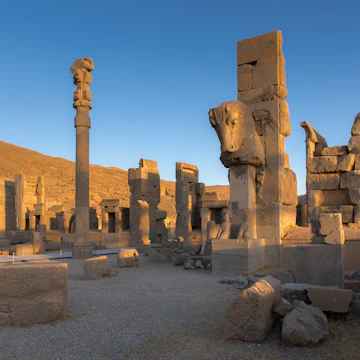
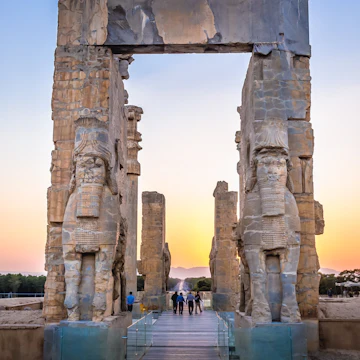
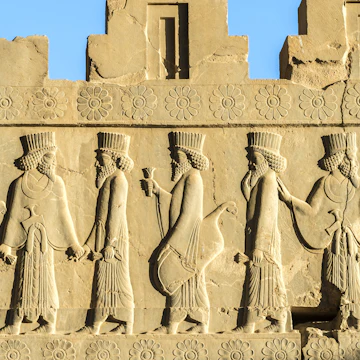
    Magnificent Persepolis embodies the greatest successes of the ancient Achaemenid Empire…and its final demise. The monumental staircases, exquisite reliefs and imposing gateways leave you in no doubt how grand this city was and how totally dominant the empire that built it. Equally, the broken and fallen columns attest that the end of empire was emphatic. Persepolis is a result of the vast body of skill and knowledge gathered from throughout the Achaemenids’ empire. It is Persian in ideology and design, but truly international in its superb architecture and artistic execution.

    reviewed

  7. White Palace

    What is now called the White Palace was built between 1931 and 1936 and served as the Pahlavi summer residence. The two bronze boots outside are all that remain of a giant statue of Reza Shah – he got the chop after the revolution. The 5000-sq-metre, 54-room palace is no Versailles. Instead it’s a modern building filled with a hodge-podge of extravagant furnishings, paintings and vast made-to-measure carpets. The tiger pelt in the office, among other things, reveals the shah as a man of dubious taste, though in fairness pelts were more in vogue in the 1950s.

    reviewed

  8. Arg-e Bam

    The ancient mud city of Bam is the largest adobe structure on earth and, until the 2003 earthquake, it was one of the jewels in Iran’s tourism crown. The site has been occupied for almost 2000 years and post-earthquake analysis has revealed the walls were first built using Sassanian-style mud-bricks. Bam was a staging post on the trade routes between India and Pakistan at one end and the Persian Gulf and Europe at the other. Visitors, including Marco Polo, were awestruck by the city’s 38 towers, huge mud walls and fairy-tale citadel – the Arg-e Bam.

    reviewed

  9. Choqa Zanbil

    One of Iran's Unesco World Heritage sites, Choqa Zanbil's magnificent brick ziggurat is the best surviving example of Elamite architecture anywhere in the world. Even if you're not a fan of ancient ruins, the great bulk and splendid semi-desert isolation of Choqa Zanbil will impress.

    The ziggurat originally had five concentric storeys but only three remain, reaching a total height of some 25m (82ft). It's hard to believe that such an imposing landmark was lost to the world for more than 2500 years; it was accidentally spotted in 1935 during an oil company's aerial survey.

    reviewed

  10. Pigeon Towers

    For centuries Esfahan relied on pigeons to supply guano as fertiliser for the city's famous fields of watermelons. The guano was collected in almost 3000 squat, circular pigeon towers, each able to house about 14,000 birds. Today they are unused, made redundant by chemical fertiliser, but more than 700 of the mud-brick towers remain in the city's environs.

    The best place to see them is dotted along the Zayandeh River south of the Ateshkadeh. The 10km walk back into Esfahan makes a great afternoon, and you're also likely to see locally made cloth being laid out to dry.

    reviewed

  11. Advertisement

  12. Green Palace

    At the uphill end of the complex, the more classical-looking Green Palace was built at the end of the Qajar era and extensively remodelled by the Pahlavis. Shah Reza lived here for only a year and apparently found the bed, if not the mirror stalactites on the ceiling, a little too soft. It was later used as a private reception hall (upstairs) and residence (downstairs) for special guests.

    The design is over-the-top opulent, with wall-to-wall mirrors in the appropriately named Mirror Hall, and the bedroom. Be sure to go around the back to take in the view.

    reviewed

  13. C

    Bagh-e Tarikhi-ye Fin

    Designed for Shah Abbas I, Bagh-e Tarikhi-ye Fin is a classical Persian vision of paradise and is renowned as one of the finest gardens in Iran. It’s famous for its spring water, which flows into the garden via the Lasegah, an octagonal pool behind the garden. From here the water, which has unusually high levels of mercury, is channelled through several pools and fountains, watering the garden’s orchards and tall trees, before continuing on down the road in jubs (canals, pronounced ‘joobs’).

    reviewed

  14. D

    Nader Shah Mausoleum

    Elsewhere in the Middle East, Nader Shah is considered something of a historical tyrant. But here he’s a local hero for briefly returning Khorasan to the centre of a vast Central Asian empire. Nader’s horseback statue crowns his otherwise rather dour 1950s grey-granite mausoleum, which was designed to emulate the lines of a tent (reputedly Nader was born and died under canvas). A small museum displays guns, a rhino-hide shield and four-pointed hats that must have made Afshar-dynasty courtiers look like jesters.

    reviewed

  15. E

    Museum of the Islamic Period

    This modern building contains two floors of exhibits from a selection of Islamic arts, including calligraphy, carpets, ceramics, woodcarving, stone carving, miniatures, brickwork and textiles. Don’t miss the silks and stuccowork from Rey, portraits from the Mongol period, a collection of Sassanian coins and gorgeous 14th-century wooden doors and windows. Look also for the beautiful Paradise Door, a 14th-century lustre-painted mihrab (niche in a mosque indicating the direction of Mecca) from Qom, and a 19th-century inlaid door from Esfahan.

    reviewed

  16. Madraseh va Masjed-e Sepahsalar

    The Madraseh va Masjed-e Sepahsalar, at the eastern end of Jomhuri-ye Eslami Ave, is one of the most noteworthy examples of Persian architecture of its period, as well as one of the largest. Built between 1878 and 1890, it’s famous for its multiple minarets and poetry inscribed in several ancient scripts in the tiling. It still operates as an Islamic college and is usually open to male members of the public on Fridays only. Photography is not encouraged, especially outside where the Majlis building is just to the north.

    reviewed

  17. Alamut Castle

    The region’s greatest attraction is the fabled ruin of Alamut Castle, Hasan-e Sabbah’s famous fortress site. The site is a dramatic crag rising abruptly above the pleasant, unpretentious little cherry-growing village of Gazor Khan. The access path starts about 700m beyond the village square and requires a steep, sweaty 25-minute climb via an obvious stairway. On top, archaeological workings are shielded by somewhat unsightly corrugated metal sheeting. But the phenomenal views from the ramparts are unmissable.

    reviewed

  18. F

    Chehel Sotun

    One of the only surviving palaces from the royal parklands between Imam Sq and Chahar Bagh Abbasi St, Safavid-era Chehel Sotun is today most famous for its frescoes. It was built as a pleasure pavilion and reception hall, using the Achaemenid-inspired talar (columnar porch) style. There are historical references to the palace dating from 1614; however, an inscription uncovered in 1949 says it was completed in 1647 under the watch of Shah Abbas II. Either way, what you see today was rebuilt after a fire in 1706.

    reviewed

  19. Saheb A Zaman Club Zurkhaneh

    Just off the north side of Amir Chakhmaq Sq is the Saheb A Zaman Club Zurkhaneh, which is worth seeing both for its Iranian brand of body building and because it’s a quite amazing structure. The modern club is inside a cavernous ab anbar (water reservoir) built about 1580. Looking like a 29m-high standing egg from the inside, and crowned with five burly badgirs, the reservoir stored water for much of the town. The hour-long workouts in the Zurkhaneh are an interesting window on Iranian culture.

    reviewed

  20. Traditional Houses

    Hiding behind the high mud-brick walls of Kashan are hundreds of once-grand traditional houses. Built during the 19th century, most have long-since been carved up or are literally turning to dust, but several have been restored and, mercifully for the city, the idea is catching.

    Those that can be visited are monuments to the importance of Kashan as a Qajar-era commercial hub, embellished with fine stucco panels, ostentatious stained glass and lofty badgirs (windtowers), all set around a series of interlinked courtyards.

    reviewed

  21. Qadamgah Razavi

    In Qadamgah village (98km from Mashhad), a two-block scattering of souvenir shops and kababis fronts this charming 17th-century octagonal shrine with fine blue dome and attractive tiling. It sits in a pretty garden of ancient plane trees and enshrines a black stone slab indented with what are believed to be the footprints of Imam Reza. Floods of pilgrims find the site very moving so questioning aloud the authenticity of the Imam’s (remarkably large) prints would be rather bad form.

    reviewed

  22. Advertisement

  23. Shams-Al Emarat

    Shams-Al Emarat, at the end of the garden, is an imposing structure and was the tallest palace of its day, designed to blend European and Persian architectural traditions. Born of Nasser al-Din Shah's desire to have a palace that afforded him a panoramic view of the city, it was designed by master architect Moayer al-Mamalek and built between 1865 and 1867. A sequence of mirrored and tiled rooms display a collection of photographs, together with furniture and vases given to the shahs by European monarchs, especially the French.

    reviewed

  24. ziggurat

    One of Iran’s Unesco World Heritage sites, Choqa Zanbil’s magnificent brick ziggurat is the best surviving example of Elamite architecture anywhere. Even if you’re not a fan of ancient ruins, the great bulk and splendid semi-desert isolation of Choqa Zanbil can’t fail to impress. Although close access is prevented after 6pm, the ziggurat arguably looks most appealing after dusk when the golden floodlighting emphasises the structure’s form better than the hazy desert daylight.

    reviewed

  25. G

    Jameh Mosque Domes

    In the Jameh Mosque, the room beneath the grand Nezam al-Molk Dome and the Seljuk-era hypostyle prayer halls either side just breathe history, while at the other end of the complex the Taj al-Molk Dome is widely considered to be the finest brick dome ever built. While relatively small, it is said to be mathematically perfect, and has survived dozens of earthquakes with nary a blemish for more than 900 years. To reach it you walk through a forest of imposing pillars.

    These domes are among the oldest parts of the mosque.

    reviewed

  26. H

    Museum of the Holy Defence

    The Museum of the Holy Defence commemorates the eight-year Iran–Iraq War. Symbolism abounds, although much of it won’t be obvious without an English-speaking guide. Inside is a gallery of gruesome photos, artefacts, letters and documents from the war, and an animated model re-enacting the Karbala V, a famous battle. Outside, along with a line-up of tanks and missile launchers, is a battlefield complete with bunkers, minefield and sound effects recorded from the actual war. Well worth a look.

    reviewed

  27. I

    Imam Khomeini Mosque

    The Imam Khomeini Mosque is right inside the Tehran bazaar and is very much a working mosque and one of the largest and busiest in Tehran. The building itself dates from the early 18th century but the real reason you come here is to see Islam in action. The courtyard is accessed from several parts of the bazaar and hundreds of people pass through here, so it’s usually possible for non-Muslims to stand and watch the faithful performing their ablutions and praying, though photography is less welcome.

    reviewed