MaharashtraSights

Sights in Maharashtra

‹ Prev

of 2

  1. A

    Osho Teerth gardens

    The five-hectare Osho Teerth gardens behind the Bhagwan Rajneesh ashram commune are accessible all day for those with a meditation pass.

    reviewed

  2. B

    Raja Dinkar Kelkar Museum

    This fascinating museum is one of Pune’s true delights. Housing only a fraction of the 21,000-odd objects of daily life collected by Dinkar Gangadhar, who died in 1990, it’s worth an entire day out. The quirky collection includes a suit of armour made of fish scales and crocodile skin, hundreds of hookah pipes, writing instruments, lamps, toys, betel-nut cutters and an amazing gallery of musical instruments.

    reviewed

  3. Shree Chhatrapati Shahu Museum

    ‘Bizarre’ takes on a whole new meaning at this ‘new’ palace, built by the Kolhapur kings in 1884. Designed by British architect ‘Mad’ Charles Mant, this Indo-Saracenic behemoth still serves as the royal family’s private residence. The ground floor houses a wacky museum, with one of the most peculiar collections of memorabilia in the country. An unconventional sort of an animal-lover, the eponymous king went on several trigger-happy trips into the jungles. The trophies he returned with were then put to some ingenious uses, such as making walking sticks from tiger vertebrae, or fashioning ashtrays out of rhino feet! Then, there’s an armoury, which houses enoug…

    reviewed

  4. Buddhist Caves of Ajanta

    Being Ellora’s venerable twin in the World Heritage listings, the Buddhist caves of Ajanta, 105km northeast of Aurangabad and about 60km south of Jalgaon, are the Louvre of ancient India. Much older than Ellora, these secluded caves date from around the 2nd century BC to the 6th century AD and were among the earliest monastic institutions to come up in the country. As Buddhism gradually waned in the region, the site was abandoned. Upon being deserted, the caves were soon reclaimed by the greens and were forgotten until 1819, when a British hunting party led by officer John Smith stumbled upon them purely by chance. Despite their age, the paintings in these caves remain …

    reviewed

  5. Janjira

    Murud is home to the commanding island fortress of Janjira, built on an island 500m offshore, which might just revoke your childhood memories of Long John Silver and Captain Flint. The citadel was built in 1140 by the Siddis, descendants of sailor-traders from the Horn of Africa, who settled here and allegedly made their living through piracy. Their exploits soon prompted many local kings to wage wars against them, including Shivaji and his son Sambhaji, who even attempted to tunnel to it. However, no outsider ever made it past the fort’s 12m-high walls which, when seen during high tide, seem to rise straight from the sea. Unconquered through history, the fort finally fel…

    reviewed

  6. Daulatabad Fort

    No trip to Aurangabad is complete without a pit-stop at the ruined but truly magnificent hilltop fortress of Daulatabad, about 15km away from town en route to Ellora. A 5km battlement surrounds this ancient fort, a most beguiling structure built by the Yadava kings through the 12th century. In 1328, it was renamed Daulatabad, the City of Fortune, by Delhi sultan Mohammed Tughlaq, who decided to shift his kingdom’s capital to this citadel from Delhi. Known for his eccentric ways, Tughlaq even marched the entire population of Delhi 1100km south to populate it. Ironically, Daulatabad soon proved untenable as a capital for strategic reasons, and Tughlaq forced its weary inhab…

    reviewed

  7. C

    Bibi-qa-Maqbara

    Built by Aurangzeb’s son Azam Khan in 1679 as a mausoleum for his mother Rabia-ud-Daurani, Bibi-qa-Maqbara is widely known as the ‘Poor man’s Taj’. With its four minarets flanking a central onion-domed mausoleum, the white structure bears striking resemblance to the original Taj Mahal in Agra. However, it is much less grand, and apart from a few marble adornments, most of the structure is finished in lime mortar. Apparently, the prince had conceived the entire mausoleum in white marble like the Taj, but was thwarted by his frugal father who opposed his extravagant idea of draining state coffers for the purpose. Despite the use of cheaper material and the obvious weather…

    reviewed

  8. Ellora Cave Temples

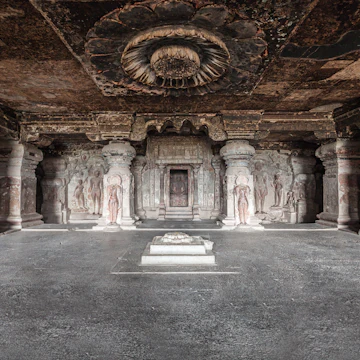
    The saga of the hammer and chisel comes full circle at the World Heritage–listed Ellora cave temples, located 30km from Aurangabad. The pinnacle of ancient Indian rock-cut architecture, these caves were chipped out laboriously through five centuries by generations of Buddhist, Hindu and Jain monks. Monasteries, chapels, temples; the caves served every purpose, and style quotient was duly met by embellishing them with a profusion of remarkably detailed sculptures. Unlike the caves at Ajanta, which are carved into a sheer rock face, the Ellora caves line a 2km-long escarpment, the gentle slope of which allowed architects to build elaborate courtyards in front of the shrin…

    reviewed

  9. Ramtek Temples

    About 40km northeast of Nagpur, Ramtek is believed to be the place where Lord Rama, of the epic Ramayana, spent some time during his exile with his wife Sita and brother Lakshman. The place is marked by a cluster of temples, about 600 years old, which sit atop the Hill of Rama and have their own population of resident monkeys. Autorickshaws will cart you the 5km from the bus stand to the temple complex for Rs. 40; you can return to town via the 700 steps at the back of the complex. On the road to the temples you’ll pass the delightful Ambala Tank, lined with small temples. If you’re interested, you can take a boat ride (Rs. 20 per head) around the lake.

    reviewed

  10. Alamgir Dargah

    The scruffy walled town of Khuldabad, the Heavenly Abode, is a quaint and cheerful little Muslim pilgrimage village just 3km from Ellora. A number of historical figures are buried here, including emperor Aurangzeb, the last of the Mughal greats. Despite matching the legendary King Solomon in terms of state riches, Aurangzeb was an ascetic in his personal life, and insisted that he be buried in a simple tomb constructed only with the money he had made from sewing Muslim skullcaps. An unfussy affair of modest marble in a courtyard of the Alamgir Dargah is exactly what he got, which, in stark contrast to the tombs of other Mughal greats, was prudent, to say the least.

    reviewed

  11. Advertisement

  12. Ganesha Temple

    Can’t make it to Goa? Well, at least you can visit Ganpatipule, on the coast 375km south of Mumbai – and you won’t be crying sour grapes. A sleepy but picturesque seaside village, it boasts several kilometres of almost perfect beaches and clean waters. Life generally plods along very slowly here, but heaven help anyone coming for a bit of peace and quiet during holidays such as Diwali or Ganesh Chaturthi. These are times when hordes of raucous ‘tourists’ turn up to visit the seaside Ganesha Temple housing a monolithic Ganesha (painted a lurid orange), supposedly discovered 1600 years ago.

    reviewed

  13. D

    Aga Khan Palace & Gandhi National Memorial

    Set amid a sylvan 6.5-hectare plot across the Mula River in Yerwada, the grand Aga Khan Palace & Gandhi National Memorial is easily Pune’s biggest crowd-puller. Built in 1892 by Sultan Aga Khan III, this lofty building was where the Mahatma and other prominent nationalist leaders were interned by the British for about two years following Gandhi’s Quit India resolution in 1942. Both Kasturba Gandhi, the Mahatma’s wife, and Mahadeobhai Desai, his secretary for 35 years, died here in confinement. You’ll find their shrines (containing their ashes) in a quiet garden to the rear.

    reviewed

  14. Bhaja Caves

    Across the Mumai-Pune expressway, it’s a 3km jaunt from the main road to the Bhaja Caves, where the setting is lush, green and quiet. Thought to date from around 200 BC, 10 of the 18 caves here are viharas, while Cave 12 is an open chaitya, containing a simple dagoba. Beyond this is a strange huddle of 14 stupas, five inside and nine outside a cave. From Bhaja Caves, you’ll see the ruins of the Lohagad and Visapur Forts, which local kids will happily lead you to for a tip (not recommended during the rains).

    reviewed

  15. Mahalaxmi Temple

    Kolhapur’s atmospheric old town is built around the lively and colourful Mahalaxmi Temple dedicated to Amba Bai, or the Mother Goddess. The temple’s origins date back to AD 10, but much of the modern structure is from the 18th century. It’s one of the most important Amba Bai temples in India and therefore attracts an unceasing tide of humanity. Non-Hindus are welcome and it’s a fantastic place for a spot of people- watching. Nearby, past a foyer in the Old Palace, is Bhavani Mandap, dedicated to the goddess Bhavani.

    reviewed

  16. Sinhagad

    Now reduced to near-rubble, the scenic Sinhagad or Lion Fort, about 24km southwest of Pune, is steeped in history. Earlier controlled by Bijapur, the fort was conquered by Shivaji after an epic battle in 1670, in which he lost his son Sambhaji. Legend has it that Shivaji used pet monitor lizards yoked with ropes to scale the craggy walls of the fort. Today, all is forgotten, and the fort’s interiors are studded with telecommunication towers and ugly government buildings. However, it’s worth a visit for the sweeping views it offers.

    reviewed

  17. Pratapgad Fort

    Closely associated with Deccan’s history, the windy Pratapgad Fort, built by Shivaji in 1656, straddles a high Sahyadri ridge 24km west of Mahabaleshwar. It was here that a cornered Shivaji agreed to meet Bijapuri General Afzal Khan in an attempt to end a stalemate in 1659. Despite a no-arms agreement, Shivaji, upon greeting Khan, disembowelled his enemy with a set of iron baghnakh (tiger’s claws). Khan’s tomb marks the site of this painful encounter at the base of the fort, though it’s out of bounds for tourists.

    reviewed

  18. Raigad Fort

    Some 80km northwest of Mahabaleshwar, all alone on a remote hilltop, stands Raigad Fort, a must-see for history buffs. This was Shivaji’s capital, from where he held sway over his vast empire, from when he was crowned in 1648 until his death in 1680. Much of the fort was later destroyed by the British, and some colonial structures added. But monuments such as the royal court, plinths of royal chambers, the main marketplace and Shivaji’s tomb still remain, and are worth a day long excursion.

    reviewed

  19. Pandav Leni

    Dating from the 1st century BC to the 2nd century AD, the 24 early Buddhist caves of Pandav Leni are located about 8km south of Nasik along the Mumbai road. There’s a steep, 20-minute hike separating the caves from the highway. Caves 19 and 23 have some interesting carvings; the rest are virtually empty and of limited interest to the lay person. Some caves bear animal figures and dice boards once engraved into the stone floors by resident monks.

    reviewed

  20. Karla Cave

    Karla Cave, the largest early Buddhist chaitya in India, is reached by a 20-minute climb from a mini-bazaar at the base of the hill. Completed in 80 BC, the chaitya is around 40m long and 15m high, and sports similar architectural motifs as chaityas in Ajanta and Ellora. Ellora’s Kailasa Temple apart, this is probably the most impressive cave temple in the state.

    reviewed

  21. Thibaw Palace

    Around 50km south of Ganpatipule, Ratnagiri is the largest town on the southern Maharashtra coast and the main transport hub (it’s on the Konkan Railway). There’s little to see and do apart from viewing the remnants of the Thibaw Palace, where the last Burmese king, Thibaw, was interned under the British from 1886 until his death in 1916.

    reviewed

  22. Advertisement

  23. E

    Shaniwar Wada

    The ruins of this fortress-like palace are located in the old part of the city of Pune. Built in 1732, the palace of the Peshwa rulers burnt down in 1828, but the massive walls and plinths remain, as do the sturdy palace doors with their daunting spikes. In the evenings there is an hour-long sound-and-light show.

    reviewed

  24. F

    Panchakki

    Literally meaning ‘water wheel’, Panchakki takes its name from the hydro-mill which, in its day, was considered a marvel of engineering. Driven by water carried through earthen pipes from the river 6km away, it once ground grain for pilgrims. You can still see the humble machine at work, but don’t expect any grandeur.

    reviewed

  25. G

    Pataleshvara Cave Temple

    The curious rock-cut Pataleshvara Cave Temple is a small and unfinished (though active) 8th-century temple, similar in style to the grander caves at Elephanta Island off the Mumbai coast. Adjacent is the Jangali Maharaj Temple, dedicated to a Hindu ascetic who died here in 1818.

    reviewed

  26. H

    Katraj Snake Park & Zoo

    There’s a mediocre selection of Indian wildlife on show at the Katraj Snake Park & Zoo. But a trip to this faraway park on Pune’s southern outskirts makes sense if you want to know more about snakes, of which there are plenty. Most snakes are housed in open pits; don’t lean over!

    reviewed

  27. Museum

    Around 50km south of Ganpatipule, Ratnagiri is the largest town on the southern Maharashtra coast and the main transport hub (it’s on the Konkan Railway). There’s little to see and do apart from visiting the former home of freedom fighter Lokmanya Tilak, now a small museum.

    reviewed