go to content go to search box go to global site navigation

Hungary

Things to do in Hungary

  1. Budapest Sightseeing Tour with Parliament House Visit

    Budapest Sightseeing Tour with Parliament House Visit

    4 hours 30 minutes (Departs Budapest, Hungary)

    by Viator

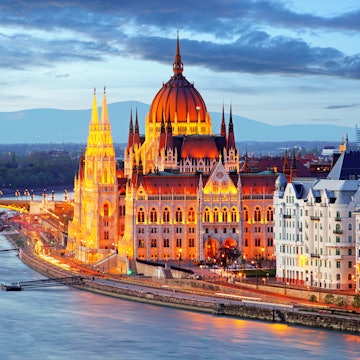
    Combine a comprehensive tour of Budapest sightseeing with a fascinating guided tour of the city's spectacular Parliament House, Hungary's largest building. Your…

    Not LP reviewed

    from USD$57.18
  2. A

    Napoleon-ház

    Known only to pedants and Lonely Planet guidebook writers is the 'footnote fact' that Napoleon actually spent a night in Hungary on 31 August 1809. at a building now called Napoleon-ház (Napoleon House), appropriately enough, which contains a branch of the City Museum. And why did NB choose Győr to make his grand entrée into Hungary? Apparently the city was near a battle site and an inscription on the Arc de Triomphe in Paris recalls 'la bataille de Raab'.

    reviewed

  3. Hungarian Rhapsody

    Hungarian Rhapsody

    8 days (Vienna)

    by World Expeditions

    Cycle from Vienna to Budapest along the Danube cycle path.

    Not LP reviewed

    from USD$1,160
  4. Károly Viski Museum

    The Károly Viski Museum is rich in folklore and art, and highlights the life and ways of the Swabian (Sváb), Slovak (Tót), Serbian (Rác) and Hungarian peoples of the area. It's surprising to see how colourful interiors of peasant houses became as wealth increased; walls, furniture, doors - virtually nothing was left undecorated by the famous 'painting women' of Kalocsa. The museum also has a large collection of coins dating from Roman times to today.

    reviewed

  5. B

    Gundel

    Gundel, next to the zoo and directly behind the Museum of Fine Arts, is the city’s fanciest (and most famous) restaurant, with a tradition dating back to 1894. Indeed, apparently it still feeds the Habsburgs (or what’s left of them) when they’re in town. But we’ve always found Gundel to be vastly overpriced, offering little value for money. Except, that is, for Sunday brunch, a multicourse themed gobble-fest of cold and warm dishes and desserts that change every week.

    reviewed

  6. C

    Lukács

    Housed in a sprawling, 19th-century complex, these baths are popular with very keen spa aficionados. The thermal baths (temperatures 22°C to 40°C) are mixed and a bathing suit is always required. The renovated mud and weight bath, open from 6am to 6pm weekdays and to 4pm on Saturday, welcomes men on Tuesday, Thursday and Saturday, and women on Monday, Wednesday and Friday. There are three swimming pools. You get 400/200Ft back if you leave within two/three hours.

    reviewed

  7. D

    Vogue

    This fine old vessel moored off XIII Szent István Park in Újlipótváros and opposite the eastern side of Margaret Island has fine views south to Margaret and Chain bridges, and (unusually) you can also take in both sides of the river. The food is Serbian and other South Slav – čevapčiči (spicy meatballs) and pljeskavica (spicy meat patties; both 2490Ft) and ražnjiči (shish kebab; 2800Ft) – always grilled and always in large portions.

    reviewed

  8. E

    Margit Kovács Ceramic Collection

    If you descend Görög utca and turn south onto Vastagh György utca, you’ll reach the Margit Kovács Ceramic Collection, Szentendre’s biggest draw. Kovács (1902–77) was a ceramicist who combined Hungarian folk, religious and modern themes to create elongated, Gothiclike figures. Some of her works are overly sentimental, but many are very powerful, especially the later ones in which she became obsessed with mortality.

    reviewed

  9. F

    Budapest History Museum

    The Budapest History Museum looks at the 2000 years of the city, on three floors. Restored palace rooms dating from the 15th century can be entered from the basement, where there are three vaulted halls, one with a magnificent Renaissance door frame in red marble bearing the seal of Queen Beatrice and tiles with a raven and a ring (the seal of her husband King Matthias Corvinus), leading to the Gothic Hall, the Royal Cellar and the 14th-century Tower Chapel.

    reviewed

  10. G

    County Hall

    The tree-lined street of Kossuth Lajos utca boasts dozens of architectural gems, including the delightful County Hall, the main door of which is crowned by a wrought-iron representation of Faith, Hope and Charity by Henrik Fazola, a Rhinelander who settled in Eger in the mid-18th century. Walk down the passageway, and you’ll see more of his magnificent work – two baroque wrought-iron gates that have superseded the minaret as the symbol of Eger.

    reviewed

  11. Advertisement

  12. H

    Georgikon Farm Museum

    The Georgikon Farm Museum is housed in several early-19th-century buildings of what was the Georgikon's experimental farm. It contains exhibits on the history of the college and the later Pannon Agricultural University (now a few blocks to the southeast on the corner of Széchenyi utca and Deák Ferenc utca), viniculture in the Balaton region and traditional farm trades such as those performed by wagon builders, wheelwrights, coopers and blacksmiths.

    reviewed

  13. I

    National Pantheon

    Dóm tér contains Szeged's most important monuments and is the centre of events during the annual summer festival. The National Pantheon - statues and reliefs of 80 notables running along an arcade around three sides of the square - is a crash course in Hungarian art, literature, culture and history. Even the Scotsman Adam Clark, who supervised the building of Budapest's Chain Bridge, wins accolades, but you'll look forever for any sign of a woman.

    reviewed

  14. Budapest Half-Day Sightseeing Tour

    Budapest Half-Day Sightseeing Tour

    3 hours (Departs Budapest, Hungary)

    by Viator

    With a half day to discover Budapest, the Grand City Sightseeing Tour makes the perfect introduction for the first time visitor. With hotel pickup included and…

    Not LP reviewed

    from USD$32.49
  15. J

    Smidt Museum

    In a baroque mansion just south of the Bishop's Palace in Szombathely, the Smidt Museum contains the private collection of one Lajos Smidt, a pack-rat hospital superintendent who spent most of his adult life squirreling away antique weapons, furniture, fans, pipes, clocks, Roman coins and so on. None of it looks like it's worth very much, but the volume and zaniness of it all makes the museum worth a visit. (Keep an eye open for Franz Liszt's pocket watch.)

    reviewed

  16. K

    Roman Military Amphitheatre

    Built in the 2nd century for the Roman garrisons, this amphitheatre about 800m south of Flórián tér could accommodate up to 15,000 spectators and was larger than the Colosseum in Rome. The rest of the military camp extended north to Flórián tér. Archaeology and classical-history buffs taking bus 86 to Flórián tér should descend at III Nagyszombat utca. HÉV passengers should get off at Tímár utca.

    reviewed

  17. L

    Leroy Café

    Like the other branches of the Leroy chain, this cafe-restaurant serves international cuisine that is not especially inspired but is of a certain standard – and it’s there in Óbuda just when you’ve ordered one too many pints of Dreher. Pasta dishes (1650Ft to 2150Ft) are always a good blotter. The large terrace fills up (and stays that way) very early in the warm weather. Two-course weekday lunches are a big draw at only 1250Ft.

    reviewed

  18. M

    Víziváros

    Below Castle Hill on the banks of the Little Danube is Víziváros, the colourful 'Watertown' district of pastel town houses, churches and museums. The fastest way to get there is to walk down steep Macskaút, which can be accessed from just behind the Esztergom Basilica. An easier route is to cross the Royal Palace's drawbridge, walk down the grassy hill to Batthyány Lajos utca and then turn west onto Pázmány Péter utca.

    reviewed

  19. N

    Ark of the Covenant

    As you descend narrow Gutenberg tér to the east of the Basilica, you'll pass the outstanding Ark of the Covenant, a large statue dating from 1731. Local tradition has it that King Charles (Károly) III erected the ark, the city's finest baroque monument, to appease the angry people of Győr after one of his soldiers accidentally knocked a monstrance containing the Blessed Sacrament out of the bishop's hands during a religious procession.

    reviewed

  20. O

    Nótafa

    There are a couple of csárdák (Hungarian-style inns) amid the wine cellars in Szépasszony-völgy, which at the end of the day are much of a muchness, but if you sit down to a meal here you'll most certainly be serenaded by Imré, an old, round chap who churns out Gypsy ballads on his whiny violin. We recommend Nótafa because it pays homage to the man, Imré; his photo takes pride of place over the dining area.

    reviewed

  21. P

    Basilica

    The basilica, whose foundations date back to the 11th century, is an odd amalgam of styles, with Romanesque apses (have a look from the outside), a neoclassical façade and a Gothic chapel riding piggyback on the south side. But most of what you see inside, including the stunning frescoes by Franz Anton Maulbertsch, the main altar, the bishop's throne and the pews hewn from Dalmatian oak, is baroque and dates from the 17th and 18th centuries.

    reviewed

  22. Advertisement

  23. Visszhang-hegy

    You'll find Visszhang-hegy at the end of Pisky sétány. At one time, up to 15 syllables of anything shouted in the direction of the Abbey Church would bounce back but, alas, because of building in the area (and perhaps climatic changes) you'll be lucky to get three nowadays. From Visszhang-hegy you can descend Garay utca and Váralja utca to the Inner Harbour and a small beach, or continue on to the hiking trails that pass this way.

    reviewed

  24. Q

    Pesti Lampás

    The light leads the way (we’re being figurative here) to the ‘Pest Lantern’, a stunning new restaurant and coffee house in the university district. The place beckons not so much for the food (though it is very good) but for its location in a renovated mansion near ELTE university. It has a wonderful terrace in the palace courtyard open in the warmer months and the menu has lots of options for vegetarians (1450Ft to 1950Ft).

    reviewed

  25. R

    Savaria Museum

    The Savaria Museum fronting a little park east of Mártírok tere, is worth a short look around. The ground floor is devoted to highly decorative but practical items carved by 19th-century shepherds to while away the hours; the cellar is full of Roman altars, stone torsos and blue-glass vials found at Savaria excavation sites. There's a local history exhibit on the 1st floor and a collection devoted to the Romanesque church at Ják.

    reviewed

  26. S

    Inner Town Parish Church

    On the eastern side of Március 15 tér, now uncomfortably close to the Elizabeth Bridge flyover, is where a Romanesque church was first built in the 12th century within a Roman fortress. You can still see a few bits of the fort, Contra Aquincum, in the small park to the north. The present church was rebuilt in the 14th and 18th centuries, and you can easily spot Gothic, Renaissance, baroque and even Turkish elements.

    reviewed

  27. T

    Cave Chapel

    This chapel is on a small hill directly north of the landmark art nouveau Gellért Hotel (1918). The chapel was built into a cave in 1926 and was the seat of the Pauline order until 1951 when the priests were arrested and imprisoned by the communists and the cave was sealed off. It was reopened and reconsecrated in 1992. Behind the chapel there is a monastery, with neo-Gothic turrets that are visible from Liberty Bridge.

    reviewed