go to content go to search box go to global site navigation

Georgia

Things to do in Georgia

  1. Tsunda

    Opposite the slave market is the turning to the village of Nakalakevi, whose name means 'a city used to be here'. The city in question was Tsunda, which until the 9th century was the capital of Javakheti. Tsunda's remains are just east of the north end of the next village, Tmogvi, 1km further along the road: it's worth stopping to see Tsunda's beautifully ornamented 12th-century Church of St John the Baptist, with, curiously enough, a medieval stone lavatory next to it.

    reviewed

  2. Dadiani Museum

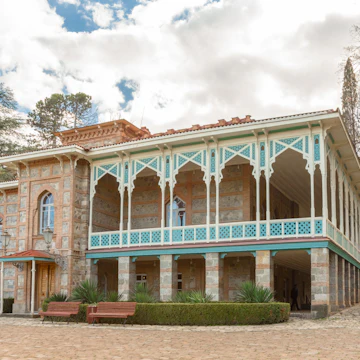
    The palace of the Dadiani family (old lords of Samegrelo), a castle-like building from the 17th to 19th centuries in a park 500m beyond the north end of Zviad Gamsakhurdia, is now the Dadiani Museum. The most unusual exhibit is one of Napoleon Bonaparte’s three bronze death masks, acquired via a 19th-century marriage between a Dadiani and a descendant of Napoleon’s sister. The wooded botanical gardens beside the park are worth a stroll.

    reviewed

  3. Shatili

    Some 8km past Gudani comes the Datvis-Jvari Pass (2876m), from which it's 18km northeast to Shatili. Shatili's old town, built between the 7th and 13th centuries, is an agglomeration of tall towers clinging together on a rocky outcrop to form a single fortress-like whole. The old town was abandoned between the 1960s and '80s, and the new village, of about 20 houses, is just around the hill. But several towers have recently been restored and one contains a museum.

    reviewed

  4. Evropas Moedani

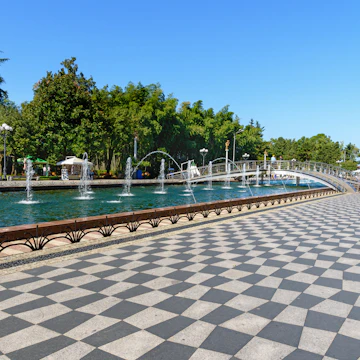
    The main central square, Evropas moedani, is a broad, attractive space sporting musical fountains which are a magnet for kids on hot summer evenings. Towering over the square is a striking monument, unveiled in 2007, to Medea, 'the person who brought Georgia closer to Europe,' according to Batumi's mayor at the time. The Georgian government controversially paid over 1 million GEL for the monument, sculpted by Davit Khmaladze.

    reviewed

  5. A

    Erekle II moedani

    North of the Sioni Cathedral, Sionis qucha becomes Erekle II qucha, which leads to Erekle II moedani, site of the walled residence of the Catholicos-Patriarch (head of the Georgian church) and of a leafy little park. The large Church of the Archangels here was destroyed by the Mongols in the 13th century. Later, three smaller churches were built from the ruins, one of which is the Karis Eklesia, at the north end of the park.

    reviewed

  6. Mtskheta Museum

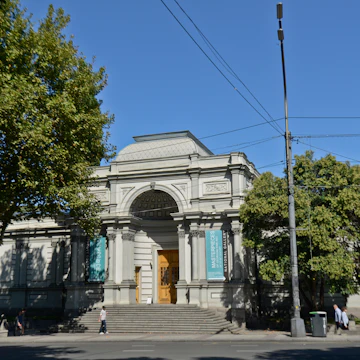
    Mtskheta Museum has an interesting collection of finds from archaeological excavations in the Mtskheta area, labelled in both English and Georgian. Highlights include jewellery and an elaborately worked bronze ritual belt from the Bronze Age, perfume vials from the 2nd to 5th centuries AD, and a miniature mother-of-pearl Iranian sun temple from the 3rd or 4th century AD, found in the Samtavro cemetery.

    reviewed

  7. Walk to Ushguli

    You can spend a lovely three days walking to Ushguli if you start by taking a jeep as far as Ipari (Nakipari on some maps), about 20km southeast of Mestia. From Ipari the first stage takes you to Adishi, where you can sleep at Zhora Kaldani's homestay. The second day is from Adishi to Iprari, where there are rooms at Ucha Margvelani's.

    On the third day it's three or four hours' walk from Iprari to Ushguli.

    reviewed

  8. Gori Fortress

    The heart of Gori is the ancient fortress, an oval citadel atop the big hill west of the Stalin Museum. The walk to the top is easy; from the Hotel Intourist, cross the square and keep going until you reach the foot of the hill, from where a newly cobbled path leads up to the gate. There are fine views from up here and it’s particularly attractive late in the day when the sun is setting.

    reviewed

  9. Samtavro Church

    The large Samtavro Church is also now part of a nunnery. Once the palace church of the lords of Mtskheta, it was built in the 1130s. King Mirian and his wife, Queen Nana, are buried in the southwest corner, under tombstones from the early 20th century. The little church in the Samtavro grounds, Tsminda Nino, dates from the 4th century and stands on a spot where St Nino is said to have prayed.

    reviewed

  10. Mineral Water Park

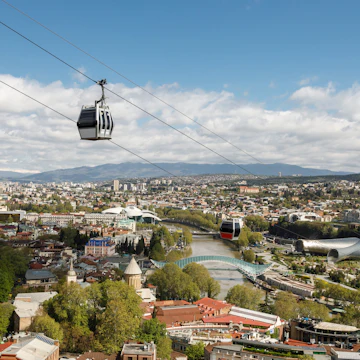
    Borjomi’s Mineral Water Park dates from 1850 and is a lovely place to walk. This was where the original water spring was discovered, and named Yekaterinsky Spring after the governor’s daughter, who was cured here. Mineral water flows from taps in a pavilion straight in front of the entrance, and a modern cable car (down/up 1/2 GEL) carries you above the park to a hilltop Ferris wheel.

    reviewed

  11. Advertisement

  12. B

    Armenian Cathedral of St George

    Just above Gorgasalis moedani is the large Armenian Cathedral of St George, founded in 1251 (although the current structure dates mainly from the 18th century). Its interior is surprisingly small but it has interesting frescoes. King Erekle II’s Armenian court poet Sayat Nova was killed here during the Persian invasion of 1795 and his tomb is in front of the main door.

    reviewed

  13. C

    Tarabua Beach Club

    A fresh-air venue close to the beach, with stages and large dance spaces where people party till dawn every night. Long lists of guest DJs from around Europe provide high-energy and chill-out beats, helped out some nights by singers or bands. They open their doors around 21:00 and start to fill after 23:00. Plenty of smaller bars along the beach develop their own nocturnal scenes too.

    reviewed

  14. D

    Prozak

    A fresh-air venue close to the beach, with stages and large dance spaces where people party till dawn every night. Long lists of guest DJs from around Europe provide high-energy and chill-out beats, helped out some nights by singers or bands. They open their doors around 21:00 and start to fill after 23:00. Plenty of smaller bars along the beach develop their own nocturnal scenes too.

    reviewed

  15. E

    Coordinate 41/41

    A fresh-air venue close to the beach, with stages and large dance spaces where people party till dawn every night. Long lists of guest DJs from around Europe provide high-energy and chill-out beats, helped out some nights by singers or bands. They open their doors around 21:00 and start to fill after 23:00. Plenty of smaller bars along the beach develop their own nocturnal scenes too.

    reviewed

  16. Vardzia

    The cave city of Vardzia is a cultural symbol with a special place in the hearts of Georgians. In the 12th century Giorgi III built a fortification at the site. His daughter, Queen Tamar, established a monastery here, which grew into a virtual holy city housing perhaps 2000 monks, renowned as a spiritual bastion of Georgia and of Christendom’s eastern frontier.

    reviewed

  17. Trekking

    The track up the Pirikiti Alazani valley beyond Chesho, through Parsma and Girevi, eventually leads to the 3431m Atsunta Pass, a very steep and demanding route over into Khevsure. It's a one-week trek all the way from Shenakho or Omalo to Shatili in Khevsureti.

    If you prefer to ride, horses are available in Omalo and Shenakho for between 35 GEL and 70 GEL per day.

    reviewed

  18. Jvari Church

    Visible for miles around on its hilltop overlooking Mtskheta from the east, Jvari Church is to many Georgians the holiest of holies, the country’s spiritual heart. Jvari, or the Holy Cross Church, stands where a sacred wooden cross was erected in the 4th century (either by St Nino before she converted Mtskheta, or by King Mirian soon afterwards).

    reviewed

  19. Mount Mtatsminda & Mtatsminda Park

    Mtatsminda is the hill topped by the 210m-high TV mast looming over central Tbilisi from the west. You can get up there by a steep funicular railway from Chonkadze.

    At the top of the hill, Mtatsminda Park spreads over more than 1 sq km, with wonderful views and a new amusement park that includes what Georgians consider Europe's highest roller coaster (60m high).

    reviewed

  20. Statue of Kartlis Deda

    From outside the Narikala Fortress entrance, you can follow a path west in front of the walls along to the statue of Kartlis Deda. As attractive as a 20m aluminium woman can be, this symbol of the city holds a sword in one hand and a cup of wine in the other - a perfect metaphor for the Georgian character, warmly welcoming guests and passionately fighting off enemies.

    reviewed

  21. Walk to Chalati Glacier

    The walk to the Chalati Glacier is a lovely route, taking you out past Mestia's airstrip and up the Mestiachala valley. The last section is up through woods to the foot of the glacier. Watch out for rocks falling off the glacier in summer. This route is a nine- or 10-hour round-trip including stops. There is a border-guard checkpoint en route, so take your passport.

    reviewed

  22. Advertisement

  23. F

    Abanotubani

    The social hub of the area is further south – Tbilisi’s famed sulphur baths, the Abanotubani. Alexanders Dumas and Pushkin both bathed here, the latter describing it as the best bath he’d ever had. Abano (Bath St) is full of subterranean bathhouses with beehive domes rising at ground level, most dating back to the 17th century

    reviewed

  24. G

    Gorgasalis Moedani

    A good place to get your initial bearings is Gorgasalis moedani, now a rather bland, traffic-infested junction but once the setting of Tbilisi's bustling bazaar. From here the Metekhi Bridge crosses the river to the Metekhi Church, busy Gorgasalis qucha heads off southeast along the riverbank, and Leselidze and Sharden dive into the maze of streets to the north.

    reviewed

  25. H

    Iunga

    There’s no better place than Batumi to decide whether you like khachapuri acharuli, Adjara’s large boat-shaped variety of Georgia’s national fast food with a lightly fried egg on top. And there’s no better place to try it than this tiny, neat place which specialises in it – if one of its four tables is vacant.

    reviewed

  26. I

    Mosque

    A short distance uphill behind the baths is the mosque, built in 1895 and the only mosque in Tbilisi that survived Lavrenty Beria’s antireligious purges of the 1930s. Unusually, Shiite and Sunni Muslims pray together here. The interior is prettily frescoed and visitors are welcome to enter (after removing shoes).

    reviewed

  27. J

    Teremok

    This cosy little restaurant in the style of an old Russian cottage specialises in scrumptious bliny, little round pancakes beloved of Russians and indeed most people who have ever tried them. You can enjoy them with mushrooms, meat, cream, jam, cheese, fruit or many other options. Other Russian and Ukrainian dishes are served too.

    reviewed