Things to do in Georgia
-
Mutso
From Shatili the track continues 3km northeast to the border of Chechnya. Before the border you'll encounter a 'No Entry' sign, but you can turn south up the Andaki valley to almost-empty Mutso , about 8km from Shatili. Mutso's roofless old village on a very steep rock pinnacle across the river is one of the most spectacular in Khevsureti, with large stone tombs in which you can see human skulls.
Ardoti is 6km further up the valley beyond Mutso. From Andaki (uninhabited), a similar distance beyond Ardoti, begins the very steep route over the 3431m Atsunta Pass into Tusheti.
reviewed
-
A
Sans Souci
This quirkily attractive little restaurant makes a great place for lunch or dinner. It offers friendly service and a view of both the Anchiskhati Basilica and the Hangar sports bar. The food is Georgian with original twists – try the leek hors d’oeuvre for starters.
reviewed
-
Tsminda Sameba Church
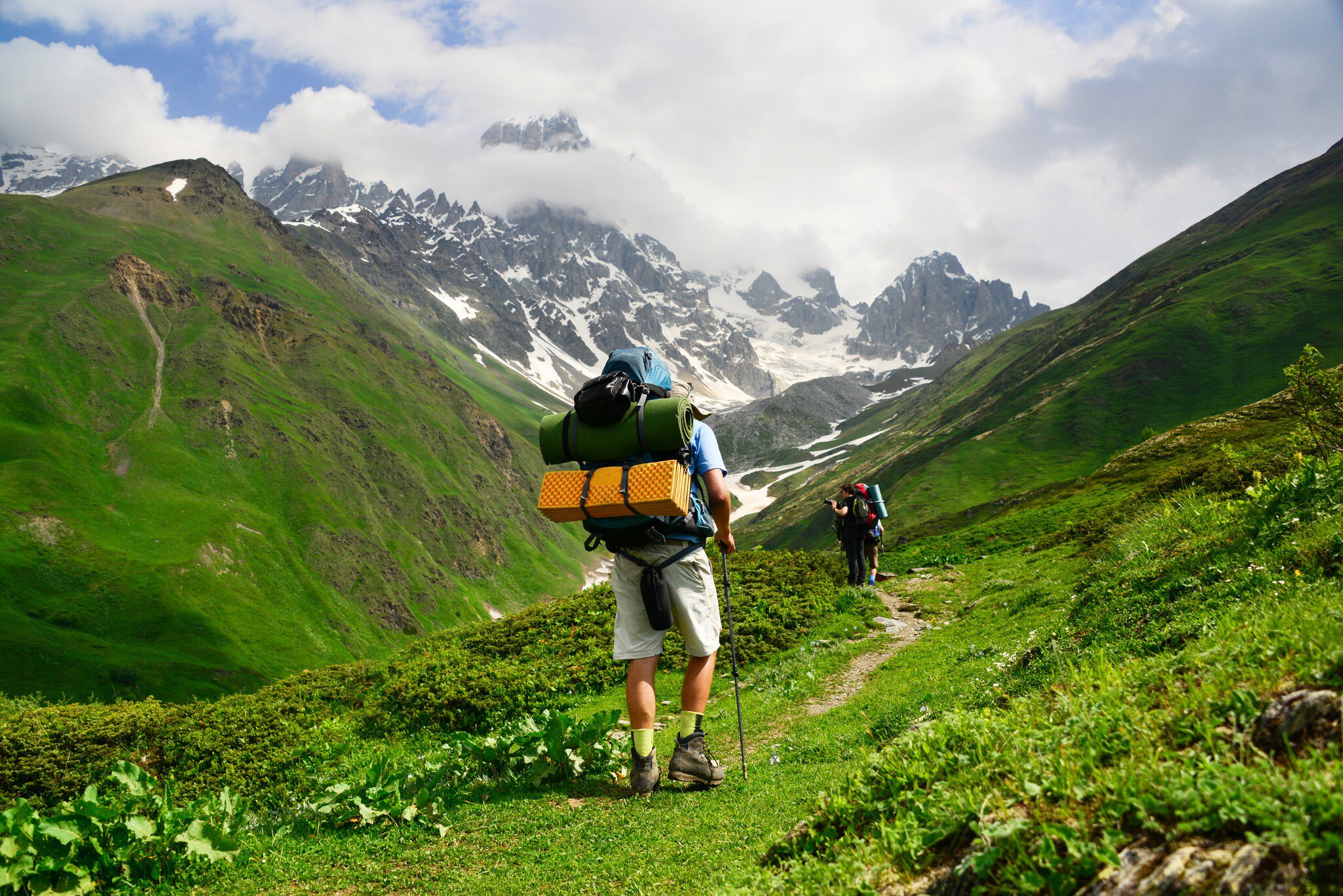
The 14th-century Holy Trinity Church above Kazbegi at 2200m has become something of a symbol of Georgia - its beauty, piety and the fierce determination to build it on such a lofty, isolated perch are all emblematic of the country and its people. The walk up to the church and the panoramas this affords are a highlight of Georgia.
In 1988 the Soviet authorities constructed a cable-car line to the church, with one station in Kazbegi and the other right next to Tsminda Sameba. The people of Kazbegi quite rightly felt this defiled their sacred place and soon destroyed it. You can still see its base in the village, almost behind the Alexander Kazbegi Museum.
It takes about 1½…
reviewed
-
Alexander Kazbegi Museum
Alexander Kazbegi (1848-93) made the unusual decision to become a shepherd after studying in Tbilisi, St Petersburg and Moscow. Later he worked as a journalist and wrote the novels and plays that made him famous. At the end of his life he suffered from insanity. He died in Tbilisi, but his coffin was carried back to Kazbegi. His museum is a five-minute walk north from the main square.
You first come to a church, dated 1809-11, with a striking relief of two lions with a chain above its door. To its east and west are two structures that look like bell towers but are actually the tombs of Alexander's father and mother. The writer's own grave lies under a large stone…
reviewed
-
B
Open-Air Museum of Ethnography
The Open-Air Museum of Ethnography is about 3km beyond, and uphill from, the Vake Park. This collection of nearly 70 traditional, mostly wooden houses from around Georgia is spread over a wooded hillside with good views, and makes an enjoyable visit. The most interesting exhibits are in the lower section of the museum (near the entrance), where the buildings are kitted out with fine traditional furnishings, rugs and utensils. There’s also an archaeological section, which includes a basilica from the 6th and 7th centuries. You can reach the open-air museum by walking up from Vake Park, or down the road from Kus Tba (about 2km). Or take bus 59 from opposite Marjanishvili…
reviewed
-
C
Narikala Fortress
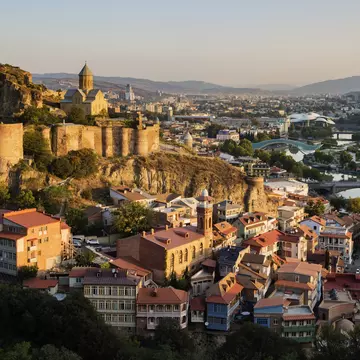
Dominating the city skyline (until the TV tower came along, anyway), Narikala Fortress is an ancient symbol of Tbilisi’s defensive brilliance. The fortress walls date from various periods, the earliest from the 4th century, when it was a Persian citadel. The foundations of the towers and most of the present walls were built in the 8th century by the Arab emirs, whose palace was inside the fortress. Subsequently Georgians, Turks and Persians captured and patched up Narikala, but in 1827 a huge explosion of the Russian munitions stored here ruined not only the fortress but also the Church of St Nicholas inside it. The church was rebuilt in the 1990s with the help of…
reviewed
-
Uplistsikhe
Uplistsikhe is strategically located, with a deep valley to the east and cliffs to the west. Entering the main part of the site, you pass through what was the main gate, at the head of a small ravine, then wind your way up the main street. Over to the left, on the southwest edge of the site overlooking the river, you'll see a cave with a pointed arch carved in the rock above it. Inside, the ceiling is carved with octagonal designs in a similar style to Caracalla's Baths in Rome.
Known as the Theatre, this is probably a temple dating from the 1st or 2nd century AD, where religious mystery plays may have been performed.
reviewed
-
Gergeti Glacier
If you're up for another 900m of ascent from Tsminda Sameba, this quite strenuous walk rewards with spectacular views. The path heads straight up the ridge behind the church; an alternative route, more protected on windy days, runs up the left flank of the ridge.
The two meet at a cairn at 2960m altitude, from where a path leads on up towards the left side of the Gergeti (Ortsveri) Glacier as it snakes its way down from Mt Kazbek. Head up here for about one hour for views of the glacier, then return. You'll need about nine hours to get up there from Kazbegi and down again the same day.
reviewed
-
Stalin Museum
Possibly the most interesting museum in Georgia, the Stalin Museum is an impressive 1957 building that exudes a faintly religious air. The visit includes the tiny wood-and-mud-brick house where Stalin’s parents rented the single room in which they lived for the first four years of his life. This stands in front of the main museum building, perfectly preserved and with its own temple-like protective superstructure. The rest of the poor neighbourhood in which it stood was demolished in the 1930s as Gori was redesigned to glorify its famous son.
reviewed
-
Borjomi Museum of Local Lore
The Borjomi Museum of Local Lore is housed in the former Romanov offices.The collection includes china, glass and other articles from the Romanov palace, photos and documentation about the Borjomi mineral waters, some exhibits of local flora and fauna, and a papier-mâché map of Borjomi made in 1917.
reviewed
Advertisement
-
Tmogvi Castle
Two kilometres further along the road from Tsunda, but atop a high rocky hill on the other side of the river (which flows far below in the gorge), is the near-impregnable Tmogvi Castle, which was already an important fortification by the 10th century.
reviewed
-
Bebris Tsikhe
Bebris Tsikhe, Mtskheta's castle, was built in the early feudal period to protect Mtskheta's northern approaches. It's a romantic ruin situated at the north end of Davit Aghmashenebeli, about 1.2km past Samtavro Church.
reviewed
-
Restaurant Diaroni
For a satisfying full meal with friendly, efficient service, look no further than this atmospheric cellar-like place. A full range of Georgian and Russian dishes is on offer and there’s an English-language menu.
reviewed
-
Vanis Qvabebi
About 1.5km past Tmogvi Castle, up on the left of the road, are the remains of Vanis Qvabebi, a cave monastery that predated Vardzia by four centuries, with a maze of tunnels inside the rock.
reviewed
-
D
China Town
Colourful and consistently popular, China Town serves authentic Chinese dishes including tofu combinations and plenty of other options for vegetarians. There are meat dishes on offer too.
reviewed
-
E
Prospero’s Books
This English-language bookshop and café has a terrific if expensive selection including lots of titles on Georgia and the Caucasus region.
reviewed
-
F
Badagoni Tour
Badagoni specialises in wine and food tours but also offers a range of other trips in Georgia, Azerbaijan and Turkey.
reviewed
-
Udabno
The caves of Udabno were churches or chapels or rooms, and their inner walls still bear frescoes painted by the renowned fresco school that flourished here between the 10th and 13th centuries. The monastery's refectory, where the monks had to kneel to eat at low stone tables, is decorated with beautiful light-coloured frescoes, the principal one being an 11th-century depiction of the Last Supper.
Paintings on the north wall of what was the main church show Davit Gareja and Lukiane surrounded by deer, a reference to the story that deer gave them milk when they were wandering without sustenance in this remote wilderness. Below them are figures of Kakhetian princes.
To get…
reviewed
-
G
Fine Arts Museum
Just off the northeast corner of Tavisuplebis moedani is the Fine Arts Museum, a comprehensive if underwhelmingly presented storehouse of Georgian art and artisanry from several centuries BC up to the late 20th century. Sections may be closed because of air-conditioning problems, and at the time of research the museum was due for renovation, which may put it out of action altogether for a while. The major highlight is the treasury section, which can only be entered with a guide (no extra charge). This contains a great wealth of icons, crosses and jewellery in precious metals and stones from all over Georgia and old Georgian churches and monasteries on what is now Turkish…
reviewed
-
H
Tsminda Sameba (Holy Trinity) Cathedral
High on Elia Hill above Avlabari rises the biggest symbol of Georgia's post-Soviet religious revival, the Tsminda Sameba (Holy Trinity) Cathedral, (an unmissable landmark by night and day) consecrated in 2004 after a decade of building work. A massive expression of traditional Georgian architectural forms in concrete, brick, granite and marble, it rises 84m to the top of the gold-covered cross above its central dome.
The main entrance to the cathedral's extensive grounds is on Uritski, reached via Meskhishvili up the hill from Ketevan Tsamebulis moedani. The cathedral is five-aisles wide but its emphasis is on verticality, with a result like one single, many-bulwarked…
reviewed
Advertisement
-
Walking the Upper Mtkvari Valley
A network of fascinating walking trails has been opened up between Khertvisi and Vardzia, giving access to places like Tmogvi Castle, Vanis Qvabebi and the convent of Zeda (Upper) Vardzia with its 11th-century stone church. You'll notice information boards showing these routes and describing their features in English and Georgian as you travel along the valley.
Five routes of up to 8km are marked with yellow-and-black paint stripes and arrows in a project coordinated by the Swiss-based Foundation for Sustainable Development in Mountain Regions. Guesthouses with hot-water bathrooms at Gelsunda, Tmogvi and Vardzia enable you to stay overnight and enjoy exploring this…
reviewed
-
Walk to the Cross
A moderately demanding half-day walk that many people do without a guide is up to the Cross, visible 900m above Mestia on the north side of the valley (actually just a single pole at research time). The views get better as you go, and from the Cross you can see the spectacular twin peaks of Mt Ushba (4710m), Georgia's toughest and most dangerous mountaineering challenge. From Mestia's central square walk 450m east along the main street then take the lane up to the left.
Take the uphill option at all junctions. You pass under an arch after about 350m, and after 150m more the street becomes a footpath: follow this up and after 800m it bends to the right across the hillside,…
reviewed
-
Bodbe Convent
The convent, set among tall cypresses, is dedicated to St Nino, who is buried here. The little church was originally built, over her grave, by King Mirian in the 4th century. It was converted into a triple-church basilica in the 8th or 9th century and has been renovated several times since. Nino's fairly simple tomb, beneath a recently installed marble slab, is in a small chapel in its southeast corner. The murals were painted in 1823 by Bishop John Maqashvili.
A convent, founded here in the late 19th century, then turned into a hospital in Soviet times, has functioned again since 1991. Through an opening just northeast of the church, and then down a steep path of 800m,…
reviewed
-
Kolkheti National Park
This 285-sq-km national park encompasses three separate areas of coastline and wetlands north and southeast of Poti. It’s the southeastern area, focused on Lake Paliastomi, which is of most interest to visitors, thanks to its large bird population. More than 190 species have been sighted in the park. The best months to visit are September and October, when large and small raptors can be seen migrating southwards, and January to May, when swans, geese, ducks, other water birds and even rare pelicans, storks and booted eagles gather to winter here. The area is also a paradise for frogs (the cacophony in the mating season can be tremendous). Ancient Greek physician…
reviewed
-
Gelati Monastery
Gelati Monastery was founded by King David the Builder in 1106 as a centre for both Christian culture and Neo-Platonist learning. King David invited scholars such as Iaone Petritsi and Arsen Ikaltoeli to teach here and the Gelati Academy became, according to medieval chroniclers, 'a second Jerusalem' and 'another Athos, albeit superior to it'. Many Georgian rulers were buried here, including David the Builder himself, Queen Tamar (according to her chronicler, although this is disputed) and Bagrat III of Imereti.
In 1510 the Ottoman Turks set fire to the complex, but Bagrat III subsequently restored the monastery, and it was made the seat of a bishop and the residence of…
reviewed