Things to do in Normandy
-
Normandy American Cemetery & Memorial
The huge Normandy American Cemetery & Memorial, 17km northwest of Bayeux, is the largest American cemetery in Europe. Featured in the opening scenes of Steven Spielberg’s Saving Private Ryan, it contains the graves of 9387 American soldiers, including 41 pairs of brothers, and a memorial to 1557 others whose remains were never found. White marble crosses and Stars of David stretch off in seemingly endless rows, surrounded by an immaculately tended expanse of lawn. The cemetery is overlooked by a large colonnaded memorial, centred on a statue dedicated to the spirit of American youth.
Opened in 2007, the visitor center, mostly underground so as not to detract from the si…
reviewed
-
A
Cathédrale Notre Dame
Most of Bayeux' spectacular Norman Gothic cathedral dates from the 13th century, though the crypt (accessible from the north side of the choir), the arches of the nave and the lower portions of the entrance towers are 11th-century Romanesque. The central tower was added in the 15th century; the copper dome dates from the 1860s. First prize for tackiness has got to go to 'Litanies de la Sainte Vierge', a 17th-century retable in the first chapel on the left as you enter the cathedral.
reviewed
-
Musée du Débarquement
Down in Arromanches and right on the beach, the Musée du Débarquement, redesigned in 2004 for the 60th anniversary of D-Day, makes an informative stop. Dioramas, models and two films explain the logistics and importance of Port Winston. Written material is available in 18 languages.
reviewed
-
B
Bayeux Tapestry
Undoubtedly the world's most celebrated embroidery, the misnamed Bayeux Tapestry (it's actually wool thread embroidered onto linen cloth) vividly recounts the story of the Norman conquest of England in 1066. Divided into 58 scenes briefly captioned in almost-readable Latin, the main narrative – told from an unashamedly Norman perspective – fills up the centre of the canvas, while religious allegories and depictions of daily life in the 11th century unfold along the borders. The final showdown at the Battle of Hastings is depicted in truly graphic fashion, complete with severed limbs and decapitated heads (along the bottom of scene 52). Halley's Comet, which blazed across …
reviewed
-
C
Musée de la Tapisserie de Bayeux
Undoubtedly the world's most celebrated piece of embroidery, the Bayeux Tapestry is housed in the Musée de la Tapisserie de Bayeux . Upstairs there's a short historical film and a full-size reconstruction of the tapestry, but you'll be better off skipping both and heading downstairs to see the real thing. An audioguide is included in the admission price.
The tapestry recounts the story of the Norman conquest of England in 58 remarkable scenes, briefly captioned in Latin, and all told from an unashamedly Norman perspective. Scholars believe that the 70m-long tapestry was commissioned by Bishop Odo of Bayeux, William's half-brother, to commemorate the opening of Bayeux cat…
reviewed
-
D
Cathédrale Notre Dame
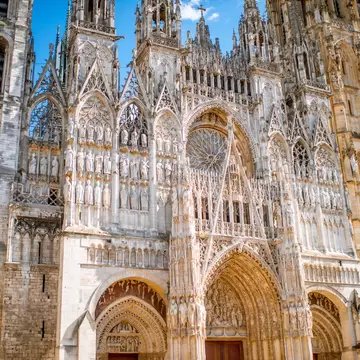
On a site occupied by churches since the 4th century, Rouen's magnificent cathedral was painted repeatedly by Claude Monet, who was fascinated by the subtle changes of light and colour on the cathedral's towering French Gothic facade. Built between 1201 and 1514, the building was damaged by time, WWII and a 1999 storm, and is still undergoing renovation. Monet would hardly recognise its recently cleaned facade, now almost white.
The Romanesque crypt was part of a cathedral completed in 1062 and destroyed by a conflagration that flattened much of the city at Easter in the year 1200. The free tours to the crypt, ambulatory and Chapel of the Virgin are in French, but some gu…
reviewed
-
E
Mémorial – Un Musée pour la Paix
Situated 3km northwest of the city centre, this innovative memorial-museum provides an insightful and vivid account of the Battle of Normandy. Tickets bought after 1pm can be used to re-enter until 1pm the next day. All signs are in French, English and German.
The visit begins with a whistle-stop overview of Europe's descent into total war, tracing events from the end of WWI and the Treaty of Versailles, through the rise of fascism in Europe and the German occupation of France, right up through the Battle of Normandy. It's a hugely impressive affair, using sound, lighting, film, animation and audio testimony, as well as a range of artefacts and exhibits, to graphically evo…
reviewed
-
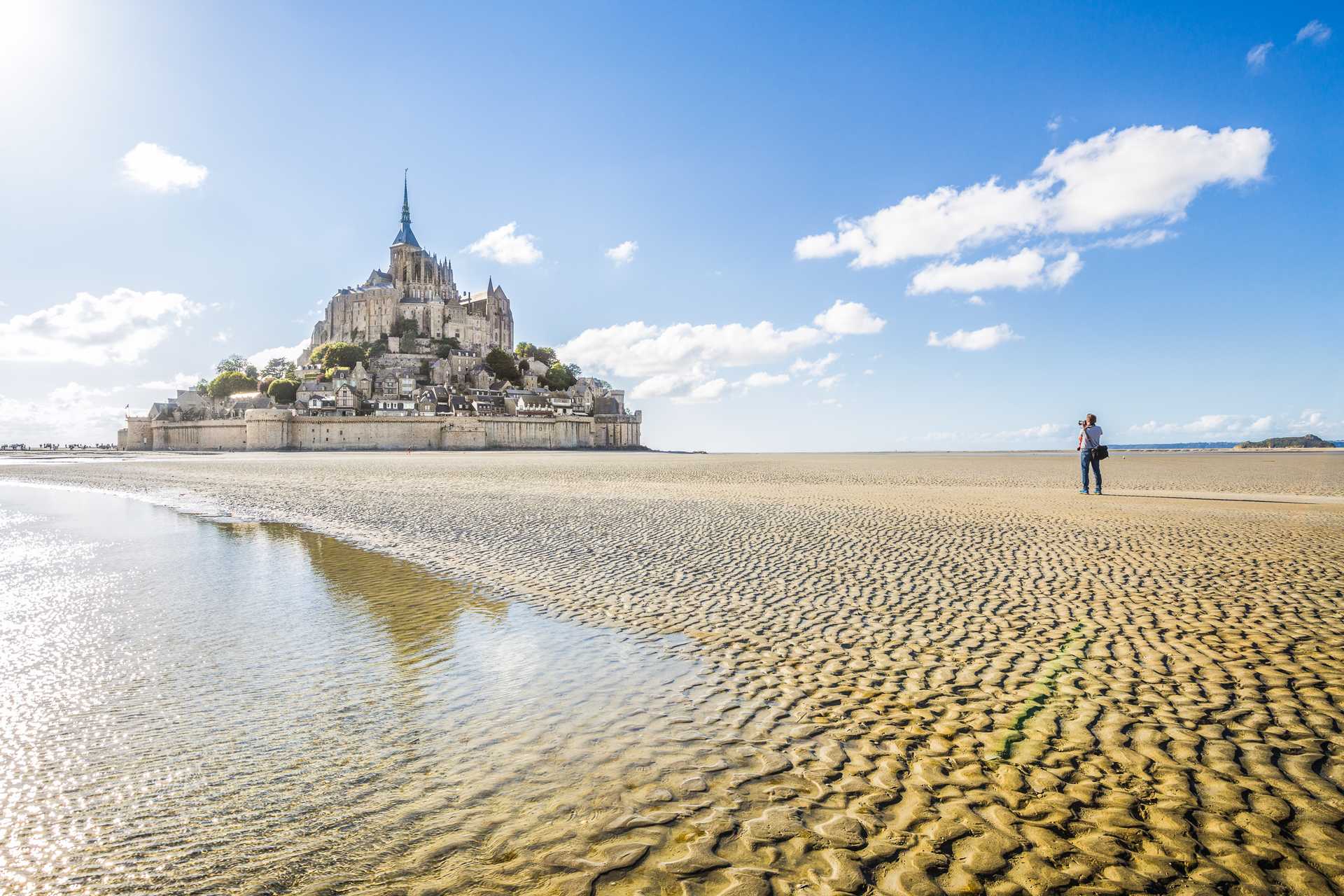
La Merveille
The buildings on the northern side of the Mont are known as La Merveille . The famous cloître (cloister) is surrounded by a double row of delicately carved arches resting on granite pillars. The early-13th-century, barrel-roofed réfectoire (dining hall) is illuminated by a wall of recessed windows – remarkable, given that the sheer drop precluded the use of flying buttresses. The Gothic Salle des Hôtes (Guest Hall), dating from 1213, has two enormous fireplaces. Look out for the promenoire (ambulatory), with one of the oldest ribbed vaulted ceilings in Europe, and the Chapelle de Notre Dame sous Terre (Underground Chapel of Our Lady), one of the abbey's oldest rooms,…
reviewed
-
Pointe du Hoc Ranger Memorial
At 7.10am on 6 June 1944, 225 US Army Rangers commanded by Lt Col James Earl Rudder scaled the 30m cliffs at Pointe du Hoc, where the Germans had a battery of huge artillery guns perfectly placed to rain shells onto the beaches of Utah and Omaha. Unbeknown to Rudder and his team, the guns had already been transferred inland, and they spent the next two days repelling fierce German counterattacks. By the time they were finally relieved on 8 June, 81 of the rangers had been killed and 58 more had been wounded.
Today the site , which France turned over to the US government in 1979, looks much as it did more than half a century ago. The ground is pockmarked with bomb craters, …
reviewed
-
Abbaye du Mont St-Michel
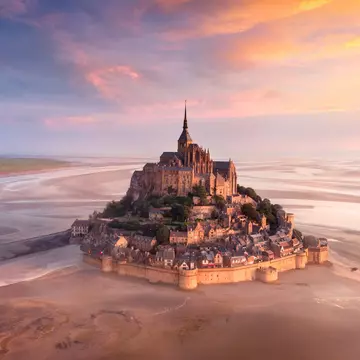
The Mont's major attraction is the stunning architectural ensemble of the Abbaye du Mont St-Michel, towards which you'll be swept by a human tide ascending the Grande Rue and a steep stairway. From Monday to Saturday in July and August, there are illuminated nocturnes (night-time visits) with music from 7pm to 10pm.
Most rooms can be visited without a guide but it's worth taking the one-hour tour, included in the ticket price. The frequency of English tours ranges from twice a day (11am and 3pm) in the dead of winter to hourly in summer; the last leaves at least 1½ hours before closing time. Audioguides (one for €4.50, two for €6) are available in six languages. Don't forg…
reviewed
Advertisement
-
F
Abbaye aux Hommes
Caen's two Romanesque abbeys were founded in the mid-11th century by William the Conqueror and his wife, Matilda of Flanders, as part of a deal in which the Church pardoned these fifth cousins for having semi-incestuously married each other. With its magnificent and multiturreted Église St-Étienne, the Abbaye aux Hommes is near the western end of rue Écuyère. This was William's final resting place, though the original tomb was destroyed by a 16th-century Calvinist mob and, in 1793, by fevered Revolutionaries – a solitary thighbone is all that's left of Will's mortal remains. Today, the 18th-century convent buildings house the town hall, and tours of the abbey run at 9.30a…
reviewed
-
G
Palais de Justice
The ornately Gothic Law Courts, little more than a shell at the end of WWII, have been restored to their early-16th-century Gothic glory, though the 19th-century western facade is still pockmarked by bullet holes. The courtyard, with its impossibly delicate spires, gargoyles and statuary, is accessible via a metal detector from rue aux Juifs; this is also the entrance to use if you'd like to sit in on a trial.
Under the staircase at the courtyard's eastern end is the Monument Juif (Jewish Monument), the oldest Jewish communal structure in France and the only reminder of Rouen's medieval Jewish community, expelled by Philippe le Bel in 1306.
reviewed
-
H
Château de Guillaume le Conquérant
Looming above the centre of the city and surrounded by a dry moat and massive battlements, the castle was established by William the Conqueror, Duke of Normandy, in 1060 and extended by his son Henry I. Visitors can walk around the ramparts, and visit the 12th-century Église St-Georges (open during temporary exhibitions) and the Échiquier (Exchequer), which dates from about 1100 and is one of the oldest civic buildings in Normandy. The Jardin des Simples is a garden of medicinal and aromatic herbs cultivated during the Middle Ages – some of them poisonous.
Near the château are two of the only prewar buildings left in the city centre: the half-timbered, 16th-century Mu…
reviewed
-
I
Château de Caen
Looming above the centre of the city from a domed hilltop, and surrounded by a dry moat, the Château de Caen was founded by William the Conqueror in 1060 and extended by his son Henry I. It has been used over the centuries by royals, revolutionaries, townsfolk and the military.
Take a walk around the ramparts and visit the 12th-century Chapelle de St-Georges and the Échiquier (Exchequer), which dates from about AD 1100 and is one of the oldest civic buildings in Normandy.
reviewed
-
J
Bayeux War Cemetery
This peaceful cemetery, a few hundred metres west of the Musée Mémorial, is the largest of the 18 Commonwealth military cemeteries in Normandy. It contains 4848 graves of soldiers from the UK and 10 other countries, including, rather surprisingly, Germany. Across the road is a memorial for 1807 Commonwealth soldiers whose remains were never found; the Latin inscription across the top reads: 'We, whom William once conquered, have now set free the conqueror's native land'.
reviewed
-
K
Le Bouchon
Look no further for Caen's most popular and buzzing restaurant. Le Bouchon is well worth reserving ahead for, though you may squeeze in if you simply turn up. You may well be the only foreigners here and certainly don't expect a translation of the chalk-board menu – but if your French is up to it, come and savour some spectacular modern Norman cooking and enjoy a wonderful choice of well-priced wines, which the manager will very passionately help you choose.
reviewed
-
Église Abbatiale
The Église Abbatiale was built on the rocky tip of the mountain cone. The transept rests on solid rock, while the nave, choir and transept arms are supported by the rooms below. The church is famous for its mix of architectural styles: the nave and south transept (11th and 12th centuries) are solid Norman Romanesque, while the choir (late 15th century) is Flamboyant Gothic. Mass is held at 12.15pm from Tuesday to Sunday and at 11.30am on Sunday.
reviewed
-
Normandy Battlefields Tour - Canadian World War II Sites
by Viator
Begin your Normandy Battlefields Tour with a visit to the Juno Beach Center, the only museum in the Canadian sector. The Center retraces the implementation of t…Not LP reviewed
from USD$75.15 -
Normandy Beaches Half-Day Trip from Bayeux
by Viator
Pay tribute to the soldiers who fought at Omaha Beach on this afternoon tour of the Normandy beaches from Bayeux. You'll visit the famous battlefield sites of …Not LP reviewed
from USD$75.15 -
Omaha Beach Half-Day Trip from Bayeux
by Viator
If time is tight and you'd like to tour the Normandy beaches, this quick morning tour from Bayeux will show you all the poignant highlights of these important W…Not LP reviewed
from USD$56.36 Advertisement
-
Normandy Battlefields Day Trip: Omaha, Sword and the British Airborne Sector
by Viator
Retrace the main assaults undertaken by the British forces during the first days of the Battle of Normandy on a poignant battlefields tour you'll never forget. …Not LP reviewed
from USD$112.73 -
Normandy Battlefields Tour - Sword Beach and the British Airborne Sector
by Viator
On this Normandy Battlefields Tour, you will visit the famous site of Pegasus Bridge, captured just after midnight on D-Day by elements of the 6th Airborne Divi…Not LP reviewed
from USD$75.15 -
Private Tour to Bayeux, Honfleur and Pays d' Auge from Bayeux
by Viator
Discover the history, culture and food of the Normandy region on this private tour of Bayeux, Honfleur and Pays d'Auge departing from central Bayeux. See the fa…Not LP reviewed
from USD$91.60 -
Private Tour: Normandy Landing Beaches, Battlefields, Museums and Cemeteries from Bayeux
by Viator
Take a private tour from Bayeux to Normandy, where you’ll relive the events of the Allied invasion on June 6, 1944 – more famously known as D-Day. You can perso…Not LP reviewed
from USD$91.58 -
Private Day Tour of Mont Saint-Michel and Saint Malo from Bayeux
by Viator
See the spectacular sights of the island of Mont Saint-Michel and the walled town of Saint-Malo on this private day trip from Bayeux. Mont Saint-Michel, situate…Not LP reviewed
from USD$91.60