Things to do in Luxor
-
A
Salahadeen
Salahadeen offers a set menu of Egyptian dishes, served as if it were an Egyptian home – knives and forks are offered but guests are encouraged to eat in the Egyptian way by dipping bread in the various dishes. There are two choices, the ‘platter’ (E£85), which includes three courses with14 dishes of fresh home-cooked food to share, or the ‘Feast’ (E£125) with five courses including 25 different dishes. Most dishes consist of vegetables, and the vegetarian options are not cooked in a meat broth as in so many other places. The bar opens for pre-dinner drinks at 6pm, and alcohol is available in the restaurant, too.
reviewed
-
B
Oasis Café
Set in a renovated 1930s building right in the centre of town, the Oasis is a good place to recover from the bustle of Luxor town, from the heat or from sightseeing. The dining rooms are cool with fans, high ceilings and old tiled floors, painted in soft colours with local artwork on the walls, and furnished with traditional-style furniture. With jazz softly playing, smoking and nonsmoking rooms, the New Yorker to read and friendly staff, this is the perfect place for lunch, to linger over a good morning latte or to spend the afternoon reading. The place is very Western, but in a nice way like your favourite cafe back home. The food is good too, with an extensive brunch…
reviewed
-
Karnak
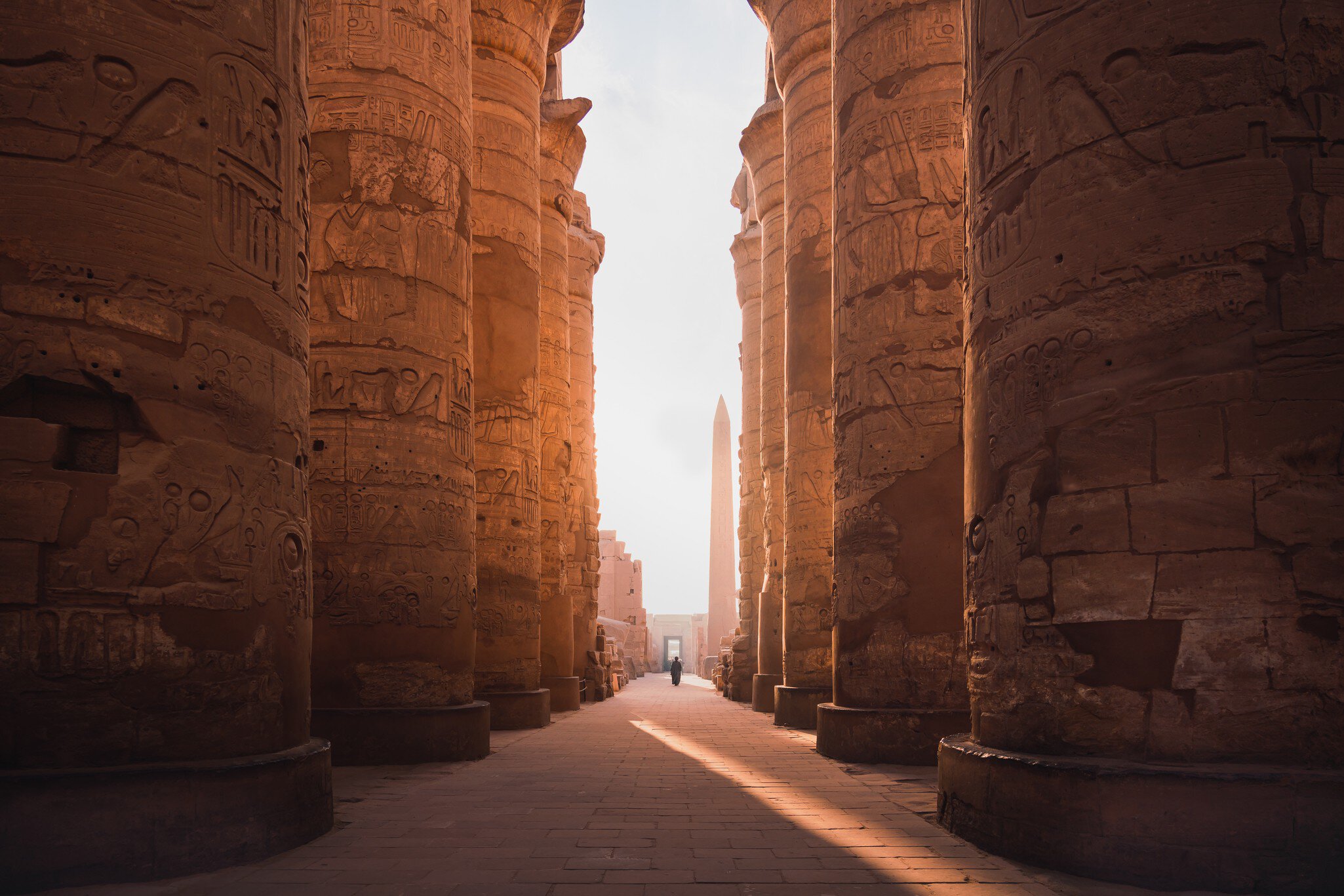
More than a temple, Karnak is an extraordinary complex of sanctuaries, kiosks, pylons and obelisks dedicated to the Theban gods and the greater glory of pharaohs. Everything is on a gigantic scale: the site covers over 2 sq km, large enough to contain about 10 cathedrals, while its main structure, the Temple of Amun, is the largest religious building ever built. This was where the god lived on earth, surrounded by the houses of his wife Mut, and their son Khonsu, two other huge temple complexes on this site. Built, added to, dismantled, restored, enlarged and decorated over nearly 1500 years, Karnak was the most important place of worship in Egypt during the New Kingdom.…
reviewed
-
C
Valley of the Kings
Once called the Great Necropolis of Millions of Years of Pharaoh, or the Place of Truth, the Valley of the Kings has 63 magnificent royal tombs from the New Kingdom period (1550–1069 BC), all very different from each other. The West Bank had been the site of royal burials from the First Intermediate Period (2160–2025 BC) onwards. At least three 11th-dynasty rulers built their tombs near the modern village of Taref, northeast of the Valley of the Kings. The 18th-dynasty pharaohs, however, chose the isolated valley dominated by the pyramid-shaped mountain peak of Al-Qurn (The Horn). The secluded site enclosed by steep cliffs was easy to guard and, when seen from the Theban…
reviewed
-
D
Sofra
Sofra remains our favourite restaurant in Luxor. Located in a 1930s house, away from all the tourist tat, it is as Egyptian as can be, in menu and decor, and even in price. The ground floor has three private dining rooms and a salon, giving the feeling of being in someone’s home. There is also a wonderful rooftop terrace, which is also a cafe, where you can come for a drink. The house is filled with antique oriental furniture, chandeliers and traditional decorations, all simple but cosy and very tasteful. The menu is large, featuring all the traditional Egyptian dishes, such as stuffed pigeon and excellent duck, as well as a large selection of salads, dips (E£4) and…
reviewed
-
Ace
ACE was opened in 2000 by a British-run charity to give free treatment for the working animals of Egyptians, particularly donkeys and horses, and it is today a great veterinary hospital and animal welfare centre seeing up to 200 animals a day. For those distressed by the state of the horses in Luxor streets, you may like to see what is done here. The centre also runs an education program receiving 80 local children a day, aiming to impart a love and care for animals. This is a great place to visit, and foreign children can spend the day at the centre to help care for the animals. Volunteers and donations are very welcome.
reviewed
-
E
Nobi’s Arabian Horse Stables
Excellent horses can be found at Nobi’s Arabian Horse Stables, which also provides riding hats, English saddles and insurance. Nobi also has 25 camels and as many donkeys at the same price, and organises longer horse riding and camping trips into the desert or a week from Luxor to Kom Ombo along the West Bank. Call ahead to book, and he can arrange a hassle-free transfer to make sure you arrive at the right place, as often taxi drivers will try and take you to a friend’s stable instead.
reviewed
-
F
Habiba
Run by an Australian woman who loves to travel in Egypt and who wants to promote the best of Egyptian crafts, this tiny shop goes from strength to strength. It sells an ever-expanding selection of Bedouin embroidery, jewellery, leather work, wonderful Siwan scarves, cotton embroidered scarves from Sohag, the best Egyptian cotton towels (usually only for export), mirrors and brass lights – and all at fair-trade fixed prices. A world away from what is available in the nearby souq.
reviewed
-
G
Temple of Hatshepsut
The eyes first focus on the dramatic rugged limestone cliffs that rise nearly 300m above the desert plain, a monument made by nature, only to realize that at the foot of all this immense beauty lies a man-made monument even more extraordinary, the dazzling Temple of Hatshepsut. The almost modern-looking temple blends in beautifully with the cliffs from which it is partly cut, a marriage made in heaven.
reviewed
-
H
Jamboree Restaurant
A small British-run restaurant, Jamboree serves international fare in its small, rather undistinct dining room or much better, upstairs on a pleasant roof terrace. Lunchtime dishes are limited to good homemade sandwiches and snacks. The menu includes filled jacket potatoes, pastas and the traditional, perhaps not so authentic, Egyptian dishes.
reviewed
Advertisement
-
I
Snobs
Popular and well-managed Western-style restaurant that has gained an excellent reputation for its great salads, pastas, pizzas and steaks, cooked by a young and talented chef. There is no alcohol but you are welcome to bring your own discreetly.
reviewed
-
J
Luxor Museum
This wonderful museum has a beautifully displayed collection, from the end of the Old Kingdom right through to the Mamluk period, mostly gathered from the Theban temples and necropolis.
reviewed
-
Grand Restaurant & Café
A favourite with tour groups, the Grand has a pleasant terrace for mezze and sheesha. It's located just off Sharia Khalid ibn al-Walid.
reviewed
-
K
Pharaoh’s Stables
Pharaoh’s Stables has horses, donkeys and camels (all E£30 to E£35 per hour).
reviewed
-
Amun Temple Enclosure - Main Axis
The most important place of worship at Karnak was the massive Amun Temple Enclosure (Precinct of Amun), dominated by the great Temple of Amun-Ra, which contains the famous hypostyle hall, a spectacular forest of giant papyrus-shaped columns. On its southern side is the Mut Temple Enclosure, once linked to the main temple by an avenue of ram-headed sphinxes. To the north is the Montu Temple Enclosure, which honoured the local Theban war god.
The 3km-long paved avenue of human-headed sphinxes that once linked the great Temple of Amun at Karnak with Luxor Temple, is now again being cleared.
The Quay of Amun was the dock where the large boats carrying the statues of the gods…
reviewed
-
L
Colossi of Memnon
The two faceless Colossi of Memnon that rise majestically about 18m from the plain are the first monuments tourists see when they visit the West Bank. The enthroned figures have kept a lonely vigil on the changing landscape, and few visitors have any idea that these giants were only a tiny element of the largest temple ever built in Egypt, Amenhotep III's memorial temple, believed to have covered an area larger than Karnak.
The pharaoh's memorial temple has now all but disappeared. It was built largely of mud brick on the flood plain of the Nile, where it was flooded every year. The walls simply dissolved after it was abandoned and no longer maintained, and later pharaohs…
reviewed
-
Amun Temple Enclosure - Southern Axis
The secondary axis of the Amun Temple Enclosure, running south from the third and fourth pylons, is a walled processional way from the seventh to the tenth pylon, leading to the Mut Temple Enclosure. The courtyard between the Hypostyle Hall and the seventh pylon, built by Tuthmosis III, is known as the cachette court, as thousands of stone and bronze statues were discovered here in 1903.
The priests had the old statues and temple furniture they no longer needed buried around 300 BC. Most statues were sent to the Egyptian Museum in Cairo, but some remained, standing in front of the seventh pylon, including four of Tuthmosis III on the left.
The well-preserved eighth pylon,…
reviewed
-
M
Temple of Seti I
At the northern end of the Theban necropolis lies the Temple of Seti I. Seti I (1294-1279 BC), who also built the superbly decorated temple at Abydos and Karnak's magnificent hypostyle hall, died before this memorial temple was finished, so it was completed by his son Ramses II. The temple sees few visitors, despite its picturesque location near a palm grove and recent restoration, after it was severely damaged by torrential rain and floods in 1994.
The entrance is through a small door in the northeast corner of the reconstructed fortresslike enclosure wall. The first and second pylon and the court are in ruins, but recent excavations have revealed the foundations of the…
reviewed
-
N
Temple of Merneptah
Almost directly behind Amenhotep's temple, lie the remains of the Temple of Merneptah, who succeeded his father Ramses II in 1213 BC and ruled for 10 years. In the 19th century, the 'Israel Stele', now in the Egyptian Museum in Cairo, was found here, which was the only Egyptian text to mention 'Israel' (which Merneptah claimed to have defeated). The Swiss Institute in Egypt has done considerable work here, uncovering the temple's original plan and a large number of statues and reliefs.
At the small museum near the entrance, the history of the temple is illustrated with text, plans and finds from excavations, a great help to understand the little that remains of the…
reviewed
-
O
Mummification Museum
Housed in the former visitors centre on Luxor’s Corniche, the small Mummification Museum has well-presented exhibits explaining the art of mummification. On display are the well-preserved mummy of a 21st-dynasty high priest of Amun, Maserharti, and a host of mummified animals. Vitrines show the tools and materials used in the mummification process – check out the small spoon and metal spatula used for scraping the brain out of the skull. Several artefacts that were crucial to the mummy’s journey to the afterlife have also been included, as well as some picturesque painted coffins. Presiding over the entrance is a beautiful little statue of the jackal god, Anubis, the…
reviewed
Advertisement
-
Qurna Discovery
These will be devoted to explaining the history of life on the hillside in the last millennia. The zawiya (a family meeting, ceremonial and religious building) houses the permanent collection of the early-19th-century British artist Robert Hay’s drawings of Gurna. These finely detailed works depict the ancient mudbrick structures and a way of life that are now lost, plus the famous tomb houses. The adjoining Daramalli house will be used to exhibit household objects and agricultural implements to show how Gurnawi families lived and worked. Historic photos will show the village and its residents as recorded from the 1850s to the 1950s. Entry to Qurna Discovery is free, but…
reviewed
-
P
Caravanserai
This delightful shop, the only one of its kind on the West Bank, is kept by the friendly Hamdi and his family in a beautifully painted mudbrick house near Medinat Habu. He began travelling around Egypt and realised that making things was one of the few things poor people could do to earn money, so he decided to set up shop to encourage and help them, the women in particular. Hamdi buys almost everything people make, telling them what sells well, suggesting ways of improving their goods; above all he loves the people’s creativity. The shop has the beautiful pottery from the Western Oases, Siwan embroideries, amazing appliqué bags and lots of other crafts that can be found…
reviewed
-
Q
Restaurant Mohammed
With an outdoor terrace and laid-back atmosphere, Mohammed’s is the perfect place to recharge batteries in the middle of a day exploring temples and tombs, or to linger in the evening. This is a family affair, the restaurant being attached to the owner’s mudbrick house; the charming Mohammed Abdel Lahi serves with his son Azab, while his wife cooks. The menu is small but includes meat grills, delicious chicken and duck as well as stuffed pigeon, served with fries and excellent simple salads. Stella beer is available (E£10) and Egyptian wine. They can organise a picnic in the desert or on a felucca upon demand. Call ahead.
reviewed
-
Open-Air Museum
Off to the left (north) of the first court of the Amun Temple Enclosure is Karnak’s open-air museum. This museum is missed by most visitors but is definitely worth a look. The well-preserved chapels include the White Chapel of Sesostris I, one of the oldest and most beautiful monuments in Karnak, which has wonderful Middle Kingdom reliefs; the Red Chapel of Hatshepsut, its red quartzite blocks reassembled in 2000; and the Alabaster Chapel of Amenhotep I. The museum also contains a collection of statuary found throughout the temple complex.
reviewed
-
R
Jewel of the Nile
Laura and Mahmud offer traditional Egyptian food using organic vegetables from their own farm, as well as well-prepared British food for homesick Brits including steaks, cottage pie, apple crumble and an all-day English breakfast (E£25). On Sundays a traditional lunch is served all day with roast beef and Yorkshire pudding (E£50), and on Saturdays and Wednesdays at 5.30pm there is a popular quiz night in aid of local charities. The menu features a good selection of vegetarian dishes. You can dine in the small outside sitting area or the air-conditioned interior dining room. Alcohol available.
reviewed