Sights in Luxor
- Sort by:
- Popular
-
Karnak
More than a temple, Karnak is an extraordinary complex of sanctuaries, kiosks, pylons and obelisks dedicated to the Theban gods and the greater glory of pharaohs. Everything is on a gigantic scale: the site covers over 2 sq km, large enough to contain about 10 cathedrals, while its main structure, the Temple of Amun, is the largest religious building ever built. This was where the god lived on earth, surrounded by the houses of his wife Mut, and their son Khonsu, two other huge temple complexes on this site. Built, added to, dismantled, restored, enlarged and decorated over nearly 1500 years, Karnak was the most important place of worship in Egypt during the New Kingdom.…
reviewed
-
A
Valley of the Kings
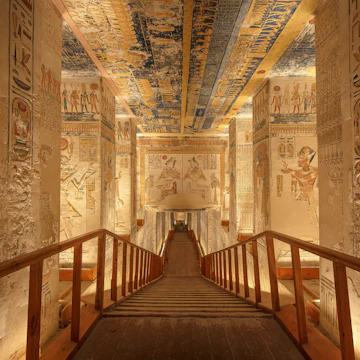
Once called the Great Necropolis of Millions of Years of Pharaoh, or the Place of Truth, the Valley of the Kings has 63 magnificent royal tombs from the New Kingdom period (1550–1069 BC), all very different from each other. The West Bank had been the site of royal burials from the First Intermediate Period (2160–2025 BC) onwards. At least three 11th-dynasty rulers built their tombs near the modern village of Taref, northeast of the Valley of the Kings. The 18th-dynasty pharaohs, however, chose the isolated valley dominated by the pyramid-shaped mountain peak of Al-Qurn (The Horn). The secluded site enclosed by steep cliffs was easy to guard and, when seen from the Theban…
reviewed
-
B
Temple of Hatshepsut
The eyes first focus on the dramatic rugged limestone cliffs that rise nearly 300m above the desert plain, a monument made by nature, only to realize that at the foot of all this immense beauty lies a man-made monument even more extraordinary, the dazzling Temple of Hatshepsut. The almost modern-looking temple blends in beautifully with the cliffs from which it is partly cut, a marriage made in heaven.
reviewed
-
C
Luxor Museum
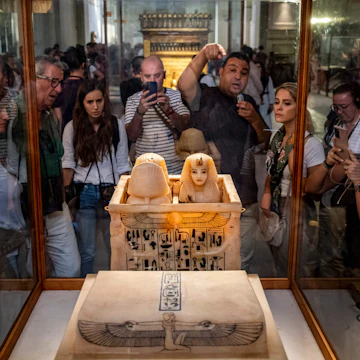
This wonderful museum has a beautifully displayed collection, from the end of the Old Kingdom right through to the Mamluk period, mostly gathered from the Theban temples and necropolis.
reviewed
-
Amun Temple Enclosure - Main Axis
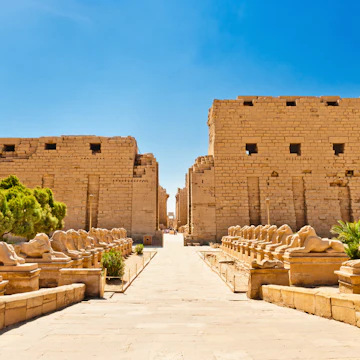
The most important place of worship at Karnak was the massive Amun Temple Enclosure (Precinct of Amun), dominated by the great Temple of Amun-Ra, which contains the famous hypostyle hall, a spectacular forest of giant papyrus-shaped columns. On its southern side is the Mut Temple Enclosure, once linked to the main temple by an avenue of ram-headed sphinxes. To the north is the Montu Temple Enclosure, which honoured the local Theban war god.
The 3km-long paved avenue of human-headed sphinxes that once linked the great Temple of Amun at Karnak with Luxor Temple, is now again being cleared.
The Quay of Amun was the dock where the large boats carrying the statues of the gods…
reviewed
-
D
Colossi of Memnon
The two faceless Colossi of Memnon that rise majestically about 18m from the plain are the first monuments tourists see when they visit the West Bank. The enthroned figures have kept a lonely vigil on the changing landscape, and few visitors have any idea that these giants were only a tiny element of the largest temple ever built in Egypt, Amenhotep III's memorial temple, believed to have covered an area larger than Karnak.
The pharaoh's memorial temple has now all but disappeared. It was built largely of mud brick on the flood plain of the Nile, where it was flooded every year. The walls simply dissolved after it was abandoned and no longer maintained, and later pharaohs…
reviewed
-
Amun Temple Enclosure - Southern Axis
The secondary axis of the Amun Temple Enclosure, running south from the third and fourth pylons, is a walled processional way from the seventh to the tenth pylon, leading to the Mut Temple Enclosure. The courtyard between the Hypostyle Hall and the seventh pylon, built by Tuthmosis III, is known as the cachette court, as thousands of stone and bronze statues were discovered here in 1903.
The priests had the old statues and temple furniture they no longer needed buried around 300 BC. Most statues were sent to the Egyptian Museum in Cairo, but some remained, standing in front of the seventh pylon, including four of Tuthmosis III on the left.
The well-preserved eighth pylon,…
reviewed
-
E
Temple of Seti I
At the northern end of the Theban necropolis lies the Temple of Seti I. Seti I (1294-1279 BC), who also built the superbly decorated temple at Abydos and Karnak's magnificent hypostyle hall, died before this memorial temple was finished, so it was completed by his son Ramses II. The temple sees few visitors, despite its picturesque location near a palm grove and recent restoration, after it was severely damaged by torrential rain and floods in 1994.
The entrance is through a small door in the northeast corner of the reconstructed fortresslike enclosure wall. The first and second pylon and the court are in ruins, but recent excavations have revealed the foundations of the…
reviewed
-
F
Temple of Merneptah
Almost directly behind Amenhotep's temple, lie the remains of the Temple of Merneptah, who succeeded his father Ramses II in 1213 BC and ruled for 10 years. In the 19th century, the 'Israel Stele', now in the Egyptian Museum in Cairo, was found here, which was the only Egyptian text to mention 'Israel' (which Merneptah claimed to have defeated). The Swiss Institute in Egypt has done considerable work here, uncovering the temple's original plan and a large number of statues and reliefs.
At the small museum near the entrance, the history of the temple is illustrated with text, plans and finds from excavations, a great help to understand the little that remains of the…
reviewed
-
G
Mummification Museum
Housed in the former visitors centre on Luxor’s Corniche, the small Mummification Museum has well-presented exhibits explaining the art of mummification. On display are the well-preserved mummy of a 21st-dynasty high priest of Amun, Maserharti, and a host of mummified animals. Vitrines show the tools and materials used in the mummification process – check out the small spoon and metal spatula used for scraping the brain out of the skull. Several artefacts that were crucial to the mummy’s journey to the afterlife have also been included, as well as some picturesque painted coffins. Presiding over the entrance is a beautiful little statue of the jackal god, Anubis, the…
reviewed
Advertisement
-
Qurna Discovery
These will be devoted to explaining the history of life on the hillside in the last millennia. The zawiya (a family meeting, ceremonial and religious building) houses the permanent collection of the early-19th-century British artist Robert Hay’s drawings of Gurna. These finely detailed works depict the ancient mudbrick structures and a way of life that are now lost, plus the famous tomb houses. The adjoining Daramalli house will be used to exhibit household objects and agricultural implements to show how Gurnawi families lived and worked. Historic photos will show the village and its residents as recorded from the 1850s to the 1950s. Entry to Qurna Discovery is free, but…
reviewed
-
Open-Air Museum
Off to the left (north) of the first court of the Amun Temple Enclosure is Karnak’s open-air museum. This museum is missed by most visitors but is definitely worth a look. The well-preserved chapels include the White Chapel of Sesostris I, one of the oldest and most beautiful monuments in Karnak, which has wonderful Middle Kingdom reliefs; the Red Chapel of Hatshepsut, its red quartzite blocks reassembled in 2000; and the Alabaster Chapel of Amenhotep I. The museum also contains a collection of statuary found throughout the temple complex.
reviewed
-
Tomb of Tutankhamen
Only one tomb, the Tomb of Tutankhamen, found in 1922 by Howard Carter, has so far been discovered intact. If you've seen Tutankhamen's treasures in the Cairo Museum, a visit to the simple tomb of this minor pharaoh helps indicate what unimaginable riches once attended the tombs of more illustrious pharaohs such as Tuthmosis I or Ramses II. The corridors and antechambers of the tombs of Sethos I and Ramses IX have some of the best wall paintings, while the tomb of Amenophis II, hidden in the escarpment, is the most exciting to visit. Many tombs are regrettably closed.
reviewed
-
H
Tombs of the Nobles
The tombs in this area are some of the best, but least visited, attractions on the West Bank. Nestled in the foothills opposite the Ramesseum, there are more than 400 tombs belonging to nobles from the 6th dynasty to the Graeco-Roman period. Where the pharaohs decorated their tombs with cryptic passages from the Book of the Dead to guide them through the afterlife, the nobles, intent on letting the good life continue after their death, decorated their tombs with wonderfully detailed scenes of their daily lives.
reviewed
-
The Ramesseum
Ramses II called his massive memorial temple ‘the Temple of Millions of Years of User-Maat-Ra’; classical visitors called it the Tomb of Ozymandias; and Jean-François Champollion, who deciphered hieroglyphics, called it the Ramesseum. Like other memorial temples it was part of Ramses II’s funerary complex. His tomb was built deep in the hills, but his memorial temple was on the edge of the cultivation on a canal that connected with the Nile and with other memorial temples.
reviewed
-
I
Luxor Temple
Largely built by the New Kingdom pharaohs Amenhotep III (1390–1352 BC) and Ramses II (1279–1213 BC), this temple is a strikingly graceful monument in the heart of the modern town. Visit early when the temple opens, before the crowds arrive or later at sunset when the stones glow. Whenever you go, be sure to return at night when the temple is lit up, creating an eerie spectacle as shadow and light play off the reliefs and colonnades.
reviewed
-
J
Carter's House
Surrounded by a garden on what is otherwise a barren hill, where the road from Deir al-Bahri to the Valley of the Kings meets the road from Seti I’s temple, stands the domed house where Howard Carter lived during his search for Tutankhamun’s tomb. The house has been decorated with pictures and tools of the excavation. A cafe is expected to open shortly, making this a peaceful place to stop for a refreshment.
reviewed
-
K
Deir al-Medina
About 1km off the road to the Valley of the Queens and up a short, steep paved road is Deir al-Medina, named after a temple that was occupied by early Christian monks. Near the temple is the ruined settlement, the Workmen’s Village. Many of the workers and artists who created the royal tombs lived and were buried here. Some of the small tombs have exquisite reliefs, making it worth a visit.
reviewed
-
Tutankhamun's Tomb
The story of the celebrated discovery of the famous tomb and all the fabulous treasures it contained far outshines its actual appearance. The tomb is small and bears all the signs of a rather hasty completion and inglorious burial. The son of Akhenaten by a minor wife, he ruled briefly (1336-1327 BC) and died young, with no great battles or buildings to his credit, so there was little time to build a tomb.
reviewed
-
Temple of Merenptah
Almost directly behind Amenhotep’s temple lie the remains of the Temple of Merenptah, who succeeded his father Ramses II in 1213 BC and ruled for 10 years. In the 19th century, the ‘Israel Stele’, now in the Egyptian Museum in Cairo, was found here, which is the only known Egyptian text to mention ‘Israel’ (which Merenptah claimed to have defeated).
reviewed
Advertisement
-
Mntophaat
This group of tombs, located near Deir al-Bahri, belongs to 18th-dynasty nobles, and 25th- and 26th-dynasty nobles under the Nubian pharaohs. The area is under excavation by archaeologists, but of the many tombs here only some are open to the public, including the Mntophaat; tickets are available at the ticket office of the Deir al-Bahri Temple.
reviewed
-
Medinat Habu
Ramses III’s magnificent memorial temple of Medinat Habu is perhaps one of the most underrated sites on the West Bank. With the Theban mountains as a backdrop and the sleepy village of Kom Lolah in front, it is a wonderful place to spend a few hours late afternoon.
reviewed
-
L
Valley of the Queens
There are at least 75 tombs in the Valley of the Queens. They belonged to queens of the 19th and 20th dynasties and other members of the royal families, including princesses and the Ramesside princes.
reviewed
-
Pabasa
The tomb of Pabasa, a 26th-dynasty priest, has wonderful scenes of agriculture, hunting and fishing. Entry tickets are available at the ticket office of the Deir al-Bahri Temple.
reviewed