go to content go to search box go to global site navigation

Cairo

Sights in Cairo

‹ Prev

of 6

  1. A

    Al-Azhar Park

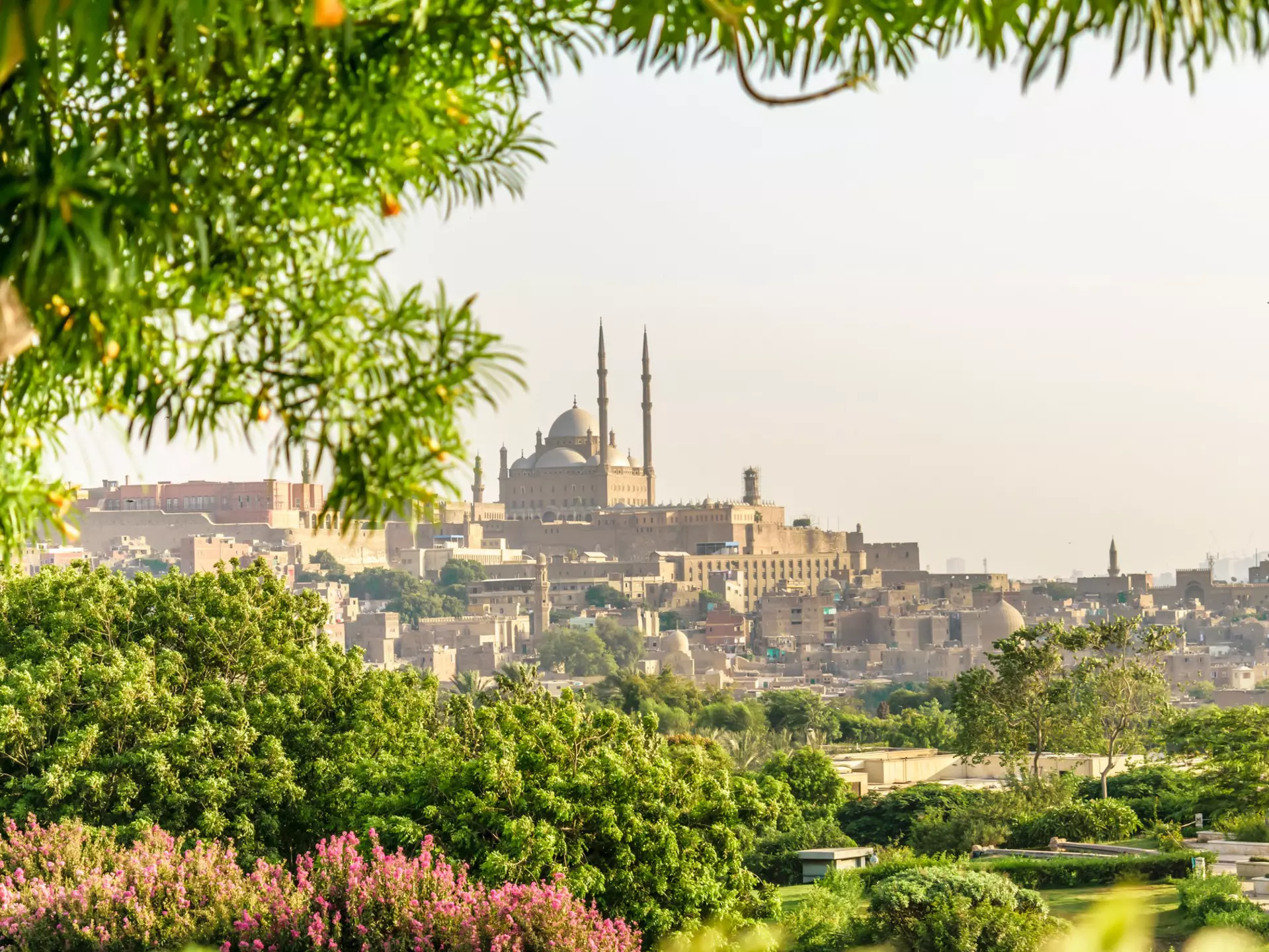
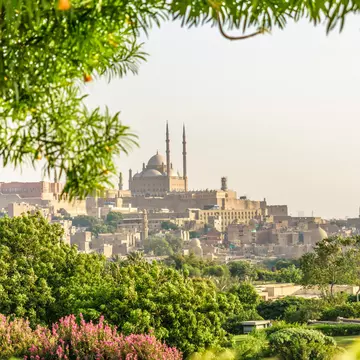
    Islamic Cairo’s eastern horizon changed substantially when Al-Azhar Park opened in 2005. With funds from the Aga Khan Trust for Culture, what had been a mountain of centuries’ worth of collected garbage was transformed into a beautifully landscaped swath of green, the city’s first (and only) park of significant size. It’s hard to convey just how dramatically different the park is from any other public space in Cairo: a profusion of gardens, emerald grass, even a lake (part of a larger public water-supply system) cover the grounds, while ambient Arabic music drifts softly from speakers and fountains bubble in front of sleek modern Islamic architecture. In addition to a…

    reviewed

  2. B

    Mosque of Ibn Tulun

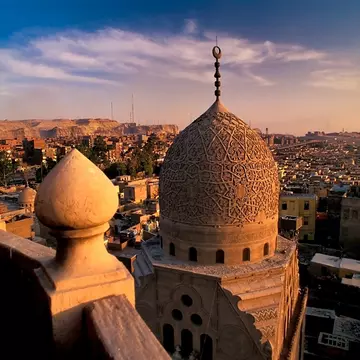
    Another 250m west on Sharia as-Salbiyya, the Mosque of Ibn Tulun is easily identified by its high walls topped with neat crenulations that resemble a string of paper dolls. Built between AD 876 and 879 by Ibn Tulun, who was sent to rule the outpost of Al-Fustat in the 9th century by the Abbasid caliph of Baghdad, it is the city’s oldest intact, functioning Islamic monument. It’s also one of its most beautiful, despite a rather ham-fisted restoration using cement on the mud-brick-and-timber structure. Ibn Tulun drew inspiration from his homeland, particularly the ancient Mosque of Samarra (Iraq), on which the spiral minaret is modelled. He also added some innovations of…

    reviewed

  3. Bent Pyramid

    Experimenting with ways to create a true, smooth-sided pyramid, Sneferu's architects began with the same steep angle and inward-leaning courses of stone they used to create step pyramids. When this began to show signs of stress and instability around halfway up its eventual 105m height, they had little choice but to reduce the angle from 54 degrees to 43 degrees and begin to lay the stones in horizontal layers. This explains why the structure has the unusual shape that gives it its name.

    Most of its outer casing is still intact, and inside (closed to visitors) are two burial chambers, the highest of which retains its original ancient scaffolding of great cedar beams to…

    reviewed

  4. Red Pyramid

    The world's oldest true pyramid is the North Pyramid, which is better known as the Red Pyramid. It derives its name either from the red tones of its weathered limestone, after the better-quality white limestone casing was removed, or perhaps from the red graffiti and construction marks scribbled on its masonry in ancient times.

    Having learnt from their experiences building the Bent Pyramid, the same architects carried on where they had left off, building the Red Pyramid at the same 43-degree angle as the Bent Pyramid's more gently inclining upper section. The entrance - via 125 extremely steep stone steps and a 63m-long passage - takes you down to two antechambers with…

    reviewed

  5. C

    Northern Cemetery

    The Northern Cemetery is the more interesting half of a vast necropolis known popularly as the City of the Dead. The titillating name refers to the fact that the cemeteries are not only resting places for Cairo's dead, but for the living too. Visitors expecting morbid squalor may be disappointed; the area, complete with power lines, a post office and multistorey buildings, is more 'town' than 'shanty'.

    Some estimates put the number of living Cairenes here at 50,000; others, at 10 times this number. As Max Rodenbeck notes in Cairo: The City Victorious, some of the tomb dwellers, especially the paid guardians and their families, have lived here for generations. Others have…

    reviewed

  6. Zoser's Funerary Complex

    The hypostyle hall leads into the Great South Court, a huge open area flanking the south side of the pyramid, with a section of wall featuring a frieze of cobras. The cobra, or uraeus, represented the goddess Wadjet, a fire-spitting agent of destruction and protector of the pharaoh. It was a symbol of Egyptian royalty, and a rearing cobra always appeared on the brow of a pharaoh's headdress or crown.

    Near the base of the pyramid is an altar, and in the centre of the court are two stone B-shaped boundary markers, which delineated the ritual race the pharaoh had to run, a literal demonstration of his fitness to rule. The race was part of the Jubilee Festival, or Heb-Sed,…

    reviewed

  7. Pyramid of Unas

    What appears to be another big mound of rubble to the southwest of Zoser's funerary complex, is actually the 2375-2345 BC Pyramid of Unas, the last pharaoh of the 5th dynasty. Built only 300 years after the inspired creation of the Step Pyramid, this unassuming pile of loose blocks and debris once stood 43m high.

    From the outside, the Pyramid of Unas is not much to look at, though the interior marked the beginning of a significant development in funerary practices. For the first time, the royal burial chamber was decorated, its ceiling adorned with stars and its white alabaster-lined walls inscribed with beautiful blue hieroglyphs.

    The aforementioned hieroglyphs are the…

    reviewed

  8. Step Pyramid

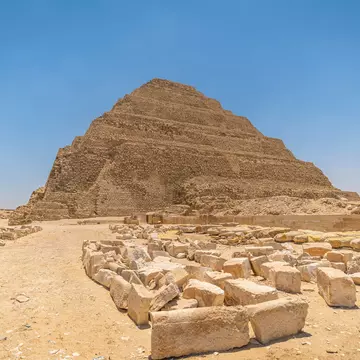
    In the year 2650 BC, Imhotep, the pharaoh's chief architect (later deified), built the Step Pyramid for Zoser. It is Egypt's (and the world's) earliest stone monument, and its significance cannot be overstated. Previously, temples were made of perishable materials, while royal tombs were usually underground rooms topped with mud-brick mastabas. However, Imhotep developed the mastaba into a pyramid and built it in hewn stone. From this flowed Egypt's later architectural achievements.

    The pyramid was transformed from mastaba into pyramid through six separate stages of construction and alteration. With each stage, the builders gained confidence in their use of the new medium…

    reviewed

  9. D

    Serapeum

    The Serapeum, which is dedicated to the sacred Apis bull, is one of the highlights of visiting Saqqara. The Apis bulls were by far the most important of the cult animals entombed at Saqqara. The Apis, it was believed, was an incarnation of Ptah, the god of Memphis, and was the calf of a cow struck by lightning from heaven. Once divinely impregnated, the cow could never again give birth, and her calf was kept in the Temple of Ptah at Memphis and worshipped as a god.

    The Apis was always portrayed as black, with a distinctive white diamond on its forehead, the image of a vulture on its back and a scarab-shaped mark on its tongue. When it died, the bull was mummified on one…

    reviewed

  10. Tombs of Mereruka & Ankhmahor

    Near the Pyramid of Teti is the tomb of his highest official, Mereruka, vizier and overseer of priests. It's the largest Old Kingdom courtier's tomb, with 32 chambers covering an area of 1000 sq metres. The 17 chambers on the eastern side belong to Mereruka, and include a magnificent six-columned offering hall featuring a life-size statue of Mereruka appearing to walk right out of the wall to receive the offerings brought to him.

    Other rooms are reserved for Mereruka's wife, Princess Seshseshat (Teti's daughter), and their eldest son, Meriteti (whose name means 'Beloved of Teti'). Much of the tomb's decoration is similar to that of the Mastaba of Ti, with an even greater…

    reviewed

  11. Advertisement

  12. Giza Pyramids

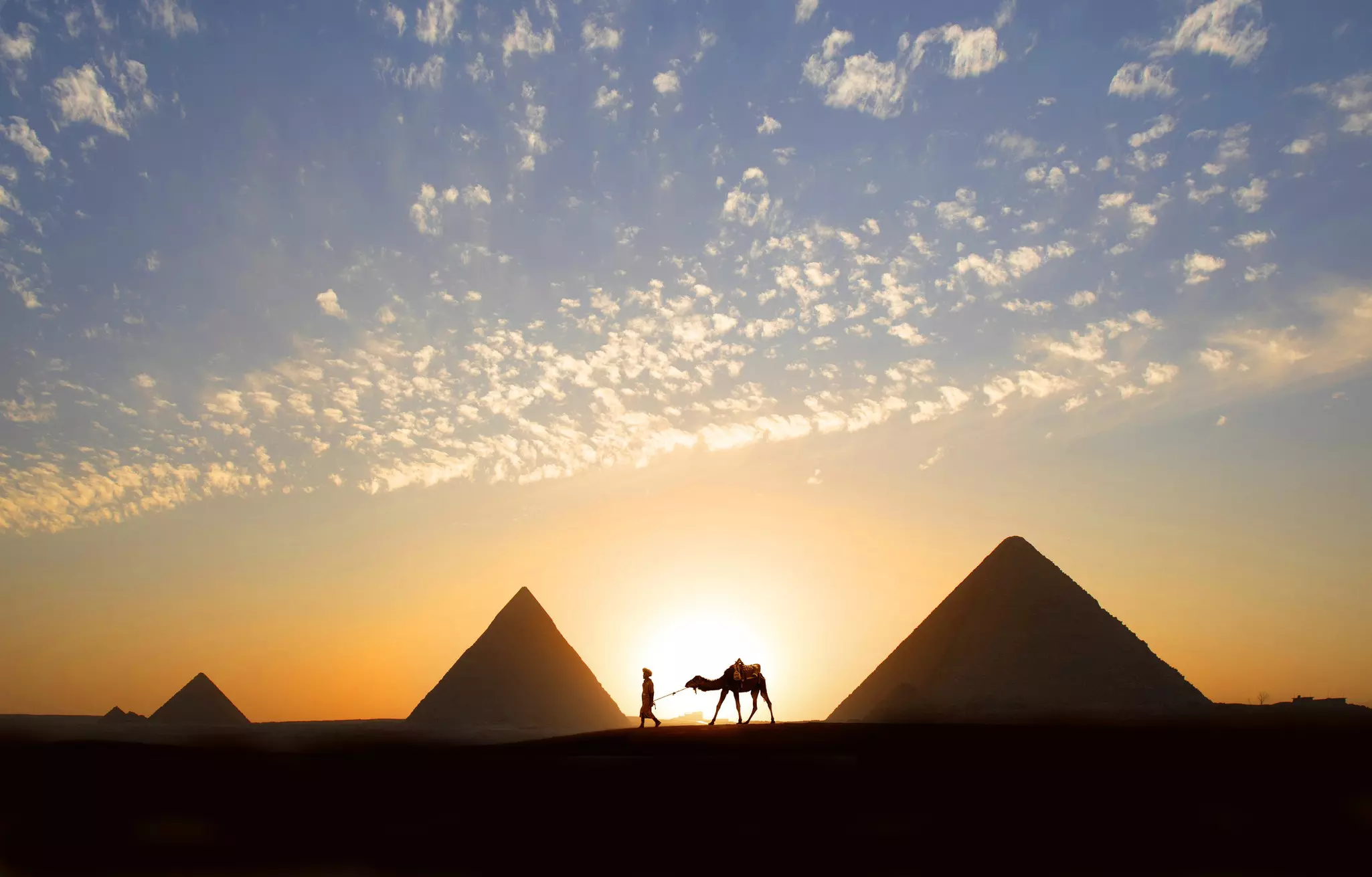
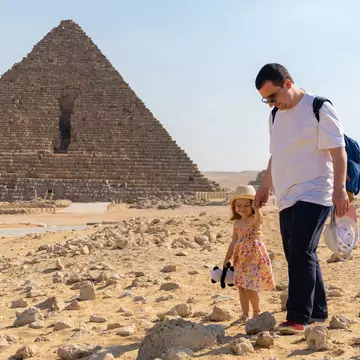
    The sole survivor of the Seven Wonders of the World, the Pyramids of Giza still live up to more than 4000 years of hype. Their extraordinary shape, geometry and age render them somehow alien constructions; they seem to rise out of the desert and pose the ever-fascinating question, 'How were we built, and why?'.

    Centuries of research have given us parts of the answer to this double-barrelled question. We know they were massive tombs constructed on the orders of the pharaohs by teams of workers tens-of-thousands strong. This is supported by the discovery of a pyramid-builders' settlement, complete with areas for large-scale food production and medical facilities. Ongoing…

    reviewed

  13. E

    Mastaba of Ti

    Northeast of the Philosophers' Circle is the Mastaba of Ti, which was discovered by Mariette in 1865. It is perhaps the grandest and most detailed private tomb at Saqqara, and one of our main sources of knowledge about life in Old Kingdom Egypt. Its owner, Ti, was overseer of the Abu Sir pyramids and sun temples (among other things) during the 5th dynasty. In fact, the superb quality of his tomb is in keeping with his nickname, Ti the Rich.

    Like Zoser, a life-size statue of the deceased stands in the tomb's offering hall (as with the Zoser statue, the original is in the Egyptian Museum). Ti's wife, Neferhetpes, was priestess and 'royal acquaintance'. Together with their…

    reviewed

  14. Dahshur

    South of Saqqara in a quiet bit of desert, Dahshur is an impressive field of 4th- and 12th-dynasty pyramids. The site was an off-limits military zone until mid-1996, remains free of large tour buses. Although the rhomboidal Bent Pyramid can only be admired from outside, the interior of the wonderful Red Pyramid is open to visitors.

    Many cluey travellers are choosing to visit Dahshur instead of the Giza Plateau for three reasons: the pyramid is just as impressive as its counterparts at Giza, the site is much more peaceful and the entry fee here is significantly cheaper.

    There were originally 11 pyramids at Dahshur, although only the two Old Kingdom ones (the Bent and Red…

    reviewed

  15. Serdab

    A stone structure right in front of the pyramid, the serdab (a small room containing a statue of the deceased to which offerings were presented) contains a slightly tilted wooden box with two holes drilled into its north face. Look through these and you'll have the eerie experience of coming face to face with Zoser himself. Inside is a near-life-size, lifelike painted statue of the long-dead pharaoh, gazing stonily out towards the stars.

    It's worth noting that this statue is only a copy - the original statue is in Cairo's Egyptian Museum. The original entrance to the Step Pyramid is directly behind the serdab, and leads down to a maze of subterranean tunnels and chambers…

    reviewed

  16. F

    Mosque of Mohammed Ali

    The fortress - and indeed, the Cairo skyline - is dominated by the Mosque of Mohammed Ali. Modelled along classic Turkish lines, it took 18 years to build (1830-48) although the domes later had to be rebuilt. Perhaps the most evocative description of it is in Olivia Manning's The Levant Trilogy: 'Above them Mohammed Ali's alabaster mosque, uniquely white in this sand-coloured city, sat with minarets pricked, like a fat, white, watchful cat'.

    Manning is not alone in not taking the mosque as seriously as Mohammed Ali intended. It has never found much favour with writers, who have criticised it for being unimaginative, lacking in grace and resembling a great toad. Beyond…

    reviewed

  17. G

    Mosque of Qaitbey

    Sultan Qaitbey, a prolific builder, was the last Mamluk leader with any real power in Egypt. He ruled for 28 years and, though he was as ruthless as any Mamluk sultan, he was also something of an aesthete. The Mosque of Qaitbey, completed in 1474 and depicted on the around £E1 note, is widely agreed to mark the pinnacle of Islamic building in Cairo.

    The façade has bold stripes and the interior has four iwans around a central court lit by large, lattice-screened windows. Featuring loads of marble, it's one of the most pleasant places in Cairo to sit for a while and relax.

    The adjacent tomb chamber contains the cenotaphs of Qaitbey and his two sisters, as well as two…

    reviewed

  18. Tomb of Akhethotep & Ptahhotep

    Akhethotep and his son Ptahhotep were senior royal officials during the reigns of Djedkare (2414-2375 BC) and Unas at the end of the 5th dynasty. Akhethotep served as vizier, judge, supervisor of pyramid cities and supervisor of priests, though his titles were eventually inherited by Ptahhotep, along with his tomb. The joint mastaba has two burial chambers, two chapels and a pillared hall.

    The painted reliefs in Ptahhotep's section are particularly beautiful, and portray a wide range of animals, from lions and hedgehogs to the domesticated cattle and fowl, that were brought as offerings to the deceased. Ptahhotep himself is portrayed resplendent in a panther-skin robe…

    reviewed

  19. H

    Saite & Persian Tombs

    Around the sides of the Pyramid of Unas are several large shaft tombs of the Saite (664-525 BC) and Persian (525-404 BC) eras. These are some of the deepest tombs in Egypt, although the precaution against grave robbers failed. However, the sheer size of the tombs and the great stone sarcophagi within, combined with their sophisticated decoration, demonstrate that the technical achievements of the later part of Egyptian history were equal to those of earlier times.

    To the north of the pyramid is the enormous tomb shaft of the Saite general Amun-Tefnakht. On the south side of the pyramid is a group of three Persian tombs - the entrance is covered by a small wooden hut to…

    reviewed

  20. I

    Mausoleum of Al-Ghouri

    On the south side of Sharia al-Azhar, opposite the khan, the grand Mosque-Madrassa of Al-Ghouri, with its red-chequered minaret, and the elegant Mausoleum of Al-Ghouri together form an exquisite monument to the end of the Mamluk era. Qansuh al-Ghouri, the penultimate Mamluk sultan, ruled for 16 years. At the age of 78, he rode to Syria at the head of his army to battle the Ottoman Turks. The head of the defeated Al-Ghouri was sent to Constantinople; his body was never recovered.

    His mausoleum (dating from 1505) contains the body of Tumanbey, his short-lived successor, hanged by the Turks at Bab Zuweila. The mausoleum, which has been under restoration for a number of…

    reviewed

  21. Pyramid of Sahure

    Sahure (2487-2475 BC) was the first of the 5th-dynasty pharaohs to be buried at Abu Sir, although his pyramid, originally 50m high, is now badly damaged. The entrance corridor is only half a metre high, and slopes down to a small room. From there, you can then walk through a 75m-long corridor before crawling 2m on your stomach through Pharaonic dust and spider webs to reach the burial chamber.

    The better-preserved remains of Sahure's funerary temple complex stand east of the pyramid. This must have been an impressive temple, with black basalt-paved floors, red granite date-palm columns and walls decorated with 10,000 sq metres of superbly detailed reliefs (some of these…

    reviewed

  22. Advertisement

  23. J

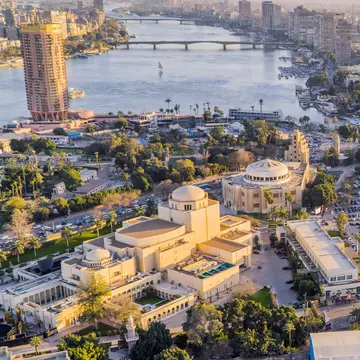
    Museum of Modern Egyptian Art

    Across from the Cairo Opera House, the Museum of Modern Egyptian Art houses a vast – perhaps too vast – collection of 20th- and 21st-century Egyptian art. It can be difficult to appreciate the work given the cramped rooms, collected dust and lack of signage. The museum’s prize items are all on the ground floor: Mahmoud Mukhtar’s deco-elegant bronze statue Bride of the Nile is here, along with Mahmoud Said’s Al Madina (The City, 1937). Though Said has a slew of kitschy imitators, he was one of the first artists to depict folk life in vivid colour, and his commitment inspired Naguib Mahfouz to pursue his own career in writing. Throughout the museum, it is…

    reviewed

  24. K

    Mosque-Madrassa of Sultan Hassan

    Massive yet elegant, the great structure of the Mosque-Madrassa of Sultan Hassan is regarded as the finest piece of early-Mamluk architecture in Cairo. It was built between 1356 and 1363 by the troubled Sultan Hassan, a grandson of Sultan Qalaun; he took the throne at the age of 13, was deposed and reinstated no less than three times, then assassinated shortly before the mosque was completed. Tragedy also shadowed the construction when one of the minarets collapsed, killing some 300 onlookers. Beyond the striking, recessed entrance, a dark passage leads into a square courtyard whose soaring walls are punctured by four iwan s (vaulted halls), one dedicated to teaching each…

    reviewed

  25. L

    Monastirli Palace

    Set in a peaceful Nileside garden, Monastirli Palace was built in 1851 for an Ottoman pasha whose family hailed from Monastir, in northern Greece. The salamlik that he built for public functions is now an elegant venue for concerts, while the other part is now the Umm Kolthum Museum (%2363 1467; Sharia al-Malek as-Salih, Rhoda; admission around £E2; h10:00-17:00).

    Dedicated to the most famous Arab diva, the small museum is more like a shrine, given the reverence with which the singer's signature rhinestone-trimmed glasses and glittery gowns are hung under spotlights in display cases. There's a multimedia room where you can listen to her music, and a short film shows key…

    reviewed

  26. M

    Abdeen Palace

    Begun in 1863 and employing Europe’s most lavish architects and designers, Abdeen Palace was a centrepiece of Khedive Ismail’s plan for a modern Cairo, inspired by Paris’ recent makeover; the khedive even called in mastermind French planner Baron Haussmann as a consultant. He wanted the palace finished for the 1869 opening of the Suez Canal, to impress visiting dignitaries, but its 500 rooms weren’t completed until 1874. It was the royal residence until the monarchy was abolished in 1952, then became the presidential palace. President Mubarak prefers his digs in Heliopolis, but uses Abdeen for official occasions. One section, though not the ritzy royal chambers, is open…

    reviewed

  27. N

    Gayer-Anderson Museum

    This quirky museum gets its current name from John Gayer-Anderson, the British major and army doctor who restored the two adjoining 16th-century houses between 1935 and 1942, filling them with antiquities, artworks and knick-knacks acquired on his travels in the region. On his death in 1945, Gayer-Anderson bequeathed the lot to Egypt. The puzzle of rooms is decorated in a variety of styles: the Persian Room has exquisite tiling, the Damascus Room has lacquer and gold, and the Queen Anne Room displays ornate furniture and a silver tea set. The enchanting mashrabiyya gallery looks down onto a magnificent qa’a (reception hall) which has a marble fountain, decorated ceiling…

    reviewed