go to content go to search box go to global site navigation

Czech Republic

Things to do in Czech Republic

  1. A

    National Memorial to the Victims of Post-Heydrich Terror

    In 1942 seven Czech paratroopers who were involved in the assassination of Reichs­protektor Reinhard Heydrich hid in the crypt of the Church of Sts Cyril & Methodius for three weeks after the killing, until their hiding place was betrayed by the Czech traitor Karel Čurda. The Germans besieged the church, first attempting to smoke the paratroopers out and then flooding the church with fire hoses. Three paratroopers were killed in the ensuing fight; the other four took their own lives rather than surrender to the Germans. The crypt now houses a moving memorial to the men, with an exhibit and video about Nazi persecution of the Czechs. In the crypt itself you can still see…

    reviewed

  2. Kladruby

    A Benedictine abbey was founded here in 1115 and, following repeated plundering in the Thirty Years' War, received a major facelift by prominent Bohemian artists Giovanni Santini and Kilian Ignatz Dientzenhofer. The main attraction is the Abbey Church of the Holy Virgin, rebuilt between 1712 and 1726 by Santini in an extraordinary 'baroque Gothic' style.

    The church has the original floor plan of a Romanesque basilica, the longest in Bohemia (85m/279ft). The church itself is an improbable marriage of baroque flamboyance and Gothic severity that would verge on tongue-in-cheek if it wasn't so beautiful. A standard tour includes the cloisters, with several dozen allegorical…

    reviewed

  3. B

    Týn Courtyard

    This picturesque courtyard tucked behind the Church of Our Lady Before Týn was originally a sort of medieval caravanserai – a fortified hotel, trading centre and customs office for visiting foreign merchants. Established as long ago as the 11th century, it was busiest and most prosperous during the reign of Charles IV. Now attractively renovated, the courtyard houses shops, restaurants and hotels. The courtyard is still often referred to by its German name, Ungelt (meaning ‘customs duty’).

    In the northwest corner is the 16th-century Granovsky Palace, with an elegant Renaissance loggia, and sgraffito and painted decoration depicting biblical and mythological scenes.…

    reviewed

  4. C

    Divoká Šárka

    The valley of the Šárecký potok (Šárka Creek), in the far western end of the city, is one of Prague’s best-known and most popular nature parks. People come here to sunbathe on the rocks, hike along the creek and even swim in an ice-cold public pool from June through August.

    reviewed

  5. D

    Petřín

    Most attractions atop this lookout point were built in the late 19th to early 20th century, creating a slightly innocent, fun-fair atmosphere. The huge stone fortifications that run from Újezd to Strahov, cutting across Petřín's peak, are different. This so-called Hunger Wall was built in 1362 under Charles IV, constructed by the city's poor in return for food under an early job-creation scheme.

    Once upon a time the hill was draped with vineyards, and you can still see the quarry that provided stone for most of Prague's Romanesque and Gothic buildings. Just south of the cable car terminus is Stefanik Observatory, where anyone can enjoy an enhanced view of a clear and…

    reviewed

  6. E

    Museum of Plzeň's Historical Underground

    The extraordinary Museum of Plzeň's Historical Underground is a web of passages under the town. The earliest were probably dug in the 14th century, perhaps for beer production or defence; the latest date from the 19th century. Of an estimated 11km excavated in the 1970s and '80s, some 500m is open to the public.

    Plzeň's wealthier set used to have wells in their cellars. Overuse led to severe water shortages until a municipal water system was established in the 15th century. When wells dried up they were often filled with rubbish and buried; these have yielded an amazing trove of artefacts. The tunnels are dotted with exhibits of wooden water pumps, mining tools, pewter,…

    reviewed

  7. F

    Přemysl Palace

    Pride of place goes to the remnants of the early 12th-century Přemysl Palace, originally built for Bishop Jindřich Zdík. A detailed English text walks you through a cloister with 15th and 16th century frescoes on the original walls up to the archaeological centrepiece, the bishops' rooms with their Romanesque walls and windows (rediscovered in 1867), and artistry unequalled elsewhere in the Czech Republic, even in Prague castle.

    Downstairs, surviving 16th century frescoes in the chapel of St John the Baptist (kaple sv Jana Křtitele), completed in 1262, include angels with instruments of torture (a sign of ecclesiastical approval?). To the left of the palace is the St…

    reviewed

  8. G

    Futura Gallery

    The Futura Gallery focuses on all aspects of contemporary art, ranging from painting, photography and sculpture to video, installations and performance art. In the garden, you'll find a rather shocking and amusing permanent installation by David Černý, called Brownnosers.

    reviewed

  9. H

    Story of Prague Castle

    Housed in the Gothic vaults beneath the Old Royal Palace, this huge and impressive collection of artefacts ranks alongside the Lobkowicz Palace as one of the most interesting exhibits in the castle. It traces 1000 years of the castle’s history, from the building of the first wooden palisade to the present day, illustrated by models of the site at various stages in its development.

    The exhibits include the grave of a 9th-century warrior discovered in the castle grounds, the helmet and chain mail worn by St Wenceslas, and replicas of the Bohemian crown jewels, including the gold crown of St Wenceslas, which was made for Charles IV in 1346 from the gold of the original…

    reviewed

  10. I

    Church of Our Lady of the Snows

    This Gothic church at the northern end of Wenceslas Square was begun in the 14th century by Charles IV, but only the chancel was ever completed, which accounts for its proportions – seemingly taller than it is long. Charles had intended it to be the grandest church in Prague; the nave is higher than that of St Vitus Cathedral, and the altar is the city’s tallest.

    It was a Hussite stronghold, ringing with the sermons of Jan Želivský, who led the 1419 defenestration that touched off the Hussite Wars. The church is approached through an arch in the Austrian Cultural Institute on Jungmannovo náměstí, but you can get a good view of the exterior from the neighbouring

    reviewed

  11. Advertisement

  12. J

    Italian Court

    Just east of St James Church (kostel sv Jakuba; 1330) lies the Italian Court, the former Royal Mint – it got its name from the master craftsmen from Florence brought in by Wenceslas II to kick-start the business, and who began stamping silver coins here in 1300. The oldest remaining part, the niches in the courtyard (now bricked up), were minters’ workshops. The original treasury rooms hold an exhibit on coins and minting. The guided tour (with English text) is worth taking for a look at the few historical rooms open to the public, notably a 15th-century Audience Hall with two impressive 19th-century murals depicting the election of Vladislav Jagiello as king of…

    reviewed

  13. K

    Basilica of St George

    The striking, brick-red, early-baroque facade that dominates St George Square conceals the Czech Republic’s best-preserved Romanesque church, established in the 10th century by Vratislav I (the father of St Wenceslas). The tiny baroque chapel beside the entrance is dedicated to St John of Nepomuk. What you see today is mostly the result of restorations made between 1887 and 1908.

    The austerity of the Romanesque nave is relieved by a baroque double staircase leading to the apse, where fragments of 12th-century frescoes survive. In front of the stairs lie the tombs of Prince Boleslav II (d 997; on the left) and Prince Vratislav I (d 921), the church’s founder. The arch…

    reviewed

  14. L

    Schwarzenberg Palace

    Sporting a beautifully preserved facade of black-and-white Renaissance sgraffito, the Schwarzenberg Palace houses the National Gallery’s collection of baroque art. Sadly, a lot of the paintings are poorly lit and suffer from reflections from nearby windows – a shame, as the inside of the palace itself is less impressive than the outside, and the collection is really only of interest to aficionados.

    The ground floor is given over to two masters of baroque sculpture, Matthias Braun and Maximilian Brokof, whose overwrought figures appear to have been caught in a hurricane, such is the liveliness of their billowing robes. The highlights of the 1st floor are the moody…

    reviewed

  15. M

    Kinský Palace

    The late-baroque Kinský Palace sports Prague’s finest rococo facade, completed in 1765 by the redoubtable Kilian Dientzenhofer. Today, the palace is home to a branch of the National Gallery, housing its collection of ancient and oriental art, ranging from ancient Egyptian tomb treasures and Greek Apulian pottery (4th century BC) to Chinese and Japanese decorative art and calligraphy.

    Alfred Nobel, the Swedish inventor of dynamite, once stayed in the palace; his crush on pacifist Bertha von Suttner (née Kinský) may have influenced him to establish the Nobel Peace Prize (she was the first woman laureate in 1905). Many older Praguers have a darker memory of the place,…

    reviewed

  16. N

    Klaus Synagogue

    The Klaus Synagogue houses a good exhibit on Jewish ceremonies of birth and death, worship and special holy days.

    reviewed

  17. O

    Šternberg Palace

    The baroque Šternberg Palace is home to the National Gallery’s collection of 14th- to 18th-century European art, including works by Goya and Rembrandt. Fans of medieval altarpieces will be in heaven; there are also several Rubens, some Rembrandts and Breughels, and a large collection of Bohemian miniatures.

    Pride of the gallery is the glowing Feast of the Rosary by Albrecht Dürer, an artist better known for his engravings. Painted in Venice in 1505 as an altarpiece for the church of San Bartolomeo, it was brought to Prague by Rudolf II; in the background, beneath the tree on the right, is the figure of the artist himself. For a bit of grotesque, snot-nosed realism,…

    reviewed

  18. P

    Museum of Communism

    It’s difficult to think of a more ironic site for a museum of communism – in an 18th-century aristocrat’s palace, between a casino on one side and a McDonald’s on the other. Put together by an American expat and his Czech partner, the museum tells the story of Czechoslovakia’s years behind the Iron Curtain in photos, words and a fascinating and varied collection of…well, stuff.

    The empty shops, corruption, fear and double-speak of life in socialist Czechoslovakia are well conveyed, and there are rare photos of the Stalin monument that once stood on Letná terrace – and its spectacular destruction. Be sure to watch the video about protests leading up to the…

    reviewed

  19. Q

    Old Town Bridge Tower

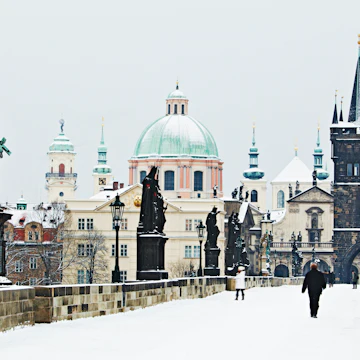
    Perched at the eastern end of Charles Bridge, this elegant late-14th-century tower was built not only as a fortification but also as a triumphal arch marking the entrance to the Old Town. Like the bridge itself, it was designed by Peter Parler and incorporates many symbolic elements. The main justification for paying the admission fee is the amazing view from the top of the tower.

    reviewed

  20. R

    Troja Chateau

    Troja Chateau is a 17th-century baroque palace built for the Šternberk family and filled with sculptures and frescoes. It houses collections of the Prague City Gallery. There’s free admission to the palace grounds, where you can wander in the beautiful French gardens, watched over by a gang of baroque stone giants on the balustrade outside the southern door.

    reviewed

  21. S

    Žerotínovo Náměstí

    Picturesque lanes thread northeast from Dolní nám to Žerotínovo Náměstí, named after the Žerotíns, a landowning family who set Velké Losiny's gruesome 17th-century witch trials in motion. Here you'll find the green-domed landmark of St Michael church (kostel sv Michala), with its robust baroque interior. Among the furnishings is a rare painting of a pregnant Virgin Mary. Wrapped around the entire block is an active Dominican seminary (Dominikánský klášter).

    Nearby is the tiny round Chapel of St Jan Sarkander (kaple sv Jana Sarkandra) named after a local priest who died under torture in 1620 for refusing to divulge false confessions. It's built on the site of…

    reviewed

  22. Advertisement

  23. T

    Casemates

    At the 19th-century Brick Gateon the northern side of the fortress you can see an exhibit explaining the history of Vyšehrad and Prague's other fortifications. Here you will also find the entrance to the Casemates, a system of vaulted brick tunnels beneath the ramparts. The largest of these is the barrel-vaulted Gorlice Hall, which served as an air-raid shelter and potato store during WWII. It now houses six of the original baroque statues from Charles Bridge, including St Ludmila with the Young St Wenceslas by Matthias Braun (the other originals are in the Lapidárium; see p131), as well as temporary art exhibitions in summer. The Casemates ticket also gives admission…

    reviewed

  24. U

    Brick Gate

    At the 19th-century Brick Gate, on the northern side of Vyšehrad, you can see an exhibit explaining the history of Vyšehrad and Prague’s other fortifications. Here you will also find the entrance to the Casemates (adult/child 30/20Kč), a system of vaulted brick tunnels beneath the ramparts. The largest of these is the barrel-vaulted Gorlice Hall, which served as an air-raid shelter and potato store during WWII. It now houses six of the original baroque statues from Charles Bridge, including St Ludmila with the Young St Wenceslas by Matthias Braun (the other originals are in the Lapidárium), as well as temporary art exhibitions in summer. The Casemates ticket also…

    reviewed

  25. V

    Slav Island

    This island is a sleepy, dog-eared sandbank with pleasant gardens, river views and several jetties where you can hire rowing boats. In the middle stands Žofín, a 19th-century cultural centre that has been restored and opened as a restaurant and social venue. In 1925 the island was named after the Slav conventions that had taken place here since 1848.

    The island's banks were reinforced with stone in 1784, and a spa and dye works were built in the early part of the following century. Bohemia’s first train had a demonstration run here in 1841, roaring down the island at a rattling 11km/h. At the southern end is Šitovská věž, a 15th-century water tower (once part of a…

    reviewed

  26. W

    Czech Silver Museum

    From the southern side of St James Church, a narrow cobbled lane (Ruthardská) leads down and then up to the Hrádek (Little Castle). Originally part of the town’s fortifications, it was rebuilt in the 15th century as the residence of Jan Smíšek, administrator of the royal mines, who grew rich from silver he illegally mined right under the building. It now houses the Czech Silver Museum. The exhibits celebrate the mines that made Kutná Hora wealthy, including a huge wooden device once used to lift loads weighing as much as 1000kg from the 200m-deep shafts. You can even don a miner’s helmet and lamp and join a 45-minute guided tour (adult/child 110/70Kč) through 500m…

    reviewed

  27. X

    V zátiší

    ‘Still Life’ is one of Prague’s top restaurants, famed for the quality of its cuisine. The decor is bold and modern, with quirky glassware, boldly patterned wallpapers and cappuccino-coloured crushed-velvet chairs. Of the 10 or so main courses on offer, four are seafood and the rest are meat – nothing vegetarian. There are also gourmet versions of traditional Czech dishes – the crispy roast duckling with red cabbage and herb dumplings is superb. If the three-course dinner is not enough, you can lash out on the five-course dégustation menu (1170Kč; plus 770Kč extra for wines to match the dishes).

    reviewed