Sights in Czech Republic
-
A
Church of Sts Peter & Paul
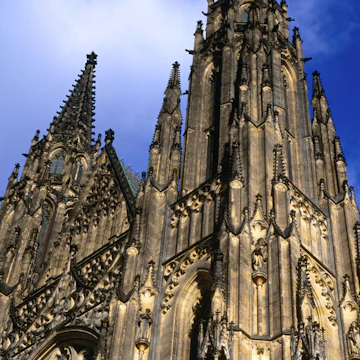
Vratislav II’s Church of Sts Peter & Paul has been built and rebuilt over the centuries, culminating in a neogothic work-over by Josef Mocker in the 1880s. The twin steeples, a distinctive feature of the Vyšehrad skyline, were added in 1903. The interior is a swirling acid trip of colourful Art Nouveau frescoes, painted in the 1920s by various Czech artists.
reviewed
-
B
Water Tower
At the end of Pražská is a stone water tower dating from 1530 and part of the first town water system (this tower supplied fountains in the square until the beginning of the 20th century).
Opposite is a former arcade of medieval butchers' stalls (masné krámy), which is now part of the West Bohemian gallery with its changing exhibits of modern Czech art.
reviewed
-
C
Stromovka
Stromovka, west of Výstaviště, is Prague’s largest park. In the Middle Ages, it was a royal hunting preserve, which is why it’s sometimes called the Královská obora (Royal Hunting Ground). Rudolf II had rare trees planted here and several lakes created. It’s now the preserve of strollers, joggers, cyclists and in-line skaters.
reviewed
-
D
Musaion
This renovated summer palace houses the National Museum’s ethnographic collection, with exhibits covering traditional Czech folk culture and art, including music, costume, farming methods and handicrafts. There are regular folk concerts and workshops demonstrating traditional crafts such as blacksmithing and woodcarving; in the summer months there’s a garden cafe.
reviewed
-
E
Dvořák Museum
The most striking building in the drab neighbourhood south of Ječná is the energetically baroque Vila Amerika, a 1720s, French-style summer house designed by (you guessed it) Kilian Dientzenhofer. It’s one of the city’s finest baroque buildings and now houses a museum dedicated to the composer Antonín Dvořák. Special concerts of Dvořák’s music are staged here from May to October.
reviewed
-
F
House at the Golden Ring
The restored Renaissance House at the Golden Ring, located at the corner of Týnská just outside the western entrance to Týn courtyard, contains another branch of the Prague City Gallery; the original painted ceiling beams can still be seen in some of the rooms. It also features a collection of Central European art from the second half of the 20th century.
reviewed
-
Telč Chateau
Like the cherry on a cake, Telč's Renaissance chateau, part of which is known as the Water Chateau, guards the north end of the peninsula. Rebuilt from the original Gothic structure in 1553-56 by Antonio Vlach and 1566-68 by Baldassare Maggi, the surviving structure remains in remarkably fine fettle, with immaculate lawns and beautifully kept interiors.
reviewed
-
G
Charles University Botanical Garden
Just south of Karlovo náměstí (main entrance on Na Slupi) is Charles University’s botanical garden. Founded in 1775 and moved from Smíchov to its present site in 1898, it’s the country’s oldest botanical garden. The steep, hillside garden concentrates on Central European flora and is especially pretty in spring.
reviewed
-
H
Exhibition Grounds
The Exhibition Grounds in the suburb of Pisárky (take tram 1 from the train station) were opened in 1928. They are now a year-round trade fair venue. In addition to the palace of Industry (Průmyslový palác) other interesting buildings include the Congress hall (Kongresová hala) and Bauhaus-style New house (Nový dům).
reviewed
-
I
Plečník Monolith
A noteworthy feature near St Vitus Cathedral is a huge granite monolith dedicated to the victims of WWI, designed by Slovene architect Jože Plečník in 1928. Nearby is a copy of the castle's famous statue of St George slaying the dragon; the original 14th-century bronze statue is now in the Story of Prague Castle exhibition.
reviewed
Advertisement
-
J
Tunnel
In 2002 an arty tunnel - red-brick and rather Freudian - was completed by architect Josef Pleskot beneath the castle's Powder Bridge, making a quirky alternative exit route from the castle. Turn west from the bridge's castle side and follow the footpath down into the moat to reach it. If you keep going, you'll reach Malostranská metro.
reviewed
-
K
St Wenceslas Cathedral
Adjacent to the museum, this cathedral, the seat of the Olomouc Archbishop, was originally a Romanesque basilica first consecrated way back in 1131. It was rebuilt several times before having a neo-Gothic makeover in the 1880s.There's a crypt inside that you can enter.
reviewed
-
L
Náprstek Museum
The small Náprstek Museum houses an ethnographical collection of Asian, African and American cultures, founded by Vojta Náprstek, a 19th-century industrialist with a passion for both anthropology and modern technology (his technology exhibits are now part of the National Technical Museum in Holešovice).
reviewed
-
M
Jan Palach Memorial
On 16 January 1969, university student Jan Palach set fire to himself and died in protest against the Soviet invasion of Czechoslovakia the preceding August. The exact spot the martyr fell is marked by a wooden cross in the pavement that seems to have suffered a small earthquake beneath it. The 16 January is now commemorated annually.
reviewed
-
N
West Bohemian Museum
The West Bohemian Museum fills a magnificent agglomeration of buildings. In the basement the original armoury (zbrojnice) features a weapons collection. The ground floor has changing exhibits, while on the 2nd floor the superb art-nouveau Jubilee Hall (Jubilejní sál) houses an exhibit of glass and porcelain.
reviewed
-
North Bohemia Fine Arts Gallery
Along Michalská at the southwest corner of Litoměřice's main square you’ll find a house where esteemed 18-th century architect Ottavio Broggio left his mark: the excellent North Bohemia Fine Arts Gallery, which features the priceless Renaissance panels of the Litoměřice Altarpiece.
reviewed
-
O
Mozart Museum
Mozart stayed at the elegant 17th-century Vila Bertramka during his visits to Prague in 1787 and 1791 as the guest of composer František Dušek – it was here that he finished his opera Don Giovanni. Today the house is a modest Mozart museum. Regular concerts are held in the salon and in the garden (April to October only).
reviewed
-
P
Prague Planetarium
The planetarium in Stromovka park, just west of Výstaviště, presents various slide and video presentations in addition to the star shows. Most shows are in Czech only, but one or two of the more popular ones provide a text summary in English (check the website for details). There’s also an astronomical exhibition in the main hall.
reviewed
-
Q
Budějovická Gate
To approach Krumlov Chateau from the north, go via the Budějovická Gate (1598); pass the post office and go through the Red gate (Červená brána) into the chateau's first courtyard. Below the entrance bridge are two brown (and pretty unhappy) bears, traditional residents since the 16th century.
reviewed
-
R
Maltese Square
References to the Knights of Malta around Malá Strana hark back to 1169, when that military order established a monastery in the Church of Our Lady Beneath the Chain on this square. Disbanded by the communists, the Knights have regained much property under post-1989 restitution laws, including the Lennon Wall.
reviewed
Advertisement
-
S
Historical Pharmacy Exhibition
Hradčany’s first pharmacy was opened here in 1749; the building, known as U zlatého lva (At the Golden Lion) retains original 19th-century fittings and houses a collection of pharmaceutical paraphernalia illustrating the history of pharmacy from Renaissance times up to the early 20th century.
reviewed
-
T
Church of the Assumption of the Virgin
Over Špilberk hill from the old town, on the corner of Úvoz and Pekařská, is the Church of the Assumption of the Virgin, Brno's finest late-Gothic building. Inside is the oldest painting on wood in the Czech Republic, the 13th-century black Madonna (černá Madona).
reviewed
-
U
Rotunda of the Holy Cross
This tiny Romanesque rotunda is one of Prague’s oldest buildings, starting out as a parish church in about 1100. Saved from demolition and restored in the 1860s by a collective of Czech artists, it still has the remnants of some 600-year-old wall frescoes, though you will have to attend Mass to see them.
reviewed
-
V
Public Transport Museum
The museum at the Střešovice tram depot has a large collection of trams and buses, from an 1886 horse-drawn tram to present-day vehicles. It’s a great place for kids as they can climb into some of the vehicles, and you can board a vintage tram for a sightseeing tour of the city.
reviewed
-
W
Gothic Cellar
The restored Gothic cellars that once lay beneath Charles IV’s palace (now gone) house an exhibition dedicated to the history and legend of Vyšehrad. It is packed with archaeological finds and religious relics associated with life in the fortress from 3800 BC until the present day.
reviewed