Things to do in Bayamo
-
A
Torre Desan Juan Evangelista
The Torre de San Juan Evangelista is to the southeast. A church dating from Bayamo’s earliest years stood at this busy intersection until it was destroyed in the great fire of 1869. Later, the church’s tower served as the entrance to the first cemetery in Cuba, which closed in 1919. The cemetery was demolished in 1940, but the tower survived. A monument to local poet José Joaquín Palma (1844–1911) stands in the park diagonally across the street from the tower, and beside the tower is a bronze statue of Francisco Vicente Aguilera (1821–77), who led the independence struggle in Bayamo.
reviewed
-
B
Iglesia Parroquial Mayor de San Salvador
The Iglesia Parroquial Mayor de San Salvador, is where the national anthem was first sung, in 1868. The plaque on the facade lists the orchestra members and their instruments in that famous debut, giving you an idea of how deep the cultural patrimony runs here. A mural painted at the front of the church in 1919 depicts the blessing of the flag by Céspedes on October 20, 1868. The only part of the building that survived the great fire of 1869, when retreating revolutionaries set fire to the town, is the striking Capilla de la Dolorosa. The chapel's main altar and the statue of the Virgen de los Dolores date from 1740.
reviewed
-
C
Museo Ñico López
The Museo Ñico López is in the former officers’ club of the Carlos Manuel de Céspedes military barracks. On July 26, 1953, this garrison was attacked by 25 revolutionaries in tandem with the assault on Moncada Barracks in Santiago de Cuba in order to prevent reinforcements from being sent. Though a failure, Ñico López, who led the Bayamo attack, escaped to Guatemala, and he was the first Cuban to befriend Ernesto ‘Che’ Guevara in 1954. López was killed shortly after the Granma landed in 1956.
reviewed
-
D
Parque Céspedes
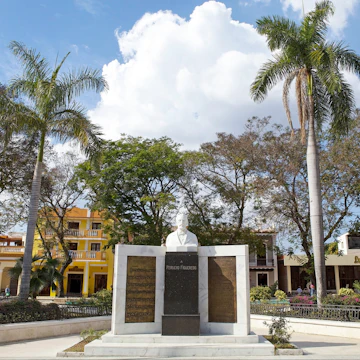
Parque Céspedes, one of Cuba's leafiest and most hassle-free squares, is an attractive smorgasbord of grand monuments and big, shady trees. There's a bronze statue of Carlos Manuel de Céspedes, hero of the First War of Independence, and a marble bust of Perucho Figueredo, with the words of the Cuban national anthem carved upon it. Marble benches and friendly Bayameses (Bayamo citizens) make this a nice place to linger. In 1868 Céspedes proclaimed Cuba's independence in front of the Ayuntamiento (city hall) on the east side of the square.
reviewed
-
E
Casa de Estrada Palma
In 1835, Cuba’s first postindependence president, Tomás Estrada Palma, was born here. A one-time friend of José Martí, Estrada Palma was disgraced after the Revolution for his perceived complicity with the US over the Platt Amendment. His birth house is now the seat of Uneac (Unión Nacional de Escritores y Artistas de Cuba; National Union of Cuban Writers and Artists), but you’ll find little about the famous former occupant inside.
reviewed
-
F
Casa Natal de Carlos Manuel de Céspedes
The birthplace of the ‘father of the motherlands,’ Casa Natal de Carlos Manuel de Céspedes, is on the north side of the park. Born here on April 18, 1819, Céspedes spent the first 12 years of his life in this residence, and the Céspedes memorabilia inside is complemented by a collection of period furniture. It’s notable architecturally as the only two-story colonial house remaining in Bayamo and was one of the few buildings to survive the 1869 fire.
reviewed
-
G
La Bodega
The best of both worlds. The front door opens out onto Bayamo’s main square; the rear terrace overlooks Río Bayamo and is fringed by a bucolic backdrop that will leave you wondering if you’ve been transported to an isolated country villa. La Bodega is Bayamo’s best restaurant and not only for its urban-rural juxtapositions. Try the beef and taste the coffee, or relax on the open terrace before the traveling troubadours arrive at 9pm.
reviewed
-
H
Ventana de Luz Vázquez
A forerunner of the national anthem, co-written by Céspedes (and also, confusingly, called ‘La Bayamesa’) was first sung from the Ventana de Luz Vázquez on March 27, 1851. A memorial plaque has been emblazoned onto the wall next to the wood-barred colonial window.
reviewed
-
I
Centro Cultural Los Beatles
Just as the West fell for the exoticism of the Buena Vista Social Club, the Cubans fell for the downright brilliance of the Fab Four. Guarded by life-size statues of John, Paul, George and Ringo, this quirky place hosts Beatles tribute bands (in Spanish) every weekend. Unmissable!
reviewed
-
Museo de Cera
The tiny Museo de Cera, Bayamo’s version of Madame Tussaud’s, has convincing waxworks of personalities such as Polo Montañez, Benny Moré and local hero Carlos Puebla. Next door is an equally tiny Museo de Arqueología.
reviewed
Advertisement
-
J
La Sevillana
Cuban chefs have a go at Spanish cuisine – paella and garbanzos (chickpeas). This is a new kind of peso restaurant, with a dress code (no shorts), a doorman in a suit, and a reservations policy. It’s OK, if you don’t mind the formalities.
reviewed
-
K
Restaurante Vegetariano
Manage your expectations before you check out this peso place. This is Cuba where vegetarianismo is still in its infancy. Don’t expect nut roast, but you should be able to order something other than the ubiquitous omelette.
reviewed
-
L
Academia de Ajedrez
The Academia de Ajedrez is the place to go to improve your pawn-king-four technique. Emblazoned on the wall of this cerebral institution, pictures of Che, Fidel and Carlos Manuel de Céspedes offer plenty of inspiration.
reviewed
-
M
Uneac
You can catch heartfelt boleros on the flowery patio here in the former home of disgraced first president Tomás Estrada Palma, who is largely blamed for handing Guantánamo to the Yanquis.
reviewed
-
N
Paladar Sagitario
The Sagitario’s been in the game for 13 years, knocking out such delicacies as chicken cordon bleu and pork chops topped with cheese on an attractive back patio with occasional musical accompaniment.
reviewed
-
O
Sala Teatro José Joaquín Palma
In a stylish old church, this venue presents theater on Friday, Saturday and Sunday nights, while the Teatro Guiñol, also here, hosts children’s theater on Saturday and Sunday mornings.
reviewed
-
P
La Victoria
Despite the sign, you won't find shrimp at this atmospheric, state-run place on the northeastern corner of Parque Céspedes. However, there are pork, chicken and even beef dishes.
reviewed
-
Q
Cine Céspedes
This cinema is on the western side of Parque Céspedes, next to the post office. It offers everything from Gutiérrez Alea to the latest Hollywood blockbuster.
reviewed
-
R
Cabaret Bayamo
Bayamo’s glittery nightclub/cabaret opposite the Hotel Sierra Maestra draws out the locals on weekends in their equally glittery attire.
reviewed
-
S
Museo Provincial
The Museo Provincial has a yellowing city document dating from 1567 and a rare photo of Bayamo immediately after the fire.
reviewed
Advertisement
-
T
Tropi Crema
In the absence of a Coppelia, the Tropi, on the southwest corner of Parque Céspedes, does its best – in pesos, of course.
reviewed
-
U
Estadio Mártires de Barbados
From October to April, there are baseball games at this stadium, approximately 1km northeast of the Hotel Sierra Maestra.
reviewed
-
V
Plaza Restaurant
The restaurant at the Hotel Royalton is Bayamo's 'upmarket' spot, serving traditional Cuban food on its pleasant patio.
reviewed
-
W
La Taberna
For something grittier, try this dark, 2nd-floor saloon with faux stained-glass; it's tucked away behind Tropi Crema.
reviewed
-
X
Mercado agropecuario
The vegetable market is in front of the train station. There are many peso food stalls along here also.
reviewed