Things to do in Split
-
A
Cathedral of St Domnius
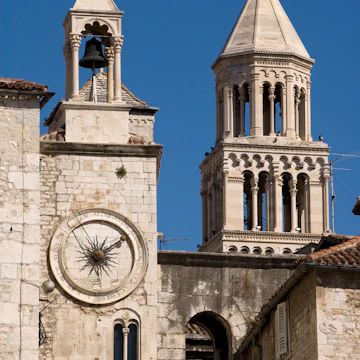
This cathedral was originally built as Diocletian's mausoleum. The original octagonal form of the mausoleum, encircled by 24 columns, has been almost completely preserved. The domed interior is round with two rows of Corinthian columns and a frieze showing Emperor Diocletian and his wife, Prisca. The Romanesque belfry was constructed between the 12th and 16th centuries and reconstructed in 1908 after it collapsed. Notice the two lion figures at the foot of the belfry and the Egyptian black-granite sphinx dating from the 15th century BC on the right wall.
The oldest monuments in the cathedral are the remarkable scenes on the wooden entrance doors from the life of Christ. …
reviewed
-
B
Peristyle
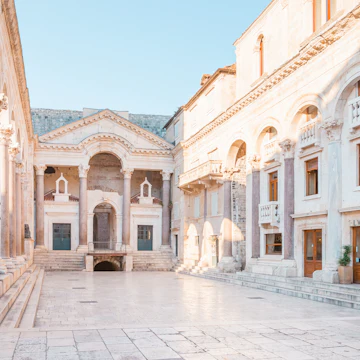
Peristyle is the ceremonial entrance court to the imperial quarters, measuring 35m by 13m and three steps below the level of the surrounding streets. The longer side is lined by six granite columns, linked by arches and decorated with a stone frieze. The southern side of the Peristyle is enclosed by the Protiron, which is the entrance into the imperial quarters. The square has an outdoor café and the ancient stones provide handy seats to relax and people-watch in this popular meeting place.
reviewed
-
C
Gregorius of Nin Statue
An imposing statue of the 10th-century Croatian bishop who fought for the right to use old Croatian in liturgical services. Sculpted by Ivan Meštrović, this powerful work is one of the defining images of Split. Notice that his left big toe has been polished to a shine. It's said that touching it brings good luck. To the west of the statue is the well-preserved corner tower of the palace.
reviewed
-
D
Marjan Hill
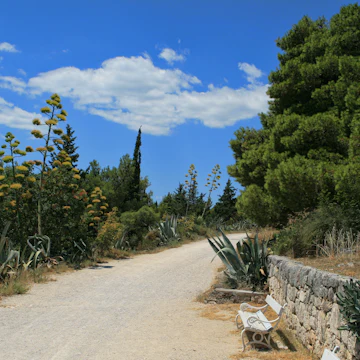
From the Meštrović Gallery it's possible to hike straight up Marjan Hill (123m). Go up Tonća Petrasova Marovića on the western side of the gallery and continue straight up the stairway to Put Meja. Turn left and walk west to Put Meja 76. The trail begins on the western side of this building. Marjan Hill offers trails through the forest, lookouts and old chapels.
reviewed
-
E
Buffet Fife
Dragomir presides over a motley crew of sailors and misfits who drop in for the simple, savoury home cooking (especially the pašticada; beef stuffed with lard and roasted in wine and spices) and his own brand of hospitality.
reviewed
-
F
Golden Gate
The Golden Gate was once the starting point for the road to Solin. From the fragments that remain, it's possible to visualise the statues, columns and arches that once decorated the gate.
reviewed
-
G
Diocletian's Palace
Facing onto the harbour, Diocletian's Palace is one of the most imposing Roman ruins in existence. Although the original structure was modified in the Middle Ages, the alterations have only served to increase the allure of this fascinating site. Far from being a museum, the 220 buildings within the palace boundaries are home to about 3000 people. The cellars are a market for crafted jewellery, reproductions of Roman busts, silver cigarette cases, candlestick holders, wooden sailing ships, leather goods and other odds and ends.
The palace was built from lustrous white stone from the island of Brač and construction lasted 10 years. Diocletian spared no expense, importing m…
reviewed
-
Croatia Cycle Adventure
10 days (Split)
An island hopping cycle adventure along Croatia's magical Dalmatian coast.
Not LP reviewed
from USD$2,260 -
H
Temple of Jupiter
At the end of the street Kraj Sveti Ivana is the Temple of Jupiter, later converted into a baptistry. The temple once had a porch supported by columns, but the one column you see dates from the 5th century. The headless sphinx in black granite guarding the entrance was imported from Egypt at the time of the temple's construction in the 5th century. The walls of the temple support a barrel-vaulted ceiling and there's a decorative frieze around the other three walls. Below the temple is a crypt, which was once used as a church.
reviewed
-
I
Papalić Palace
The Papalić Palace comes complete with a courtyard, loggia and external staircase. Built by Dalmatinac for one of the many noblemen who lived within the palace in the Middle Ages, it is considered a fine example of late-Gothic style with an elaborately carved entrance gate that proclaimed the importance of its original inhabitants. The exterior of the palace is closer to its original state than the interior, which has been thoroughly restored to house the Town Museum.
reviewed
Advertisement
-
J
Restaurant Šumica
For a splurge you couldn't do better than this place. The pasta is home-made and is combined with salmon or other fish in imaginative sauces. The grilled scampi is perfection, but you pay a steep around HRK380 per kilogram. Before your meal you'll be served a dish of home-made fish pâté with bread to whet your appetite. Meals are served on an open-air terrace under pine trees with a view of the sea.
reviewed
-
K
Arheološki Muzej
Although it's north of the town centre, the Archaeological Museum is worth the walk. The emphasis is on the Roman and early Christian period, with exhibits devoted to burial sculpture and excavations at Salona. The quality of the sculpture is high, and there are interesting reliefs based on Illyrian mythical figures. There's also jewellery, ceramics and coins on display.
reviewed
-
L
Meštrović Gallery
Split's finest art museum is the Meštrović Gallery. You'll see a comprehensive, well-arranged collection of works by Ivan Meštrović, Croatia's premier modern sculptor, who built the gallery as a personal residence in 1931-39. Although Meštrović intended to retire here, he emigrated to the USA soon after WWII.
reviewed
-
M
Town Museum
Town Museum. Captions are in Croatian, but wall panels in a variety of languages provide a historical framework for the exhibits. The museum has three floors, with drawings, heraldic coats of arms, 17th-century weaponry, fine furniture, coins and documents from as far back as the 14th century.
reviewed
-
N
Croatian National Theatre
During winter, opera and ballet are presented here. The best seats cost about around HRK60 and tickets for the same night are usually available. Erected in 1891, the theatre was fully restored in 1979 in the original style; it's worth attending a performance for the architecture alone.
reviewed
-
O
Museum of Croatian Archaeological Monuments
The Museum of Croatian Archaeological Monuments concentrates on medieval Croatian rulers, with inscribed stone fragments, parts of altars and furniture, late medieval tombstones, swords and jewellery. Captions are in Croatian, however, which makes it difficult to identify the exhibits.
reviewed
-
P
Bekan
Bekan serves an array of fish prepared Dalmatian style. It's not cheap (unless you order the spaghetti with seafood for around HRK52), but you can sample a savoury shrimp buzara (a sauce of tomatoes, white wine, onions and breadcrumbs) on an airy terrace overlooking the sea.
reviewed
-
Q
St Benedict Church
Here are the remains of the pre-Romanesque church of St Benedict with the 15th-century Chapel of Arnir. Peer through the protective glass and you'll see the altar slab and altar sarcophagus carved by the early Renaissance master Juraj Dalmatinac.
reviewed
-
R
Split Daily Market
At this daily market you can buy fruit, vegetables, shoes, confectionery, clothing, can openers, flowers, souvenirs and other products. If you can't find what you're looking for in this market, chances are it doesn't exist in Split.
reviewed
-
Tribu
When party-playpal Tara Reid taped an episode of her show at this ultrahip Split club, it became an obligatory stop on the international nightclub circuit. Dance until you drop, but don't mess up your designer rags.
reviewed
Advertisement
-
S
Găetto Club
This secluded café is tucked into a tranquil courtyard inside the palace. Relax in an overstuffed chair amid flower beds and a trickling fountain, sampling an exotic coffee - or party indoors with arty types.
reviewed
-
T
Restaurant Boban
The décor may be sober and traditional, but this family-owned restaurant devotes considerable effort to keeping its menu up to date. The risotto is perfection and the angler wrapped in bacon mouthwatering.
reviewed
-
U
Ethnographic Museum
In the centre of town is the mildly interesting Ethnographic Museum, which has a collection of photos of old Split, traditional costumes and memorabilia of important citizens. Captions are in Croatian.
reviewed
-
V
Šperun
Whether you satisfy yourself with outstanding pasta or sample the grilled tuna with capers (among a variety of hearty dishes), you'll be pleased with the careful preparation and attentive service.
reviewed
-
W
Kod Joze
A die-hard faction of locals keeps this informal konoba (simple family-run establishment) alive and kicking. It's Dalmatian all the way - ham, cheese and green tagliatelle with seafood.
reviewed