Getting around
Boat
Despite Hong Kong’s comprehensive road and rail public-transport system, the territory still relies very much on ferries to get across the harbour and to reach the Outlying Islands.
Hong Kong’s cross-harbour ferries are faster and cheaper than buses and the MTR. They’re also great fun and afford stunning views. Since the opening of the Lantau Link, ferries are not the only way to reach Lantau, but for the other Outlying Islands, they remain the only game in town.
Smoking is prohibited on all ferries inside or out; the fine is a hefty $5000. With the exception of Star Ferry services from Central to Hung Hom and Wan Chai to Hung Hom, the cross-harbour ferries ban the transport of bicycles. You can, however, take bicycles on the ordinary ferries to the Outlying Islands.
Star ferry
You can’t say you’ve ‘done’ Hong Kong until you’ve taken a ride on a Star Ferry (2367 7065; www.starferry.com.hk), that wonderful fleet of a dozen electric-diesel vessels with names like Morning Star, Celestial Star and Twinkling Star. Try to take your first trip on a clear night from Kowloon to Central. It’s not half as dramatic in the opposite direction.
The Star Ferry operates on four routes, but the most popular one is the run between Tsim Sha Tsui and Central (pier 7). The coin-operated turnstiles do not give change, but you can get it from the ticket window (unnecessary, of course, if you’re carrying an Octopus card).
Star Ferry routes:
Central (Star Ferry pier 7)–Tsim Sha Tsui Adult lower/upper deck $1.80/2.30, child $1.30/1.40, seniors free; seven minutes; every six to 12 minutes from 6.30am to 11.30pm.
Central (Star Ferry pier 8)–Hung Hom Adult/child $6/3, seniors free; 15 minutes; every 15 to 20 minutes from 7am to 7.20pm Monday to Friday, every 20 minutes from 7am to 7pm Saturday and Sunday.
Wan Chai–Hung Hom Adult/child $6/3, seniors free; 10 minutes; every 15 to 20 minutes from 7am to 8pm Monday to Friday, every 20 to 22 minutes from 7.08am to 7.10pm Saturday and Sunday.
Wan Chai–Tsim Sha Tsui Adult/child $2.30/1.40, seniors free; eight minutes; every eight to 20 minutes from 7.30am to 11pm Monday to Saturday, every 12 to 20 minutes from 7.40am to 11pm Sunday.
Other cross-harbour ferries
Two other ferry companies operate cross-harbour ferries: New World First Ferry (2131 8181; www.nwff.com.hk) has ferries from North Point to Hung Hom and Kowloon City; and the Fortune Ferry Co (2994 8155) has a service linking North Point and Kwun Tong.
North Point–Hung Hom Adult $4.50, child and senior $2.30; seven minutes; every 20 minutes from 7.20am to 7.20pm.
North Point–Kowloon City Adult $4.50, child and senior $2.30; 11 minutes; every 20 minutes from 7.10am to 7.30pm.
North Point–Kwun Tong Adult $5, child and senior $2.50; 12 minutes; every 30 minutes from 7am to 7.30pm.
New Territories Ferries - Sai Kung Peninsula & Tap Mun Chau
Boats operated by the Tsui Wah Ferry Service (2527 2513, 2272 2022; www.traway.com.hk) link the east-central New Territories near Chinese University with the Sai Kung Peninsula and Tap Mun Chau. From the pier at Ma Liu Shui, ferries cruise through Tolo Harbour to Tap Mun Chau and back, calling at various villages on the Sai Kung Peninsula both outbound and inbound.
Ferries leave Ma Liu Shui at 8.30am and 3pm daily, arriving at Tap Mun Chau at 10am and 4.20pm respectively, from where they continue on to Ko Lau Wan, Chek Keng and Wong Shek (weekdays/weekend $18/28). They leave for Ma Liu Shui at 11.10am and 5.30pm. On Saturday, Sunday and public holidays an extra ferry leaves Ma Liu Shui at 12.30pm, arriving and departing from Tap Mun Chau at 1.45pm.
An easier – and faster – way to reach Tap Mun Chau, with many more departures, is by kaido from Wong Shek pier, which is the last stop on bus 94 from Sai Kung town. The kaidos, operated by Tsui Wah Ferry Service, run about once every two hours (there’s a total of six sailings, with two callings at Chek Keng) from 8.30am to 6.30pm Monday to Friday ($9.50), and hourly (there are 12 sailings, with two stops at Chek Keng) between 8.30am and 6.35pm on the weekend and on public holidays ($14). Be aware that the last sailing back from Tap Mun Chau is at 6pm from Monday to Friday and 6.05pm at the weekend.
If you’ve missed the boat or can’t be bothered waiting for the next, the private sampans at Wong Shek pier, which seat up to three people in addition to the driver, charge from $70 per trip to or from the island.
New Territories Ferries - Tung Ping Chau
You can reach Tung Ping Chau from Ma Liu Shui, near the Chinese University, on ferries operated by Tsui Wah Ferry Service (2527 2513; www.traway.com.hk), but only on the weekend and on public holidays.The Sunday morning ferry could well be booked out, so call ahead to check availability.
Ma Lui Shui-Tung Ping Chau Adult return $90; 1¾ hours; departs 9am and returns 5.15pm.
Outlying islands ferries
Regular ferry services link the main Outlying Islands to Hong Kong. Fares are cheap and the ferries are comfortable and usually air-conditioned. They have toilets, and some have a basic bar that serves snacks and cold drinks. The ferries can get very crowded on Saturday afternoon and all day Sunday, especially in the warmer months. They depart early and return in the evening.
There are two types of ferries: the large ‘ordinary ferries’ that, with the exception of those to Lamma, offer ordinary and deluxe classes; and the smaller ‘fast ferries’ that cut travel time by between 10 and 20 minutes, but cost between 50% and 100% more. ‘Weekday’ fares apply from Monday to Saturday; prices are higher on Sunday and public holidays. Unless stated otherwise, children aged three to 11 years, seniors over 65 years and people with disabilities pay half-fare on both types of ferries and in both classes. Return is double the single fare.
The main operator serving the Outlying Islands is New World First Ferry (NWFF; 2131 8181; www.nwff.com.hk). NWFF boats sail to/from Cheung Chau, Peng Chau and Lantau, and connect all three via an interisland service. The Hong Kong & Kowloon Ferry Co (HKKF; 2815 6063; www.hkkf.com.hk) serves destinations on Lamma only and also has a customer service (pier 4, Outlying Islands ferry pier; 9am-6pm).
Ferry timetables are subject to slight seasonal changes. They are prominently displayed at all ferry piers, or you can read them on the ferry companies’ websites.
Tickets are available from booths at the ferry piers, but avoid queuing at busy times by using an Octopus card or putting the exact change into the turnstile as you enter.
Public transport
Underground Lines
The core of the MTR network comprises seven largely underground lines, including the Airport Express and the new Disneyland Resort line. It serves 53 stations and carries 2.3 million passengers a day. Trains run every two to 12 minutes from around 6am to sometime between 12.30am and 1am.
The Island line (blue) extends along the northern coast of Hong Kong Island from Sheung Wan in the west to Chai Wan in the east. The Tsuen Wan line (red) runs from Central station and travels alongside the Island line as far as Admiralty, where it crosses the harbour and runs through central Kowloon, terminating at Tsuen Wan in the New Territories.
The Kwun Tong line (green), which begins at Yau Ma Tei, shares that and two subsequent stations with the Tsuen Wan line; at Prince Edward it branches off and heads for eastern Kowloon, crossing the MTR East Rail line at Kowloon Tong before joining the Tseung Kwan O line at Yau Tong and terminating at Tiu Keng Leng in the southeastern New Territories.
The Tseung Kwan O line (purple) starts at North Point and hits Quarry Bay before crossing the eastern harbour and terminating at Po Lam in the southeastern New Territories. The Tung Chung line (orange) shares the same rail lines as the Airport Express, but stops at two additional stations in Kowloon (Kowloon and Olympic) along the way. It terminates at Tung Chung, a New Town on Lantau that offers cheaper transport options to and from the airport.
The MTR connects with the overland services of the MTR East Rail line at Tsim Sha Tsui and Kowloon Tong stations. It meets the MTR West Rail line at Nam Cheong and Mei Foo.
For short hauls, the MTR is pricier. If you want to cross the harbour from Tsim Sha Tsui to Central, for example, at $8.50/4 per adult/child (or $7.70/3.90 with an Octopus card) the MTR is more than four times the price of the Star Ferry, with none of the views, and the journey is only marginally faster. If your destination is further away – North Point, say, or Kwun Tong – the MTR is considerably faster than a bus or minibus and about the same price. If possible, it’s best to avoid the rush hours: 7.30am to 9.30am and 5pm to 7pm weekdays and Saturday morning, when 85% of the 1050 MTR carriages are in use.
Travelling by the MTR is so easy: everything from the ticket-vending machines to the turnstiles is automated. The system uses the stored-value Octopus card, really the only way to go, and single-journey tickets with a magnetic coding strip on the back. When you pass through the turnstile, the card is encoded with the station identification and time. At the other end, the exit turnstile sucks in the ticket, reads where you came from, the time you bought the ticket and how much you paid. If everything is in order, it will let you through. If you have underpaid (by mistake or otherwise), you can make up the difference at an MTR service counter; there are no fines since no one gets out without paying. Once you’ve passed through the turnstile to begin a journey you have 90 minutes to complete it before the ticket becomes invalid.
Ticket prices range from $4 to $23.50 ($3.60 and $20.70 with an Octopus card); children and seniors pay between $3 and $11.50 ($2.30 and $10.40 with a card), depending on the destination. Ticket machines accept $10 and $20 notes and $10, $5, $2, $1 and 50c coins, and they dispense change. The machines have a touch screen with highlighted destinations. You can also buy tickets from MTR service counters and get change from the Hang Seng bank branches located in most stations.
Smoking, eating and drinking are not permitted in MTR stations or on the trains, and violators are subject to a fine of $5000. You are not allowed to carry large objects or bicycles aboard trains either, though backpacks and suitcases are fine.
There are no toilets in any of the MTR stations. Like the 90-minute limit on a ticket’s validity, the reasoning behind this is to get bodies into stations, bums on seats (or hands on straps) and bodies out onto the street again as quickly as possible. The system works, and very few people complain.
MTR exit signs use an alphanumerical system and there can be as many as a dozen to choose from. We give the correct exit for sights and destinations wherever possible, but you may find yourself studying the exit table from time to time and scratching your head. There are always maps of the local area at each exit.
Train
The Mass Transit Railway (MTR; 2881 8888; www.mtr.com.hk), is the name for Hong Kong’s rail system comprising underground, overground and light rail (slower tram-style) services. Universally known as the ‘MTR’ it is a phenomenon of modern urban public transport. Sleek, pristine and always on time, it is also rather soulless.
Though it costs more than bus travel in Hong Kong, the MTR is the quickest way to get to most destinations in the urban areas and in fact it is sensational value by Western standards.
Should you leave something behind on the MTR, you can contact the lost property office (2861 0020; 8am-8pm) at Admiralty MTR station.
Travel & tourist passes
The Octopus card (2266 2222; www.octopuscards.com), originally designed for the MTR and seven other forms of transport (thus the eight-armed ‘octopus’ connection), is valid on most forms of public transport in Hong Kong and will even allow you to make purchases at retail outlets across the territory (such as 7-Eleven convenience stores and Wellcome supermarkets). All you do is touch fare-deducting processors installed at stations and ferry piers, on minibuses, in shops etc with the Octopus card and the fare is deducted, indicating how much credit you have left.
The Octopus card comes in three basic denominations: $150 for adults, $100 for students aged 12 to 25, and $70 for children aged three to 11 and seniors (‘elders’ here) over 65. All cards include a refundable deposit of $50. If you want to add more money to your card, just go to one of the add-value machines or the ticket offices located at every MTR station. The maximum amount you can add is $1000, and the card has a maximum negative value of $30, which is recovered the next time you reload (thus the $50 deposit). Octopus fares are between 5% and 10% cheaper than ordinary fares on the MTR, Light Rail systems and certain green minibuses.
You can purchase Octopus cards at ticket offices or customer service centres in MTR and LRT stations, New World First Bus customer service centres as well as Outlying Islands ferry piers on both sides.
The much-advertised Airport Express Tourist Octopus card is not really worth the microchip embedded into it. The card costs $220 (including $50 deposit) and allows one trip on the Airport Express and three days’ unlimited travel on the MTR (except Airport Express, Light Rail, MTR Bus, East Rail Line First Class, Lo Wu and Lok Ma Chau stations). Value can be added to the ticket for travel on other major means of transport. For $300 you get two trips on the Airport Express and the same benefits. At the end of your trip you can claim your deposit back (plus any part of the ‘remaining value’ added still on the card). For shorter stays there’s the Tourist MTR 1-Day Pass ($55), valid on the MTR for 24 hours.
Bus & tram
Bus
Hong Kong’s extensive bus system offers a bewildering number of routes that will take you just about anywhere in the territory. Since Kowloon and the northern side of Hong Kong Island are so well served by the MTR, most visitors use the buses primarily to explore the southern side of Hong Kong Island and the New Territories.
Although buses pick up and discharge passengers at stops along the way, on Hong Kong Island the most important bus stations are the bus terminus below Exchange Square in Central (at the time of research there were plans to move the terminus to Sheung Wan in 2009) and the one at Admiralty. From these stations you can catch buses to Aberdeen, Repulse Bay, Stanley and other destinations on the southern side of Hong Kong Island. In Kowloon the bus terminal at the Star Ferry pier in Tsim Sha Tsui is the most important, with buses to Hung Hom station and points in eastern and western Kowloon. Almost all New Towns in the New Territories are important transport hubs, though Sha Tin is particularly so, with buses travelling as far afield as Sai Kung, Tung Chung and Tuen Mun.
Bus fares range from $1.70 to $48, depending on the destination and how many sections you travel. Fares for night buses cost from $14 to $31. Payment is made into a fare box upon entry so, unless you’re carrying an ever-so-convenient Octopus card, have plenty of coins handy, as the driver does not give change.
Hong Kong’s buses are usually double-deckers. Many buses have easy-to-read LCD displays of road names and stops in Chinese and sometimes in English, and TV screens to entertain (or annoy) you as you roll along. Buses serving the airport and Hung Hom train station have luggage racks.
Hong Kong’s buses are run by a half-dozen private operators, carrying more than four million passengers a day. Though it’s much of a muchness as to who’s driving you from A to B, you may want to check the routings on their websites.
Citybus (2873 0818; www.citybus.com.hk)
Discovery Bay Transportation Services (2987 7351; www.hkri.com)
Kowloon Motor Bus Co (2745 4466; www.kmb.com.hk)
Long Win Bus Co (2261 2791; www.kmb.com.hk)
New Lantao Bus Company (2984 9848; www.kmb.com.hk)
New World First Bus Services (2136 8888; www.nwfb.com.hk)
Routes & schedules
There are no good bus maps and, because buses are run by so many different private operators, there is no longer a comprehensive directory for the whole territory. Your best option is Universal Publications’ Hong Kong Public Transport Atlas ($50).
The HKTB has useful leaflets on the major bus routes, and the major bus companies detail all their routes on their websites.
Night buses
Most buses run from about 5.30am or 6am until midnight or 12.30am, but there are a handful of useful night bus services in addition to the ones linking the airport with various parts of the territory. Citybus’ N121, which operates every 15 minutes between 12.45am and 5am, runs from the Macau ferry bus terminus through Central and Wan Chai on Hong Kong Island and through the Cross-Harbour Tunnel to Chatham Rd North in Tsim Sha Tsui East before continuing on to eastern Kowloon and Ngau Tau Kok ($13.40).
Bus N122, also run by Citybus with the same fare and schedule, runs from North Point ferry bus terminus on Hong Kong Island, through the Cross-Harbour Tunnel to Nathan Rd and on to Mei Foo Sun Chuen in the northwestern part of Kowloon. You can catch these two buses near the tunnel entrances on either side of the harbour.
Other useful night buses that cross the harbour include the N118, which runs from Siu Sai Wan in the northeastern part of Hong Kong Island to Sham Shui Po in northwest Kowloon via North Point and Causeway Bay ($13.40); and the N170, which runs from Wah Fu, a large estate near Aberdeen in the southwest of Hong Kong Island, through Wan Chai and Causeway Bay before crossing over to Kowloon and travelling as far as Sha Tin in the New Territories ($24).
Useful night buses on Lantau run by New Lantao Bus Co include the N1 ($16; $27 on Sunday and public holidays) linking Mui Wo and Tai O at 3.45am and the N35 ($21; $32 on Sunday and public holidays) between Mui Wo (3.15am and 4.20am) and the airport (1.30am and 4.30am).
Minibus
Minibuses are vans with no more than 16 seats. They come in two varieties: red and green. The red minibuses are cream coloured with a red roof or stripe, and pick up and discharge passengers wherever they are hailed or asked to stop (but not in restricted zones or at busy bus stops). Maxicabs, commonly known as ‘green minibuses’, are also cream coloured but with a green roof or stripe, and operate on fixed routes. As with red minibuses there are set stops for green minibuses, but where circumstance allows and no traffic restrictions apply, you may also flag one down.
There are 4350 minibuses running in the territory. About 40% are red minibuses and 60% green.
Red minibus
Red minibuses can be handy for short distances, such as the trip from Central to Wan Chai or Causeway Bay, and you can be assured of a seat – by law, passengers are not allowed to stand. The destination is displayed on the front in large Chinese characters, usually with a smaller English translation below.
Minibus fares range from $2 to $22. The price to the final destination is displayed on a card propped up in the windscreen, but this is often only written in Chinese numbers. Fares are equal to or higher than those on the bus, but drivers often increase their fares on rainy days, at night and during holiday periods. You usually hand the driver the fare when you get off, and change is given. You can use your Octopus card on certain routes.
If you’re in Central, the best place to catch minibuses to Wan Chai and other points east is the Central bus terminus below Exchange Square. If heading west towards Kennedy Town, walk to Stanley St, near Lan Kwai Fong.
There are a few minibuses that cross the harbour late at night, running between Wan Chai and Mong Kok. In Wan Chai minibuses can be found on Hennessy and Fleming Rds. In Kowloon you may have to trudge up Nathan Rd as far as Mong Kok before you’ll find one. Minibuses to the New Territories can be found at the Jordan and Choi Hung MTR stations in Kowloon.
Green minibus
Green minibuses operate on some 352 routes, more than half of which are in the New Territories, and serve designated stops. Fares range from $2.50 to $24, according to distance. You must put the exact fare in the cash box as you descend (no change is given) or, on some routes, use your Octopus card.
Tram
Hong Kong’s venerable old trams, operated by Hongkong Tramways Ltd (2548 7102; www.hktramways.com), are tall and narrow double-decker streetcars, the only all double-deck wooden-sided tram fleet in the world. They roll (and rock) along the northern coast of Hong Kong Island on 16km of track, carrying some 240,000 passengers daily.
The electric tramline first began operating in 1904 on what was then the shoreline of Hong Kong Island. This helps explain why roads curve and dogleg in ways that don’t seem quite right. Try to get a seat at the front window on the upper deck for a first-class view while rattling through the crowded streets: tall passengers will find it uncomfortable standing up as the ceiling is low, but there is more space at the rear of the tram on both decks.
Trams operate from 6am to midnight and arrive every couple of minutes. The six routes from west to east are: Kennedy Town–Western Market, Kennedy Town–Happy Valley, Kennedy Town–Causeway Bay, Sai Ying Pun (Whitty St)–North Point, Sheung Wan (Western Market)–Shau Kei Wan, and Happy Valley–Shau Kei Wan.
Peak tram
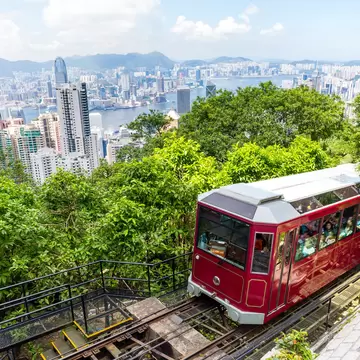
The Peak Tram is not really a tram but a cable-hauled funicular railway that has been scaling the 396m ascent to the highest point on Hong Kong Island since 1888. It is thus the oldest form of public transport in the territory.
While a few residents on the Peak and in the Mid-Levels actually use it as a form of transport – there are four intermediate stops before you reach the top – the Peak Tram is intended to transport visitors and locals to the attractions, shops and restaurants in the Peak Tower and Peak Galleria.
The Peak Tram (2522 0922, 2849 7654; www.thepeak.com.hk; one way/return adult $22/33, child 3-11yr $8/15, senior over 65 yr $8/15) runs every 10 to 15 minutes from 7am to midnight, making between one and four stops (Kennedy Rd, MacDonnell Rd, May Rd and Barker Rd) along the way in about seven minutes. It’s such a steep ride that the floor is angled to help standing passengers stay upright. Running for more than a century, the tram has never had an accident – a comforting thought if you start to have doubts about the strength of that vital cable. It carries 8500 passengers a day.
The Peak Tram lower terminus is behind the St John’s Building. The upper tram terminus is in the Peak Tower (128 Peak Rd). Avoid going on Sunday and public holidays when there are usually long queues. Octopus cards can be used.
Between 10am and 11.55pm, open-deck (or air-conditioned) bus 15C takes passengers between the Star Ferry pier and Pedder St in Central and the lower tram terminus.
Car & motorcycle
It would be sheer madness for a newcomer to consider driving in Hong Kong. Traffic is heavy, the roads can get hopelessly clogged and the ever-changing network of highways and bridges with its new numbering system is complicated in the extreme. And if driving the car doesn’t destroy your holiday sense of spontaneity, parking the damn thing will. If you are determined to see Hong Kong under your own steam, do yourself a favour and rent a car with a driver.
Driving licence & permits
Hong Kong allows most foreigners over the age of 18 to drive for up to 12 months with their valid local licenses. It’s still a good idea to carry an International Driving Permit (IDP) as well, though. This can be obtained from your local automobile association for a reasonable fee.
Anyone driving in the territory for more than a year will need to get a Hong Kong licence, which will be valid for 10 years ($900). Apply to the Licensing Division of the Transport Department (2804 2600; www.info.gov.hk/td; 3rd fl, United Centre, 95 Queensway, Admiralty; 9am-5pm Mon-Fri).
Hire
Car-hire firms accept IDPs or driving licences from your home country. Drivers must usually be at least 25 years of age. Daily rates for small cars start at just under $700, but there are weekend and weekly deals available. For example, Avis (2890 6988; www.avis.com.hk; Ground fl, Shop 46, Peninsula Centre, 67 Mody Sq, Tsim Sha Tsui East; 9am-6pm Mon-Fri, 9am-4pm Sat & Sun) will rent you a Toyota Corolla or Honda Civic for the weekend (from 2pm on Friday to 10.30am Monday) for $1600; the same car for a day/week costs $760/3500. Rates include unlimited kilometres.
If you’re looking for a car with a driver, Avis has chauffeur-driven cars for $350 to $1000 per hour with a minimum of three hours.
Road rules
Vehicles drive on the left-hand side of the road in Hong Kong, as in the UK, Australia and Macau, but not in mainland China. Seat belts must be worn by the driver and all passengers, in both the front and back seats. Police are strict and give out traffic tickets at the drop of a hat.
Train
Overland lines
The overland network (formerly known as the Kowloon-Canton Railway or KCR) is made up of two lines. The MTR East Rail, which commenced in 1910, is a single-line, 43km-long commuter railway running from the new East Tsim Sha Tsui station in southern Kowloon to Lo Wo on the border with mainland China, plus a new spur to Lok Ma Chau (also on the border). The terminus of the new spur connects to the new Shenzhen Metro system at Huanggang station via a pedestrian bridge across the Shenzhen River.
The tracks are the same as those used by the express trains to cities in Guangdong province, as well as to Shanghai and Beijing, but the trains are different and look more like MTR carriages. Ma On Shan Rail, which branches off from the MTR East Rail at Tai Wai and serves nine stations, opened in December 2004 but is of limited use to travellers.
The MTR West Rail, a separate 30.5km-long line, links Nam Cheong station in Sham Shui Po with Tuen Mun via Yuen Long, stopping at nine stations. It is linked to the MTR East Rail at East Tsim Sha Tsui and Austin (from where it is also possible to connect to Kowloon station for the Airport Express and Tung Chung lines).
The overland lines of the MTR make a quick way to get to the New Territories, and the ride offers some nice vistas, particularly between the Chinese University and Tai Po Market stations on the MTR East Rail. You can transfer from the MTR underground lines to the MTR East Rail at Tsim Sha Tsui and Kowloon Tong stations. On the MTR West Rail, there is interchange with the Tung Chung MTR line at Nam Cheong, with the Tsuen Wan line at Mei Foo and with the Light Rail (see p000R073D) at Yuen Long, Tin Shui Wai, Siu Hong and Tuen Mun.
Overland trains run every four to 14 minutes, except during rush hour when they depart every three to eight minutes. The first MTR East Rail train leaves East Tsim Sha Tsui at 5.28am and the last departs from Lo Wu at 12.30am. The MTR West Rail runs from 6am to sometime between 12.15am and 12.45am. The trip from Nam Cheong to Tuen Mun on the MTR West Rail takes 32 minutes.
Overland fares are cheap, starting at $3.50, with a 42-minute ride to Sheung Shui from East Tsim Sha Tsui costing just $11.50 (1st class is $23) and the 48-minute trip to Lo Wu $36.50 (1st class $73). Children and seniors pay reduced fares of between $1.50 and $18. Paying with an Octopus card brings down fares considerably.
The MTR runs some 129 feeder buses on 18 routes via its MTR Bus Service (2881 8888; www.mtr.com.hk), but these are generally of interest only to residents of housing estates within striking distance of the MTR East and West Rails and the Light Rail.
Local transport
Taxi
Hong Kong taxis are a bargain compared with those in other world-class cities. With more than 18,000 cruising the streets of the territory, they’re easy to flag down.
When a taxi is available, there should be a red ‘For Hire’ sign illuminated on the meter that’s visible through the windscreen. At night the ‘Taxi’ sign on the roof will be lit up as well. Taxis will not stop at bus stops or in restricted zones where a yellow line is painted next to the kerb.
The law requires that everyone in a vehicle wears a seat belt. Both driver and passenger(s) will be fined if stopped by the police, and most drivers will gently remind you to buckle up before proceeding.
‘Urban taxis’ – those in Kowloon and on Hong Kong Island – are red with silver roofs. New Territories taxis are green with white tops, and Lantau taxis are blue.
Hong Kong Island and Kowloon taxis tend to avoid each others’ turf as the drivers’ street knowledge on the other side of the harbour can be pretty shaky. Hong Kong Island and Kowloon taxis maintain separate ranks at places such as Hung Hom train station and the Star Ferry pier, and will sometimes refuse to take you to the ‘other side’. In any case, if you’re travelling from Hong Kong Island to Kowloon (or vice versa), choose the correct taxi as you’ll save on the tunnel toll. New Territories taxis are not permitted to pick up passengers in Kowloon or on Hong Kong Island at all.
The rate for taxis on Hong Kong Island and Kowloon is $18 for the first 2km and $1.50 for every additional 200m; waiting costs $1.50 per minute. In the New Territories it’s $14.50 for the first 2km and $1.30 for each additional 200m; waiting costs $1.30 per minute. On Lantau the equivalent charges are $13 and $1.30, and $1.30 per minute for waiting. There is a luggage fee of $4 to $5 per bag, but (depending on the size) not all drivers insist on this payment. It costs an extra $4 to $5 to book a taxi by telephone. Try to carry smaller bills and coins; most drivers are hesitant to make change for anything over $100. You can tip up to 10%, but most Hong Kong people just leave the little brown coins and a dollar or two.
Passengers must pay the toll if a taxi goes through the many Hong Kong harbour or mountain tunnels or uses the Lantau Link to Tung Chung or the airport. Though the Cross-Harbour Tunnel costs only $10, you’ll have to pay $20 if, say, you take a Hong Kong taxi from Hong Kong Island to Kowloon. If you manage to find a Kowloon taxi returning ‘home’, you’ll pay only $10. (It works the other way round as well, of course.) If you cross the harbour via the Western Harbour Tunnel, you must pay the $40 toll plus $15 for the return unless you can find a taxi heading for its base. Similarly, if you use the Eastern Harbour Crossing, you may have to pay the $25 toll plus $15.
There’s no way of avoiding the whopping great toll of $30 in both directions when a taxi uses the Lantau Link.
There is no double charge for the other roads and tunnels: Aberdeen ($5), Lion Rock ($8), Shing Mun ($5), Tate’s Cairn ($14), Tai Lam ($30) and Tseung Kwan O ($3).
You may have some trouble hailing a taxi during rush hour, when it rains or during the driver shift-change period (around 4pm daily). Taxis are also in higher demand after midnight. There are no extra late-night charges and no extra passenger charges, though some taxis are insured to carry four passengers and some five. You can tell by glancing at the licence plate.
Some taxi drivers speak English well; others don’t have a word of the language. It’s never a bad idea to have your destination written down in Chinese.
Though most Hong Kong taxi drivers are scrupulously honest, if you feel you’ve been ripped off, take down the taxi or driver’s licence number (usually displayed on the sun visor in front) and call the Transport Complaints Unit Complaint Hotline (2889 9999), the police report hotline (2527 7177) or the Transport Department hotline (2804 2600) to lodge a complaint. Be sure to have all the relevant details: when, where and how much. If you leave something behind in a taxi, ring the Road Co-op Lost & Found hotline (187 2920); most drivers turn in lost property.
Light rail
The MTR’s Light Rail (2881 8888; www.mtr.com.hk) system began operations in 1988 and has been extended several times since. It is rather like a modern, air-conditioned version of the trams in Hong Kong, but it’s much faster, reaching speeds of up to 70km/h. It runs along 36km of track parallel to the road and stops at 68 designated stations, carrying some 320,000 passengers a day.
Until recently, only those travellers visiting the temples of the western New Territories made much use of the Light Rail as it essentially was just a link between the New Towns of Tuen Mun and Yuen Long. But with the opening of the MTR West Rail, it is an important feeder service for the MTR.
There are 11 Light Rail lines connecting various small suburbs with Tuen Mun to the south and Yuen Long to the northeast, both of which are on the MTR West Rail. The system operates from about 5.30am to between 12.15am and 1am. Trams run every four to 12 minutes, depending on the line and time of day. Fares are $4 to $5.80, depending on the number of zones (from 1 to 5) travelled; children aged three to 11 and seniors over 65 pay from $2 to $2.90. If you don’t have an Octopus card, you can buy single-journey tickets from vending machines on the platforms.
The system of fare collection is unique in Hong Kong: there are no gates or turnstiles and customers are trusted to validate their ticket or Octopus card when they board and exit. That trust is enforced by frequent spot checks, however, and the fine is 50 times the maximum adult fare – $290 at present.
Bicycle
Cycling in urbanised Kowloon or Hong Kong Island would be suicide, but in the quiet areas of the islands (including southern Hong Kong Island) or the New Territories, a bike can be a lovely way to get around. It’s not really a form of transport, though – the hilly terrain will slow you down (unless you’re mountain biking) – but more recreational. Be advised that bicycle-rental shops and kiosks tend to run out of bikes early on weekends if the weather is good.
Hong Kong
Things to do
- All things to do (905)
- Activities (119)
- Entertainment (116)
- Restaurants (324)
- Shopping (162)
- Sights (171)
- Tours (13)