Sights in Bulgaria
-
A
Borisova Gradina
Sofia's most attractive expanse of greenery is home to the Vasil Levski Stadium, CSKA Stadium and Maria Luisa Pool, as well as bike tracks and tennis courts. It's laid out with countless statues and flowerbeds, and is a relaxing place to take a leisurely stroll on a sunny Sunday afternoon.
The eastern end of the park is dominated by a gigantic communist monument built in 1956 and known as the Mound of Brotherhood, featuring a 42m-high obelisk and socialist-realist icons including a pair of partisan fighters, dramatically gesturing comrades clutching Kalashnikovs, and smiling, stoic workers. It has long been neglected by the authorities, and several of the socialist heroes…
reviewed
-
B
Burgas Beach
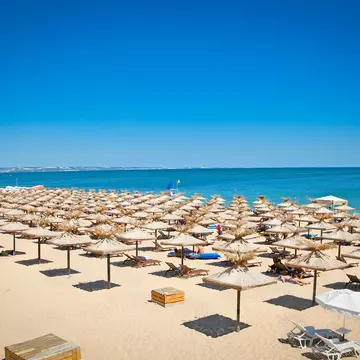
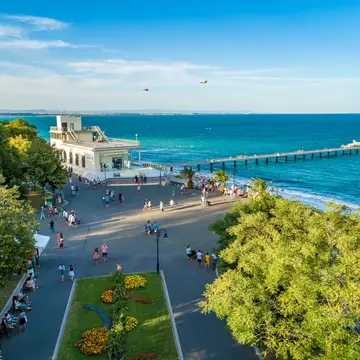
Although it can't compare with the far superior beaches at the nearby resorts, or even with Varna's urban stretch of sand, Burgas Beach still attracts plenty of locals on a hot summer day. It's a bit grubby at the southern end, with its long concrete pier, used as a diving platform by teenage boys and a fishing station by old men, but further on there are some smart beach bars and a couple of restaurants, and, in summer, the beach is kept clean by regular sweepers and watched over by lifeguards.
There are often high winds and high waves along this coast: not great for swimming, but OK for windsurfers. Boards may be rented from the Morski Klub at the northern end of the…
reviewed
-
C
Roman Fortress of Sexaginta Prista
Defensive walls, a tower, some barracks and a storage area are what remain of this once great fortress, completed in AD 70. Around 600 soldiers once stood guard here, guaranteeing safe passage for river traders from their high bluff over the river. Stone inscriptions, decorative sculptures and tombstones are also displayed, and background information is posted in English. The friendly staff will show you around, and, if you’re interested, to the somewhat more recent German Bunker, hewn out of bricks in WWII and still marvellously intact. Other ancient finds are kept in the cool confines of the underground bunker.
reviewed
-
D
Church of Sveta Troitsa
Behind the magnificent opera house is the Russian-style Church of Sveta Troitsa, Ruse’s oldest surviving Ottoman-era building, built in 1632. The Turkish stipulation that no church should stand higher than a mosque led builders here, as elsewhere, to build partially underground. Large, well-preserved murals and 16th-century crosses and icons are the standouts here, as are the tower’s stained-glass windows. The bell tower was a post-Ottoman addition from the late 19th century.
reviewed
-
E
Banya Bashi Mosque
Sofia's only working mosque was built in 1576 by the celebrated Ottoman architect Kodja Mimar Sinan, who also designed the Selim II Mosque in Edirne, Turkey. It's certainly an eye-catching edifice and the red brick minaret makes a convenient landmark. At the rear of the building is a small, recently excavated section of the bathhouse that once joined onto the mosque and a hot-water drinking fountain. Visitors are welcome outside prayer times if modestly dressed.
reviewed
-
Smolyan Art Gallery
Opposite the museum, the Smolyan Art Gallery boasts some 1800 paintings, sketches and sculptures by local, national and foreign artists.
reviewed
-
Ivan Kolev House
Paintings, drawings and sculptures are displayed at the Ivan Kolev House.
reviewed
-
F
Tsarevets Fortress
The inescapable symbol of this proud medieval town, this reconstructed fortress dominates the skyline, and is one of Bulgaria's most beloved monuments. The Tsarevets Museum-Reserve is located on Tsarevets Hill, which has been settled since time immemorial due to its strategic location. Thracians and Romans used it as a defensive position, but the Byzantines built the first significant fortress here between the 5th and 7th centuries.
The fortress was rebuilt and fortified by the Slavs and Bulgars between the 8th and 10th centuries, and again by the Byzantines in the early 12th century. When Târnovgrad became the Second Bulgarian Empire's capital, the fortress was truly…
reviewed
-
Church of Rozhdestvo Bogorodichno
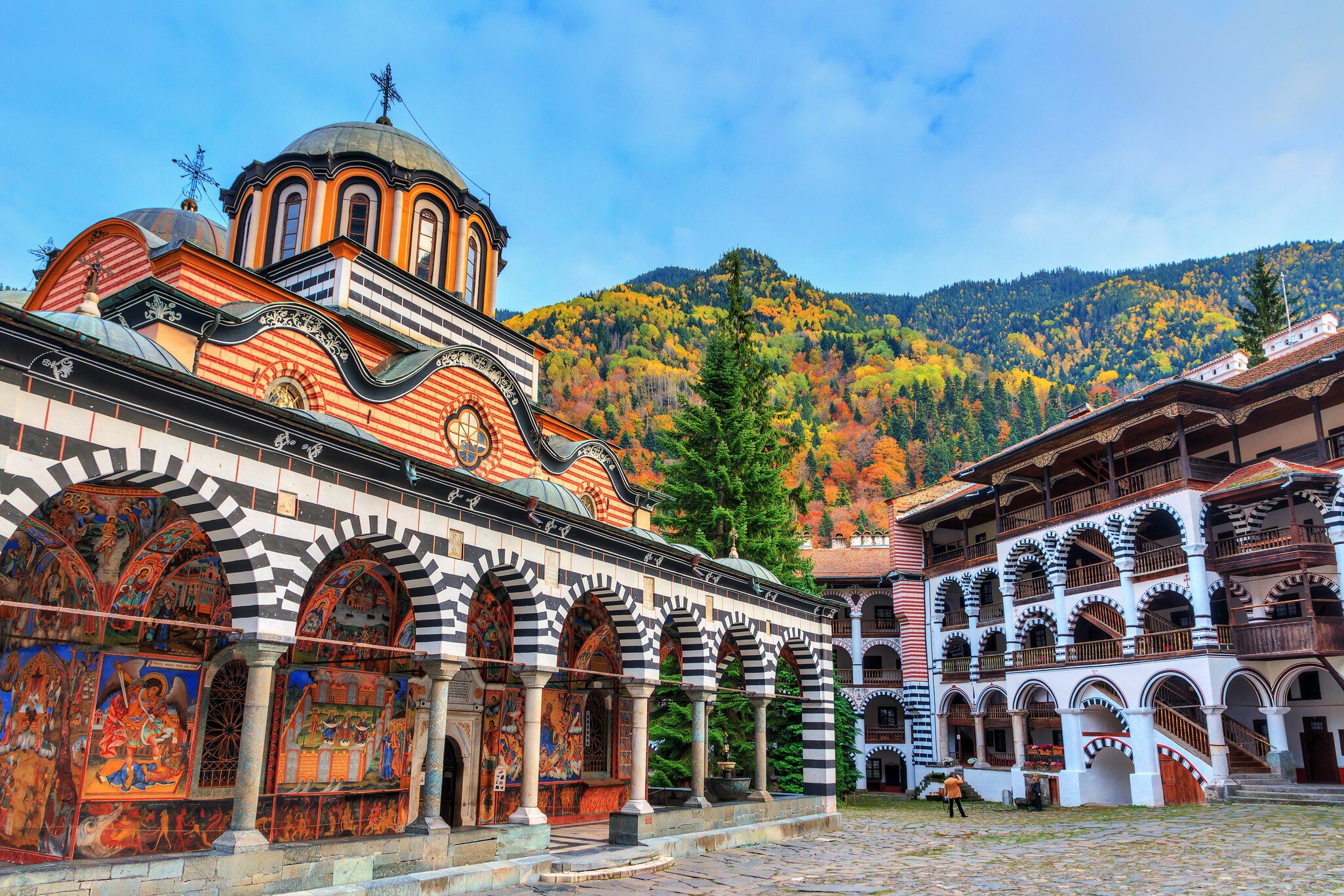
Within the monastery's walls, four levels of colourful balconies - with monastic cells, storerooms, a refectory and kitchen - surround the large courtyard, where stands the magnificent Church of Rozhdestvo Bogorodichno, Bulgaria's grandest monastery church. Built between 1834 and 1837, the structure is crowned by three great domes.
Its outside walls are covered with frescoes both vivid and harrowing (or humorous, depending on your disposition), depicting hell, where demons with whips, chains and pitchforks torture sinners in various states of woe and undress. The happier paintings, depicting the virtuous accompanied by angels and saints, indicate the moral lesson that…
reviewed
-
G
National Museum of Military History
Don’t be put off by the rusting army trucks in the overgrown front yard – this museum is among the most interesting and best presented in Sofia. Displays over three floors tell the story of warfare in Bulgaria from the time of the Thracians onwards, with extensive labelling and information boards in English. Most space goes to the period from the 1876 April Uprising through to WWI, with cases filled with weaponry, rebel flags and a seemingly endless parade of uniforms and personal belongings of soldiers. Among the more striking are the shaggy-fur flying costume, resembling a traditional Kuker outfit, worn by a Lt Simeon Petrov during the First Balkan War, and the…
reviewed
Advertisement
-
H
Archaeological Museum
The Buyuk Djami (Great Mosque) since 1899 has housed Sofia’s fascinating Archaeological Museum. Thracian and Roman tombstones fill up much of the ground floor, along with weaponry and jewellery. Among the more eye-catching artefacts are a 3rd-century AD bronze head of the Emperor Gordianus; a stone plaque showing gladiatorial fights in the circus, now under the Arena di Serdica hotel; and the original 4th-century AD mosaic floor from the apse of the Church of Sveta Sofia. On show upstairs are the remarkable finds unearthed near Shipka in 2004, including the 4th-century BC gold burial mask of a Thracian king, and a magnificent bronze head with coloured glass eyes and…
reviewed
-
Nativity Memorial Church
Even before arriving in Shipka, you’ll see the splendid, onion-shaped golden domes of the Nativity Memorial Church glittering from amidst thick woods above the village, framed against the mountain. Part of the Shipka Monastery, and also known as the Church of St Nikolai, the magnificent structure was built in 1902 as a dedication to soldiers who died at the Shipka Pass during the Russo-Turkish War (1877–78). The design is heavily influenced by Russian architecture, and features five golden domes and 17 church bells that can be heard for several kilometres when rung. Inside the crypt Russian soldiers who perished are interred, and there are some wonderful frescoes…
reviewed
-
Preobrazhenski Monastir
Preobrazhenski Monastir, or the Monastery of the Transfiguration, is located high in a forest about 7km north of Veliko Târnovo. Originally built in 1360, it’s Bulgaria’s fourth largest monastery and offers fantastic views. Despite being destroyed by the Turks in the late 14th century, it was rebuilt in 1825, about 500m from the original site, but later damaged by landslides. To the sides of the main church you will see massive rocks that tumbled down the hill and miraculously just missed the building. The monastery’s churches boast murals painted between 1849 and 1851 by the renowned Zahari Zograf. While the best are now in Veliko Târnovo’s Archaeological Museum, a…
reviewed
-
I
National Art Gallery
Occupying the east wing of the royal palace, the National Art Gallery holds one of the country’s most comprehensive collections of Bulgarian art, with several galleries full of mainly 19th and 20th century paintings and sculptures. All the big names are represented, including the ubiquitous Vladimir Dimitrov, whose orange, Madonna-like Harvester hangs in the former royal music room. Other standouts include Goshka Datsov’s The Dream of Mary Magdalene and Georgi Mashev’s creepy Outcast. Anton Mitov’s paintings of early-20th-century Sofia, such as Vegetable Market at Sofia, offer a fascinating insight into local history. On the floor above, a warren of corridors and…
reviewed
-
Tsarevets Museum-Reserve
The inescapable symbol of this proud medieval town, this reconstructed fortress dominates the skyline, and is one of Bulgaria’s most beloved monuments. The Tsarevets Museum-Reserve is located on Tsarevets Hill, which has been settled since time immemorial due to its strategic location. Thracians and Romans used it as a defensive position, but the Byzantines built the first significant fortress here between the 5th and 7th centuries. The fortress was rebuilt and fortified by the Slavs and Bulgars between the 8th and 10th centuries, and again by the Byzantines in the early 12th century. When Târnovgrad became the Second Bulgarian Empire’s capital, the fortress was truly…
reviewed
-
J
National Gallery for Foreign Art
An eclectic assemblage of international artworks is on display in this huge gallery, and although you won’t find any world-class treasures here, there are a few big names and plenty of little-known artists to discover. On the ground floor you can browse Indian woodcarvings, Burmese Buddhas, African tribal art and colourful Japanese prints. Upstairs are several galleries of European paintings, mostly by long-forgotten artists, while highpoints include a Van Dyck portrait, minor sketches by Renoir, Matisse and Degas, and a Last Supper attributed to Palma Vecchio. There are also some small bronzes by the 16th-century German Master Conrad Meit and bronze studies for The…
reviewed
-
Galeriya Dimitâr Dobrovich
Galeriya Dimitâr Dobrovich is signposted from the centre as ‘Sirak Skirnik’. This art gallery in the park displays the works of 19th- and 20th-century Bulgarian artists, including many by its namesake, Sliven-born painter Dimitâr Dobrovich. Among the works, which display strong French and Italian influences, are portraits of local luminaries and ordinary people, as well as numerous impressionistic landscape paintings (including an evocative portrayal of Veliko Târnovo). The gallery’s most intriguing section, however, belongs to the Museum of Christian Art on the lower floor, which has a large collection of 18th- and 19th-century icons, some from the Tryavna…
reviewed
-
K
Sveti Sedmochislenitsi Church
Set in a leafy garden just off the main road, the Sveti Sedmochislenitsi Church, or Church of the Seven Saints, as it's known in its more tongue-friendly translation, is dedicated to Sts Cyril and Methodius and their five disciples. Originally built as a mosque in 1528, it had already fallen into disuse by the time the Russians came along in 1878 and turned it into an arms depot.
After a brief spell as a prison, the structure was restored and remodelled in a style termed Bulgarian National Romanticism, and consecrated as a church in 1903. Inside, the walls are covered in traditional murals of saints, while an image of the Trinity decorates the huge central dome. The…
reviewed
-
Kaleto Fortress
The massive Belogradchik rock formations tower over the town, at the end of a 2km-long road that passes around them. Seamlessly blended in with these bizarre wonders of nature is the Kaleto Fortress, built by the Romans in the 1st century BC. The fortress was later augmented and expanded with towers, walls and gates by the Byzantines and Bulgars. The remaining sections, interwoven with the rocks, date mostly from the late Ottoman period (between 1805 and 1837). There’s no need to pay for the offered tour, as the fortress is fairly self-explanatory and scattered signs tell the stories and legends associated with the place. Likewise, despite the stated ban on photos, no-one…
reviewed
-
L
Mineral Baths
The Mineral Baths – also known as the Turkish Baths – was built between 1911 and 1913. With its elegant striped façade and ceramic decorations recalling the designs of Nesebâr’s medieval churches, it’s one of Sofia’s architectural gems, but it fell into dereliction in the 1990s and has been undergoing sporadic restoration for over a decade. When restoration is finally complete, it will house a new civic museum, although no date has been set for this. The centrepiece of the little square between the baths and the Banya Bashi Mosque, known as pl Banski, is a modern fountain, while a smart drinking-fountain complex has been constructed just behind the baths,…
reviewed
Advertisement
-
Danube Bridge
Sights Some 6km Downstream From Ruse, This Double-Decker Highway And Railway Bridge Finished In 1954 Links The City With Giurgiu On The Romanian Side Of The Danube. At 2.8km In Length, And Towering 30m Above The Water, It's The Largest Steel Bridge In Europe.
In A Nod To The Neighbourly Bickering Between Bulgarians And Romanians, The Soviets Named It The Friendship Bridge. Whatever Filial Sentiments This Act May Have Inspired Were Sorely Tested In The 1980s, When A Romanian Chlorine-And-Sodium Plant Caused Massive Air Pollution And Health Problems In Ruse. More Recently, Locals Suffered The Misfortune Of Another Catastrophic Spill In Romania. In The Wake Of These…
reviewed
-
M
History Museum
Watching over the ruins of the Roman baths, Varna’s ivy-covered History Museum is itself an intriguing part of the city’s history. Built in 1851 as the Belgian Embassy, it subsequently became a hotel, a prison and, under the communists, a Museum of the Revolution, before taking on its present role in 1990. Displays on the ground floor include photographs of the city from the 1920s, while the basement holds an exhibition on local trades and handicrafts such as printing, weaving and brewing. More imagination has gone into the replicas of long-gone 1920s and ’30s shops and offices on the 1st floor, including ‘Uncle Mityu’s Café’, a hat shop, toy shop and lawyer’s office.…
reviewed
-
South Beach
There are a few scrappy beaches around the coast of the old town which are popular with some locals and visitors, but they're small and rocky and the water is often choked with seaweed. Around 1.5km west of the old town is South Beach, a long and well managed stretch of sand which has seen some major developments over the last few years. All the usual water sports are available, including jet-skiing, water-skiing, windsurfing and pedalos. The beach is lined with several giant hotel complexes, although the officially protected sand dunes at the far end should, hopefully, prevent further construction.
The beach is lined with several giant hotel complexes, although the…
reviewed
-
Dancing Bears Park
The cruel practice of ‘dancing’ bears was officially banned in 1993, and rescued bears now live in the Dancing Bears Park in Belitsa, in the Rila Mountains. Located around 33km northeast of Bansko (and 12km outside the village of Belitsa itself), the park is the largest of its kind in Europe, and visitors are welcome to join guided tours. You will need your own transport to visit. The park is dependent on donations, and it costs €10 for basic care for just one bear for one day, so anything you can spare will be appreciated. As well as helping these abused animals, the park also provides employment in a poor region of the country and it is hoped that this will become a…
reviewed
-
N
Sveti Nikolai Russian Church
This gorgeous church with its glittering mosaic exterior was built between 1912 and 1914 for Sofia’s Russian community, and named in honour of St Nikolai, the ‘miracle worker’. Like the Aleksander Nevski Church, the design is strongly influenced by Russian architecture, most notably in its five golden onion domes. The surprisingly cramped interior features colourful murals and icons painted between the 11th and 14th centuries. Bishop Serafim (1881–1950), one of Bulgaria’s most revered spiritual leaders, lies entombed in the crypt (accessed by a separate door to the left of the main entrance). Sitting in a flower-filled garden, the church is one of the most photographed…
reviewed