Sights in Belarus
-
Regional Museum
A few houses away from the Art Museum, past the town hall distinguishable by its clock tower, is the Regional Museum, where you are guaranteed something interesting and thought provoking. There are up to five temporary exhibitions (usually paintings and photography) plus a permanent one full of 11th- to 14th-century artefacts from the city and region.
reviewed
-
A
Belarusian State Art Museum
The Belarusian State Art Museum is a very interesting place. Here you'll find the country's largest collection of Belarusian art, in two rooms devoted to works depicting the depopulated agrarian bliss of the 1920s and 1930s. There are also impressive works by Arkhip Kuindji, Nikolai Ghe, Ilya Repin, Isaak Levitan and Konstantin Makovsky.
reviewed
-
B
Valour monument
The centrepiece of the Brest Fortress ensemble is the huge Valour monument, a stone soldier's head projecting from a massive rock. Adjacent is a sky-scraping obelisk, with an eternal flame and stones bearing the names of those who died. There are often men and women in period military uniforms marching to sombre orchestral music.
reviewed
-
C
Museum of Confiscated Art
The city's most interesting museum is the Museum of Confiscated Art, a display of valuable international art pieces (paintings, sculptures, ceramics) seized by Brest border guards as they were being smuggled out of the country. It is no doubt the most eclectic art collection in Belarus. It often has great temporary exhibits.
reviewed
-
D
Bernadine Church & Seminary
The 16th-century Catholic Bernadine Church & Seminary was built predominantly in the Renaissance style, and the bell tower was redone with a defiant baroque flair 250 years later, and again after WWII. It stands atop a hill opposite the bizarre, spiderlike Drama Theatre, looking much like a spacecraft about to lift off.
reviewed
-
E
History of Brest Museum
In the History of Brest Museum there's a small exhibit on the city in its different guises throughout history. Check the painting of Brest-Litovsk in medieval times to see what a vibrant European city it was then. The quiet neighbourhood around the museum, lined with quaint wooden houses, is worth strolling through.
reviewed
-
Museum of the Belarusian Army
The Museum of the Belarusian Army, set up by veterans of the Afghan War, has some touching exhibits on the history of war on Belarusian soil from the 6th century, as well as of Belarusians participating in foreign wars. The museum is difficult to find on your own; take an around BR8000 taxi from the centre.
reviewed
-
Brest Fortress
If you are going to see only one Soviet WWII memorial in your life, make it Brest Fortress. As if the scale of the fortress and the heroism of its defenders weren't enough, the Soviet additions of a giant stone face and glistening obelisk show everything that was wrong and right with the Soviet Union.
reviewed
-
F
Museum of the First Congress of the Russian Social Democratic Workers' Party
The Museum of the First Congress of the Russian Social Democratic Workers' Party is where the Russian Social-Democratic Workers Party - Russia's original Marxist party - held its illegal founding congress in 1898. Today, you can wander around the small museum inside, just as Fidel Castro did in 1972.
reviewed
-
G
Brest Art Museum
Heading south inside the Brest Fortress, there's the Brest Art Museum, which showcases local arts and crafts. To the right is the unmistakable Kholmskie Gate; its bricks are decorated with crenulated turrets and its outer face is riddled with hundreds of bullet and shrapnel holes.
reviewed
Advertisement
-
H
Church of Sts Simon & Elena
Breaking the theme of Soviet classicism that dominates ploshcha Svabody is the red-brick catholic Church of Sts Simon & Elena, built in 1910. Its tall, gabled bell tower and attractive detailing are reminiscent of many brick churches in the former Teutonic north of Poland.
reviewed
-
I
St Mary Magdeline Church
The attractive little St Mary Magdeline Church was built in 1847 in the ancient Orthodox style, with a pointed octagonal bell tower over the entrance and a single sweeping dome over the cruciform plan. It's the nicest church in the city and is located near Hotel Belarus.
reviewed
-
J
Sts Peter & Paul Church
Across the vulitsa Lenina overpass is the attractively restored 17th-century Sts Peter & Paul Church, the city's oldest church (built in 1613, looted by Cossacks in 1707 and restored in 1871). Now it is awkwardly dwarfed by the surrounding morose concrete structures.
reviewed
-
K
Palats Mastatsva (Art Palace)
While it doesn't necessarily hold the largest or most impressive collection of Belarusian art, Palats Mastatsva is a cool place to hang out. There are several exhibition halls showing modern art, used book and antique stalls and a general buzz of free-spirited activity.
reviewed
-
L
Town Hall
A new town hall was constructed in 2003 on the square using old photographs and drawings to replicate the long-destroyed original. A general reconstruction plan for the Upper Town has been drawn up which will see many buildings in the area repaired, restored or rebuilt.
reviewed
-
Church of St Aleksandr Nevsky
Church of St Aleksandr Nevsky. Built in 1898, it was closed by the Bolsheviks, opened by the Nazis, closed by the Soviets and now it's open again. It's said that during WWII, a bomb crashed through the roof and landed plum in front of the altar, but never detonated.
reviewed
-
M
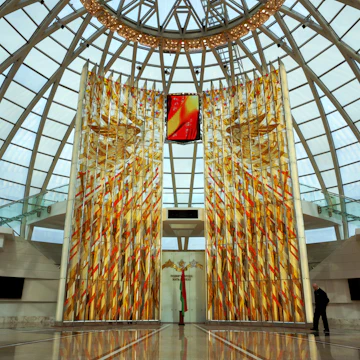
Belarus National Museum of History & Culture
Most visitors leave here with their head spinning (Belarusian-only explanation panels don't help). It takes you on a journey into the turbulent history of the nation, and features a replica of the printing press used by national hero Francyska Skaryny.
reviewed
-
N
Holy Spirit Cathedral
The baroque, twin-towered orthodox Holy Spirit Cathedral, built in 1642, stands confidently on a small hill. It was once part of a Polish Bernardine convent, along with the former Bernardine Church next door, which now houses city archives.
reviewed
-
Praspekt Nezalezhnastsi
After it was obliterated in WWII, Minsk was rebuilt from the ground up, under the direction of Stalin. A walk down Praspekt Nezalezhnastsi is a testament to the grandiose monumentalism the Soviets were so famous for.
reviewed
-
Obelisk
Just to the north of the synagogue on vul Vjalikaja Traetskaja, take a left turn down a shaded lane and across a wooden bridge through the park, which will take you to an obelisk marking Hrodna's 850th anniversary.
reviewed
Advertisement
-
O
Pobrigitski Monastery
About 400m west of the bus station is the Pobrigitski Monastery, built in 1651, which has some lovely ornaments on its façade, as well as some 18th-century wooden buildings inside the complex.
reviewed
-
P
St Nikolaiv Church
With its gold cupolas and yellow-and-blue façades shining gaily in the sunshine, the finely detailed 200-year-old Orthodox St Nikolaiv Church is one of several lovely churches in Brest.
reviewed
-
Q
Museum of Garadnitsa History
This tiny city history museum has almost nothing in it, but it's pleasant to walk around the 18th-century wooden home it's housed in, and they sell curious handcrafted items and souvenirs.
reviewed
-
R
St Simon Orthodox Cathedral
Just a block west of Hotel Intourist is the peach-and-green St Simon Orthodox Cathedral, built in 1865 in the Russian Byzantine style (the gold on the cupolas was added in 1997).
reviewed
-
S
St Christopher's Polish Catholic Church
On pl Lenina, a statue of Lenin faces east towards Moscow, but it appears to be pointing accusatorily across the street to the 1856 St Christopher's Polish Catholic Church.
reviewed