go to content go to search box go to global site navigation

Bangladesh

Sights in Bangladesh

‹ Prev

of 4

  1. A

    Beach

    The main reason to come to Cox's Bazar is for the beach. The route to the beach, along Sea Beach Rd, can be crowded and dirty, but once on the beach you will find the sand surprisingly clean. There are plenty of places from where you can rent a sun lounge and umbrella, and staff will offer security so you can leave your belongings unattended while you go for a dip.

    You could also plant yourself in front of a big hotel, where guards will watch over your gear if you go swimming, and shoo away kids selling shell necklaces. They will also deal with the crowds of gawkers, if they get too intrusive (which they will).

    If you're intrigued by the wooden fishing boats chugging…

    reviewed

  2. Shankharia Bazar

    With a crash of drums, a cloud of incense and a bursting paintbox of colours welcome to Shankharia Bazar, otherwise known as Hindu St. Lined on either side with ancient houses, garlands of lurid orange marigolds, and dark doorways leading to matchbox-sized shops and workshops, this is by far the most photogenic street in Old Dhaka. While exploring the bazaar keep one eye on the upper levels, where many of the houses have beautiful carvings.

    The shankharis (Hindu artisans) busy themselves creating kites, gravestones, wedding-hats, jewellery, and bangles carved out of conch shells. Shankharis first came here over 300 years ago, but these days their art is slowly dying out.…

    reviewed

  3. B

    National Assembly building

    In 1963 the Pakistanis commissioned Louis Kahn, a world-renowned American architect, to design a regional capital for East Pakistan. Due to the liberation movement and ensuing war, the National Assembly building wasn't completed until 1982. The building often features in books on modern architecture, and is regarded as among Kahn's finest works.

    It's a huge assembly of concrete cylinders and rectangular boxes, sliced open with bold, multi-storey circular and triangular apertures instead of windows, and is probably only considered attractive by fans of grim '70's architecture. It is not usually possible to approach the building too closely. On the opposite side of the road…

    reviewed

  4. Mainimati Ruins

    Famous as an important centre of Buddhist culture from the 7th to 12th centuries, the buildings excavated here were made wholly of baked bricks. There are more than 50 scattered Buddhist sites, but the three most important are Salban Vihara, Kotila Mura and Charpatra Mura.

    Salban Vihara was a well-planned, 170 sq m (182 sq ft) monastery facing a temple in the centre of the courtyard. Nearby is a museum housing the finds excavated here, which include terracotta plaques, bronze statues, a bronze casket, coins, jewellery and votive stupas embossed with Buddhist inscriptions.

    Kotila Mura comprises three large stupas representing Buddha, Dharma and Sangha, the 'Three Jewels of…

    reviewed

  5. Sadarghat

    Running calmly through the centre of Old Dhaka, the Buriganga River is the muddy artery of Dhaka and the very life blood of both this city and nation. To explore it from the deck of a small boat is to see Bangladesh at its most raw and grittiest. The panorama of river life is fascinating. Triple-towered ferries leer over thousands of bustling ant-like canoes. Country boats bump off the dirty hulks of domineering cargo and fishing boats.

    On the grease-and-mud stained foreshores, you'll find children fishing with homemade nets in the lee of rusting tankers. Further out, repair men busy themselves crashing, bashing and scrubbing ship hulls while floating on planks of wood.…

    reviewed

  6. Bangladesh Tea Research Institute

    The Bangladesh Tea Research Institute isn’t a commercial estate as such, but rather the scientific headquarters of Bangladeshi tea production. New strains of tea and new growing techniques are tried out here, and the staff are knowledgeable and very happy to spread that knowledge. There is also a production factory, which with a bit of luck you might be allowed to visit, and a tea-tasting room which you are almost certain to be ushered into. It is polite to give advance notice of your visit. See also p156.

    reviewed

  7. C

    Lalbagh Fort

    Along with Sadarghat, Lalbagh Fort is one of the big hitters of Old Dhaka. Unlike the waterfront, which is full of raw energy, the fort is a slightly melancholy step back in the misty Mughal past of emperors and princesses. It’s particularly atmospheric in the early morning light.

    reviewed

  8. D

    Shrine of Hazrat Shah Jalal

    In the north of the city, off Airport Rd, is the Shrine of Hazrat Shah Jalal, a 14th-century Sufi saint. The shrine is one of the biggest pilgrimage sites in the country and a fascinating place to visit. Being buried near the saint is considered a great honour. Shah Jalal's sword and robes are preserved within the large new mosque, but aren't on display. The tomb is covered with rich brocade, and at night the space around it is illuminated with candles - the atmosphere is quite magical.

    It's never entirely clear whether non-Muslims can visit the shrine, though it seems to be OK if you are suitably solemn and well dressed. Women, however, are definitely not allowed up to…

    reviewed

  9. E

    Painam Nagar

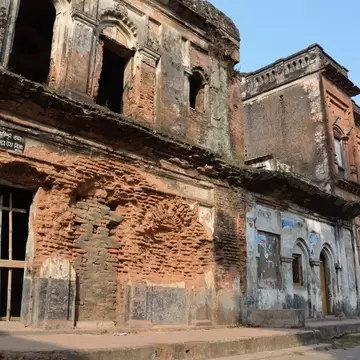
    The once elegant town of Painam Nagar is busy fighting a losing battle with nature, and with every passing year the trees and vines drape themselves a little further over the decaying houses. The result is a delightful ghost-town quality where the buildings appear to hang like exotic fruits from the branches of the trees.

    Constructed almost entirely between 1895 and 1905 on a small segment of the ancient capital city, this tiny settlement consists of a single narrow street, lined with around 50 (now dilapidated) mansions built by wealthy Hindu merchants. At the time of Partition, many owners fled to India, leaving their elegant homes in the care of poor tenants, who did…

    reviewed

  10. Karnaphuli River

    An unusual adventure is to head out onto the Karnaphuli River, close to the airport, where you'll be blown away by the massive number of equally massive ships riding at anchor in this deep-water channel. To get here take a baby taxi (mini auto-rickshaw; with bargaining you might get it down to Tk 200 return) along the river in the direction of the airport.

    Just before you reach the junction turning away from the river and leading immediately to the airport, you will see a small jetty with little wooden boats moored up. Ask here about renting one for an hour or so to explore - Tk 200 should suffice for a small boat.

    Be warned that this is a working port and there is also a…

    reviewed

  11. Advertisement

  12. Sitara Mosque

    About 350m north of the Armenian church, you’ll come to Sitara Mosque, one of the city’s most popular tourist attractions. Its striking mosaic decoration makes it look like your granny’s best teacups. The mosque dates from the early 18th century, but has been radically altered. It was originally built in the typical Mughal style, with four corner towers. Around 50 years ago a local businessman financed its redecoration with Japanese and English china-tiles, and the addition of a new veranda. If you look hard you can see tiles illustrated with pictures of Mt Fuji. Non-Muslims are normally welcome outside of prayer time, but you should dress appropriately and women should…

    reviewed

  13. F

    Baro Kuthi

    A block southeast of Rajshahi Government College, on a high bank of the Padma River, is a historic structure known as Baro Kuthi. It's one of the last remaining examples of the indigo kuthis (factories) that once flourished in the region. The simple buildings are of little architectural interest but their history is fascinating.

    In the early-19th century Baro Kuthi was built by the Dutch for the silk trade, and served as a fort in times of emergency. Some rooms were probably used as a prison and for mounting cannons. After 1833, when Baro Kuthi was taken over by the British East India Company, it was used for the indigo trade, which lasted about 25 years. It is reputed to…

    reviewed

  14. G

    Shait Gumbad Mosque

    Built in 1459, the same year Khan Jahan Ali died, the famous Shait Gumbad Mosque is the largest and most magnificent traditional mosque in the country. Shait Gumbad means 'the Temple with 60 Domes' - a misnomer given that there are actually 77. This fortress-like structure has unusually thick walls built in the tapering brick fashion known as Tughlaq and is an impressive sight.

    Around Shait Gumbad are three other smaller, but equally worthwhile, mosques, all single-domed and in reasonably good condition. These are Bibi Begni's Mosque, about 500m behind Shait Gumbad and across a large pond, which has some interesting floral motifs; the bulbous Chunakhola Mosque, in a paddy…

    reviewed

  15. H

    Liberation War Museum

    Liberation War Museum, chronicling one of the 20th century’s more deadly wars, is spread out over two floors and has been put together with enormous pride and respect. The display on the 1971 War of Independence is arranged chronologically, with English and Bengali newspaper reports, photographs and various memorabilia. The displays start off tame enough but gradually become more graphic before culminating in a room full of personal items (each of which comes with a short story on the owner’s life); a large pile of human skulls and bones; and some very disturbing photos of rotting corpses with bound hands being eaten by dogs and ­vultures. Though the displays might not…

    reviewed

  16. Somapuri Vihara

    The 8th-century Somapuri Vihara at Paharpur was formerly the biggest Buddhist monastery south of the Himalaya. It's by far the most impressive archaeological site in Bangladesh, and covers some 11 hectares (27 acres).

    Although in an advanced state of decay, the overall plan of the temple complex is easy to figure out and includes a large quadrangle with the monks' cells forming the walls and enclosing a courtyard. From the centre of the courtyard rises the 20m (66ft) high remains of a stupa which dominates the surrounding countryside.

    The monastery's recessed walls are embellished with well-preserved terracotta bas-reliefs, and a small museum houses a representative…

    reviewed

  17. Salban Vihara

    While Salban Vihara lacks Paharpur’s imposing stupa, the remains give a better idea of the extent of the structure, as they were rebuilt more recently. This 170-sq-metre monastery has 115 cells for monks, facing a temple in the centre of the courtyard. The royal copper plates of Deva kings and a terracotta seal bearing a royal inscription found here indicate that the monastery was built by Sri Bhava Deva in the first half of the 8th century. The original cruciform plan of the central temple was reduced in scale during subsequent rebuilding. The entire basement wall was heavily embellished with decorative elements such as terracotta plaques and ornamental bricks.

    reviewed

  18. I

    Khan Jahan's Tomb

    Khan Jahan's Tomb is the only monument in Bagerhat that retains its original cupolas (domed ceilings). The cenotaph at the entrance is covered with tiles of various colours and inscribed with Quranic verses, but it is usually covered with a red cloth embroidered with gold threads. The mausoleum and the single-domed Dargah Mosque are enclosed by a massive wall with short towers at each corner and archways on the front and back.

    It's a popular pilgrimage site and therefore has a little more colour and flair than some of the other monuments around here. The pond out front has a couple of crocodiles lurking in its depths which get regular chicken dinners from the site…

    reviewed

  19. Nawab Syed Abdus Sobhan Chowdhury Memorial Museum

    Two blocks east of Sat Mata, the Nawab Syed Abdus Sobhan Chowdhury Memorial Museum is one of only a handful of furnished rajbaris in Bangladesh. The mosaic ceiling of the audience hall is impressive, and the rooms have mannequins dressed to impress in both Bengali and British fashions. The last room you’ll see is dedicated to modern art – it’s a compelling display, but the lack of English explanation leaves it somewhat obscure. Look out also for the rare gharial (a type of crocodilian). We’re sure you’ll agree that they look far better nailed to the wall here than they would do in the wild…

    reviewed

  20. J

    Dhakeswari Temple

    About 1km north of Lalbagh Fort, up a short alley off Dhakeswari Rd, is the city's main Hindu temple, Dhakeswari Temple , dating from the 12th century. There are two sets of buildings. The one often seen in tourist photos consists of four adjoining rekha temples (buildings with a square sanctum on a raised platform with mouldings on the walls) covered by tall pyramidal roofs of the typical curvilinear bangla (bamboo-thatched hut with curved roof) style.

    It's nothing special, but it is colourful and you are likely to find some long-haired sadhus (itinerant holy men) hanging around smoking ganja.

    reviewed

  21. K

    National Museum

    A visit to the National Museum is a good way of downloading information about Bangladesh. Sprawling over several floors it begins at the beginning with the geological formation of Bangladesh, whisks you through a rundown of the nation’s flora and fauna, saunters through a Buddhist and Hindu past, and brings you bang up to date with the War of Liberation and the creation of the modern state. Some of the exhibits are a little stale – the stuffed birds are looking more stuffed and less bird with every passing year, and it’s amazing how badly lit, displayed and labelled everything is.

    reviewed

  22. Advertisement

  23. L

    Osmani Museum

    In Nur Manzil, near the centre of town and east of Noya Sarok Rd, is the Osmani Museum. This small, colonial-era house is dedicated to General Osmani, a key figure in the Liberation War. As it’s one of the few tourist sights in town, you should visit, but be warned – it’s slightly less interesting than an algebra lesson. It contains such thrilling articles as a ‘chair’ (and that is exactly what it is). Electricity is a hit-and-miss affair and if you’re lucky you’ll get a man following you around with an oil lamp to illuminate the displays for you.

    reviewed

  24. M

    Suhrawardi Park

    Beginning near the Old High Court and stretching all the way to the National Museum, Suhrawardi Park covers an enormous area. This was once a racecourse, where both the Bangladeshi Declaration of Independence and the surrender of Pakistani occupation forces took place in 1971. At night the park turns into an open-air market and also attracts hundreds of homeless who, living by the ‘safety in numbers’ motto, set up camp each evening on the pavements outside. A few unsavoury characters mean you should keep your wits about you at night around here.

    reviewed

  25. N

    Dhaka University

    Dating from 1921, Dhaka University has some fine old buildings. North of the Engineering University campus is the British Council Library and further north, on Kazi Nazrul Islam Ave, is the Institute of Arts & Crafts, which has an art gallery.

    On the main campus, south of the Old High Court, Curzon Hall is the university's architectural masterpiece and science faculty. It's a fine example of the European-Mughal style of building erected after the first partition of Bengal in 1905. The red-brick building has eye-catching detail, and an elegant façade.

    reviewed

  26. O

    Fairy Hill

    Fairy Hill is said to be named for the fairies and genies that were believed to occupy it when the Sufi saint Badar Shah first came to Chittagong. Legend says that he made a number of requests to the fairies before they would allow him to build a place of worship.

    It's behind the main post office and New Market - climb the path leading off Jubilee Rd just north of the pedestrian bridge near New Market. Ask directions for the High Court, the building on top of the hill - Fairy Hill was the common name during the Raj era and is rapidly being forgotten.

    reviewed

  27. Khodla Math Temple

    The 20m-high spire on this extraordinary beehive-like Hindu building makes it one of the tallest Hindu structures ever built in Bangladesh and a must see. It was built by a Brahman in the early-17th century. The entrance façade is thought to have originally been decorated with moulded terracotta art, but it's now badly weathered.

    Khodla Math is just outside the village of Ayodhya, about 11km from Bagerhat. Take a rickshaw or baby taxi to the market town of Jatrapur. From there ask directions to Ayodhya, 3km east along winding, paved paths.

    reviewed