Things to do in Austria
-
A
Tiergarten
Founded in 1752 as a menagerie by Franz Stephan, the Schönbrunn Tiergarten is the oldest zoo in the world. It houses some 750 animals of all shapes and sizes, including giant pandas that arrived in 2003. A batch of emus, armadillos and baby Siberian tigers joined them in 2006. Thankfully most of the original cramped cages have been updated and improved. The zoo’s layout is reminiscent of a bicycle wheel, with pathways as spokes and an octagonal pavilion at its centre. The pavilion dates from 1759 and was used as the imperial breakfast room. Feeding times are staggered throughout the day – maps on display tell you who’s dining when.
reviewed
-
B
Schloss Schönbrunn Gardens
The beautifully tended formal gardens of the palace, arranged in the French style, are a symphony of colour in summer and a combination of greys and browns in winter; all seasons are appealing in their own right. The grounds, which were opened to the public by Joseph II in 1779, hide a number of attractions in the tree-lined avenues (arranged according to a grid and star-shaped system between 1750 and 1755). From 1772 to 1780 Ferdinand Hetzendorf added some of the final touches to the park under the instructions of Joseph II: fake Roman ruins in 1778; the Neptunbrunnen (Neptune Fountain), a riotous ensemble from Greek mythology, in 1781; and the crowning glory, the …
reviewed
-
C
Maschu Maschu
Zippy service, a relaxed atmosphere, and delicious felafels, hummus and salads are the keys to Maschu Maschu’s success. This branch on Rabensteig, with its meagre number of tables, is better used as a takeaway joint, while another branch in Neubau is best for sit-down meals.
reviewed
-
D
MuseumsQuartier
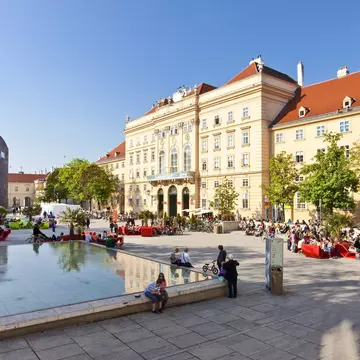
The MuseumsQuartier is a remarkable ensemble of museums, cafés, restaurants and bars inside former imperial stables designed by Fischer von Erlach. This breeding ground of Viennese cultural life is the perfect place to hang out and watch or meet people on warm evenings. With over 60,000 sq metres of exhibition space, the complex is one of the world’s most ambitious cultural spaces. Of the combined tickets on offer, the MQ Kombi Ticket (€25) includes entry into every museum (Zoom only has a reduction) and a 30% discount on performances in the TanzQuartier Wien; MQ Art Ticket (€21.50) gives admission into the Leopold Museum, MUMOK, Kunsthalle and reduced entry into Zoom,…
reviewed
-
E
Café Central
Grand Central has a rich history – Trotsky came here to play chess, and turn-of-the-century literary greats such as Karl Kraus and Hermann Bahr regularly met here for coffee. Its impressive interior of marble pillars, arched ceilings and glittering chandeliers now plays host to tourists rather than locals, but it’s worth stopping in for a look. There’s live piano music daily from 5pm to 10pm, and the plaster patron with the walrus moustache near the door is a model of the poet Peter Altenberg.
reviewed
-
F
Figlmüller
Vienna, and the Viennese, would simply be at a loss without Figlmüller. This famous Beisl has some of the biggest – and best – schnitzels in the business. Sure, the rural decor is contrived for its inner-city location, and beer isn’t served (only wine from the owner’s own vineyard), but it’s a fun Viennese eating experience and one you won’t find anywhere else in the world.
reviewed
-
G
Sigmund Freud Museum
Sigmund Freud is a bit like the telephone – once it happened, there was no going back. The apartment where he lived and worked from 1891 till his forced departure from Vienna with the arrival of the Nazis in 1938 is now a museum devoted to the father of psychoanalysis. It contains a number of his possessions, and Freud’s obsessions – travelling, smoking and collecting ancient art – are well represented; Egyptian and Buddhist statues are everywhere. Notes (in English) illuminate the offerings and audio guides (€2) are available at the ticket desk. The 2nd floor is used for temporary exhibitions.
reviewed
-
Eisriesenwelt
Billed as the world’s largest accessible ice caves, Eisriesenwelt is a glittering ice empire spanning 30,000 sq m and 42km of narrow passages burrowing deep into the heart of the mountains. Even if it’s hot outside, entering the caves in any season is like stepping into a deep freeze – bring warm clothing and sturdy footwear.
A tour through these Narnia-esque chambers of blue ice is a unique experience. As you climb up wooden steps and down pitch-black passages, with carbide lamps aglow, otherworldly ice sculptures shaped like polar bears and elephants, frozen columns and lakes emerge from the shadows. A highlight is the cavernous Eispalast (ice palace), where the…
reviewed
-
H
Il Sole
The wood-fired pizza at this authentic trattoria is delicious. The smiley Italian owner starred on the German TV series DasTraumschiff (Love Boat), and the evidence is plastered all over the walls in the entrance.
reviewed
-
I
Fürst
Pistachio, nougat and dark chocolate dreams, the Mozartkugeln (Mozart balls) here are still handmade to Paul Fürst’s original 1890 recipe and cost €1 per mouthful. Other specialities include cube-shaped Bach Würfel – coffee, nut and marzipan truffles dedicated to yet another great composer.
reviewed
Advertisement
-
J
Spanish Riding School
The world-famous Spanish Riding School (Spanische Hofreitschule) is a Viennese institution truly reminiscent of the imperial Habsburg era. This unequalled equestrian show is performed by Lipizzaner stallions formerly kept at an imperial stud established at Lipizza (hence ‘Lipizzaner’; see). These graceful stallions perform an equine ballet to a program of classical music while the audience watches from pillared balconies – or cheaper standing room – and the chandeliers shimmer above. There are many different ways to see the Lipizzaner. Performances are the top-shelf variant, and for seats at these you will need to book several months in advance. The website has the…
reviewed
-
K
Leopold Museum
This museum is named after Rudolf Leopold, a Viennese ophthalmologist who, on buying his first Egon Schiele (1890–1918) for a song as a young student in 1950, started to amass a huge private collection of mainly 19th-century and modernist Austrian artworks. In 1994 he sold the lot – 5266 paintings – to the Austrian government for €160 million (sold individually, the paintings would have made him €574 million), and the Leopold Museum was born. The building has a white, limestone exterior, open space (the 21m-high glass-covered atrium is lovely) and natural light flooding most rooms. Considering Rudolf Leopold’s love of Schiele, it’s no surprise the museum contains the…
reviewed
-
L
MUMOK
The dark basalt edifice and sharp corners of the Museum moderner Kunst (Museum of Modern Art) are a complete contrast to the MuseumsQuartier’s historical sleeve. Inside, MUMOK is crawling with Vienna’s finest collection of 20th-century art, centred on fluxus, nouveau realism, pop art and photo-realism. The best of expressionism, cubism, minimal art and Viennese Actionism is represented in a collection of 9000 works that are rotated and exhibited by theme – but take note that sometimes all this Actionism is packed away to make room for temporary exhibitions. On any visit you might glimpse: wearily slumped attendant (not part of any exhibit), photos of horribly deformed…
reviewed
-
M
Mozarthaus Vienna
Mozarthaus Vienna, the residence where the great composer spent two and a half happy and productive years, is now the city’s premiere Mozart attraction. The museum was revamped a few years ago and is well worth a visit for an insight into the life and times of Mozart in Vienna (a total of 10 years). One floor deals with the society of the late 18th century, providing asides into prominent figures in the court and Mozart’s life, such as the Freemasons to whom he dedicated a number of pieces. Mozart’s vices – his womanising, gambling and ability to waste excessive amounts of money – lend a spicy edge (you can look through some peepholes). Another floor concentrates on…
reviewed
-
Otto Wagner Buildings
Something of a problem zone due to flooding, the Wien River needed regulating in the late 19th century. It would be more accurate to say that its last semblance of being a natural river was utterly and completely obliterated. At the same time, Otto Wagner had visions of turning the area between Karlsplatz and Schönbrunn into a magnificent boulevard. The vision blurred and the reality is a gushing, concrete-bottomed creek (a shocking eyesore designed by Wagner) and a couple of attractive Wagner houses on the Linke Wienzeile. Majolika-Haus at No 40 (1899) is the prettiest as it’s completely covered in glazed ceramic to create flowing floral motifs on the facade. The second…
reviewed
-
N
Haus der Musik
The Haus der Musik is one of Vienna’s more unusual museums. Although some of the activities and exhibits could be a little more user-friendly, it manages to explain sound in an amusing and interactive way (in English and German) for both children and adults.
The 1st floor hosts historical archives of the Vienna Philharmonic. Here you can listen to a shortened version of the world-famous New Year’s concert, and a bizarre interactive tool allows you to compose your own waltz with the roll of a die. The 2nd floor, called the Sonosphere, is where you can delve into the mechanics of sound. This features plenty of engaging instruments, interactive toys and touch screens. Here…
reviewed
-
O
Nationalbibliothek
Austria’s flagship library, the Nationalbibliothek contains an astounding collection of literature, maps, globes of the world and other cultural relics; its highlight, though, is the Prunksaal (Grand Hall), a majestic baroque hall built between 1723 and 1726. Commissioned by Karl VI (whose statue is under the central dome), it holds some 200,000 leather-bound scholarly tomes. Rare volumes (mostly 15th century) are stored within glass cabinets, with books opened to beautifully illustrated pages of text. The central fresco, by Daniel Gran, depicts the emperor’s apotheosis.
reviewed
-
P
Schatzkammer
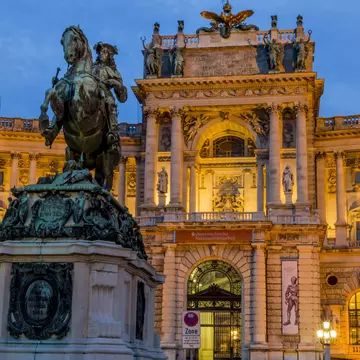
The Schatzkammer (Imperial Treasury) contains secular and ecclesiastical treasures of priceless value and splendour – the sheer wealth of this collection of crown jewels is staggering. As you walk through the rooms you see magnificent treasures such as a golden rose, diamond studded Turkish sabres, a 2680-carat Colombian emerald and, the highlight of the treasury, the imperial crown. The wood-panelled Sacred Treasury has a collection of rare religious relics, some of which can be taken with a grain of salt: fragments of the True Cross, one of the nails from the Crucifixion, a thorn from Christ’s crown and a piece of tablecloth from the Last Supper. Audio guides in German,…
reviewed
-
Q
Schloss Schönbrunn
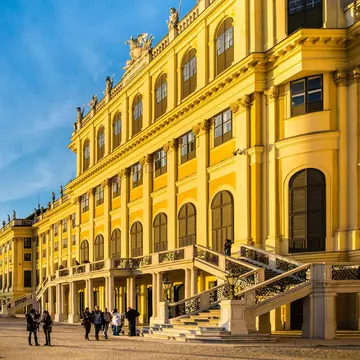
A tour of Schloss Schönbrunn focuses on the palace itself – especially the Habsburg residents. This means grand rooms and background on the habits and quirks of Austria’s famous family. Of the 1441 rooms within the palace, 40 are open to the public. The Imperial Tour takes you into 26 of these, and in the last room those on a Grand Tour show their tickets again and continue through the remaining rooms. Note that the Grosse Galerie (Great Gallery), part of both tours, is being restored until late 2012. Despite the rather steep prices, both tours are well worth doing for an insight into the people and the opulence of the baroque age. Because of the popularity of the palace,…
reviewed
-
R
Kirche am Steinhof
Situated in the grounds of the Psychiatric Hospital of the City of Vienna, Kirche am Steinhof, built from 1904 to 1907, is the remarkable achievement of Otto Wagner. Kolo Moser chipped in with the mosaic windows, and the roof is topped by a copper-covered dome that earned the nickname Limoniberg (Lemon Mountain) from its original golden colour. It’s a bold statement in an asylum that has other art-nouveau buildings, and it could only be pushed through by Wagner because the grounds were far from the public gaze.
reviewed
Advertisement
-
The Original Sound of Music Tour in Salzburg
4 hours (Departs Salzburg, Austria)
by Viator
lt;pgt;The hills are alive with The Original Sound of Music Tour in Salzburg. Enjoy a day trip visiting the breathtaking landscapes and locations where the…Not LP reviewed
from USD$53.63 -
S
Kent
Kent means ‘small town’ in Turkish, an appropriate name considering the hordes that frequent this ever-expanding Turkish restaurant. In summer the tree-shaded garden is one of the prettiest in the city, and the food is consistently top-notch. The menu is extensive, but highlights include shish kebab, Ispanakli Pide (long Turkish pizza with sheep’s cheese, egg and spinach) and Büyük Meze Tabagi (a starter plate as big as a main with baked aubergine, carrots, courgettes, rice-filled vine leaves, green beans, hummus and other delights). The vegetarian and breakfast selections will please most, and everything is available for takeaway. For late-night desserts, try the…
reviewed
-
T
Naschmarkt
The market in Vienna. This massive market extends for more than 500m along Linke Wienzeile between the U4 stops of Kettenbrückengasse and Karlsplatz. The western end near Kettengasse is more fun, with all sorts of meats, fruit and vegetables (this is the place for that hard-to-find exotic variety), spices, wines, cheeses and olives, Indian and Middle Eastern specialities and fabulous kebab and felafel stands. (Check out the vinegar and oil place, with 24 varieties of fruit- and veg-flavoured vinegar, 11 balsamics and over 20 types of flavoured oil.) The market peters out at the eastern end to stalls selling Indian fabrics and jewellery and trashy trinkets – suddenly…
reviewed
-
Swarovski Kristallwelten
Swarovski Kristallwelten tops the list of Austria’s most-visited attractions. Call them kitsch or classy, there is no doubting the popularity of these crystals, displayed in all their glory at this fantastical playground. A giant’s head spewing water into a pond greets you in the park. Inside you’ll find Alexander McQueen’s crystal tree, zebras drifting past on ruby slippers in a twinkling theatre, and the world’s biggest crystal, weighing in at 62kg. Terence Conran’s shop by the exit is where, depending on your budget, you can buy a bejewelled pen for €1.30 or splurge on a €14,800 crystal-studded iguana. Decisions, decisions…
reviewed
-
U
Zoom
Zoom children’s museum is an arts and crafts session with a lot of play thrown in. Children are guided through themed programs and have the chance to make, break, draw, explore and be creative. The museum consists of ‘Exhibition’, a section with a new exhibition every six months (free entry), a ‘Studio’ (child €5, one adult free, two adults €3.50) for budding Picassos, and sections ‘Lab’ (multimedia; child €5, adults free) and ‘Ocean’ (play activities to stimulate coordination, social and cognitive abilities; child €3, one adult free, two adults €2.50). Programs, aimed at kids from eight months to 14 years, last about 1½ hours and spots can be reserved from the ticket…
reviewed