Things to do in Albania
-
A
National Museum of History
The National Museum of History has a wonderful socialist-realist Albania mosaic on its front. It still shows proud Albanians marching through history, only now the flag is missing its communist star. Inside are many of this ancient land's archaeological treasures, dating back as far as 100,000 BC. The extensive partisan-communist section has been retained (unfortunately without English translations), but it now ends with a large memorial exhibit to victims of Hoxha's regime.
reviewed
-
B
Archaeological Museum
The ArchaeologicalMuseum on the waterfront is well laid out and has an impressive collection of artefacts from the Greek, Hellenistic and Roman periods. Highlights include engraved Roman funeral stelae (memorial stones) and some big carved stone sarcophagi. Back in the day when the city was called Epidamnos, Durrës was a centre for the worship of Venus, and the museum has a cabinet bursting with little busts of the love goddess.
reviewed
-
C
Bar Torra
Housed inside a fortified Venetian tower at the beginning of the city walls, this was one of the first private cafes in Albania, opened by a team of local artists. After you've had a peek at the tourist information section inside, and at the view from the top, you can drink a local brew in the cosy barred nooks of the old tower. The ceiling is strangely reminiscent of Hoxha's bunkers.
reviewed
-
Prince Park
Tucked into the top of the city park, this upmarket restaurant is like a hunting lodge with an open fire in winter, and wooden interiors and antlers on the walls. The cuisine is Italian, with some vegetarian pasta options.
reviewed
-
D
Outdoor Albania
Excellent trailblazing adventure-tour agency offering all manner of specialist tours, including hiking, mountain biking and village stays - with a strong commitment to ecotourism.
reviewed
-
Buke dhe Embelsira Franceze
One of the few good breakfast spots in Tirana, where you can stop for a coffee and croissant or take away a delicious pain au chocolat.
reviewed
-
E
Fortress of Justinian
Along Rruga Murat Toptani are the 6m-high walls of the Fortress of Justinian, the last remnants of a Byzantine-era castle.
reviewed
-
Butrint
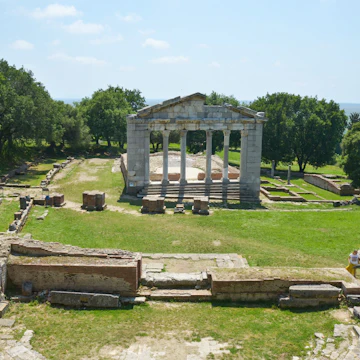
The ancient ruins of Butrint lie 18km (11mi) south of Saranda and are a real gem if you have a fascination for the ancient world. The remains are from a variety of periods, spanning 2500 years. The poet Virgil claimed that the Trojans settled Butrint, but the site has been pored over by archaeologists and no evidence of this has been found.
Greeks settled Butrint during the 6th century BC, although the area had been settled long before by the Illyrians. Within a century of the Greeks arriving, Butrint had become a fortified trading city with its own acropolis, the ruins of which you can still visit. Just below the acropolis in the forest is the 3rd century BC theatre,…
reviewed
-
Skanderbeg Square
Nothing captures the history of 20th-century Albania quite like Tirana's vast central square. On one side is a horseshoe-shaped ensemble of government buildings built by Mussolini in the 1930s, when fascist Italy practically owned its little neighbour. The former headquarters of Albania's dreaded Communist-era secret police, the Sigurimi, lies just behind them.
In front of the buildings is an equestrian statue of Albania's greatest hero, Gjergj Kastrioti (Skanderbeg), with sword held rigidly upright and beard jutting magnificently. On the other side of the square is the vast Soviet-built National History Museum, complete with an enormous mosaic of Alanian liberators…
reviewed
-
Butrinti
The ancient ruins of Butrinti are renowned for their size and beauty. They are in a fantastic natural setting, part of a 29-sq-km national park; set aside at least three hours to lose yourself and thoroughly explore this fascinating place.
Although the site had been inhabited long before, Greeks from Corfu settled on the hill in Butrinti (Buthrotum) in the 6th century BC. Within a century Butrinti had become a fortified trading city with an acropolis. The lower town began to develop in the 3rd century BC, and many large stone buildings had already been built by the time the Romans took over in 167 BC.
Butrinti's prosperity continued throughout the Roman period and the…
reviewed
Advertisement
-
F
Efendy
Foodies alert! Housed in an inconspicuous building in Blloku is an authentic Ottoman dining experience that is as much a history lesson as a sublime culinary one.
Chef Ahmet Dursun hails from Turkey, where he studied at one of the world's finest Ottoman restaurants, extracting recipes from the old chefs and researching their collection of documents. He ended up in Albania 12 years ago (as an opera singer - it's a long story), and he's since travelled throughout the Balkans ('from Croatia to Bulgaria') collecting dishes along the way. Let him lead you through his seasonal delicacies and you won't be disappointed. He'll even regale you with stories about the origins of the…
reviewed
-
G
Ethnographic Museum
Down from the castle is Berat's Ethnographic Museum . It's based in an 18th-century Ottoman house, which is as interesting as the exhibits. The ground floor has displays of traditional clothes and the tools used by silversmiths and weavers, while the upper storey has kitchens, bedrooms and guest rooms decked out in traditional style. Check out the mafil, a kind of mezzanine looking into the lounge where the women of the house could keep an eye on male guests being entertained (and see when their cups needed to be filled). Brochures are available, but to get the most out of it, ask for a guided tour.
reviewed
-
Berat Citadel
Berat is Albania's most charming medieval town, and the citadel is its best preserved quarter. Surrounded by ancient stone walls, the citadel protects over a dozen churches and many wonderful old houses. The citadel's biggest church, St Mary's, has been converted into the Onufri Museum, honouring Albania's greatest painter of Christian icons.
Just wandering around the citadel quarter reveals glorious views over the rest of Berat towards holy Mt Tomorri, glimpses into the courtyards of traditional houses and a sense of what Albania might have been like before the stolid hand of Communism fell on it.
reviewed
-
H
Onufri Museum
Kala was traditionally a Christian neighbourhood, but less than a dozen of the 20 churches remain. The quarter's biggest church, Church of the Dormition of St Mary (Kisha Fjetja e Shën Mërisë) only holds one service a year, and is now the site of the Onufri Museum . The church itself dates from 1797 but was built on the foundations of a 10th-century church. The building makes a lovely museum, and Onufri's spectacular 16th-century artworks are displayed on the ground level along with a beautifully gilded iconostasis.
reviewed
-
I
Pyramid
The Pyramid - also known as the former Enver Hoxha Museum (1988) - was designed by Hoxha's daughter and son-in-law. In a hilarious twist of fate the building with its sloping white-marble and glass walls and which once housed a grandiose statue of the ruler, is now home to a disco called the Mummy.
In front of the Pyramid the Bell of Peace is a touching little memorial to the country's difficult postcommunist years, forged from bullet cases collected by Albanian schoolchildren during the anarchy of 1997.
reviewed
-
Llogaraja Pass (National Park)
The road going south from Vlora climbs up to the Llogaraja Pass, over 1000m high, for some of Albania's most spectacular scenery. If you are going to Dhërmiu or Himara, this is the road you will take.
From the road you will see clouds descending onto the mountain, steep hillsides crashing into the sea below, shepherds on the plains guiding their herds, and thick forests where deer, wild boar and wolves roam. The local name for these mountains is Malet e Vetetimes, which means 'thunder mountains'.
reviewed
-
J
Former Residence of Enver Hoxha
Nestled between Parku Kombëtar (a public park), the Bulevardi Dëshmorët e Kombit and the river is the once totally forbidden but now totally trendy Blloku, the former exclusive Communist Party neighbourhood. When the area was opened to the general public in 1991, Albanians flocked to see the style in which their proletarian leaders lived. Judging by this three-storey pastel-coloured house the Albanian proletarian leaders lived a much simpler life than their comrades in Romania, for example.
reviewed
-
Martyrs' Cemetery
The Martyrs' Cemetery is at the top of the hill, on the other side of the road, and is where some 900 partisans who died in WWII are buried. The views over the city and surrounding mountains are excellent. Many still come here, clutching laurel sprigs to pay their respects under the shadow of the immense, beautiful and strangely androgynous Mother Albania statue (1972). Hoxha was buried here in 1985, but was exhumed in 1992 and interred in an ordinary graveyard on the other side of town.
reviewed
-
Sheshi Skënderbej
Sheshi Skënderbej is the bustling heart of the city. Until it was pulled down by the angry mob on 20 February 1991 a 10m-high gold-leaf-covered statue of Enver Hoxha stood here, watching over a mainly carless square. Now only the equestrian statue of Skanderbeg remains, deaf to the cacophony of screeching horns, as cars four lanes deep try to shove their way through the battlefield below.
reviewed
-
The Blue Eye Spring (Syri i Kalter)
The Blue Eye Spring (Syri i Kalter) is a hypnotic pool of deep-blue water surrounded by electric-blue edges like the iris of an eye. It feeds the Bistrica River and its depth is still unknown. This is the perfect picnic spot, under the shade of the oak trees.
You can also check out the 12th-century monastery of Mesopotami en route, perched on a little hill by the Bistrica.
reviewed
Advertisement
-
K
National Art Gallery
The National Art Gallery has a wonderful collection ranging from 13th-century icons to modern art, but most interesting are the large socialist-realist canvases. Note the central role of women in this work - from the breastfeeding mother with a shotgun slung over her lap in Lokja (1983), to the manager giving instructions in Giant of Metallurgy.
reviewed
-
L
Ajka Restaurant
This substantial restaurant is run by an Armenian family whose ancestors settled in Albania early in the 20th century. The restaurant has a lovely setting above the Osum River, looking over the houses of the Mangalem quarter. Pizzas cost around 400 lekë, and a substantial mixed meze platter costs 500 lekë. It also serves grilled dishes and ice cream.
reviewed
-
M
Former Palace of King Zogu I
On the hilltop west of the amphitheatre stands the decaying former palace of King Zogu I; it's a 15-minute climb up from the town centre to what was a grand palace (marble staircases, carved wooden ceilings and the like), but it's closed to the public. There are better views from the nearby lighthouse.
reviewed
-
N
Bujar's
In the markati (market) area between the two main roads in the lower town you might be able to find this simple cafe with wonderful home-style meals. The restaurant doesn't have a menu, just a selection of daily offerings. There's a small sign on the single-storey light-blue building in the lane behind the Shpëtimi Bar.
reviewed
-
Church of the Holy Evangelist
An Orthodox church set back from Rruga e Kavajës in a laneway. In the mid-1960s the infamous atheism campaign resulted in many churches and mosques being bulldozed or converted into public buildings. On this church's steeple you can clearly see where the cross-shaped holes in the brickwork were once covered over.
reviewed