Things to do in Transylvania
-
Alexandru Borza Botanic Gardens
West through the student ghetto campus housing, head past fast-food joints up Str Bogdan P Haşdeu to Str Pasteur to reach the fragrant 1930 Alexandru Borza Botanic Gardens, which covers 15 hectares, with shaded green lawns, a super Japanese garden and rose garden with some 600 different varieties, and an observation tower.
reviewed
-
Bistro de l'Arte
In the bottom of a cosy 15th-century building, the Bistro is the place for sit-back wine sessions, breakfasts with wi-fi for your laptop, or lively dinners with mingling Romanian couples (who sometimes come for plays). The menu drifts from French and includes daily fish dishes, big salads and pasta.
reviewed
-
A
Grand Plaza
Not far from the train station, this simple and busy Romanian restaurant passes on the gimmicks and focuses on tasty Romanian food, which the locals file in for.
reviewed
-
B
Black Church
Braşov's main landmark, just south of the Piaţa Sfatului (Council Square), is the Black Church, the largest Gothic church between Vienna and Istanbul and still used by German Lutherans today. Built between 1383 and 1480 (delayed by an Ottoman razing), its name comes from its appearance after a fire in 1689.
The original statues on the exterior of the apse are now inside (look back after you enter) and some 120 fabulous Turkish rugs hang from the balconies (gifts from merchants who returned from shopping sprees in the southern Ottoman lands). Worshippers drop coins through the wooden grates in the floor and hope for the best.
The church's 4000-pipe organ, built by Buchhol…
reviewed
-
Mount Tâmpa
Towering above town from the east is Mount Tâmpa, where Braşov's original defensive fortress was built. Vlad Ţepeş attacked it in 1458, finally dismantling it two years later and - out of habit - impaling some 40 merchants atop the peak. These days it's an easy, and irresistible, trip up. Many visitors go via the Tâmpa cable car offering stunning views from the top of Mt Tâmpa and a communist-era dining room. There's access to hiking trails up here.
Walk south to reach the 'Hollywood'-style Braşov sign, with a viewing platform. You can also hike to the top in an hour following zigzag trails from the cable-car station (red triangles) or from the northeastern edge of …
reviewed
-
C
Pharmaceutical Museum
Here's why we travel - for superb, fully rewarding, ever-surprising quirks like this, the small three-room Pharmaceutical Museum, housed in Cluj's first - and Romania's fourth - apothecary (1573), as a bronze-plate map painstakingly attests. Led by a hilarious pharmacist in a white lab coat, who points like a game-show model towards (seemingly ho-hum) glass cases of ground mummy dust, medieval alchemist symbols and painted 18th-century aphrodisiac bottles.
He speaks some English. If you utter a 'wow' you may get a deadpanned 'For you… interesting… for me… it is normal.'
reviewed
-
First Romanian School Museum
Beside St Nicholas' Cathedral is the two-room 1495 First Romanian School Museum, which packs a staggering far-reaching selection of old books and pieces, including the first Russian Bible (1581), King Ferdinand's coronation flag from 1922 (found in 2006), and 15th-century schoolbooks that warned 'he who will steal this book will be CURSED…his blood shall melt on his body…his left eye shall dry out!' Resist the temptation then. No English; guides are available.
reviewed
-
Bucegi
The easiest way up into the Bucegi from Sinaia is up two cable-car rides, one from the centre to the Cota 1400 station, then another up to Cota 2000 station. In the centre, the 30-person cable-car station leaves half-hourly with two station points marked by elevation. Lines are more likely in winter than summer. Buses just below the station also go up to Cota 1400 when full; there are also taxis.
reviewed
-
D
Roata
Housed in a back-alley building, with tasty traditional Romanian dishes served in clay plates, this joint is best for sitting on the small terrace and vying for space amidst potted plants and moss-covered stones. Traditional music puts a little bounce into the air. People know it's good, and it's almost always busy.
reviewed
-
Str Storii
Between Piaţa Sfatului and the Mt Tâmpa cable car is Str Storii, which is 1.32m by 83m - one of Europe's narrowest 'streets'. The cobbled pedestrian-only alley has been scrubbed up, with nice views of the 'Braşov' sign on the mountain, and connects Str Porta Schei and Str Cerbului.
reviewed
Advertisement
-
E
Crama Sibiul Vechi
This popular, evocative brick-cellar spot off the main crawl reels in locals for its tasty Transylvanian armoury of mutton, sausages and beef and fish. There's live music most nights.
reviewed
-
F
Ethnographic Museum
An Ethnographic Museum was under renovation at last pass, but its collection of folk costumes and decorations should be reopened before your visit. There's a small shop here too.
reviewed
-
G
Speed/Alcatraz
Busy fast-food option with good seating options, including an outdoor deck and an enigmatic Alcatraz basement with seating in Al Capone-style cages.
reviewed
-
Peleş Castle
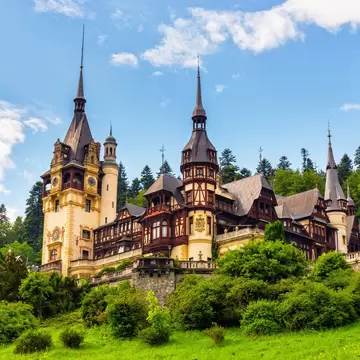
Full of pomp and brimming with confidence of a new Romanian monarchy, the magnificent century-old Peleş Castle, a 20-minute walk up from the centre, is really a palace. Fairy-tale turrets rise above acres of green meadows and grand reception halls fashioned in Moorish, Florentine and French styles, with heavy wood-carved ceilings and gilded pieces overwhelm our wee mortal minds. Even if you're bent on chasing 'Dracula', it's hard not to get a thrill visiting this castle.
The first European castle to have central heating, electricity and vacuuming(!), Peleş was intended to be the summer residence of Romania's longest-serving monarch, King Carol I (the hand-to-hip statue o…
reviewed
-
Piaţa Hermann Oberth
Cobblestones and Dracula we can understand, but what does Sighişoara have to do with space exploration? Heaps, it turns out. If it wasn't for one of Sighişoara's most beloved residents, space might still be 'out there'. Though he was born in Sibiu, Hermann Oberth (1894-1989), considered one of the fathers of modern astronautics and rocketry, is revered as a local boy (don't remind anyone that he only spent a few years here as a child).
Inspired by Jules Verne as a skygazing tyke, he started to design space rockets at the age of 14. Later, when studying medicine and physics in Munich, he wrote prolifically about the possibility and mechanics of space travel. Most of his …
reviewed
-
Pelişor Palace
About 100m up hill from Peleş Castle, the German-medieval Pelişor Palace has a hard time competing with its neighbour. King Carol I planned this house for his nephew (and future king) Ferdinand (1865-1927) and wife Marie (who didn't get on well with King C and loathed Peleş). Marie picked the design - pretty pastel decorations in simple Art Nouveau style. Most of the furniture was imported from Vienna. Marie used four apartments while Ferdinand had just one.
Marie died in the arched golden room, the walls of which are entirely covered in gilded leaves.
At the western end of the Peleş estate is the Swiss-chalet-style Foişorul Hunting Lodge, built as a temporary residence…
reviewed
-
Culture Palace
By far Târgu Mureş' top attraction dominates the square's southwestern corner, the Culture Palace, the city's beloved landmark. Built in 1911-13, the secessionist-style building is unlike anything you'll find around Transylvania. Inside its glittering, tiled, steepled roofs are ornate hallways, colourful walls, giant mirrors imported from Venice, and an often-used concert hall (with a dramatic 4463-pipe organ). Not to mention several worthwhile museums (all included in the entry price).
The best is the Hall of Mirrors (Sala Oglinzi), with 12 stained-glass windows lining a 45m hallway - a tape in various languages explains the Székely fairy tales each portrays. The Art M…
reviewed
-
H
Museum of Zoology
From the centre, walk wast along Str Clinicilor, to where it branches left through a brick gate into the wooded Biology and Geology Faculty, where you'll find (100m up on the left, past the cocky statue of Emil Racoviţa) the surprisingly rewarding Museum of Zoology, an L-shaped lab that looks like it hasn't changed since biologist Racoviţa donned his final lab coat here.
Bird noise penetrates the huge windows, bringing some life to the silence (and death) of hundreds and hundreds of jarred and stuffed specimens. Invertebrates and fish sit vertically in filled tubes that make stuff like larvae look candy-bar sized. We particularly like the display of a vulture feasting o…
reviewed
-
I
Gothic Evangelical Church
On Piaţa Huet, you'll find the Gothic Evangelical Church, built between 1300 and 1520, its great five-pointed tower visible from afar. Don't miss the four magnificent baroque funerary monuments on the upper nave on the north wall, and the 1772 organ with 6002 pipes (it's Romania's largest).
The tomb of Mihnea Vodă cel Rău (Prince Mihnea the Bad), son of a certain Vlad Ţepeş, is in the closed-off section behind the organ (ask for entry; it's the first of 67 tombstones). This prince, who ruled Wallachia from 1507 to 1510, was murdered on the square in front of the church after attending a service in March 1510. You can climb the church tower - ask for entry at Casa Luxembu…
reviewed
-
Sinaia Monastery
Half way between Peleş and the centre, the Sinaia Monastery, home to 20-some monks, is well worth a look. Inside the gate, the large Orthodox church ('biserica mare') before you dates from 1846; two icons inside were presented by Russia's Tsar Nicholas II in 1903. Beside the church is a small History Museum.
Back toward the mountains, a passageway leads to a smaller church ('biserica veche') from 1695. Monks retreated into the Bucegi Mountains from the 14th century but it was not until the late 17th century that they built a monastery.
The tomb of Tache Ionescu, the head of a transitional government for a few months in 1921-22, is in the building next to the small church.
reviewed
Advertisement
-
History Museum
Inside the tower is the great little History Museum, with small rooms that wind up to the 7th-floor look-out above the clock. On the first floor, don't miss the small exhibit on local hero Hermann Oberth; there are some English translations (as well as the sketch of Oberth's 'space suit'). A couple of floors up are 18th-century gingerbread wood blocks, a local tradition that dates from 1376.
Above you can see the clock's famed figures, as well as the clanking innards behind. It's not made clear, but you can visit the History Museum, the medieval arms collection, and the Torture Room Museum for a combined ticket price (about the same price as the student discounts for all …
reviewed
-
J
Teleki Library/Bolyai Museum
Heading halfway down Piaţa Trandafirilor, the side-street Str Bolyai leads east to the interesting Teleki Library/Bolyai Museum, a two-part museum that takes on two different angles to the city's past. More famous is Teleki Library, which includes 230,000 (and counting) rare books that stems from Samule Teleki's (Austrian chancellor to the city) donation to the city in 1802.
Modest chickenwire encases simple displays. The adjoining Bolyai Museum is dedicated to Târgu Mureş sons Farks and János, 19th century mathematicians and excellers in non-Euclidian geometry; if that's boring to you, father/son scalps and skull parts are displayed side by side.
reviewed
-
Museum of Traditional Folk Civilisation
Sibiu's top highlight is some 5km from the centre. The large Museum of Traditional Folk Civilisation is a sprawling open-air museum with 120 traditional dwellings, mills and churches brought from around the country. Many are signed in English, with maps showing where they came from; they're situated in a lovely forest around a lake. There's also a nice gift shop and restaurant with creek-side bench seats.
Trolleybus 1 from the train station goes there (get off at the last stop and keep walking for under 1km, or take the hourly Răşinari tram for a couple of stops), though it's an easy and pleasant bike ride there too.
reviewed
-
Clock Tower
Entering the citadel, you pass under the massive Clock Tower, which dates from 1280 and once housed the town council. Formerly the main entrance to the fortified city, the tower is 64m tall, with sturdy base walls measuring an impenetrable 2.35m. Inside, the 1648 clock is a pageant of slowly revolving 80cm-high figurines, carved from linden wood, each representing a character from the Greek-Roman pantheon: Peace bears an olive branch, Justice has a set of scales and Law wields a sword.
The executioner is also present and the drum-player strikes the hour. Above stand seven figures, each representing a day of the week.
reviewed
-
K
City Museum
A block northeast of Piaţa Trandafirilor, the huge Citadel dates from 1492, but was rebuilt in 1602. On its southern end, and accessed separately from the rest, is the Reform Church (1491), with the nicest grounds. Gates lead into the main area from either side, but easiest from the northeastern side. The most appealing attraction, in the 1492 gate tower on the western wall, is a small City Museum, with pottery fragments and old decrees.
There's a small information office near the northern gate; English-speaking staff can tell you if a concert or special exhibit is going on in the citadel.
reviewed