Things to do in Cardiff (Caerdydd)
-
A
Chapter Arts Centre
Probably the city's most interesting arts venue, the Chapter has a varied programme of contemporary drama, as well as art exhibitions, workshops, alternative theatre and dance performances; it's also an appealing, arty place to hang out and there's a good café-bar with Cardiff's biggest range of beers.
reviewed
-
B
Craft in the Bay
This retail gallery showcases work by contemporary Welsh artists and craftspeople, with a wide range of ceramics, textiles, woodwork, jewellery, glassware, canvases and ironwork.
reviewed
-
C
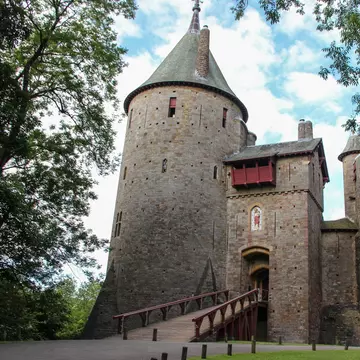
Cardiff Castle
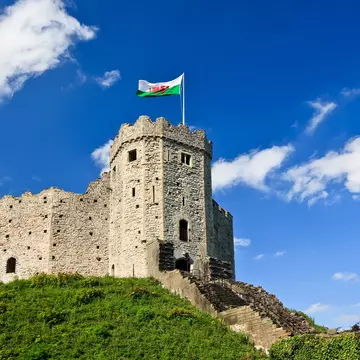
The grafting of Victorian mock-Gothic extravagance onto Cardiff's most important historical relics makes Cardiff Castle the city's leading attraction. It's far from a traditional Welsh castle, more a collection of disparate castles scattered around a central green, encompassing practically the whole history of Cardiff. The most conventional castle-y bits are the 12th-century motte-and-bailey Norman keep at its centre and the 13th-century Black Tower, which forms the entrance gate.
In the 19th century it was discovered that the Normans had built their fortifications on top of the original 1st-century Roman fort. The high walls that surround the castle now are largely a Vict…
reviewed
-
D
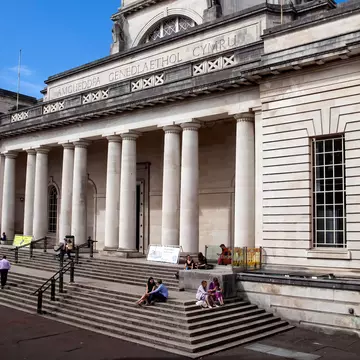
National Museum Cardiff
Set around the green lawns and colourful flowerbeds of Alexandra Gardens is the Civic Centre, an early-20th-century complex of neo-Baroque buildings in gleaming white Portland stone. They include the City Hall, police headquarters, law courts, crown offices, Cardiff University and this excellent museum, one of Britain's best, covering natural history, archaeology and art.
The Evolution of Wales exhibit takes you through 4600 million years of geological history, with a rollicking multimedia display that places Wales into a global context. Films of volcanic eruptions and aerial footage of the Welsh landscape explain how its scenery was formed, while model dinosaurs and wooll…
reviewed
-
E
Cardiff Bay Waterfront
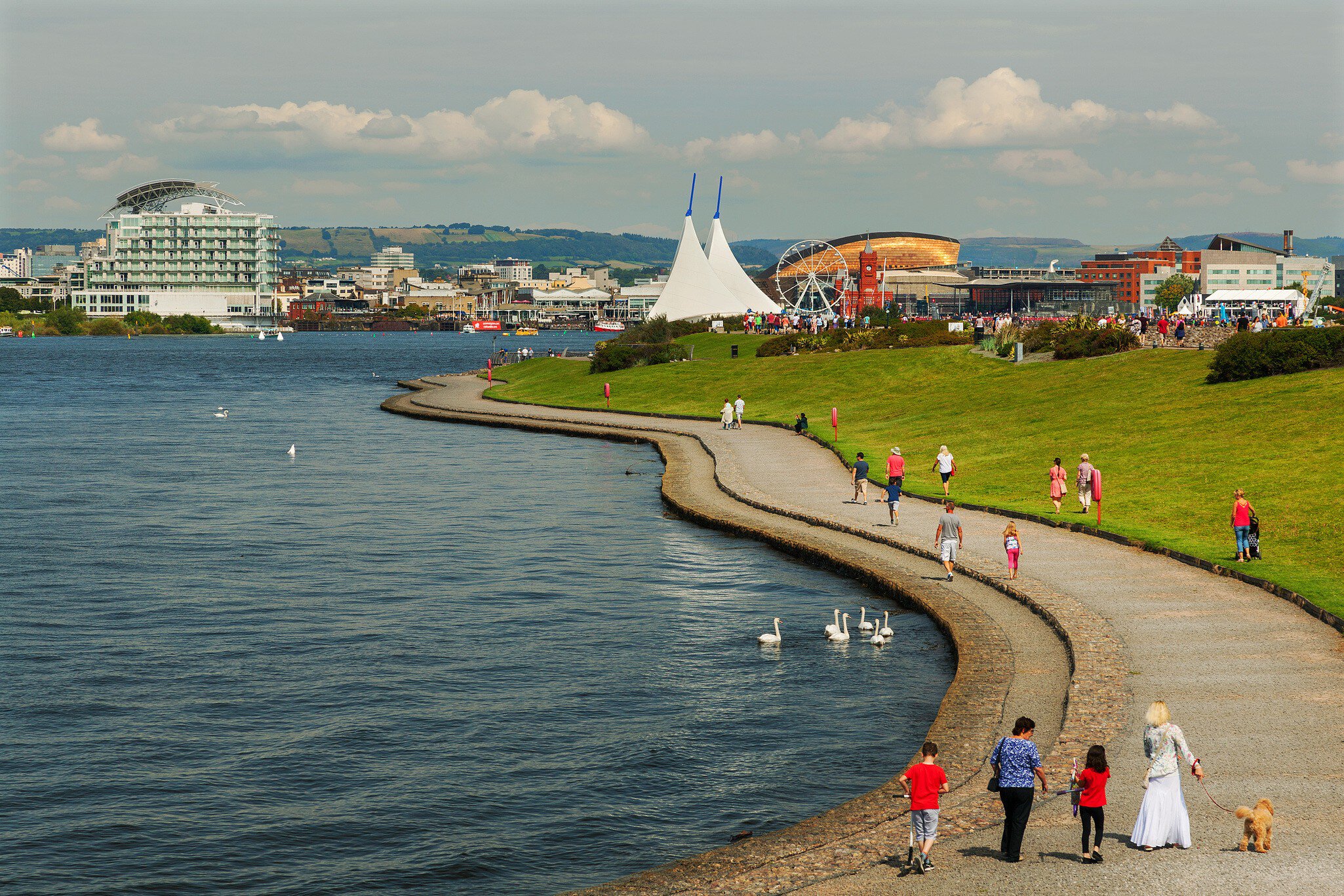
Lined with important national institutions, Cardiff Bay is where the modern Welsh nation is put on display in an architect's playground of interesting buildings, large open spaces and public art. It wasn't always this way. By 1913 more than 13 million tonnes of coal was being shipped from Cardiff's docks. Following the post-WWI slump the docklands deteriorated into a wasteland of empty basins, cut off from the city by the railway embankment. The bay outside the docks – which has one of the highest tidal ranges in the world (more than 12m between high and low water) – was ringed for up to 14 hours a day by smelly, sewage-contaminated mudflats.
Since 1987 the area has be…
reviewed
-
F
Senedd (National Assembly Building)
Designed by Lord Richard Rogers (the architect behind London's Lloyd's Building and Paris' Pompidou Centre), the Senedd is a striking structure of concrete, slate, glass and steel with an undulating canopy roof lined with red cedar. It's won awards for an environmentally friendly design, which includes a huge rotating cowl on the roof for power-free ventilation and a gutter system that collects rainwater for flushing the toilets. The lobby and surrounding area are littered with public artworks.
The Welsh National Assembly usually meets in a plenary session from 1.30pm on Tuesday and Wednesday, and seats in the public gallery may be pre-booked, although you can always take …
reviewed
-
G
Millennium Stadium
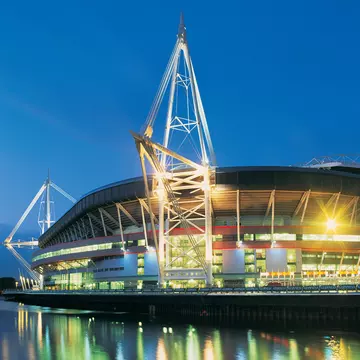
The spectacular Millennium Stadium squats like a stranded spaceship on the River Taff's east bank. Attendance at international rugby and football matches has increased dramatically since this 72,500-seat, three-tiered stadium with sliding roof was completed in time to host the 1999 Rugby World Cup. The famous Cardiff Arms Park , its predecessor, lies literally in its shadow.
Not everyone is happy with it: one critic called it 'an absurdly overexcited structure…that rears over the surrounding streets like a sumo wrestler'. The stadium cost £110 million to build and big matches paralyse the city centre, but when the crowd begins to sing, the whole city resonates and all is f…
reviewed
-
H
Llandaff Cathedral
Set in a hollow on the west bank of the River Taff is the imposingly beautiful Llandaff Cathedral, built on the site of a 6th-century monastery founded by St Teilo.
The present cathedral dates from 1130 - it crumbled throughout the Middle Ages, and during the Reformation and Civil War it was used as an alehouse and then an animal shelter. Derelict by the 18th century, it was largely rebuilt in the 19th century and extensively restored after being damaged by a German bomb in 1941. The towers at the western end epitomise the cathedral's fragmented history - one was built in the 15th century, the other in the 19th. Inside, plain glass windows provide a striking clarity of li…
reviewed
-
I
Wales Millennium Centre
The centrepiece and symbol of Cardiff Bay's regeneration, the Millennium Centre is an architectural masterpiece of stacked Welsh slate in shades of purple, green and grey topped with an overarching bronzed steel shell. Designed by Welsh architect Jonathan Adams, it opened in 2004 as Wales' premier arts complex, housing the Welsh National Opera, National Dance Company, National Orchestra, Academi (Welsh National Literature Promotion Agency), HiJinx Theatre and Ty Cerdd (Music Centre of Wales).
The roof above the main entrance is pierced by 2m-high, letter-shaped windows, spectacularly backlit at night, that spell out phrases from poet Gwyneth Lewis: 'Creu Gwir fel Gwydr o F…
reviewed
-
J
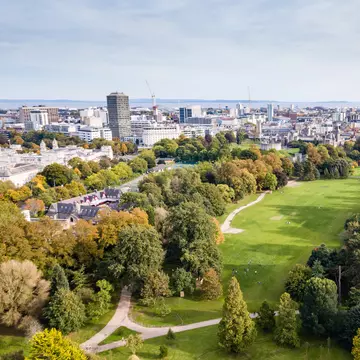
Bute Park
With Sophia Gardens, Pontcanna Fields and Llandaff Fields, Bute Park forms a green corridor that stretches northwest alongside the River Taff for 1.5 miles to Llandaff. All were once part of the Bute's vast holdings. Forming the park's southern edge, the Animal Wall is topped with stone figures of lions, seals, bears and other creatures. In the 1930s they were the subject of a newspaper cartoon strip and many Cardiff kids grew up thinking the animals came alive at night.
reviewed
Advertisement
-
K
Le Gallois
One of Cardiff's finest, Le Gallois (the Welshman) majors in an inspirational blend of Welsh produce and French cuisine. The decorous dining room of grey walls, walnut-veneer tables and starched-linen napkins makes sure the focus is on the seasonal menu of half-a-dozen starters and half-a-dozen main courses.
reviewed
-
L
Norwegian Church
On the east side of the harbour, looking like it's popped out of the pages of a storybook, is the Norwegian Church, a white-slatted wooden building with a black witch's-hat spire. Built in 1869 beside the long-gone Bute West Dock, it was a seamen's mission, modelled on the lines of a traditional Norwegian village church. It fell into disrepair, but remained a place of worship until 1974; the Cardiff-born writer Roald Dahl was christened here, and served as president of the preservation trust that restored and renovated the church. It has now been reincarnated as an arts centre with an excellent café, interesting exhibitions, concerts and arts courses.
reviewed
-
M
Cardiff Bay Barrage
The Cardiff Bay Barrage is a 0.75 mile-long dam enclosing the harbour. It took five years to build and created a new waterfront around 8 miles in length - a freshwater lake at the mouth of the rivers Taff and Ely. It was a controversial project, as its construction involved flooding mudflats that had provided an important habitat for migrating and breeding waterfowl. The barrage includes sluice gates to control the water flow, three lock gates to allow passage for boats, and a fish pass that lets migrating salmon and sea trout enter and leave the rivers.
reviewed
-
N
Bute Park Animal Wall
The southern edge of Bute Park, running west from Cardiff Castle along Castle St, is a low wall topped with stone figures of lions, seals, bears and other creatures. The Bute Park Animal Wall was designed by castle architect William Burges but only completed in 1892 after his death; it was extended and more animals added in the 1920s. A newspaper cartoon strip in the '30s brought the animals to life and many Cardiff kids grew up thinking the animals came alive at night.
reviewed
-
O
Techniquest
The biggest and best science and technology discovery centre in Britain, Techniquest has more than 160 engrossing, fun, hands-on exhibits with absorbing explanations. You can explore whirlwinds, race bubbles, play a harp with no strings and more - equally enjoyable for under-fives, stoned students and inquisitive adults. The shop has lots of quirky stuff and is reasonably priced. There's also a planetarium which stages night-sky demonstrations and science shows.
reviewed
-
P
Coal Exchange
Mount Stuart Square is the heart of Victorian Butetown, once the residential district that housed the dock workers. The old Coal Exchange was once the nerve centre of the Welsh coal trade, and for a time the place where international coal prices were set - it was here in March 1908 that a coal merchant wrote the world's first-ever around £1 million-pound cheque. The Exchange now houses a vibrant arts and performance venue.
reviewed
-
Q
Bosphorus
While the food is good, it's the setting that really distinguishes this upmarket Turkish restaurant. Jutting out over the water on its own private pier, Bosphorus enjoys wonderful views all round; the best of all are from the outdoor tables at the end. Early eaters can take advantage of the pre-7pm offer: two courses plus a drink for £13.
reviewed
-
R
Cafe Minuet
It may look a bit greasy spoon from the outside, but this unassuming eatery produces excellent cheap and cheerful Italian food. The menu includes good vegetarian dishes, including lots of pasta options. Get in early at lunchtime or expect to wait for a table.
reviewed
-
S
Ana Bela
This is a good place for a romantic dinner - chic but laid-back, with low light and candles, art on the walls and cool tunes - provided you don't mind putting your hand in your pocket. Prices are steep, but the food is superb. Try seared salmon fillet with puy lentils and bacon in a red-wine jus, roast loin of lamb with roasted red-pepper chutney. There's excellent house wine.
reviewed
-
T
Church of St John the Baptist
Jutting above the city-centre shopping street is the graceful Gothic lantern tower belonging to the 15th-century parish Church of St John the Baptist with its delicate stonework that's almost like filigree. A church has stood on this site since at least 1180. Inside are simple, elegant arches: a calm retreat from the street. Regular lunchtime organ concerts are held here.
reviewed
Advertisement
-
U
Spillers Records
The world's oldest record shop, founded in 1894 (when it sold wax phonograph cylinders), Spillers stocks a large range of CDs and vinyl, prides itself on catering to the nonmainstream end of the market (it's especially good on punk), and promotes local talent through in-store gigs.
reviewed
-
V
Goleulong 2000 Lightship
Near the Norwegian Church on the harbour is the bright-red Goleulong 2000 Lightship, which used to be stationed off Rhossili, warning sailors away from the Helwick Swatch, a treacherous sandbank. It now houses a Christian centre with bookshop, café and exhibitions; you can also check out the neat little cabins and climb to the top of the light tower for the view.
reviewed
-
W
Bali
Smiling waiters, low lighting and crisp linen napkins make for a warm and inviting atmosphere at this Southeast Asian restaurant. The menu gets your mouth watering with a list of Malay, Singapore and Indonesian classics such as satay, laksa, sambal, rendang and nasi goreng, and the kitchen does not disappoint, turning out authentically fragrant and spicy dishes.
reviewed
-
X
Pierhead Building
The Pierhead Building is one of the area's few Victorian survivors, a red-brick French-Gothic Renaissance confection built with Bute family money for the Cardiff Municipal Railway Co to impress the maritime traffic; the architect was a pupil of William Burges (who designed Cardiff Castle and Castell Coch). It now houses the National Assembly Visitor Centre.
reviewed
-
Y
Yard
Occupying the site of an 18th-century brewery, Yard sports an industrial-chic décor of stainless steel, polished copper pipes and zinc ducting, with a trad-looking bar in front and clubby sofas in back. Outdoor tables, good food and a child-friendly policy pulls in families at lunchtime, while cocktails and DJs attract a young party crowd at night.
reviewed