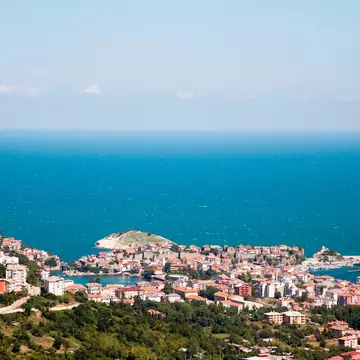
Bursa Sights

Sights in Bursa

  1. City Museum

    Bursa has a state-of-the-art City Museum, housed in what was once the old courthouse at Heykel. Ground-floor exhibits whip through the history of the city, with information on the sultans most closely associated with it. Unfortunately, the labelling is in Turkish only, apart from the section headings. Luckily the cultural and ethnographical collections upstairs need little explanation.

    Down in the basement there are reconstructions of old shops which are wonderful, with films showing old-fashioned artisans at work. Newspaper clippings also show a couple of local characters to look out for: Deli Ayten, the banjo-playing bag lady, and 'Tarzan Ali', a 59-year-old former acti…

    reviewed

  2. Karagöz Sanat Evi

    In Bursa, Şinasi Çelikkol has worked hard to keep the tradition of Karagöz puppetry alive and was instrumental in the setting up of the Karagöz Sanat Evi, opposite the Karagöz monument. It houses a small museum of puppetry with some magnificent examples from Uzbekistan. Şinasi Çelikkol's ethnographical collection is also on display here. If you would like to see the collection privately call into his shop - called, inevitably, Karagöz - in the Eski Aynalı Çarşı for an appointment.

    reviewed

  3. A

    Ulu Cami

    Prominently positioned on Atatürk Caddesi is the huge Ulu Cami, which is completely Seljuk in style and easily the most imposing of Bursa's mosques. Yıldırım Beyazıt put up the money for the monumental building in 1396. Twenty small domes and a minaret of daunting girth augment the exterior, while inside the size theme continues with immense portals and a forest of square pillars. Notice the fine work of the mimber (pulpit) and the preacher's chair, as well as the calligraphy on the walls.

    reviewed

  4. B

    Yeşil Camii

    A few minutes' walk uphill from Setbaşı, the Yeşil Camii, built for Mehmet I between 1419 and 1424, is a supremely beautiful building which represents a turning point in Turkish architectural style. Before this, Turkish mosques echoed the Persian style of the Seljuks, but in the Yeşil Camii a purely Turkish style emerged, and its influence is visible in Ottoman architecture across the country. Note the harmonious façade and the beautiful, carved marble work around the central doorway.

    reviewed

  5. C

    Yeşil Türbe

    In the small park surrounding the Yeşil Camii is the Yeşil Türbe, which unlike the mosque is not actually green; the blue exterior tiles were added during restoration work in the 19th century, although the interior tiles are original. Walk round the outside to see the tiled calligraphy above several windows. Inside, the most prominent tomb is that of the Yeşil Camii's founder, Mehmet I (Çelebi), surrounded by those of his children. There's also an impressive tiled mihrab.

    reviewed

  6. Sultan II Murat Camii

    With a shady park in front and a quiet cemetery behind, the Sultan II Murat (Muradiye) Camii is a peaceful oasis in a busy city. The mosque itself dates from 1426 and imitates the style of the Yeşil Cami, with painted decorations and a very intricate mihrab. Beside the mosque itself are the 12 Sultan II Murat Camii Tombs which date from the 15th and 16th centuries, including that of Sultan Murat II (r 1421-51) himself.

    reviewed

  7. D

    Tombs of Sultans Osman and Orhan

    In a little park on the summit of Timurtaş Paşa Park are the Tombs of Sultans Osman and Orhan, founders of the Ottoman Empire. The original structures were destroyed in the earthquake of 1855 and rebuilt in Ottoman baroque style by Sultan Abdül Aziz in 1868. Osman Gazi's tomb is the more richly decorated of the two. Remove your shoes before entering either tomb.

    reviewed

  8. E

    Emir Sultan Camii

    Rebuilt by Selim III in 1805 and restored in the early 1990s, the Emir Sultan Camii echoes the romantic decadence of Ottoman rococo style, rich in wood, curves and painted arches on the outside. The interior is surprisingly plain, but the setting, next to a large hillside cemetery surrounded by huge trees and overlooking the city and valley, is as pleasant as the mosque itself.

    reviewed

  9. Turkish & Islamic Arts Museum

    Down the road from the Yeşil Camii is its medrese (seminary), which now houses the Turkish & Islamic Arts Museum. The collection includes pre-Ottoman İznik ceramics, the original door and mihrab curtains from the Yeşil Camii, jewellery, embroidery, calligraphy and dervish artefacts, most with unusually coherent English captions.

    reviewed

  10. Tofaş Museum of Anatolian Carriages

    A short uphill walk south from Setbaşı, along Sakaldöken Caddesi, will bring you to what was once a silk factory and is now the Tofaş Museum of Anatolian Carriages. It exhibits old carts alongside old cars, and could be somewhere to bring the kids when they get tired of mosques. The museum grounds are laid out as an Ottoman garden, great for picnicking.

    reviewed

    #10 of 19 sights in Bursa

    #11913 of 49053 things to do in Europe

  11. Advertisement

  12. Ulumay Museum of Ottoman Folk Costumes & Jewellery

    Also near the Sultan Murat II Camii is the Ulumay Museum of Ottoman Folk Costumes & Jewellery, an impressive private collection housed in the 1475 Sair Ahmet Paşa medrese. Affable owner/curator Esat Ulumay, a former economist and sword-dancer now considered a leading expert in Ottoman costume, likes to take visitors round the displays personally.

    reviewed

    #11 of 19 sights in Bursa

    #12980 of 49053 things to do in Europe

  13. Ottoman House Museum

    Across the park from the Sultan II Murat Camii mosque is the Ottoman House Museum, which should now be open, although it's pot luck whether you find anyone there even during normal opening hours. On the western side of the tombs is the 15th-century Muradiye Medresesi, a theological seminary restored in 1951 as a tuberculosis clinic.

    reviewed

    #12 of 19 sights in Bursa

    #15233 of 49053 things to do in Europe

  14. F

    Irgandı Bridge

    Crossing the river just north of the Setbaşı road bridge, the Irgandı Bridge has been restored in Ottoman style as a charming dual row of tiny yellow shops, selling handicrafts and other items under their tiled roofs. A couple of little cafés make it a nice spot for a browse and a cuppa.

    reviewed

    #13 of 19 sights in Bursa

    #17267 of 49053 things to do in Europe

  15. G

    Culture Park

    The Culture Park lies north of the Muradiye complex but some way down the hill and boasts tea gardens and playgrounds. The whole park was relandscaped in 2006, and may take a couple of seasons to recover. On the Cultural Park grounds you will also find the Archaelogical Museum.

    reviewed

    #14 of 19 sights in Bursa

    #20562 of 49053 things to do in Europe

  16. H

    Yıldırım Beyazıt Camii (1391)

    Gazing across the valley from the Emir Sultan Camii, you'll spot the twin domes of the Yıldırım Beyazıt Camii, which was built earlier than the Yeşil Camii but forms part of the same architectural evolution.

    reviewed

    #15 of 19 sights in Bursa

    #25381 of 49053 things to do in Europe

  17. Atatürk House

    Across the road from the Culture Park is Atatürk House, a swish 1895 chalet in a pretty garden, with restored rooms set up as they would have been during the Father of Turkey's occasional visits (complete with freaky stuffed dog).

    reviewed

  18. Hüsnü Züber Evi

    A short walk uphill behind the Sultan Murat II Hamam (follow the signs) brings you to the restored Ottoman Hüsnü Züber Evi. Like the Ottoman House it's sporadically staffed, but worth a try anyway.

    reviewed

    #17 of 19 sights in Bursa

    #28795 of 49053 things to do in Europe

  19. Sarcophagus of Sultan Murat I

    The huge sarcophagus of Sultan Murat I, who died at Kosovo quelling a rebellion by his Albanian, Bosnian, Bulgarian, Hungarian and Serbian subjects, can be viewed in this tomb.

    reviewed

    #18 of 19 sights in Bursa

    #33418 of 49053 things to do in Europe

  20. I

    Archaeological Museum

    Inside the cultural Park is the Archaeological Museum, a predominantly classical collection of finds from local sites with little in the way of context or English signage.

    reviewed

    #19 of 19 sights in Bursa

    #34103 of 49053 things to do in Europe