Things to do in Seville
-
A
Tomb of Christopher Columbus
Inside the cathedral's southern door stands the Tomb of Christopher Columbus, an elaborate monument dating from 1902 with four sepulchre-bearers representing the four kingdoms of Spain at the time of Columbus' 1492 voyage: Castile, León, Aragón and Navarra. But are the bones within really those of the great explorer?
The tomb holds bones brought back from the Caribbean in 1899 and long thought to be Columbus'. However, the Dominican Republic in the Caribbean claims that Columbus' bones lie beneath a monument in its capital, Santo Domingo. Since 2003 researchers have been conducting tests on various bones from the Seville cathedral tomb and elsewhere to try to resolve th…
reviewed
-
Parque de María Luisa & Plaza de España
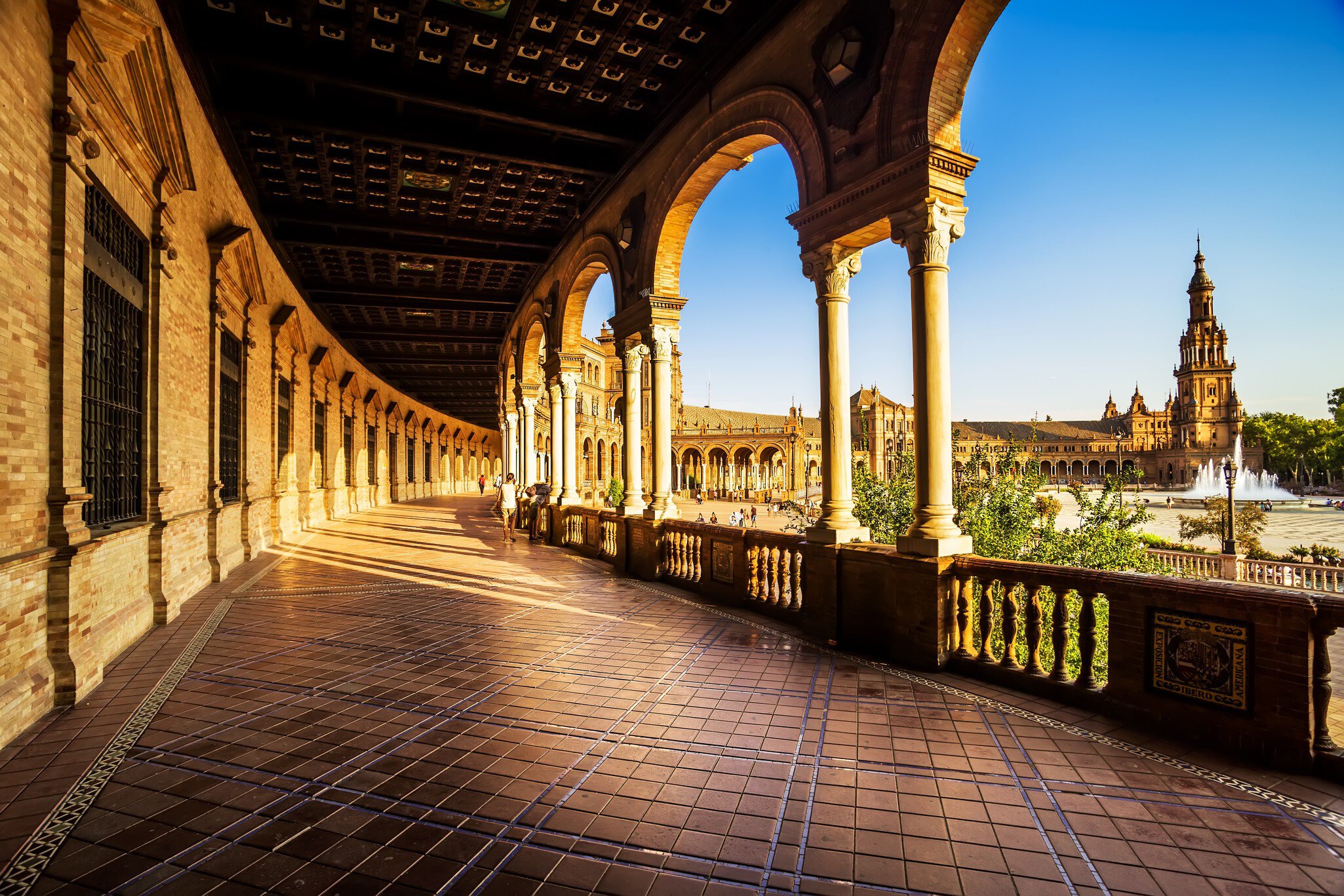
A large area south of the former tobacco factory (Antigua Fábrica de Tabacos) was transformed for Seville’s 1929 international fair, the Exposición Iberoamericana, when architects adorned it with fantastical buildings, many of them harking back to Seville’s past glory or imitating the native styles of Spain’s former colonies. In its midst you’ll find the large Parque de María Luisa, a living expression of Seville’s Moorish and Christian past.
Plaza de España, one of the city’s favourite relaxation spots, faces the park across Avenida de Isabel la Católica. Around it is the most grandiose of the 1929 buildings, a semicircular brick-and-tile confection featurin…
reviewed
-
B
Alcázar
Residence of many generations of kings and caliphs, the Alcázar is Seville’s answer to Granada’s Alhambra. It stands south of the cathedral across Plaza del Triunfo and is wheelchair accessible. This intriguing complex is intimately associated with the life and loves of the extraordinary Pedro I of Castilla (1350–69).
Originally founded as a fort for the Cordoban governors of Seville in 913, the Alcázar has been expanded and rebuilt many times in its 11 centuries of existence. The Catholic Monarchs, Ferdinand and Isabella, set up court here in the 1480s as they prepared for the conquest of Granada. Later rulers created the Alcázar’s lovely gardens.
reviewed
-
C
Cathedral
Seville’s immense cathedral, officially the biggest in the world, is awe-inspiring in its scale and sheer majesty. It stands on the site of the great 12th-century Almohad mosque, with the mosque’s minaret (the Giralda) still towering beside it. After Seville fell to the Christians in 1248 the mosque was used as a church until 1401. Then, in view of its decaying state, the church authorities decided to knock it down and start again. ‘Let us create such a building that future generations will take us for lunatics’, they decided (or so legend has it). The result is a cathedral measuring 126m long and 83m wide.
reviewed
-
D
Plaza de España
Plaza de España, a rather isolated and relaxing spot with its fountains and mini-canals, faces the northeastern side of Parque de María Luisa across Avenida de Isabel la Católica. Curving round the plaza is the most grandiose of the 1929 Exposición buildings, a brick-and-tile confection featuring Seville tilework at its gaudiest, with a map and historical scene for each Spanish province - all designed by the leading Iberoamericana architect, Sevillan Aníbal González.
reviewed
-
E
Los Coloniales
It might not look like much from the outside but trust us; this is something very special. It’s hard to pick a favourite dish as everything is outstanding, but we’d never turn down a plate of chorizo a la Asturiana, a divine spicy sausage in an onion sauce served on a bed of lightly fried potato. To follow up try the aubergines in honey. There is another, inferior and more touristy branch, Taberna Los Coloniales, on Calle Jimios near the cathedral.
reviewed
-
F
Vinería San Telmo
If the thought of the Andalusian-Basque dishes on offer here – such as foie gras with quails eggs and lychees or exquisitely cooked bricks of tuna or maybe the rascacielos de tomate, berenjena, queso de cabra y salmón (which roughly translates into a pyramid of tomato, aubergine, goats cheese and salmon) – don’t make you drool with expectation then you’re probably dead. In our opinion this is the best place to eat in Barrio de Santa Cruz.
reviewed
-
G
Casa de la Memoria de al-Andalus
This flamenco tablao in Santa Cruz is probably the most intimate and authentic nightly flamenco show, offering a wide variety of flamenco styles in a room of shifting shadows. Space is limited to 100, so reserve tickets in advance.
reviewed
-
H
Bodega Santa Cruz
Forever crowded and with a mountain of paper on the floor, this place is usually standing room only, with tapas and drinks enjoyed alfresco as you dodge the marching army of tourists squeezing through Santa Cruz’s narrow streets.
reviewed
-
I
El Patio San Eloy
Patches of old tiling remain at the always-busy Patio San Eloy, where you can sit on the tiled steps at the back and feast on a fine array of burguillos (small filled rolls).
reviewed
Advertisement
-
J
Basílica de la Macarena
Basílica de La Macarena, off Calle San Luis, is the home of Seville’s most revered Virgin and will give you a whiff of the fervour inspired by Semana Santa. The Virgen de la EsperanzaMacarena (Macarena Virgin of Hope), a magnificent statue adorned with a golden crown, lavish vestments, and five diamond-and-emerald brooches donated by a famous 20th-century matador, Joselito El Gallo, stands in splendour behind the main altarpiece. La Macarena, as she is commonly known, is the patron of bullfighters and Seville’s supreme representation of the grieving, yet hopeful, mother of Christ. The power of this fragile, beautiful statue is most evident in the wee hours of the mad…
reviewed
-
K
Bullring
In the world of bullfighting Seville’s bullring is the Old Trafford and Camp Nou of bullfighting. In other words, if you’re selected to fight here then you’ve made it. In addition to being regarded as a building of almost religious significance to fans, it’s also the oldest ring in Spain (building began in 1758) and it was here, along with the bullring at Ronda, that bullfighting on foot began in the 18th century. Interesting guided visits, in English and Spanish, take you into the ring and its museum. Should you want to catch a bullfight the season runs from Easter to October with fights most Sundays at around 7pm and every day during the Feria de Abril. Tickets,…
reviewed
-
L
Iglesia de la Magdalena
One of Seville's outstanding baroque churches, the Iglesia de la Magdalena was built between 1691 and 1709. Two paintings by Zurbarán hang in the Capilla Sacramental (the first chapel on the right from the entrance), and a fine 1612 Crucifixion sculpture, El Cristo del Calvario (The Christ of Calvary) by Francisco de Ocampo, is in the chapel to the right of the main altar.
The church is the home of the Quinta Angustia brotherhood, whose 17th-century Descendimiento tableau, showing the taking down of Jesus from the cross, is carried through Seville's streets during Semana Santa. This can usually be seen in the chapel on the left as you enter the church: the Christ is attr…
reviewed
-
M
Patio del León
The Patio del León was the garrison yard of the Al-Muwarak palace. Off here, the Sala de la Justicia (Hall of Justice), with beautiful Mudéjar plasterwork, was built in the 1340s by Alfonso XI, who disported here with his mistress Leonor de Guzmán.
Alfonso's dalliances left his heir Pedro I (El Cruel/Justiciero) with five half-brothers and a severe case of sibling rivalry. Pedro had a dozen friends and relatives murdered in his efforts to stay on the throne. One of the half-brothers, Don Fadrique, met his maker right here in the Sala de la Justicia. The room gives on to the pretty Patio del Yeso, a 19th-century reconstruction of part of the 12th-century Almohad palace.
reviewed
-
N
Casa Anselma
If you can squeeze in past the foreboding form of Anselma (a celebrated Triana flamenco dancer) at the door you’ll quickly realise that anything can happen in here. Casa Anselma (beware: there’s no sign, just a doorway embellished with azulejos tiles) is the antithesis of a tourist flamenco tablao, with cheek-to-jowl crowds, thick cigarette smoke, zero amplification and spontaneous outbreaks of dexterous dancing. Pure magic. Anselma is in Triana on the corner of Calle Alfarería about 200m from the western side of the Puente de Isabel.
reviewed
-
O
Empresa Pagés
From the start of the season until late June/early July, nearly all the fights are by fully fledged matadors. Seats cost €32.50 to €110 but only cheap sol seats (those in the sun at the start of proceedings) may be available to those who don't hold season tickets. Most of the rest of the season, novilleras (novice bullfights) are held, with tickets costing €4 to €26. Tickets are sold in advance at Empresa Pagés and from 4.30pm on fight days at the bullring itself.
reviewed
-
P
Parroquia del Divino Salvador
The Plaza Salvador, which has a few popular bars, was once the forum of Roman Hispalis. It's dominated by the Parroquia del Salvador, a big baroque church built between 1674 and 1712 on the site of Muslim Ishbiliya's main mosque. Before the mosque, early Christian churches stood here, and before them, a Roman temple.
At the time of writing the church was closed for restoration work and archaeological investigation, but on its northern side, the mosque's small patio remains open, with a few half-buried Roman columns.
reviewed
-
Granada Day Trip including Alhambra and Generalife Gardens from Seville
by Viator
Take a trip to Granada and the Alhambra Palace, one of the most beautiful architectural marvels in the world, on a day trip from Seville. Granada is home to two…Not LP reviewed
from USD$150.47 -
Q
Bar Ego
In terms of hipness and trendy places to go out, La Alameda is where it's at. The slightly run-down feeling of the area adds to the exclusivity and repels the more posh sevillanos, so the boho lot get to keep the place more or less to themselves. Bar Ego is a strange hybrid of a DJ bar, restaurant, clothes shop and art gallery, and strives for something completely different in predominantly traditional Seville. It's newly opened, Barcelona-hip, and original, and we are hoping it'll survive.
reviewed
-
R
Capilla de San Antonio
The sheer size of the broad, five-naved cathedral is obscured by a welter of interior decoration typical of Spanish cathedrals. The chapels along the northern and southern sides are as rich in sculpture, stained glass and painting as any church chapels in Spain. Near the western end of the northern side is the Capilla de San Antonio, with Murillo's large 1666 canvas depicting the vision of St Anthony of Padua; thieves excised the kneeling saint in 1874 but he was found in New York and put back.
reviewed
Advertisement
-
S
Estadio Manuel Ruiz de Lopera
It is said that the only thing that divides Seville, apart from the Guadalquivir, is the sevillanos' passionate support for its two rival professional clubs, Real Betis and Sevilla. Both teams are currently well established in the Primera Liga and players on Betis' books include Spanish international midfield star Joaquín.
Betis plays at the Estadio Manuel Ruiz de Lopera, beside Avenida de Jerez (the Cádiz road). Take the southbound bus 34 from opposite the main tourist office.
reviewed
-
T
Palacio de Don Pedro
Whatever else Pedro I may have done, posterity owes him a big thank you for building this wonderful palace inside the Alcázar in the 1360s. His Muslim ally Mohammed V of Granada, the man responsible for the Alhambra's fabulous Palacio de los Leones, sent along many of his best artisans to help. These were joined by others from Toledo and Seville, and their work, drawing on the traditions of the Almohads and caliphal Córdoba, is a unique synthesis of Iberian Islamic art.
reviewed
-
Iglesia del Cristo de la Expiración
Triana has several diverse and important churches and chapels. Among the most important is the Iglesia del Cristo de la Expiración, which houses a much loved figure of the dead Christ, dating from 1682, that takes an honoured place in Seville's Semana Santa processions. The image is known as El Cachorro (The Puppy): sculptor Antonio Ruiz Gijón was reputedly inspired by the agonised body of a gitano singer of that name who had died in a fight in this street.
reviewed
-
U
Capilla Mayor
Towards the east end of the main nave of the Cathedral is the Capilla Mayor, whose Gothic altarpiece is the jewel of the cathedral and reckoned to be the biggest altarpiece in the world. Begun by Flemish sculptor Pieter Dancart in 1482 and completed by others by 1564, this sea of gilded and polychromed wood holds more than 1000 carved biblical figures. At the centre of the lowest level is the 13th-century image of the Virgen de la Sede, patron of the cathedral.
reviewed
-
V
El Rinconcillo
Seville’s oldest bar first opened in 1670 and has been dishing out the goods since before many countries were even a twinkle in someone’s eye. Time has allowed it to build up an impressive range of little morsels; though to be fair you do probably come here more for the sense of history than for the food. However, the ortiguillas fritas (fried sea anemones) are memorable for all the right reasons and it serves the biggest olives we’ve ever seen.
reviewed