Sights in Zaragoza
- Sort by:
- Popular
-
A
Basílica de Nuestra Señora del Pilar
Brace yourself for the saintly and the solemn in this great baroque cavern of Catholicism. It was here on 2 January 40 that Santiago (St James the Apostle) is believed by the faithful to have seen the Virgin Mary descend atop a marble pilar (pillar). A chapel was built around the remaining pillar, followed by a series of ever-more-grandiose churches, culminating in the enormous basilica that you see today. Originally designed in 1681 by Felipe Sánchez y Herrera, it was greatly modified in the 18th century by the heavier hand of Ventura Rodríguez; the towers were not finished until the early 20th century. The exterior is another story altogether, its splendid main dome lor…
reviewed
-
B
Aljafería
La Aljafería is Spain’s finest Islamic-era edifice outside Andalucía. It’s not in the league of Granada’s Alhambra or Córdoba’s Mezquita, but it’s nonetheless a glorious monument.
The Aljafería was built as a pleasure palace for Zaragoza’s Islamic rulers, chiefly in the 11th century. After the city passed into Christian hands in 1118, Zaragoza’s Christian rulers made alterations. In the 1490s the Reyes Católicos (Catholic Monarchs), Fernando and Isabel, tacked on their own palace, whereafter the Aljafería fell into decay. From the 1940s to 1990s restoration was carried out, and in 1987 Aragón’s regional parliament, the Cortes de Aragón, was established here.…
reviewed
-
C
La Seo
Dominating the eastern end of Plaza del Pilar is the Catedral de San Salvador, more popularly known as La Seo.
La Seo may lack the fame of the Basílica de Nuestra Señora del Pilar, but its interior is easily its architectural superior. Built between the 12th and 17th centuries, it displays a fabulous spread of architectural styles from Romanesque to baroque. It stands on the site of Islamic Zaragoza’s main mosque (which in turn stood upon the temple of the Roman forum). The northwest facade is a Mudéjar masterpiece, deploying classic dark brickwork and colourful ceramic decoration in eye-pleasing geometric patterns. All the chapels are framed by beautiful stonework and ri…
reviewed
-
Monasterio de Veruela
Backed by the often snowcapped Sierra del Moncayo, the fortified, Cistercian Monasterio de Veruela, founded in the 12th century, looks more like a Castilian castle than a monastery. The rather stern Gothic church is flanked by a charming cloister, which has a lower Gothic level surmounted by a Renaissance upper gallery. There’s a good wine museum within the complex. The monastery is 13km southeast of Tarazona and 1km from Vera de Moncayo. Two of Therpasa’s daily Zaragoza–Tarazona buses stop in Vera itself (one on Sunday); the others stop at the Vera turn-off on the N122, 4km from the monastery.
reviewed
-
D
Museo del Foro de Caesaraugusta
The trapezoid building on Plaza de la Seo is the entrance to an excellent reconstruction of part of Roman Caesaraugusta’s forum, now well below ground level.
The remains of porticoes, shops, a great cloaca (sewer) system, and a limited collection of artefacts dating from between 14 BC and about AD 15 are on display. Sections of lead pipes used to channel water to the city demonstrate the Romans’ genius for engineering. An interesting audiovisual show, presented on the hour in Spanish, breathes life into things, and audio guides (€2) are available.
reviewed
-
E
Museo del Teatro de Caesaraugusta
Discovered during the excavation of a building site in 1972, the ruins of Zaragoza’s Roman theatre are the focus of this interesting museum; the theatre once seated 6000 spectators. Great efforts have been made to help visitors reconstruct the edifice’s former splendour, including evening projections of a virtual performance on the stage; get there early to ensure a place. The exhibit culminates in a boardwalk tour through the theatre itself. The theatre is visible from the surrounding streets.
reviewed
-
F
La Lonja
Now an exhibition hall, this finely proportioned Renaissance-style building, the second building east of the basilica, was constructed in the 16th century as a trading exchange. The coloured medallions on its exterior depict kings of Aragón, but the soaring columns rising to an extraordinary ceiling are the standout features. La Lonja is the site for a full calendar of temporary exhibitions.
reviewed
-
G
Centro de Historia de Zaragoza
The old convent of San Agustín (only the neoclassical facade remains) is the site of this museum. Each of the eight exhibit rooms focuses on a different aspect of the city's heritage, from trade and transport to popular celebrations. Of particular interest is a series of models depicting Zaragoza's physical transformation through four key phases of its development.
reviewed
-
Casa Natal de Goya
Some 23km east of Cariñena along the A220 lies the small village of Fuendetodos, where Francisco José de Goya y Lucientes (Goya) began his days in 1746. The Casa Natal de Goya stayed in his family until the early 20th century, when renowned artist Ignacio Zuloaga bought it.
reviewed
-
H
Museo de Zaragoza
Devoted to archaeology and fine arts, the city museum displays artefacts from prehistoric to Islamic times with some exceptional mosaics from Roman Cesaraugusta. The upper floor contains 15 paintings by Goya and more than two dozen of his etchings. It’s 400m south of the Teatro Romano.
reviewed
Advertisement
-
I
Museo Camón Aznar
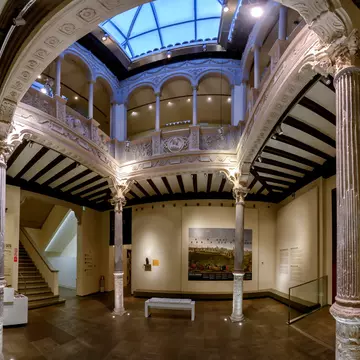
This eclectic collection of Spanish art through the ages features a room of Goya etchings (on the top floor) and half a dozen paintings attributed to El Greco. It spreads over the three storeys of the Palacio de los Pardo, a Renaissance mansion.
reviewed
-
J
Patio de la Infanta
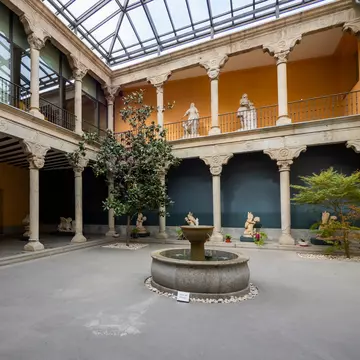
This exhibition space houses the Ibercaja bank’s collection of paintings (with big names such as Goya regularly on show), displayed in a lovely plateresque (15th- and 16th-century Spanish baroque) courtyard. It’s 600m south of Plaza de España.
reviewed
-
Plaza del Pilar & Plaza de la Seo
In Zaragoza's old town, just south of Río Ebro, is Plaza del Pilar and its eastward continuation, Plaza de la Seo. Together, these two squares form a 500m open space and are flanked by important buildings and historic monuments.
reviewed
-
Mudéjar Towers
The Iglesia de La Magdalena, Iglesia de San Miguel and Iglesia de San Gil all boast fine 14th- and 15th-century Mudéjar towers - at their best when floodlit at night. You'll find them in El Tubo neighbourhood.
reviewed
-
K
Museo de Pablo Gargallo
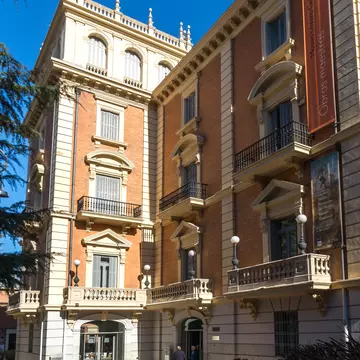
Within the wonderfully restored 17th-century Palacio Argillo is a representative display of sculptures by Pablo Gargallo (1881–1934), probably Aragón’s most gifted artistic son after Goya.
reviewed
-
Museo del Vino
The A23 south towards Teruel passes through Campo de Cariñena, one of Aragón’s premier wine regions. In Cariñena there’s a good Museo del Vino.
reviewed
-
L
Iglesia de San Pablo
This pretty church has a delicate 14th-century Mudéjar tower and an early-16th-century retablo (altarpiece) by Damián Forment. It’s 200m west of Av de César Augusto.
reviewed
-
M
Museo del Puerto Fluvial
Museo del Puerto Fluvial displays the Roman city’s river-port installations. There’s a quaint but enjoyable audiovisual program every half-hour.
reviewed
-
N
Iglesia de Santa Engracia
The 16th-century Iglesia de Santa Engracia has an underground crypt containing the bones of the eponymous saint and other Zaragozan early Christian martyrs.
reviewed
-
Parroquia de San Juan el Real
The baroque Parroquia de San Juan El Real features four Goya paintings of the fathers of the church, housed in the angles below its dome.
reviewed
Advertisement
-
O
Museo de Tapices
La Seo's Museo de Tapices has an impressive collection of 14th- to 17th- century Flemish and French tapestries.
reviewed
-
Colegiata de Santa María
The Mudéjar towers of the Colegiata de Santa María is worth a look.
reviewed
-
P
-