-
Asan Tole
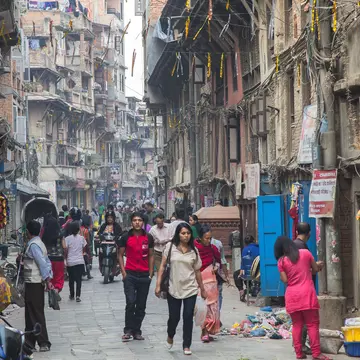
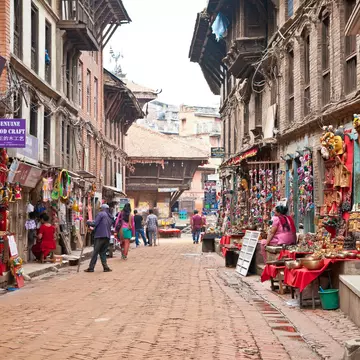
From dawn until late at night the six-road junction of Asan Tole is jammed with buyers, sellers and passers-by, making it the busiest square in Kathmandu. Every day, produce is carried to this popular marketplace from all over the valley so it is fitting that the three-storey Annapurna Temple is dedicated to the goddess of abundance, Annapurna, represented by a purana bowl full of grain.
-
Ashok Binayak
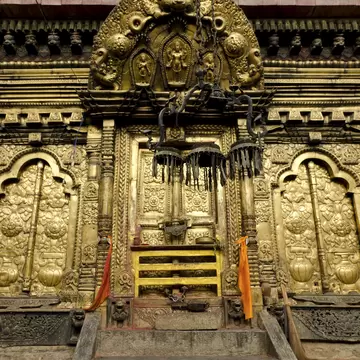
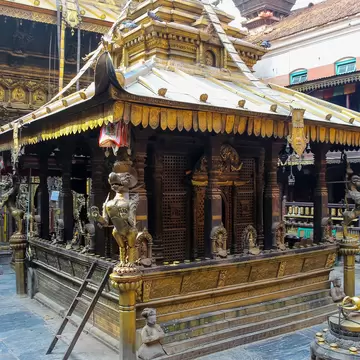
On the northern side of Kasthamandap, at the top of Maru Tole, stands the tiny golden Ashok Binayak, or Maru Ganesh Shrine. The small size of this shrine belies its importance, as this is one of the four most important Ganesh shrines in the valley. Ganesh is a much-loved god and there is a constant stream of visitors, helping themselves to the self-serve tika dispenser and then ringing the bells at the back.
-
Balcony
Across from the great bell is a very ornate corner Balcony, decorated in gorgeous copper and ivory, from where members of the royal court could view the festival action taking place in Durbar Sq.
-
Basantapur Tower
The nine-storey Basantapur Tower, which was extensively restored prior to King Birendra's coronation is inside the Tribhuvan Museum. There are superb views over the palace and the city from the top. The struts along the facade of the Basantapur Tower, particularly those facing out to Basantapur Sq, are decorated with erotic carvings.
-
Bhagwati Temple
Next to the Gaddhi Baithak, this triple-storey, triple-roofed Bhagwati Temple is easily missed since it surmounts the building below it, which currently has thangka (religious Tibetan paintings) shops along its front. The best view of the temple and its golden roofs is probably from the Maju Deval, across the square.
-
Bhimsen Tower (Dharahara)
Towering like a lighthouse over the old town, this white, minaret-like tower is a useful landmark near the main post office. The views from 61.88m up - 213 steps above the city - are the best you can get. There is a small Shiva shrine right at the very top.
-
Degutaleju Temple
This triple-roofed temple is actually part of the Hanuman Dhoka, surmounting the buildings below it, but is most easily seen from outside the palace walls. Degutaleju is another manifestation of the Malla's personal goddess Taleju. This temple was built by Shiva Singh Malla.
-
Dhum Varahi Shrine
In an unprepossessing schoolyard just inside Kathmandu's Ring Rd to the northeast of Kathmandu, a huge pipal tree encloses a small shrine and a dramatic 5th-century sculpture of Vishnu as a wild boar with a stocky human body, holding Prithvi, the earth goddess, on his left elbow.
-
Durbar Square
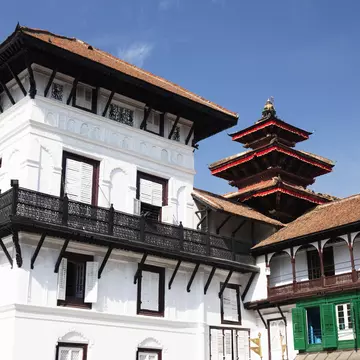
Kathmandu's Durbar Sq was where the city's kings were once crowned and legitimised, and from where they ruled ( durbar means 'palace'). As such, the square remains the traditional heart of the old town and Kathmandu's most spectacular legacy of traditional architecture, even thought the king no longer lives in the Hanuman Dhoka - the palace was moved north to Narayanhiti about a century ago.
-
Ethnographic Museum
If you have some time to kill while waiting for your visa extension, pop into the next-door tourism service centre and its Ethnographic Museum, which has a vaguely interesting collection of puppets, costumes and traditional crafts. There are grand plans (but no money as yet) to build a huge new ethnographic museum complex south of Kirtipur in the southern Kathmandu Valley.
-
Advertisement
-
Freak Street
Kathmandu's most famous street from the hippy overland days of the 1960s and '70s runs south from Basantapur Square. Its real name is Jochne but since the early '70s it has been better known as Freak Street. In its prime, the street's squalor and beauty was irresistible.
-
Gaddhi Baithak
The eastern side of Durbar Sq is closed off by this white neoclassical building. The Gaddhi Baithak, with its imported European style, was built as part of the palace in 1908 during the Rana period and it makes a strange contrast to the traditional Nepali architecture that dominates the square. It is said to have been modelled on London's National Gallery.
-
Garden of Dreams
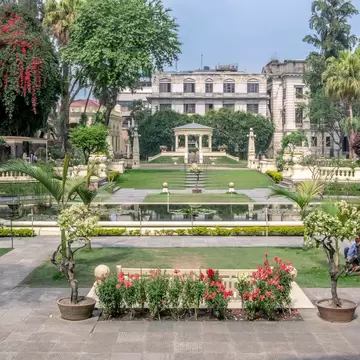
Just two minutes' walk, but a million miles from Thamel is the beautifully restored Swapna Bagaicha, or Garden of Dreams, one of the most serene and beautiful enclaves in Kathmandu.
-
Great Bell
On your left as you leave the main square along Makhan Tole is the Great Bell, elevated atop a white building erected by Rana Bahadur Shah (son of Prithvi Narayan Shah) in 1797. The bell's ring drives off evil spirits, but it is only rung during puja (worship) at the Degutaleju Temple.
-
Great Drums
Just beyond the Krishna Temple are the Great Drums, to which a goat and a buffalo must be sacrificed twice a year. In front of these is the police headquarters building (currently sandbagged against possible Maoist attacks). Beyond here is the closed-off Kot Sq.
-
Hanuman Dhoka
The inner palace complex of the Hanuman Dhoka was originally founded during the Licchavi period, but as it stands today most of it was constructed by King Pratap Malla in the 17th century. The royal palace was renovated many times in later years. The oldest parts are the smaller Sundari Chowk and Mohan Chowk at the northern part of the palace (both closed).
-
Indigo Gallery
An upmarket gallery at Mike's Breakfast, set in a lovely old Rana building, with excellent exhibits of modern thangkas, photography and prints, most for sale at top-end prices.
-
Indra Chowk
The busy shopping street of Makhan Tole spills into Indra Chowk, the courtyard named after the ancient Vedic deity, Indra. On the right of the square is the Akash Bhairab Temple, or Bhairab of the Sky Temple. From the balcony four metal lions rear out over the street. The temple's entrance is at the right-hand side of the building, guarded by two more metal lions, but non-Hindus cannot enter.
-
Indrapur Temple
This puzzling temple may be of great antiquity but has been renovated recently and little is known of its history. Even the god to which it is dedicated is controversial - the lingam inside indicates that it is a Shiva temple but the Garuda image half-buried on the southern side indicates that it is dedicated to Vishnu. However, the temple's name clearly indicates it is dedicated to Indra!
-
Itum Bahal
The long, rectangular courtyard of the Itum Bahal is the largest Buddhist bahal (courtyard) in the old town and remains a haven of tranquillity in the chaotic surroundings. A small, white-painted stupa stands in the centre of the courtyard. On the western side of the courtyard is the Kichandra Bahal or 'Keshchandra Paravarta Mahar Bihar', one of the oldest bahals in the city, dating from 1381.
-
Advertisement
-
Jagannath Temple
Jagannath Temple, noted for the erotic carvings on its roof struts, is the oldest structure in this part of the square. Pratap Malla claimed to have constructed the temple during his reign, but it may actually date back to 1563, during the rule of Mahendra Malla. The temple has a three-tiered platform and two storeys. There are three doors on each side of the temple, but only the centre door opens.
-
Jaisi Deval Temple
The south of Kathmandu's old city was the heart of the ancient city in the Licchavi period (4th to 9th centuries) and its major temple is the tall, triple-roofed Jaisi Deval Temple, built just two years before Durbar Sq's famous Maju Deval (which is one platform higher). It's a Shiva temple, as indicated by the bull on the first few steps and the mildly erotic carvings on some of the temple struts.
-
Kabindrapur Temple
Kabindrapur Temple, or Dhansa Dega, is an ornate 17th-century performance pavilion which houses the god of music.
-
Kakeshwar Temple
Kakeshwar Temple was originally built in 1681 but, like so many other structures, was rebuilt after it was badly damaged in the 1934 earthquake. It may have been considerably altered at that time as the temple is a strange combination of styles. It starts with a Newari style floor, above which is an Indian shikhara -style upper storey, topped by a spire shaped like a kalasa (water vase), indicative of a female deity.
-
Kala (Black) Bhairab
Behind the Jagannath Temple is the large figure of Kala (Black) Bhairab. Bhairab is Shiva in his most fearsome aspect, and this huge stone image of the terrifying Kala Bhairab has six arms, wears a garland of skulls and tramples a corpse, which is symbolic of human ignorance. The figure is said to have been brought here by Pratap Malla, having been found in a field to the north of the city. The image was originally cut from a single stone, but the upper left-hand corner has since been repaired.