Tangier Sights

  1. 1001 Nights

    In the 1950s Tangier's kasbah was the setting for a legendary café called 1001 Nights, which was established by Brion Gysin, the artist who introduce the cut-up writing technique to William Burroughs. The café was famous for its house band of trance musicians - the Master Musicians of Jajouka - who later released a record produced by the Rolling Stones' Brian Jones. Long-closed for renovation, no one seems to know if it will ever reopen.

    Read more about 1001 Nights

  2. beaches

    The beaches of Tangier are decent for a seaside stroll or an afternoon aperitif, but not for swimming or surfing. The sand itself is clean enough for a city beach and still manages to attract beachcombers, football-playing kids and the odd courting couple. A stroll in the sea breeze is a good way to clear the air if Tangier's hustlers have been over-attentive. Football matches take place here at weekends and in the evening and the beach bars strung along the sand can be fun.

    Read more about beaches

  3. Church of the Immaculate Conception

    Heading down Rue as-Siaghin from the gateway of the medina, you soon pass the lovely Spanish Church of the Immaculate Conception on your right, built in 1880 when Spaniards comprised one-fifth of Tangier's population.

    Read more about Church of the Immaculate Conception

  4. Dar el-Makhzen Museum

    The former sultan's palace, which now houses a worthwhile collection of Moroccan arts, dominates the kasbah.

    Read more about Dar el-Makhzen Museum

  5. Galerie Delacroix

    Contemporary art gallery operated by the Institut Français.

    Read more about Galerie Delacroix

  6. Gran Teatro de Cervantes

    Beneath the Terrasse des Paresseux in Ville Nouvelle, in a side street off Rue Salah Eddine el-Ayoubi, the Gran Teatro de Cervantes is a remnant of the days when Spaniards formed the largest non-Moroccan community in Tangier. Opened in 1913, the theatre enjoyed its zenith between the wars. You can't miss the dazzling Art Deco façade, but the building has long been in decline.

    Read more about Gran Teatro de Cervantes

  7. Grand Hôtel Villa de France

    To the north of Place de France in Ville Nouvelle, down Rue de la Liberté, stands the closed and crumbling Grand Hôtel Villa de France. The French painter Eugène Delacroix stayed here in 1832, when it really was a grand hotel. His fellow artist and compatriot, Henri Matisse, followed in the early 1900s.

    Read more about Grand Hôtel Villa de France

  8. Grand Socco

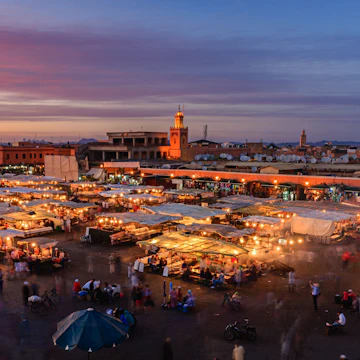
    The gateway to the medina is the Grand Socco, once as full of life as Place Djemaa el-Fna in Marrakesh. Its official name, Place du 9 Avril 1947, refers to the date that Mohammed V first publicly allied himself to the cause of Moroccan independence. The square was being rebuilt and gentrified during research, so it's hard to know if its soul will survive. The best we may hope for is that the terrible traffic surrounding the square is tamed.

    Read more about Grand Socco

  9. Grande Mosquée

    From the Petit Socco in the medina, Rue Jemaa el-Kebir (formerly Rue de la Marine) leads east past the Grande Mosquée. It is said to have been the site of a Roman temple, and at one time housed a church built by the Portuguese. A little further on you reach a scenic overlook over the port.

    Read more about Grande Mosquée

  10. Kasbah

    The Kasbah sits on the highest point of the city, behind stout walls. It is dominated by Dar el-Makhzen, the former sultan's palace. Coming from the medina, you enter through Bab el-Aassa, the southeastern gate.

    Read more about Kasbah

  11. Advertisement

  12. Medina

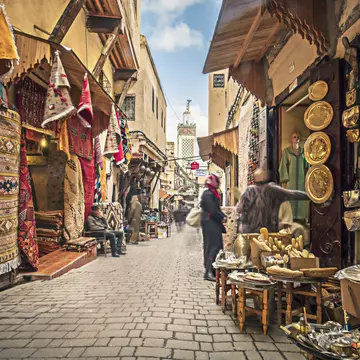
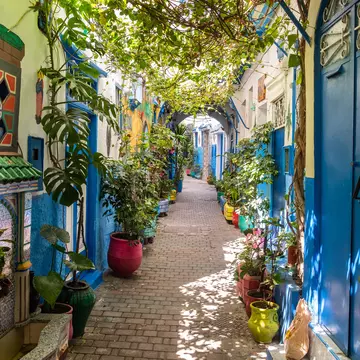
    The gateway to the medina is the Grand Socco (Place du 9 Avril 1947). From here, enter the medina by Rue Semmarine through a gate surrounded by Riffian women selling fruit and vegetables. This is Rue as-Siaghin. This was once Tangier's main gold market (a fair number of jewellery stores remain). South of here was the mellah (old Jewish quarter).

    Read more about Medina

  13. Musée d'Art Contemporain

    Housed in the former British consulate, the Musée d'Art Contemporain displays examples of Moroccan art, mainly from the 1980s and early '90s. Given the Islamic injunction against figurative art, the paintings tend towards the abstract. Notable exhibits include the exuberant colours of Fatima Hassan, and the African styles of Mohammed Hamid.

    Read more about Musée d'Art Contemporain

  14. Musée de la Fondation Lorin

    Housed in a former synagogue, the Musée de la Fondation Lorin is a gem of a place if you're interested in Tangier's 20th-century history. A large peaceful room houses an engaging collection of photographs, newspaper cuttings and posters of Tangier from 1890 to the 1960s.The Moroccan and foreign great and good are all well represented, from Mohammed V and Winston Churchill to Caid McLean, Emily Keane and the artist James McBeay. There are some fascinating street scenes, and an early brochure from the El Minzah Hotel, advertising its tennis courts and boar hunting.

    Read more about Musée de la Fondation Lorin

  15. Old American Legation Museum

    Tucked into the southwest corner of the medina, the Old American Legation Museum is an intriguing relic of the international zone. The five-storey mansion straddling the street was originally a small stone building, given to the USA in 1821 by Sultan Moulay Suleyman. Morocco was the first nation to recognise the USA politically (look for the letter of thanks from George Washington to the sultan) and the diplomatic mission to Morocco was located here until 1961.

    Read more about Old American Legation Museum

  16. Petit Socco

    Gone are the days when William Burroughs could cheerfully write of the endless stream of louche offers from young boys and men around the Petit Socco. Nowadays, the busy little square in the medina is a great place to linger over a mint tea, watch the world go by and contemplate its colourful past. And sleaze remains close to the surface: you'll have plenty of offers of 'something special, my friend' and several of the cheap pensions overlooking the square still double as brothels.

    Read more about Petit Socco

  17. Place de France

    The area around Place de France and Blvd Pasteur still hints at something of the glamour of the 1930s. It's a popular place for an early evening promenade, or a few hours sipping mint tea in one of the many pavement cafés. Don't forget to look up at the Riviera architecture.

    Read more about Place de France

  18. residence of the naib

    A few doors down from the Church of the Immaculate Conception, at No 41 on Rue as-Siaghin in the medina, is the old residence of the naib , who was the point of contact between the Moroccan leader and European legations until 1923. Inside is a small courtyard filled with orange trees. Another reminder of international Tangier is the huge painted sign for the British Bank of West Africa on a nearby wall. Continue downhill to emerge onto the Petit Socco.

    Read more about residence of the naib

  19. Sidi Hosni Palace

    The Sidi Hosni Palace is where Barbara Hutton, the Woolworth heiress, lived and gave some of her grandest parties.

    Read more about Sidi Hosni Palace

  20. St Andrew's Church

    A small English church existed in Tangier as far back as the 1660s, when England occupied the city for a 20-year period. The present church, St Andrew's, was built in 1894 on ground donated by Sultan Moulay al-Hassan and consecrated in 1905. You might recognise it from Matisse's rendition (a copy of which hangs inside). The church is a beautiful white Anglo-Moorish building, with a carved cedar ceiling and the Lord's Prayer in Arabic around the chancel arch.

    Read more about St Andrew's Church

  21. Terrasse des Paresseux

    The aptly named Terrasse des Paresseux just east of Place de France in Ville Nouvelle, provides sweeping views of the port and, on a clear day, Gibraltar and Spain. A set of ancient cannons face the bay, symbolically warding off usurpers.

    Read more about Terrasse des Paresseux

  22. Advertisement

  23. Tomb of Sidi Hosni

    From the Petit Socco in the medina, Rue des Almohades (formerly Rue des Chrétiens) takes you north, past some very determined shopkeepers, to join Rue M Torres. From here, if you stick to the wider streets and continue uphill and you should eventually emerge near a little, white domed building that contains the Tomb of Sidi Hosni. Nearby is the Sidi Hosni Palace.

    Read more about Tomb of Sidi Hosni