Sights in Fès
-
A
Attarine Souks
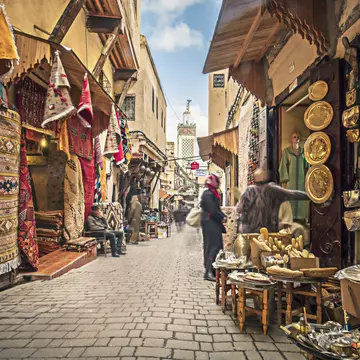
There's a cluster of souks just off the Talaa that are worth exploring. Coming from Bab Bou Jeloud, the first is Souk Triba, meaning 'square in shape', with a small orange tree and some cosmetic and electronic shops. Walk through to Souk Tallis where sacks for wool and wheat were sold. Now there's a carpet stall and several shops selling cloth for jellabas (cloak with a hood) - though many of the shops are now closed.
Continue through to the next souk, L'Hayek (;09:00-12:30 & 15:00-17:00 Sat-Thu), which refers to the white cloth used for women's clothes. These days there are jellabas, gandoras (men's embroidered jacket and pants) and jabadors (garment worn under a…
reviewed
-
B
Moulay Idriss Zawiya
Here is the heart of Fez: the mausoleum of the city's founder and the most venerated pilgrimage spot in Morocco. You can't enter unless you're a Muslim, but you can peek inside. It's worth walking around the building to see the beautiful carved and painted wood porches, the wall zellij and painted carved plaster at each doorway.
Near the main entrance are a fountain and a mzara (niche on the outside wall, richly decorated with zellij and plasterwork) where people in too much of a hurry to enter can pay their respects; there's another mzara on Talaa Kebira. The brass money-slot is for giving alms. Housing a mosque and ablution facilities, as well as the tomb of Moulay…
reviewed
-
C
Sahrij Medersa
Taking its present name from the large rectangular pool or sahrij (basin) in its courtyard, this medersa dates from the 14th century. Built by the Merinid sultan Abou al-Hassan as a theological school attached to the Al-Andalous mosque, it features rich decoration including ornate and exquisite panels of mashrabiya (intricate carved wood), zellij and decorative plasterwork.
The building was designed to lead students from the entrance through the ornate screen door, past the sahrij and to the mihrab (niche indicating direction of Mecca) in the prayer room opposite the entrance. The Getty Foundation recently funded a conservation analysis of the building, which is in poor…
reviewed
-
D
Moulay Hassan Square
Created towards the end of 19th century by order of the Alawite sultan Moulay al-Hassan I, this impressive square is surrounded by high pisé walls. The northern gate of the royal palace, known as Bab Makhzen, is here, as is the monumental Bab Sbaâ (the Lion Gate, aka Bab Dkaken), which features three solid arches flanked by two towers. Walk through Bab Sbaâ to see Bab al-Makina, the mechouar (assembly place) that is the main venue for the Fes Festival of World Sacred Music.
Fronting the mechouar is Dar Makina, a muscular European-influenced building dating from 1886. Designed by Italian architects and engineers, it was built to house the imperial arsenal. Behind the …
reviewed
-
E
Dar Glaoui
Probably the most impressive residence in Fez, this 150-year-old palace comprises some 17 houses, stables, a mausoleum and cemetery, Quranic school, hammam, garages and two large gardens. It's privately owned by the El-Glaoui family of Marrakesh, but you can make an appointment to view it with Abdou (phone after midday).
Abdou, whose art is on display at the entrance, will show you the massive courtyard and four salons resplendent with carved, painted wood, carved plaster, Iraqi glass and carved and painted 'stalactites'. He'll also take you to the kitchen (large enough to serve the entire complex), which leads to the harem, with another courtyard, wall fountain and…
reviewed
-
F
Mosque
One of the two great mosques of Fez, this started life as a relatively modest structure in the 9th century, but became the congregational mosque of the quarter in the 10th century. Its minaret, a gift from the caliph of Córdoba, dates from 956 and is very similar to that of its sister mosque, the Kairaouine. The mosque was totally rebuilt by the Almohads between 1203 and 1207 and the magnificent monumental door on the northern façade dates from this time.
Designed and built by artisans from the Nasrid kingdom of Granada, the triple-entry wooden door features colourful zellij (mosaic tilework), ornate decorative plasterwork and a huge cornice of carved cedarwood. Though…
reviewed
-
G
Fondouk Americain
This animal hospital was established in 1927 at the instigation of Amy Bend Bishop, an American traveller who was appalled at the poor condition of the many working animals in the medina. A team headed by Canadian veterinarian Denis Frappier treats the city's animals free of charge, courtesy of funding from The Massachusetts Society for the Prevention of Cruelty to Animals.
In a country where many humans cannot easily access medical care, veterinary care is often viewed as a luxury, so the work of charities such as this one is extremely important, particularly as many locals rely on the their animals to transport goods, carry water and help with the harvesting of crops.…
reviewed
-
H
Nejjarine Museum of Wooden Arts & Crafts
Opened in 1998, this museum is in a wonderfully restored funduq – a caravanserai for travelling merchants who stored and sold their goods below and took lodgings on the floors above. Centred on a courtyard, the rooms are given over to displays of traditional artefacts from craftsmen’s tools, chunky prayer beads and Berber locks, chests and musical instruments (compare the traditional wedding furniture with the modern glitzy chairs outside in Place an-Nejjarine). Everything is beautifully presented, although the stunning building gives the exhibits a run for their money. The rooftop café has great views over the medina. Photography is forbidden.
reviewed
-
I
Kairaouine Mosque & University
The largest mosque in Africa, the Kairaouine claims to be the oldest university in the world. A wide variety of subjects was taught here, which is why Fez became such a centre of learning, culture and religious tolerance. The mosque is open to Muslims only.
The complex has grown since its founding in 859 and has many beautiful elements such as the pavilions, mihrab and decorative plasterwork, cedarwood and zellij reminiscent of the Alhambra in Spain. It has a 10th-century square minaret with cupola. The mosque was expanded to its current size under the Almoravids in the 12th century. Surrounding it are several medersas.
reviewed
-
J
Dar Ba Mohamed Ben Chergui
This magnificent place belonged to a previous pasha of Fez, Ba Mohamed Ben Chergui. There are two houses in the complex - one the main house for the men, the other the harem. The harem has a remarkable garden made of raised star-shaped flower beds. Inside, the hammam is worth a visit, and look out for the black-and-white photograph of the last pasha to live there. It's all decaying badly, though the complex is up for sale.
The caretaker is happy to show people around the ground floor of the main house, the hammam, and the harem garden. Tip him about around DH20.
reviewed
Advertisement
-
K
Jewish Cemetery & Habarim Synagogue
The southwest corner of the mellah is home to the fascinating Jewish Cemetery & Habarim Synagogue, where the sea of blindingly white tombs stretches down the hill; those in dedicated enclosures are tombs of rabbis. One of the oldest, high up against the north wall, is that of Rabbi Vidal Hasserfaty, who died in 1600. On the slope below, the large tomb with green trimming is that of the martyr Solica, a 14-year-old girl who refused to convert to Islam or accept the advances of the governor of Tangier and subsequently had her throat slit.
reviewed
-
L
Henna Souk
One of the oldest market places this souk, off Talaa Kebira, has graceful plane trees shading the stalls selling ceramics and traditional cosmetics, including henna. The mohtassib (price-controller), now defunct, had his office here and you can still see his large scales. On one side is the restored Maristane Sidi Frej, a former psychiatric hospital built by the Merinids in the 13th century. Leo Africanus worked here as a young man. It's now a small kissaria (covered market).
reviewed
-
M
Riyad Mokri
This fabulous house, formerly owned by the powerful Mokri family, is now home to the Institute of Traditional Building Crafts. Students learn carpentry, wood painting, plaster sculpture and design. The house is surely an inspiration to them with its carved and painted doors, spectacular ceilings and wonderful views. The gardens are the best in Fez, full of fruit trees, jasmine, honeysuckle, rosemary, lavender and plumbago. Do tip the person who shows you round (about around DH20).
reviewed
-
N
Ain Khaïl Mosque
Where can a camel pass under a minaret? If you know the answer to this question, you're a true Fassi. This 11th-century mosque has an octagonal minaret built over the street. The Sufi philosopher Ibn el-Arabi (1165-1240) is said to have seen a mystical vision of intense light here. A few years ago, a badly degraded house collapsed into the prayer-hall, killing 12 men. The mosque is not in use and funding has been applied for from the EU's Euromed Heritage Programme to restore it.
reviewed
-
O
Merenid Tombs
These 14th-century tombs are in ruins now, but command a good view over the city and the ramparts, as well as to the Borj Sud in the south and the rolling hills to the north. Take a taxi to the tombs (from Batha around DH7) and avoid the quasi guides. Walk back down the goat paths to the main road (look out for the caves where people still live). Once across the road, turn left for Bab Guissa or right for Ain Azleten - the walk back to the medina takes around 10 minutes.
reviewed
-
P
Abou Bakr Ibn Arabi Mausoleum
Abou Bakr ibn Arabi arrived in Fez from Seville in the 11th century. An ala (learned man) and an imam, he was on a pilgrimage to meet all of the renowned ulama (Islamic scholars) of his day. So taken was he with the learned atmosphere of Fez that he returned here after his trip. When he died, the Fassis built this mausoleum with its green-tiled dome to honour his memory. You'll find it just outside the medina ramparts, to the east of Bab Sagma.
reviewed
-
Q
Medersa el-Attarine
Founded by Abu Said in 1325 in the heart of the medina, the Medersa el-Attarine was designed as a separate annexe to the Kairaouine Mosque. Halls for teaching and a modest masjid flank the central courtyard. Displaying the traditional patterns of Merenid artisanship, the zellij (tilework) base, stuccowork and cedar wood at the top of the walls and on the ceiling are every bit as elegant as the artistry of the Medersa Bou Inania.
reviewed
-
R
Batha Museum
Housed in a wonderful 19th century summer palace, converted to a museum in 1916, the Batha Museum houses an excellent collection of traditional Moroccan arts and crafts. Historical and artistic artefacts include fine woodcarving, zellij and sculpted plaster, much of it from the city’s ruined or decaying medersas. It also has some fine Fassi embroidery, colourful Berber carpets and antique instruments.
reviewed
-
S
Dar el-Makhzen
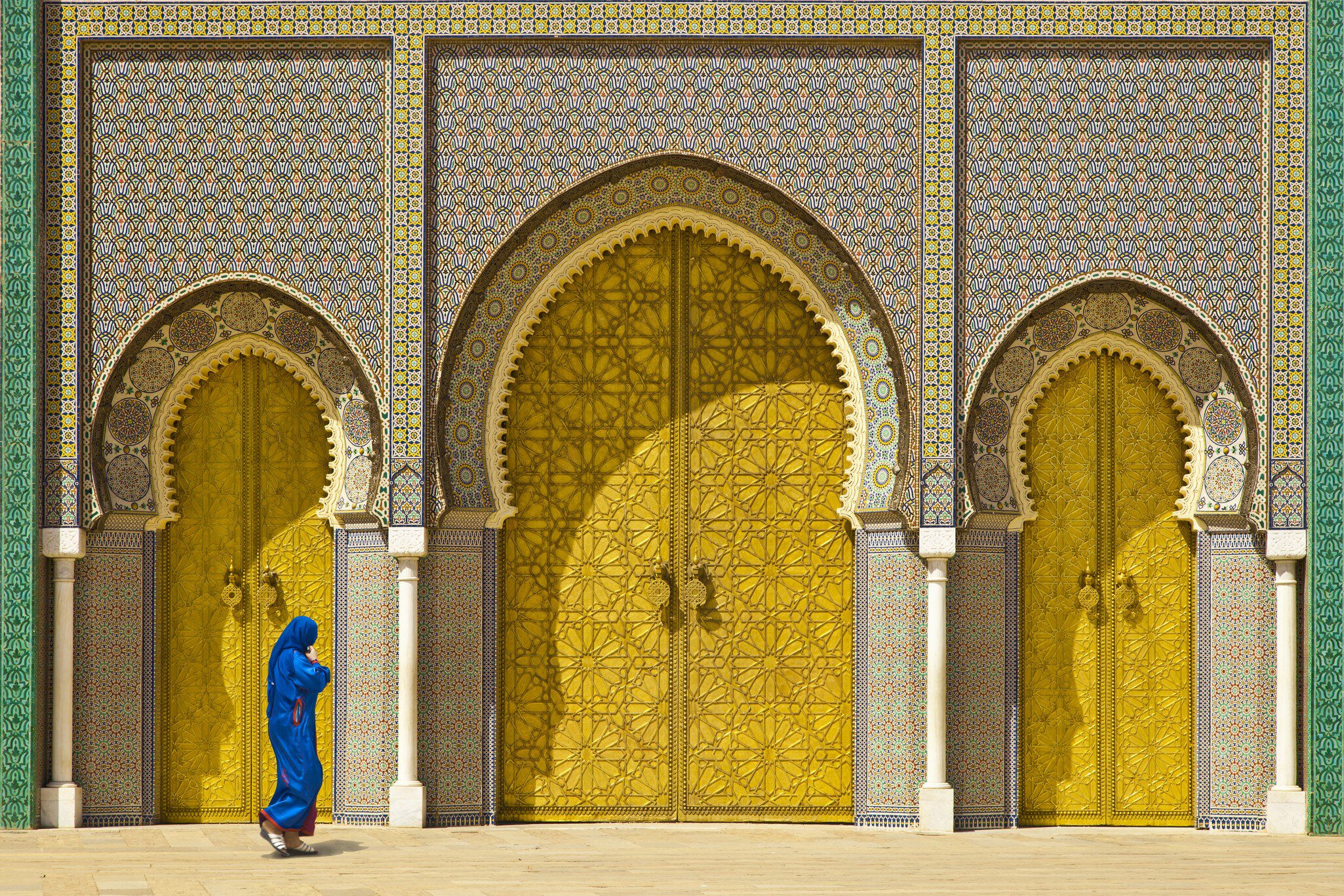
The entrance to Dar el-Makhzen is a stunning example of modern restoration, but the 80 hectares of palace grounds are not open to the public. Visitors must suffice with viewing its imposing brass doors, surrounded by fine zellij and carved cedarwood. Note the lemon trees to one side – tour guides are prone to plucking the fruit to demonstrate the juice’s astringent cleaning properties on the palace gates.
reviewed
-
T
Achebine Souk
This street formerly housed traditional medicine shops; there's one left, with jars of snakeskins, birds in cages, live chameleons, gazelle horns and skins on the walls. Nowadays it's a bird market - locals buy chickens and turkeys, doves and pigeons. There are lots of food stands here and the air is thick with smoke from kefta (spiced meatballs of lamb or beef) kebabs being grilled.
reviewed
Advertisement
-
U
Jnan Sbil (Bou Jeloud Gardens) & Baghdadi Square
These gardens, also known as Jnane Sbil, have been providing welcome green space for well over a century. They’re a good halfway break between the mellah and Bab Bou Jeloud, and were undergoing extensive renovation and replanting when we visited. If you continue from here, you reach Baghdadi Square, an open-air market on the edge of the medina.
reviewed
-
V
Tanneries
The Chouwara tanneries are one of the city’s most iconic sights (and smells). Head east or northeast from Place as-Seffarine and take the left fork after about 50m; you’ll soon pick up the unmistakeable waft of skin and dye that will guide you into the heart of the leather district (the touts offering to show you the way make it even harder to miss).
reviewed
-
W
Belghazi Museum
The private Belghazi Museum, owned by the family of the same name, contains a collection that almost rivals that of the Batha Museum. The 17th-century palace in which it is housed provides a perfect backdrop for the exquisite carpets, jewellery, weapons and wedding chests on display. Much of this stuff is actually for sale if the price is right.
reviewed
-
X
L'marqtane
Follow a dark passage into this enclosed square north of Sagha and imagine being sold: this used to be an old slave market. Now it's a second-hand clothing market in the mornings (hugely crowded at weekends). A good search can turn up superb antique velvet caftans rich with silver embroidery, or a silk takshita (garment worn over a caftan) for weddings.
reviewed
-
Y
Demnati Fountain & Dar Dmana
This street opens out into a square with an ancient mulberry tree. There's an exceptionally tall traditional house, Dar Dmana, with a massive studded door, and the Demnati fountain. Wait a while, and you might see magnificent stallions being washed, their manes and tails stained red with henna. Also here is an antique shop worth a browse, Brocante Bab Touta .
reviewed