Royal Palace Museum

Save
  • Address
    Th Sisavangvong, Old Town
  • Phone
    212470

Let us know if these details are incorrect

Lonely Planet review

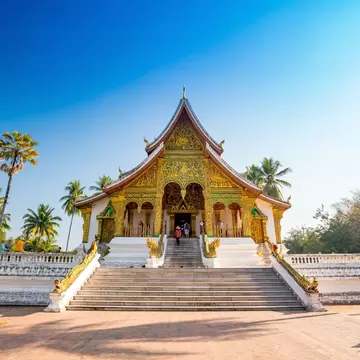
Visit this quaint museum to get a sense of local history. You need to be appropriately dressed to enter, which means having your shoulders covered and no shorts. This museum was built in 1904 during the early French colonial era as a residence for King Sisavang Vong and his family. The site for the palace was chosen so that official visitors to Luang Prabang could disembark from their river journeys directly below the palace and be received there.

Architecturally, the building features a blend of traditional Lao motifs and French beaux-arts styles, and has been laid out in a double-cruciform shape with the entrance on one side of the lower crossbar. The steps leading to the entrance are Italian marble. Most of the private chambers of the royal family have been preserved since the day the Pathet Lao forced the royals into exile. Many locals believe the palace to be haunted by the spirits of the royal family, and few Lao will venture into the building after dark.

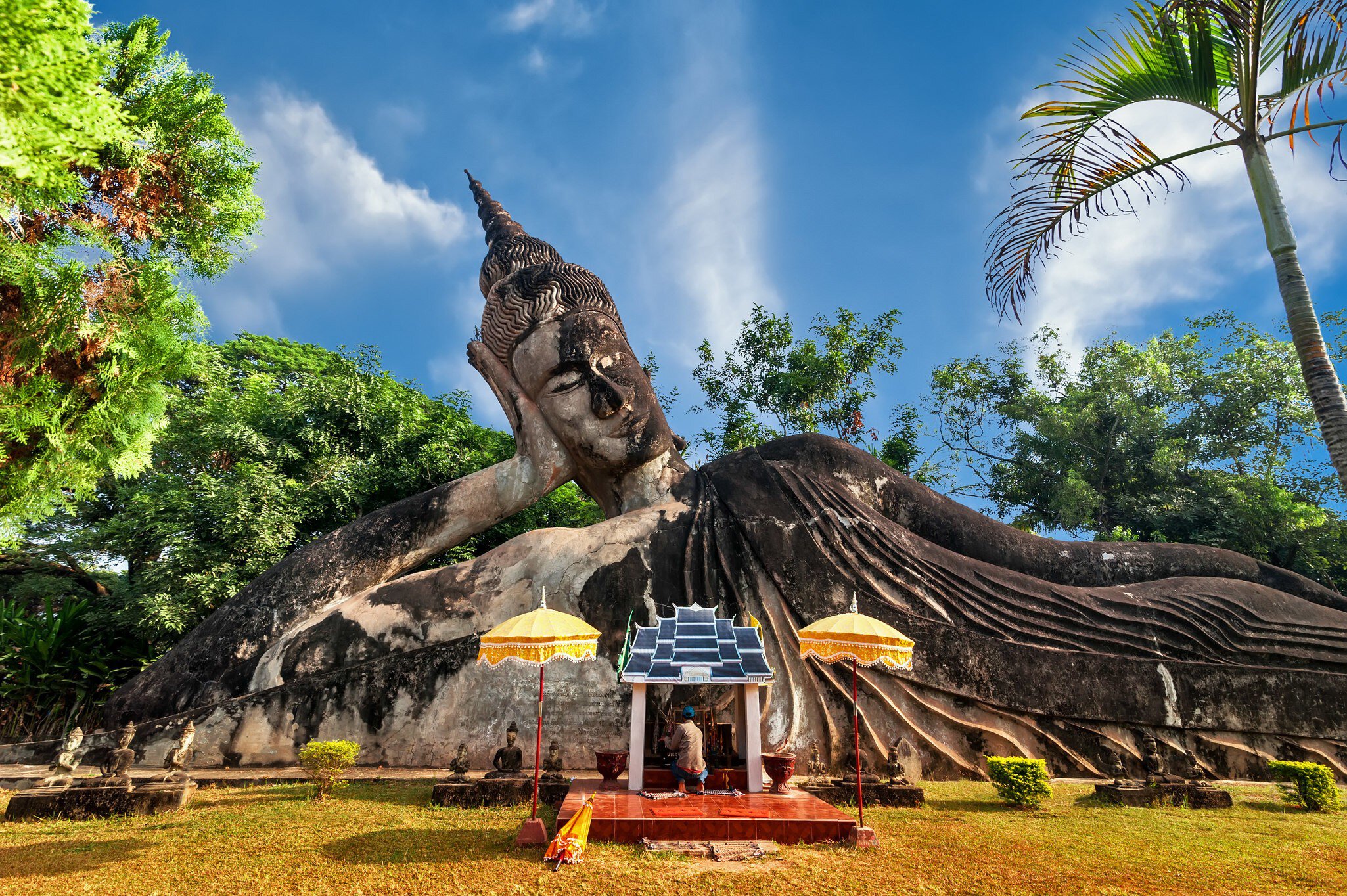
The large entry hall displays royal religious objects, including the dais of the former Supreme Patriarch of Lao Buddhism; an ancient Buddha head presented to the king as a gift from India; a reclining Buddha with the unusual added feature of sculpted mourners at his side; an equally uncommon seated Buddha with a begging bowl (the bowl is usually only depicted with a standing figure); and a Luang Prabang-style standing Buddha sculpted of marble in a 'Contemplating the Bodhi Tree' pose.

To the right of the entry hall is the king's reception room, where busts of the Lao monarchy are displayed along with two large, gilded and lacquered Ramayana screens crafted by local artisan Thit Tanh. The walls of the room are covered with murals that depict scenes from traditional Lao life. French artist Alix de Fautereau painted these in 1930, intending that each wall be viewed at a different time of day - according to the light that enters the windows on one side of the room - to correspond with the time of day depicted.

The front right corner room of the palace, open to the outside, contains a collection of the museum's most prized art, including the Pha Bang. Cast of a gold, silver and bronze alloy, this Buddha stands 83cm tall and is said to weigh 53.4kg. Legend has it the image was cast around the 1st century AD in Sri Lanka and later presented to Khmer King Phaya Sirichantha, who in turn gave it to King Fa Ngum in 1359 (other accounts have it that his successor, King Visoun, received it in 1512) as a Buddhist legitimiser of Lao sovereignty. Since stylistically it's obviously of Khmer origin, its casting most likely took place nearer to the latter date. The Siamese twice carried the image off to Thailand (in 1779 and 1827) but it was finally restored to Lao hands by King Mongkut (Rama IV) in 1867. Persistent rumours claim that the actual image on display is a copy and that the original is stored in a vault either in Vientiane or Moscow. The 'real' one supposedly features a bit of gold leaf over the eyes and a hole drilled through one ankle.

Also in this room are large elephant tusks engraved with Buddhas, including Khmer-crafted sitting Buddhas and Luang Prabang-style standing Buddhas; an excellent Lao frieze taken from a local temple; and three beautiful saew mâi khán (embroidered silk screens with religious imagery) that were crafted by the queen.

To the left of the entry hall, the secretary's reception room is filled with paintings, silver and china that have been presented to Laos as diplomatic gifts from Myanmar, Cambodia, Thailand, Poland, Hungary, Russia, Japan, Vietnam, China, Nepal, the USA, Canada and Australia. The objects are grouped according to whether they're from 'socialist' or 'capitalist' countries.

The next room to the left was once the queen's reception room. Large royal portraits of King Sisavang Vatthana, Queen Kham Phouy and Crown Prince Vong Savang, painted by the Russian artist Ilya Glazunov in 1967, are hung on the walls. Also on display in this room are friendship flags from China and Vietnam, and replicas of sculpture from New Delhi's Indian National Museum.

Behind the entry hall is the throne hall where royal vestments, gold and silver sabres, and the king's elephant chair (or saddle) are exhibited. Glass cases hold a collection of small Buddhas made of crystal and gold that were found inside the That Makmo (Makmo Stupa). Intricate wall mosaics, placed on a deep red background, took eight craftsmen 3½ years to complete and are a highlight of the palace's art.

Beyond the throne room are the halls or galleries that lead to the royal family's residential quarters. The royal bedrooms have been preserved as they were when the king departed, as have the dining hall and a room that contains royal seals and medals. One of the more interesting displays in the museum is a room in the residential section that now contains Lao classical musical instruments and masks for the performance of Ramayana dance-drama - just about the only place in the country where you see these kinds of objects on display.

Towards the southeastern corner of the compound stands a large, unlabelled bronze statue of King Sisavang Vong. Behind the statue is a palace building now designated as the Royal Theatre.