TuscanyThings to do

Things to do in Tuscany

‹ Prev

of 38

  1. A

    Galleria degli Uffizi

    Reason enough to come to Florence, this fabled museum contains quite simply the world’s finest collection of Renaissance art, including both 12th- to 14th-century forebears and 16th- and 17th-century inheritors. Its 50-plus rooms are crammed with more than 1500 works, nearly all of them masterpieces. Part of the museum’s mystique is the difficulties it presents: long lines, crowded galleries, a daunting combination of quantity and quality. There are two tricks to enjoying your experience: pre-book tickets and concentrate on select artists or periods. While signage is less than satisfying, the museum is laid out chronologically, and largely over a single floor. For a menta…

    reviewed

  2. B

    Galleria dell’Accademia

    A lengthy queue marks the otherwise inauspicious entrance to this museum, built especially to hold a single masterpiece, Michelangelo’s David. The collection now encompasses works by Botticelli and Taddeo Gaddi, a fine group of Russian icons, and several rooms of 14th-century paintings, including a remarkable embroidered Coronazione della Vergine (Coronation of the Virgin). However, it’s David everyone’s hot for – and for good reason. The subtle detail – the veins in his sinewy arms, the muscles that seem to ripple under his marble skin, the change in expression as you move around the statue – is impressive. Michelangelo was also the master behind the unfinish…

    reviewed

  3. C

    Scuola Leonardo da Vinci

    Italian-language school with supplementary cultural and culinary options.

    reviewed

  4. D

    Ponte Vecchio

    This famous bridge has twinkled with the glittering wares of jewellers ever since the 16th century, when Ferdinando I de’ Medici ordered them here to replace the often mal­odorous presence of the town butchers, who were wont to toss unwanted leftovers into the river.

    The bridge as it stands was built in 1345 and was the only one in Florence saved from destruction by the retreating Germans in 1944. Look above the shops on the eastern side and you will see the Corridoio Vasariano, an elevated covered passageway joining the Palazzo Vecchio, Uffizi and Palazzo Pitti that was designed by Vasari for Cosimo I in 1565. Its original design incorporated small windows to ensure t…

    reviewed

  5. E

    Duomo

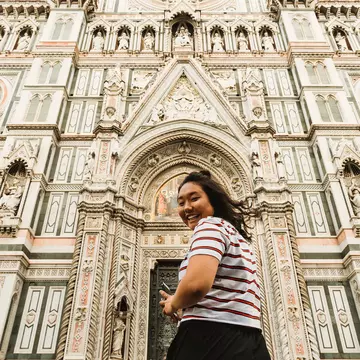
    Begun in 1296 by Sienese architect Arnolfo di Cambio, the world’s fourth-largest cathedral took almost 150 years to complete. Behind the Gothic welter of its white, green and red marble facade (actually a 19th-century re-creation), the interior of the city’s cathedral is surprisingly Spartan, as most of its treasures have been moved to the adjacent Museo dell’Opera del Duomo. However, the vast and soaring space still houses masterpieces such as Uccello’s portrait of Sir John Hawkwood and Michelino’s fresco Dante e I Suoi Mondi (Dante and His Worlds). The gorgeously geometric marble paving is best appreciated when climbing up to Brunelleschi’s cupola del duomo

    reviewed

  6. F

    Il Santo Bevitore

    Favoured by youthful foodies who’ve saved up their pennies for something more enticing than pizza, Il Santo Bevitore offers good value for money, including carefully crafted cheese and salumi (cold cuts), savoury pastas and steak tartare using prized Chianina beef. The menu is complemented by a list of well-priced wines.

    reviewed

  7. G

    Colle Beretto

    On the same square as the fortress-like Palazzo Strozzi, this bar/cafe opts instead for plate glass and beefy bouncers. The terrace is luxuriously fitted out with cushy sofas, while inside, pea-green neon and transparent Kartell chairs scream design. The aperitivo buffet is among the city’s most generous.

    reviewed

  8. H

    Amon

    Pop in to this family-run joint for what are possibly the best kebabs in Florence. Refreshingly nongreasy, they’re served on pita bread fresh from the oven. Admire the Egyptian kitsch on the walls while you wait.

    reviewed

  9. I

    Santo Spirito Organic Market

    This monthly market attracts artisans and organic farmers from around Tuscany, with stands devoted to fresh produce, hand-painted crockery, spices gathered from Chianti hillsides and much more.

    reviewed

  10. Freya’s Florence

    Highly recommended tours by an Australian-born, Florence-based private tour guide introducing the art, history and magic of Florence. It costs €50 to €60 per hour for private tours of between one and 20 people, including two-hour ‘Secret Florence at Twilight’ and Uffizi Gallery tours (admission fees extra).

    reviewed

  11. Advertisement

  12. J

    Osteria del Gatto e la Volpe

    On the corner of Via de' Giraldi, this is a small and welcoming spot where the food is reasonable and the prices are stable. It gets its fair share of tourists, but this hasn't yet ruined what's on offer at the 'Cat and Wolf'. It's closer to a genuine Florentine experience than most of the places that line this much-trampled city.

    reviewed

  13. K

    Palazzo Pitti

    Begun in 1458 for the Pitti family, rivals of the Medici, the original nucleus of this palace took up the space encompassing the seven sets of windows on the 2nd and 3rd storeys. Cosimo I and Eleonora di Toledo acquired the palace in 1549 and it remained the official residence of Florence’s rulers until 1919, when the Savoys handed it over to the state.

    The ground-floor Museo degli Argenti often has no silver on display. Go figure. Come instead to see the elaborately frescoed audience chambers, which host temporary exhibitions.

    Raphaels and Rubens vie for centre stage in the enviable collection of 16th- to 18th-century art amassed by the Medici and Lorraine dukes in the…

    reviewed

  14. L

    Basilica di Santa Croce

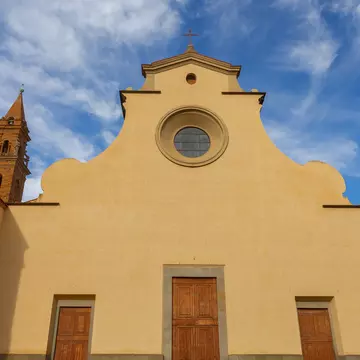
    Behind an opulent candy-coloured facade (actually a 19th-century neo-Gothic addition), the nave of this Gothic church, built between 1294 and 1385, is surprisingly austere. EM Forster described the interior as ‘barnlike’, because of the timber, A-frame–style ceiling and general lack of finery. But lurking in the transept is a series of chapels brightly decked out with masterly fresco cycles. Unfortunately, only parts of Giotto’s cycle depicting the life of St Francis survive. Those by his loyal pupil Taddeo Gaddi are in much better shape, as are Taddi’s Last Supper in the refectory – considered his masterpiece – and his Crucifixion in the sacristy. The basil…

    reviewed

  15. M

    Piazza della Signoria

    A massive holding tank for tourists (if you want space, bring a bicycle bell), the city's most splendid piazza was created virtually by accident in the 13th century and - lined with replicas of famous sculptures and historical buildings - has been the hub of Florentine political life ever since.

    In times of political crises, the public would be summoned here for popular votes, which usually decided the fates of conflicting families and frequently descended into frenzied riots. Emotions would be stirred up by political speeches delivered from an arringhiera (oration platform) in front of Palazzo Vecchio, from where we get the word 'harangue'.

    Nowadays it's predominantly to…

    reviewed

  16. N

    Cappelle Medicee

    Nowhere is Medici conceit expressed so explicitly as in their mausoleum. The soaring and rather overblown main chapel is sumptuously adorned in baroque style with granite, marble and semi-precious stones. From here a corridor leads to the stark Sagrestia Nuova (New Sacristy), Michelangelo’s first architectural work and showcase for three of his most haunting sculptures. Aurora e Crepusculo (Dawn and Dusk) lounges on the sarcophagus of the unpopular Lorenzo Duke of Urbino (1492–1519), to whom Machiavelli dedicated The Prince. Notte e Giorno (Night and Day) marks the spot opposite where a son of Lorenzo il Magnifico is buried. The unfinished tomb of Lorenzo il Magnifico…

    reviewed

  17. O

    Il Latini

    You have two choices at this Florentine favourite: request a menu (as a tourist, you might not be offered one) or put yourself in the hands of the exuberant waiters and feast on a mixed antipasto of melt-in-your-mouth crostini and mixed Tuscan meats followed by a bowl of (indifferent) pasta and a hunk of roasted meat – rabbit, lamb, chicken or veal with white beans (the rabbit is particularly tasty). The wine and water flow and if you’re lucky you might get a complimentary plate of cantuccini (a type of biscuit) and glass of moscato (an Italian dessert wine) with the bill. There are two dinner seatings (7.30pm and 9pm), seating is shared and bookings are mandatory.

    reviewed

  18. Treno Natura

    A great way to see the stunning scenery of the Crete Senese, south of Siena. The line dates back to the 19th century but trains now run exclusively for tourists and are staffed by volunteers. The route loops from Siena, through Asciano, across to the Val d'Orcia and Stazione di Monte Antico and back to Siena. Trains stop at Asciano and Monte Antico and connect with the service from Florence. They only run for about 20 days a year so check the website or ask at the tourist office.

    reviewed

  19. P

    Il Chicco di Caffè

    It’s unfortunate that this wonderfully simple corner cafe only opens for lunch, because you couldn’t dine better at these prices. Sate yourself for €10. Eat like a peasant-king for €15. The septuagenarian nonna in the kitchen produces simple but delicious pastas and roasted meats, but the real draw are the contorni (grilled or sautéd vegetables). Tables are communal and water and wine are buffet-style – drink at will.

    reviewed

  20. Q

    La Corte dei Vini

    Strategically placed between Piazza Napoleone and Piazza San Michele, this friendly ‘enoteca e picola cucina’ (wine bar and small kitchen) is a great choice for an aperitivo or casual meal. It specialises in rustic dishes, including tortelli Lucchesi (meat ravioli) and minestra di farro della Garbagnana (soup made with spelt). Get here early to score a choice table on the front terrace.

    reviewed

  21. R

    La Dolce Vita

    A perennial favourite of the city’s status-conscious youth and nearly young, Dolce Vita has stood up to competition from newer offerings such as Noir and Colle Beretto and remains the best place to show off your prowess in selecting designer labels. As weather permits, crowds spill out of the industrial-style interior onto the adjacent piazza, which would be stunning if it weren’t made to double as a car park.

    reviewed

  22. Advertisement

  23. S

    Central Park

    Hidden off in the leafy Parco delle Cascine, Florence’s largest disco brings several acres of Ibiza to the city’s western edge. The sprawling club has two outdoor dance floors, an artificial waterfall, VIP lounge seating raised a metre or so above the common folk, plus a pair of indoor dance floors. Move back and forth between pop, dance, electronica or disco kitsch, as the mood dictates.

    reviewed

  24. T

    Trattoria I Fratellini

    Amid all the high-flying dining in Santa Croce, this combination grocery shop, wine bar and trattoria seems to have changed little since it opened in the 1950s. Even prices remain stuck in time. Two courses (perhaps minestrone followed by rotisserie chicken) and a glass of quaffable Chianti cost under €10. And you won’t regret the calories in the homemade tiramisu.

    reviewed

  25. U

    Trattoria Mario

    Despite being in every guidebook, this jam-packed place retains its soul and allure with locals. A 100% family affair since opening in 1953, its chefs shop at the nearby Mercato Centrale and dish up tasty, dirt-cheap dishes with speed and skill. Get here right on the dot of noon to score a stool (tables are shared) and be aware that credit cards aren’t accepted.

    reviewed

  26. V

    Cantina Senese

    Food- and value-conscious harbour workers are the first to fill the long wooden tables at this wonderfully unpretentious and friendly eatery, with neighbourhood families arriving later. Ordering is frequently done via faith in one’s server, rather than by menu. The mussels are exceptionally good, as is the cacciucco di pesce (fish stew).

    reviewed

  27. W

    Twice

    Mainstream fun is on tap at this venue that starts the night as a wine bar and then turns into a dance club after 11pm (hence the name). The clientele tends to be Pretty Young Things in search of same. After the aperitivo buffet closes down, the DJs start to arrive with their iPods stuffed with hip-hop and Top 40 dance hits.

    reviewed