ItalyThings to do

Things to do in Italy

‹ Prev

of 257

  1. Highlights Of Italy

    Highlights Of Italy

    8 days (ex Venice)

    by Intrepid

    Lose yourself in enchanting Venice city, Feast on scrumptious seafood on Italy's coast, Travel down the Cinque Terre's rugged coastal path, Witness a golden sun…

    Not LP reviewed

     
    from USD$1,480
  2. All things to do
  3. Rental Bike Venice

    The scenic plains of the Brenta Riviera make an easy, enjoyable bicycle ride, and you can speed past those tour boats along 150km of cycling routes. Rental Bike Venice is a friendly bike-rental spot accessible by bus from Venice, Mestre or Padua offering city bikes with baskets, mountain bikes and handy foldable bikes to take on buses, plus free parking, roadside assistance and advice in English on itineraries, local restaurants and shops.

    reviewed

  4. A

    Colosseum

    The Colosseum is the most extraordinary of all Rome’s monuments. It’s not just the amazing completeness of the place, or its size, but the sense of its gory history that resonates: it was here that gladiators met in mortal combat and condemned prisoners fought off hungry lions. Two thousand or so years on, it’s still hauling in the crowds. Don’t let the lengthy queue put you off: just pop down to the Palatine ticket office, buy your combined ticket there, and on returning march straight in.

    reviewed

  5. B

    Pantheon

    Competition is fierce, but the Pantheon is surely ancient Rome’s most astonishing building. This Roman temple has been standing for almost 2000 years, and it’s a unique, unparalleled experience to enter its great doors and have your vision directed upwards, just as it would have been for the ancient Romans. Its current form dates to around AD 120, when the emperor Hadrian built the Pantheon over Marcus Agrippa’s original temple (27 BC). For centuries, historians read the name Agrippa in the inscription on the pediment and thought that Hadrian’s version was the 1st-century-BC original. When excavations in the 19th century revealed traces of the earlier temple, they realise…

    reviewed

  6. C

    Trevi Fountain

    Immortalised by Anita Ekberg’s dip in La Dolce Vita, the Trevi Fountain (Fontana di Trevi) is Rome’s largest and most famous fountain. The flamboyant baroque ensemble was designed by Nicola Salvi in 1732 and depicts Neptune’s chariot being led by Tritons with sea horses – one wild, one docile – representing the moods of the sea. The water comes from the aqua virgo, a 1st-century-BC underground aqueduct, and the name Trevi refers to the tre vie (three roads) that converge at the fountain. The famous custom is to throw a coin into the fountain, thus ensuring your return to the Eternal City. According to the same tradition if you throw in a second coin you’ll fall …

    reviewed

  7. D

    St Peter’s Basilica

    In Vatican City, a city of astounding churches, St Peter’s Basilica outdazzles them all. Awe-inspiringly huge, rich and spectacular, it’s a monument to centuries of artistic genius. On a busy day, around 20,000 visitors pass through here. If you want to be one of them, remember to dress appropriately – no shorts, miniskirts or bare shoulders. If you want to hire an audioguide (€5), they’re available at a desk in the cloakroom to the right of the entrance. Free English-language guided tours of the basilica are run from the Vatican tourist office, the Centro Servizi Pellegrini e Turisti, at 9.45am on Tuesday and Thursday and at 2.15pm every afternoon between Monday and Fr…

    reviewed

  8. E

    Galleria degli Uffizi

    Reason enough to come to Florence, this fabled museum contains quite simply the world’s finest collection of Renaissance art, including both 12th- to 14th-century forebears and 16th- and 17th-century inheritors. Its 50-plus rooms are crammed with more than 1500 works, nearly all of them masterpieces. Part of the museum’s mystique is the difficulties it presents: long lines, crowded galleries, a daunting combination of quantity and quality. There are two tricks to enjoying your experience: pre-book tickets and concentrate on select artists or periods. While signage is less than satisfying, the museum is laid out chronologically, and largely over a single floor. For a menta…

    reviewed

  9. F

    Ex Mauri

    Go to this contemporary, stylish Venetian bacaro (bar) on Milan’s urban island when you need a little Lombard-free time. Pull up a school chair at a lovingly scuffed table for imaginative seafood cicheti (Venetian-style tapas) : baccalà fritters, sardines in saôr (sweet-and-sour onion jam) and braised baby octopus. Smart but hearty mains take their cues from both Venice and further afield, while the gelati and cakes are house-made.

    reviewed

  10. G

    Vatican Museums

    Visiting the Vatican Museums is an unforgettable experience that requires strength, stamina and patience. You’ll need to be on top of your game to endure the inevitable queues – if not for a ticket then for the security checks – and enjoy what is undoubtedly one of the world’s great museum complexes.

    Founded by Pope Julius II in the early 16th century and enlarged by successive pontiffs, the museums are housed in what is known collectively as the Palazzo Apostolico Vaticano. This massive 5.5-hectare complex consists of two palaces – the Vatican palace nearest St Peter’s and the Belvedere Palace – joined by two long galleries. On the inside are three courtyards: th…

    reviewed

  11. H

    Basilica di San Marco

    Luminous angels trumpet the way into San Marco in glittering mosaics above vast portals. Inside, the soaring stone structure still sets standards for razzle-dazzle, from the intricate geometry of 12th-century polychrome marble floors to 11th- to 15th-century mosaic domes glittering with millions of gilt-glass tesserae (tiles). This show-stopper took a brains trust of Mediterranean artisans almost 800 years and grand larceny to complete. Legend has it that Venetian merchants smuggled the corpse of St Mark out of Egypt in 828; the arrival of St Mark’s body in Venice is depicted in mosaics dating from 1270 on the left of the facade. Riots and fires thrice destroyed exterior …

    reviewed

  12. I

    Galleria dell’Accademia

    A lengthy queue marks the otherwise inauspicious entrance to this museum, built especially to hold a single masterpiece, Michelangelo’s David. The collection now encompasses works by Botticelli and Taddeo Gaddi, a fine group of Russian icons, and several rooms of 14th-century paintings, including a remarkable embroidered Coronazione della Vergine (Coronation of the Virgin). However, it’s David everyone’s hot for – and for good reason. The subtle detail – the veins in his sinewy arms, the muscles that seem to ripple under his marble skin, the change in expression as you move around the statue – is impressive. Michelangelo was also the master behind the unfinish…

    reviewed

  13. Advertisement

  14. J

    Palazzo Ducale

    Don’t be fooled by its Gothic elegance: this building was all business, from medieval carved stone capitals depicting key Venetian guilds along the arcade, to Giovanni and Bartolomeo Bon’s 15th-century PortadellaCarta (Paper Door), the bulletin board for government decrees facing the piazza. The building was damaged by fire in 1577, but Antonio da Ponte (who designed the Ponte di Rialto) restored it.

    Entering through the colonnaded courtyard, you’ll spot Sansovino’s statues of Mars and Neptune flanking the Scala dei Giganti (Giants’ Staircase), which Antonio Rizzo built as a suitably grand entrance for Venice’s dignitaries and which is currently undergoing restora…

    reviewed

  15. K

    Peggy Guggenheim Collection

    After tragically losing her father on the Titanic, heiress Peggy Guggenheim befriended Dadaists, dodged Nazis, and amassed avant-garde works by 200 modern artists at her palatial home on the Grand Canal. Peggy’s Palazzo Venier dei Leoni became a modernist shrine, chronicling surrealism, Italian futurism, and abstract expressionism, with a subtext of Peggy’s romantic pursuits – the collection includes key works by Peggy’s ex-husband Max Ernst and Jackson Pollock, among Peggy’s many rumoured lovers. Peggy collected according to her own convictions rather than for prestige or style, so her collection includes inspired folk art and lesser-known local artists alongside artis…

    reviewed

  16. Scicli

    Scicli is full of wonderful baroque architecture - in particular Palazzo Beneventano and Palazzo Fava - and framed by rocky cliffs. It is well off the beaten track and there is seldom another tourist in sight. From here you can head down to Modica Marina (around €2.20, six buses daily) and Sampieri (around €2.50, three buses daily) on the southern coast for long sandy beaches, as well as rocky coves.

    Both are popular with the town's youth, with bars and loungers (bed & umbrella for two around €10) on the sand, though there are vast unpopulated areas if you walk along the beaches, where you can be undisturbed by the crowds.

    reviewed

  17. L

    Scuola Leonardo da Vinci

    Italian-language school with supplementary cultural and culinary options.

    reviewed

  18. M

    Ponte Vecchio

    This famous bridge has twinkled with the glittering wares of jewellers ever since the 16th century, when Ferdinando I de’ Medici ordered them here to replace the often mal­odorous presence of the town butchers, who were wont to toss unwanted leftovers into the river.

    The bridge as it stands was built in 1345 and was the only one in Florence saved from destruction by the retreating Germans in 1944. Look above the shops on the eastern side and you will see the Corridoio Vasariano, an elevated covered passageway joining the Palazzo Vecchio, Uffizi and Palazzo Pitti that was designed by Vasari for Cosimo I in 1565. Its original design incorporated small windows to ensure t…

    reviewed

  19. N

    Chiesa del Gesù

    Rome’s most important Jesuit church, the Chiesa del Gesù is a much-copied example of Counter-Reformation architecture. It was built between 1551 and 1584 with money donated by Cardinal Alessandro Farnese. Although the façade by Giacomo della Porta is impressive, it is the awesome, interior that is the real attraction. Designed by Giacomo Barozzi da Vignola, a pupil of Michelangelo, it’s a shimmering ensemble of gold and marble. Of the art on display, the most astounding is the Trionfo del Nome di Gesù (Triumph of the Name of Jesus), the swirling, hypnotic vault fresco by Giovanni Battista Gaulli (aka Il Baciccia). Baciccia also painted the cupola frescoes and desig…

    reviewed

  20. O

    Palazzo Donn’Anna

    Few buildings fire up the local gossipmongers like Posillipo’s seaside Palazzo Donn’Anna. Incomplete, semiderelict yet strangely beautiful, it takes its name from Anna Carafa, for whom it was built as a wedding present from her husband, Ramiro Guzman, the Spanish viceroy of Naples. When Guzman hotfooted it back to Spain in 1644 he left his wife heartbroken in Naples. She died shortly afterwards and architectural whiz-kid Cosimo Fanzago gave up the project. The grand yet forlorn heap sits on the site of an older villa, La Sirena (The Mermaid), reputed setting for Queen Joan’s scandalous sex orgies and crimes of passion (rumour has it that fickle Joan dumped her lovers …

    reviewed

  21. P

    Duomo

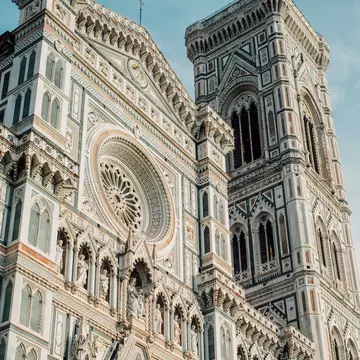
    Begun in 1296 by Sienese architect Arnolfo di Cambio, the world’s fourth-largest cathedral took almost 150 years to complete. Behind the Gothic welter of its white, green and red marble facade (actually a 19th-century re-creation), the interior of the city’s cathedral is surprisingly Spartan, as most of its treasures have been moved to the adjacent Museo dell’Opera del Duomo. However, the vast and soaring space still houses masterpieces such as Uccello’s portrait of Sir John Hawkwood and Michelino’s fresco Dante e I Suoi Mondi (Dante and His Worlds). The gorgeously geometric marble paving is best appreciated when climbing up to Brunelleschi’s cupola del duomo

    reviewed

  22. Q

    Piazza del Popolo

    For centuries the sight of public executions, this elegant neoclassical piazza is a superb people-watching spot. It was originally laid out in 1538 to provide a grandiose entrance to the city – at the time, and for centuries before, it was the main northern gateway into the city. Since then it has been extensively altered, most recently by Giuseppe Valadier in 1823. Guarding its southern entrance are Carlo Rainaldi’s twin 17th-century baroque churches, Chiesa di Santa Maria dei Miracoli and Chiesa di Santa Maria in Montesanto, while over on the northern flank is the Porta del Popolo, created by Bernini in 1655. In the centre, the 36m-high Egyptian obelisk was moved he…

    reviewed

  23. R

    Campo de’ Fiori

    Noisy and colourful, ‘Il Campo’ is a major focus of Roman life: by day it hosts a much-loved market, while at night it turns into a raucous open-air pub. For centuries, it was the site of public executions, and in 1600 the philosophising monk Giordano Bruno, immortalised in Ettore Ferrari’s sinister statue, was burned at the stake here for heresy. Many of the streets surrounding Il Campo are named after the artisans who traditionally occupied them: Via dei Cappellari (hatters), Via dei Baullari (trunk makers) and Via dei Chiavari (key makers). Via dei Giubbonari (jacket makers) is still full of clothing shops.

    reviewed

  24. Advertisement

  25. S

    Trattoria Corte Sconta

    The Biennale jet set seeks out this vine-covered corte sconta (hidden courtyard) for imaginative housemade pasta and ultrafresh, visually striking seafood. Crustaceans are arranged on a platter like dabs of paint on an artist’s palette, black squid-ink pasta is artfully topped with bright orange squash and tender cappesante (scallops) sticking out their red feet, and roast eel loops like the River Brenta on the plate with a drizzle of balsamic reduction.

    reviewed

  26. T

    Siciliainbocca

    Lemon-yellow and lined in dazzling southern ceramics, this trattoria is sunny in demeanour and colour. It's a great place to sample sumptuous seafood, Sicilian specialities like caponata (browned vegetables, anchovies and capers), and the island's legendary desserts, such as cannoli (fried pastry tubes filled with ricotta) accompanied by pantelleria, the great muscatel. There's another branch in Flaminio (06 324 01 87; Via Flaminia 390; ;Tue-Sun).

    reviewed

  27. U

    Antiche Carampane

    Hidden in the once-shady lanes behind Ponte delle Tette (Tits Bridge), this culinary indulgence is a trick to find, and you may wonder who you have to, erm, know to get a reservation. The sign proudly announcing ‘no tourist menu’ signals a welcome change: say goodbye to soggy lasagne and hello to lagoon-fresh crudi (Venetian sushi), bottarga pasta, and filetto di San Pietro (steak with artichokes or radicchio trevisano ).

    reviewed

  28. V

    Cimitero Monumentale

    Behind striking Renaissance- revival black-and-white walls, Milan’s wealthy have kept their dynastic ambitions alive long after death with grand sculptural gestures since 1866. Nineteenth-century death-the-maiden eroticism gives way to some fabulous abstract forms from midcentury masters. Studio BBPR’s geometric steel-and-marble memorial to Milan’s WWII concentration camp dead is stark and moving. Grab a map inside the forecourt - it’s easy to get lost.

    reviewed

  29. W

    ‘Gusto

    If Terence Conran were Italian, he might have dreamed up ‘Gusto, once a mould-breaking warehouse-style gastronomic complex. It’s still buzzing after all these years, and is a great place to sit on the terrace and eye up the new Richard Meier-designed Ara Pacis museum. Go for the Neapolitan-style pizzas rather than the restaurant fare, which receives mixed reports. There’s a recommended brunch (weekends) and lunchtime buffet.

    reviewed