PalermoThings to do

Things to do in Palermo

‹ Prev

of 4

  1. A

    Fontana Pretoria

    At the civic heart of Palermo, a crowd of imposing churches and buildings surrounds the ornate Fontana Pretoria. This huge fountain fills the piazza with its tiered basins, supporting the sculptures, rippling in concentric circles. The city bought the fountain in 1573; however, the flagrant nudity of the provocative nymphs proved too much for Sicilian church-goers attending Mass at the grandly formal San Giuseppe dei Teatini, and they prudishly dubbed it the Fountain of Shame.

    reviewed

  2. B

    Chiesa di San Domenico

    The Chiesa di San Domenico lies Off Via Roma. It was built in 1640 following the design of architect Andrea Cirincione; the façade was added in 1726 after the buildings that once occupied the square were demolished to give the church some space.

    The church has been the place where Italian VIPs have been buried since the Middle Ages; among the tombs and cenotaphs of notable Sicilians, you'll find the names of parliamentarian Ruggero Settimo, painter Pietro Novelli, and the former Italian prime minister Francesco Crispi.

    reviewed

  3. C

    Cathedral

    The Cathedral is an extraordinary (and enormous) feast of geometric patterns, ziggurat crenulations, majolica cupolas and blind arches. The interior, although impressive in scale, is a marble shell, a sadly un-exotic resting place for the royal Norman tombs. The crypt and treasury contain various jewels belonging to Queen Costanza of Aragón, a bejewelled Norman crown and, most bizarrely, a tooth extracted from Santa Rosalia, Palermo’s patron saint.

    reviewed

  4. D

    Orto Botanico

    Laid out by Léon Dufourny and Venanzio Marvuglia, the gorgeous Orto Botanico is a tropical paradise, with massive fig trees, tall palms and dazzling hibiscus bushes. There is an avenue of the bizarre-looking bottle, soap and cinnamon trees, as well as coffee trees, papaya plants and sycamores. It's a real haven of silence and fascinating botany, with a large herb garden that focuses on Mediterranean plants. Beware the mosquitos at dusk though.

    reviewed

  5. E

    Quattro Canti

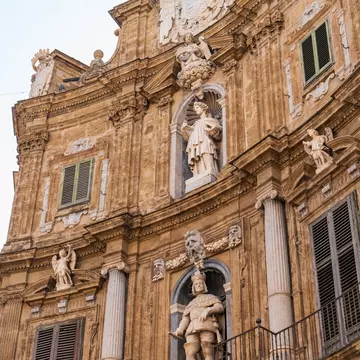
    The busy intersection of Corso Vittorio Emanuele and Via Maqueda marks the Quattro Canti, the centre of the oldest part of town, neatly dividing the historic nucleus into four manageable sectors.

    reviewed

  6. F

    Kursaal Kalhesa

    Recline on plump sofas with silk cushions and sip a cocktail beneath the high vaulted ceilings. There’s a roaring fire in winter, plus art exhibits and a bookstore with foreign newspapers. A lively unpretentious crowd is attracted by the good program of music and literary events. Meals (from €30) are served in the dining room or on the leafy patio flanked by 15th-century walls.

    reviewed

  7. G

    Teatro Massimo

    The grand neoclassical Teatro Massimo took more than 20 years to complete. Nowadays the theatre is an iconic Palermo landmark and has become a symbol of the triumph and tragedy of the city. Appropriately, the closing scene of The Godfather: Part III, with its visually stunning juxtaposition of high culture, low crime, drama and death, was filmed here.

    reviewed

  8. H

    Sant’Andrea

    The position of this excellent restaurant is a reflection of Palermo’s contradictory appeal. It’s tucked into the corner of a ruined church in a shabby piazza. Sant’Andrea’s well-heeled customers pick their way across the broken flagstones to enjoy creative, yet classic, dishes such as tagliatelle with lobster and almond pesto.

    reviewed

  9. I

    Giardino Garibaldi

    Surrounded on all sides by elegant palazzi, gentrified Piazza Marina (M0154) is Palermo's quietest piazza, and its small Giardino Garibaldi encloses Palermo's oldest tree, a venerable 25m-high, 150-year-old ficus benjamin. Dedicated to Garibaldi, the square has witnessed its fair share of bloody executions.

    reviewed

  10. J

    Teatro Politeama Garibaldi

    Teatro Politeama Garibaldi is Palermo’s second theatre. Designed by architect Giuseppe Damiani Almeyda between 1867 and 1874, it has the same imposing circular layout as the Teatro Massimo and features a striking facade resembling a triumphal arch topped by a huge bronze chariot.

    reviewed

  11. Advertisement

  12. K

    Cucina Papoff

    Specialising in Sicilian classics like trancio di pesce in umido con capperi e olive (slow-simmered fish stew with capers and olives), Papoff creates an intimate ambience with carved wooden ceilings, exposed brickwork and torch-style lighting.

    reviewed

  13. L

    Chiesa di San Giuseppe dei Teatini

    In the southwestern corner of the Quattro Canti is the Chiesa di San Giuseppe dei Teatini, topped by a soaring cupola. The monumental interior is baroque at its brashest, and has been lovingly restored after it suffered substantial damage during WWII.

    reviewed

  14. M

    Villa Giulia

    Villa Giulia in La Kalsa is a welcome relief from the claustrophobic streets, although the formal planting scheme of the park is severely challenged by the rampant fecundity of the island.

    reviewed

  15. N

    Antico Caffè Spinnato

    A sophisticated cafe dating back to 1860 located on the smart pedestrian boulevard. Sit on the vast terrace to enjoy coffees, cocktails, ice creams, sumptuous cakes and snacks.

    reviewed

  16. O

    Mercato di Ballarò

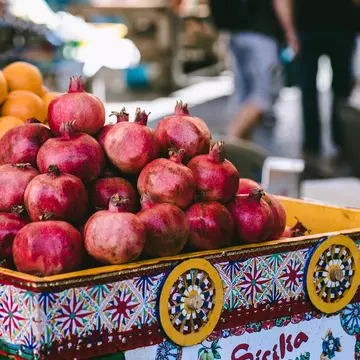
    Although it's popular with tourists, many Palermitans shop for their fresh produce and household goods at Mercato di Ballarò.

    reviewed

  17. P

    Tre Erre Ceramiche

    Tre Erre Ceramiche has a huge selection of ceramics.

    reviewed

  18. Q

    Museo Diocesiano

    The Museo Diocesiano houses an important and rather extensive collection of artworks from the cathedral and churches destroyed during WWII; these include paintings, and marble, fresco and mosaic fragments. There's a friendly guide who will explain the significance of each piece (they are largely unmarked), though she speaks Italian and French only.

    The ground floor holds 15th-century frescoes, along with Byzantine paintings and icons, among which the most beautiful is the 1171 Madonna della Perla, rescued from the now-no-more church of San Nicoló Reale.

    Seek out the room dedicated to the 17th-century Sicilian painter Pietro Novelli (1603-47), who was one of the region's f…

    reviewed

  19. R

    Cappella Palatina

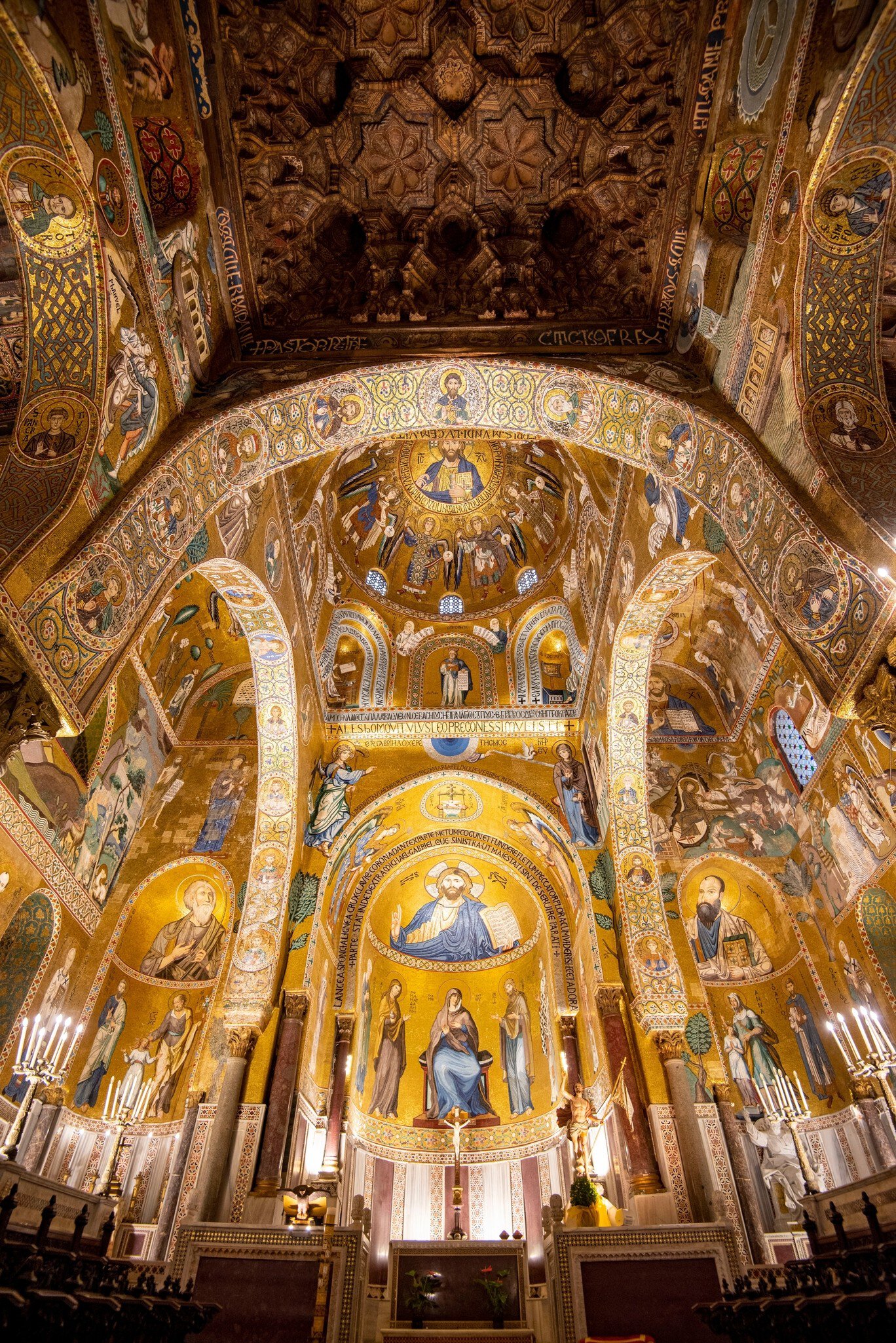
    On the middle level of the three-tiered loggia is Palermo’s premier tourist attraction, the Cappella Palatina, designed by Roger II in 1130. Restoration work completed in July 2008 (after a small earthquake in 2002 damaged the structure) has returned the chapel to its original splendour, and the walls once again swarm with figures in glittering, dreamy gold. These exquisite mosaics recount tales of the Old and New Testaments, capturing expression, detail and movement with extraordinary grace. The harmony of the chapel’s decoration is further enhanced by the inlaid marble floors and the wooden muqarnas ceiling, a masterpiece of honeycomb carving in Arabic style that re…

    reviewed

  20. S

    Catacombe dei Cappuccini

    The morbid Catacombe dei Cappuccini is home to the mummified bodies and skeletons of some 8000 Palermitans who died between the 17th and 19th centuries. Earthly power, sex, religion and professional status are still rigidly distinguished; men and women occupy separate corridors and within the women’s area there’s a 1st-class section for virgins. Dressed in their Sunday best, the corpses’ clothes have survived better than some of the bodies themselves. This is possibly not a place to take the kiddies. From Piazza Independenza, it’s a 15-minute walk; alternatively, catch any bus running along Via Cappuccini to the corner of Via Pindemonte, then walk one block to Piazza Capp…

    reviewed

  21. T

    Antica Focacceria di San Francesco

    A Palermitan institution, this atmospheric, informal place is one of the city’s oldest eating houses (opened in 1834). It hosted the first Sicilian parliament and was a favourite haunt of notorious Mafia boss ‘Lucky’ Luciano. Fixed-price menus including cannoli and the drink of your choice cost €6 to €12. The sandwiches (€2 to €4) are also great – try an oven-baked Vecchia Palermo moffoletta with cherry tomatoes, anchovies, caciocavallo cheese and oregano, or brave a maritata, the age-old Palermitan snack featuring milza (veal innards) and ricotta cheese.

    reviewed

  22. Advertisement

  23. U

    Chiesa di San Francesco d'Assisi

    The Piazza San Francesco d'Assisi (M0151) is Palermo's picture-perfect piazza, overlooked by the charming Chiesa di San Francesco d'Assisi , which features a fine rose window and a flamboyant Gothic portal; it's understandably popular on the wedding circuit. The church's most interesting feature is the rare arch of the Cappella Mastrantonio (Chapel of Mastrantonio), carved in 1468 by Francesco Laurana and Pietro da Bonitate, and one of the only true examples of Renaissance art in Palermo.

    The church also showcases sculptures by the Gagini family, Giambattista Ragusa and Giacomo Serpotta.

    reviewed

  24. V

    Trattoria Biondo

    Biondo has a split personality. The trattoria side is pure Fellini film set, always crammed with congenial, noisy locals who come for Palermitan classics such as involtini di pesce spada (swordfish roulades) or pasta con le sarde. Crates of fresh produce greet you at the door, which leads to several low-ceilinged dining rooms decorated with plates, tiles and paintings. Just around the corner, Pizzeria Biondo offers the same great quality at half the price. An animated crowd fills the sidewalk tables every night for some of Palermo’s finest pizza.

    reviewed

  25. W

    Trattoria Basile

    This popular, unpretentious trattoria offers an unforgettable, authentic Palermitan eating experience. Pay first, take a number at the window for your pasta (€2 to €2.50) or main course (€3 to €4), then sidle over to the antipasti bar where you can choose three items for €2 or six items for €3.50. While enjoying your appetisers, listen for your number – they’ll bellow it out (in Italian) when the rest of your food is ready. Try to avoid the really busy period between 1pm and 2pm when every workman in town is elbowing in for his plate of pasta.

    reviewed

  26. X

    Palazzo Mirto

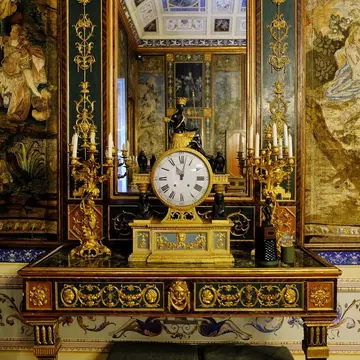
    Just off Piazza Marina is one of the only palazzi open to the public, Palazzo Mirto . Considering Palermitan extravagances, the palazzo is actually pretty modest. Its walls are covered in acres of silk and velvet wallpaper, and vast embroidered wall hangings, while its floors are paved in coloured marbles and mosaics.

    The real extravagance, however, is the tiny Salottino Cinese (Chinese Salon) full of black lacquer, silken wallpaper and a rather conceited ceiling painting of European aristos viewing the room from above.

    reviewed

  27. Y

    La Martorana

    Twelfth-century La Martorana was originally planned as a mosque by King Roger’s Syrian Emir, George of Antioch. In 1433 the church was donated to an aesthetically challenged order of Benedictine nuns who demolished most of the stunning mosaics executed by Greek craftsmen and replaced them with gaudy baroque ornamentation, thus destroying the church’s cohesive integrity. The few remaining original mosaics include two magnificent portraits of George of Antioch and Roger II that are well worth seeking out.

    reviewed